Queens District RCMP are looking for the public’s help finding a Caledonia man wanted on a provice-wide arrest warrant.
Nolan Conway, 21, faces five counts each of assault with a weapon and possession of a weapon for a dangerous purpose, two counts of uttering threats and one count of mischief under $5,000.
Conway is described as five-foot-nine, 165 pounds. He has brown hair and brown eyes.
RCMP say they’ve made several attempts to find him.
Anyone with information about Conway is asked to call Queens District RCMP at 902-354-5721 or their local police detachment.
People can also leave anonymous tips by calling Nova Scotia Crime Stoppers, toll-free, at 1-800-222-TIPS (8477), or submit a secure web tip at www.crimestoppers.ns.ca, or use the P3 Tips app.
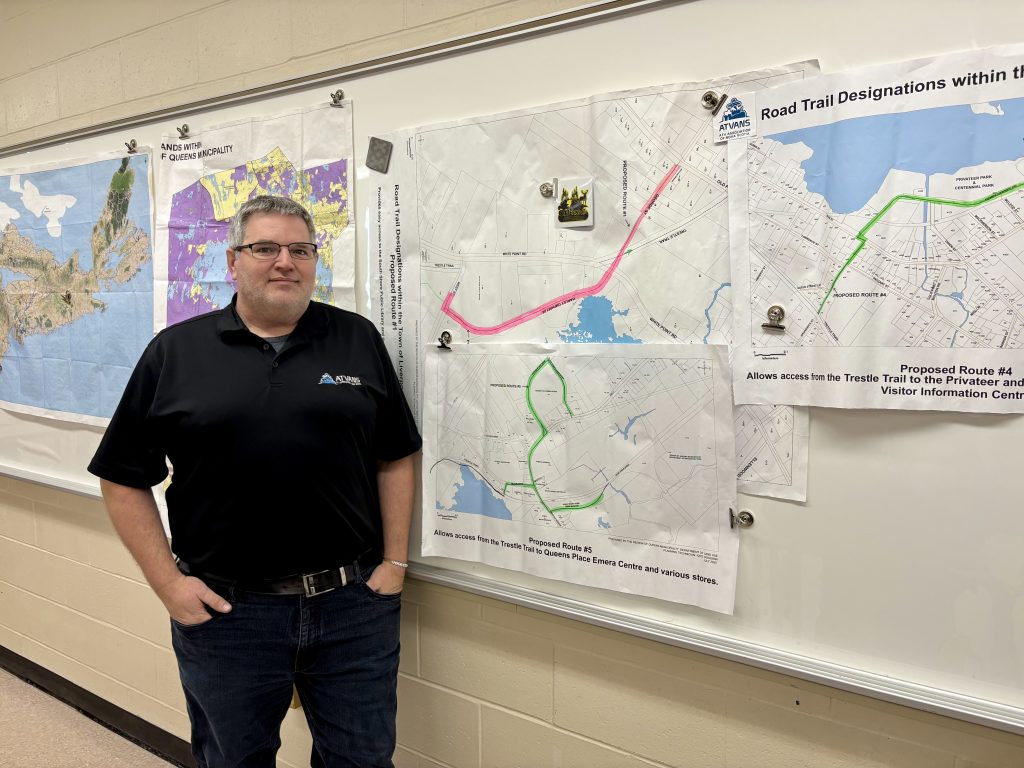
Dave White is the president of the Queens County ATV Association. (Rick Conrad)
ATV operators in Queens County will soon be able to ride their vehicles on some municipal roads in Liverpool.
Region of Queens councillors adopted a new road trails bylaw on Tuesday, paving the way for off-highway vehicles to use some roads to access trails and services.
The rules take effect Feb. 1. But Dave White, president of the Queens County ATV Association, says there’s still some work to do to get the trails ready for riders.
“It’s really important for people to note that, although it’s passed second reading today, it will not become officially open. … Things that have to be done is we have trail signage to go up as well as the region has some signage for where the trail crosses streets. So they’ve already done some preliminary work.”
White said the association, the ATV Association of Nova Scotia and the municipality will update users on when the trails are ready to use.
The bylaw designates five routes around Liverpool that riders can use to access services or other trails.
It’s been about two and a half years since the association and the Queens Rails to Trails Association approached the region to create a connected trail network similar to those that exist in neighbouring Lunenburg and Shelburne counties and in other parts of Atlantic Canada.
ATV groups say that the changes will bring more economic activity to Queens County. In 2022, ATV users said they spent $454 million in Nova Scotia.
The Nova Scotia government passed the Road Trails Act in 2023, which allows off-highway vehicles on provincial and municipal roads with certain conditions.
“It’s been a major development and a lot of work with the municipality, over the last six months, but really over almost two and a half years at this point,” White said .
“So we are exceptionally pleased with it.”
White says motorists won’t see much of a change once the rules go into effect, since the vehicles won’t be allowed everywhere.
“You will see off-highway vehicles on defined streets. That’s important, it is not all of town. It’s very specific.”
The routes are behind the municipal offices on White Point Road and at various points from the Trestle Trail that would allow access to the Visitor Information Centre, downtown shops and services like the gas stations and grocery stores around Queens Place Drive.
The association also signed an agreement with a local landowner so riders can access the former rail bed to get to the Milton Road.
“And then you’ll travel like any other vehicle down to the light, and have all of the options open to you, including the yield lane to the right to access Irving, Shell and Hank Snow Drive, which will allow us to have combined tourism events with the friends of the Hank Snow Society, which we’re very excited for, and we’re hoping to do an event with them in February.
“You will also be able to turn left at the light to access businesses like Sobeys, Superstore, McDonald’s, Dollarama, Queens Place, Best Western, which is a major win because people will be able to come in and do expanded tourism opportunities. So we’re very excited.”
White says once the trails are open, they should bring in business from off-highway vehicle users from around the province.
He says people can get more details about the routes by downloading the ATV Association of Nova Scotia’s mobile app.
Here are the routes outlined in the bylaw:
West Street from civic number 181 to the intersection with Harley Umphrey Drive, then to the intersection with White Point Road.
King Street from civic number 56 to the intersection with Lawrence Street, then to the intersection with Wolfe Street to civic number 16.
Main Street from the intersection with Central Boulevard to civic number 741.
Brunswick Street from civic number 63 to the intersection with Main Street, then to the intersection with Henry Hensey Drive to the pump station at civic number 4 Henry Hensey Drive.
Milton Road from civic number 31 to the intersection with Bristol Avenue, west to the intersection with Hank Snow Drive and east to the intersection with Queens Place Drive. Included is Hank Snow Drive to civic number 38 and the entirety of Queens Place Drive and Old Cobbs Barn Road.
RCMP and other emergency crews are on the scene of a possible plane crash near Mill Village. (RCMP)
UPDATED 5:35 P.M.
Emergency crews rushed to the scene of a possible plane crash on Tuesday afternoon near Mill Village.
But after extensive air and ground patrols of the area, “neither RCMP nor (search and rescue crews) observed evidence of a plane crash, a plane in distress, or a situation that required emergency response,” according to a statement from Nova Scotia RCMP on Tuesday just before 5 p.m.
Queens District RCMP received several calls at about 1:15 p.m. of emergency flares near Mill Village. One caller said they saw a plane in distress in addition to the flares, the RCMP said.
The Joint Rescue Co-ordination Centre in Halifax deployed a CH149 Cormorant helicopter and a CC295 Kingfisher airplane as part of the search. Queens RCMP officers searched on the ground through rural areas and worked with drone operators as part of the search.
Firefighters and RCMP rushed to an area off Highway 103 just before 2 p.m. after reports that flares and smoke could be seen.
The RCMP thanked members of the public who called 911.
Assessment notices were sent to property owners this week. (Rick Conrad / File)
Nova Scotia property values continue to rise, but the double-digit increases seen during the Covid-fuelled buying spree are over.
Overall, total property assessments in Nova Scotia have topped $200 billion for the first time, with residential and commercial properties combining for $206.3 billion on 2026 assessments, according to numbers released Monday by the independent, non-profit Property Valuation Services Corporation.
Residential assessments rose by 8.5 per cent over 2025. That compares to an 11 per cent increase over 2024.
In Queens County, residential assessments rose by $151,836,700 or seven per cent over 2025.
In 2025, they rose by 9.5 per cent and the 2024 assessments were 25 per cent higher than the year before.
Jeff Caddell, director of valuation standards for PVSC, told QCCR on Monday that lower-priced properties such as mobile homes are becoming more attractive. Even so, properties near the water are still popular.
“We’re starting to see a more focused demand for property. So, we’re seeing smaller, more affordable homes increasing at a faster pace from a market perspective, than higher-value homes. We’re also seeing more of those types of homes being constructed as well,” Caddell said.
“Queens County is no exception. We’re seeing a trend towards smaller homes, more moderately priced homes selling, we’re seeing good market growth, and those types of properties, manufactured homes across the province, the last couple of years we’ve seen strong market demand for those properties, and that’s continuing into this year as well. Semi-detached townhouses, duplexes, multi-units, we’re seeing market increase in those types of properties as well.”
Caddell said people are also looking for properties beyond urban areas like the Halifax region.
“So typically, provincially, much of that value increase is centred around HRM, the urban areas in the province, but we’re starting to see value shift outside of the urban cores in the province. So looking at small towns, small municipalities across the province, where there’s access to amenities. It’s these types of areas where we’re seeing good, strong market change, and as well as construction to meet the housing needs in those areas.”
2026 assessments are based on sales and financial data from 2024 and reflect a market value as of Jan. 1, 2025, and the physical state of properties as of Dec. 1, 2025.
Municipalities received the assessment roll for their region in mid-December.
The PVSC mailed 2026 assessments to more than 650,000 property accounts on Monday.
This year’s Capped Assessment Program rate is 2.6 per cent, up from 1.5 per cent last year. About 72 per cent of residential properties qualify for the CAP, which limits the amount assessments can increase every year. Municipalities assess property taxes based on the CAP amount.
Caddell said they received about 9,000 appeals last year, with about 20 to 25 per cent of those having their assessments adjusted.
“So in many cases, the taxable doesn’t change, because it’s already lower than the market value assessment. So it’s just an important consideration, but if property owners have questions, they can certainly give us a call on that.”
The deadline to appeal your property assessment is Feb. 12.
A Liverpool man is accused of impersonating an RCMP officer. (RCMP)
A Queens County man has been charged with several offences, including stealing a dump truck and impersonating a police officer.
Christopher Allan MacLeod, 43, of Liverpool was charged after incidents on Boxing Day and New Year’s Day.
RCMP say that on Dec. 26 at about 9:20 p.m., a man approached an RCMP officer outside the Cookville RCMP detachment in Bridgewater and said he was an RCMP sergeant who had just been transferred from another province.
He drove to the detachment in a black Dodge Ram and was dressed in civilian clothes, according to an RCMP news release. He said he didn’t have any RCMP identification.
The officer confirmed that the man was not a fellow officer and arrested him.
Lunenburg District RCMP charged MacLeod with impersonating a peace officer and breach of a recognizance. He appeared in Bridgewater provincial court on Dec. 29 and was released on conditions.
On Jan. 1, at 11:45 a.m., Queens District RCMP got a call about a stolen dump truck from a garage on Devonshire Road in West Caledonia.
While officers were on their way to the scene, they saw the vehicle on Highway 3 in Liverpool.
They stopped the truck and safely arrested the driver, whom police identified as MacLeod. They allege that MacLeod entered the garage on Dec. 31 and stayed overnight before taking the truck.
Queens District RCMP have charged MacLeod with break and enter with intent, theft of a motor vehicle, possession of property obtained by crime and two counts of failing to comply with an order.
MacLeod appeared in Bridgewater provincial court on those charges on Jan. 2 and was remanded into custody. He appeared again on Jan. 7 and was ordered back to jail until his next appearance on Feb. 4.
RCMP spokeswoman Cpl. Carlie McCann asked people to contact police or Crime Stoppers if they have any information about either incident.
“At this point I don’t anticipate there being further charges related to either of these two files, but we will continue to investigate if new information is learned.”
MacLeod is listed in Nova Scotia property records as the co-owner, with Charles King, of 27 West Berlin Wharf Rd. in West Berlin. A house, truck and several outbuildings were destroyed in a fire there on Dec. 22. RCMP said at the time that one man was arrested at the scene but later released and not charged in the fire. They have not said what caused the blaze, but said they had reports of fireworks before it began.
RCMP say that anybody worried about the identity of a police officer should ask the officer for identification or contact their local detachment’s non-emergency line. In an emergency, call 911.
“Nova Scotia RCMP regularly reinforces with all of our officers the importance of self-identification,” McCann said.
“If you are in a situation where you suspect that someone might be using or planning to use real or replica police equipment or if you’re in a situation where something is concerning or seems off, please don’t hesitate to call local police or if you believe you may be in immediate danger, call 911.
“In a situation like a traffic stop, you can ask to see an officer’s badge and ID card and that will have their regimental number and the ID card will have a photo. We always want Nova Scotians to be aware of suspicious behaviour, and don’t hesitate to reach out to police to report it.”
Shelburne District RCMP continue to investigate a fatal dog attack in Shelburne County. (Vlad Vasnetsov via Pixabay)
People all along the South Shore and across Nova Scotia are showing support for a grieving mother of a 13-year-old boy who died after a dog attack in Shelburne County on Saturday.
Drew died in a Halifax hospital after he was mauled by three dogs around 5 p.m. on Jan. 3, according to Shelburne District RCMP.
As of Wednesday afternoon, the online fundraiser had raised almost $65,000 of its $70,000 goal.
“Our community is absolutely devastated by this loss,” organizer Trish Harris wrote on the page.
“My hope is to ease any financial burden so his mom can focus on grieving and healing during this unimaginable time. “
Shelburne District RCMP are still investigating the attack that involved two Cane Corsos and a Rottweiler.
RCMP say the three large dogs attacked Drew as he was riding his bicycle past a property on Upper Sandy Cove Road in Welshtown.
“This is an extremely distressing and tragic incident for everyone involved,” Staff Sgt. Mark Macpherson of Shelburne District RCMP said in a news release.
“Our thoughts are with the youth’s loved ones as they process their heartbreaking loss.”
The dogs were euthanized by a local veterinarian after the attack.
No charges have been laid, though RCMP say they continue to investigate. They’re gathering and analyzing video footage of the area, going door-to-door in the community and interviewing several people about the dogs’ behaviour before the attack.
“Our team is working through several investigative steps to fully understand what happened and to determine the circumstances surrounding the attack,” Staff Sgt. Macpherson said.
“Community members have been very supportive of our work, and the dog owners have been co-operative throughout.”
Anyone with information is asked to contact Shelburne District RCMP at 902‑875‑2490.
After the fire, the region declared the property dangerous and unsightly and ordered Jacob to clean it up. After she failed to appeal the order, the region cleaned it up and sent her the bill.
Citing privacy, the region has refused to disclose how much that cost taxpayers.
Anyone interested in bidding on one of the properties in the tax tender has to submit a sealed bid by Feb. 10 at 2 p.m. to cover outstanding taxes, interest and expenses. If the property owner pays all outstanding taxes and fees before the deadline, the property is removed from the tax sale.
An accessible washroom at the inclusive play park in Liverpool likely won’t be finished until the end of 2026. (Rick Conrad)
Accessible washrooms at Liverpool’s universal playground and splash pad have been delayed as Region of Queens staff look into an off-grid design.
Regional councillors voted in April 2024 to speed up installation of the permanent washroom and change room facilities at the site, next to Queens Place Emera Centre.
But at a capital budget meeting just before Christmas, Director of Infrastructure Adam Grant told council that the $425,810 project has hit some roadblocks.
“We’ve done a lot of work in the background, trying to identify a feasible solution for that site. It is challenging, it’s constrained physically,” he said.
“We do not have a lot of real estate to work within next to that parcel of land. There’s no provisions put in for electricity to allow for any development… So we have maybe 30 amps of power, which is not enough to run a facility like that. There’s no water provided for a washroom facility and there’s no wastewater whatsoever at the site. So it’s those three strict parameters and combined with having not much real estate to work within, that makes it very challenging to find a solution that fits within that footprint.”
The $600,000 Etli Milita’mk playpark opened in October 2023, the result of a years-long community fundraising initiative by local members of Autism Nova Scotia. The region contributed the land and about $112,000 to the project. The province chipped in the rest.
In the meantime, the region has supplied a portable accessible toilet for users of the park and splash pad, which is closed until the spring.
In response to a question from District 5 Coun. Jack Fancy, Grant said that power, water and sewer can’t be extended from the Queens Ground Search and Rescue building nearby because of the way the playpark was built.
“Unfortunately, with the building, the splash pad and the playground, we limited any opportunity to make any kind of addition in that area by putting a perimeter fence right into the curb and sidewalk. Getting involved with the asphalt to remove it, to put power, to put sewer (and) water, is going to get extremely expensive.”
Grant said that’s why staff are looking at some kind of off-grid accessible facility, though it will likely be more expensive to maintain.
“The caution is that it’s going to probably create a lot more of an operational burden than we’d like to see, but it will fulfill council’s wish to have an accessible facility there.”
The accessible washroom and change room at the playpark and splash pad are now expected to be finished by the end of 2026.
The Nova Scotia Regulatory and Appeals Board has approved increases for customers of the Region of Queens Water Utility. (Rick Conrad)
More than 1,200 water utility customers in Liverpool and Brooklyn will see a significant spike in their bills this year.
In a decision released Dec. 22, the Nova Scotia Regulatory and Appeals Board has approved an 85 per cent increase in water bills for customers of the Region of Queens Water Utility. Once the full increases take effect, it will mean an extra $300 per year for most residential customers.
The new rates took effect Jan. 1, but the board also ordered the utility to phase in the increases to 2027 to help mitigate “rate shock”. It also ordered that interest on the utility’s debt to the municipality be eliminated, and to adjust the utility’s earnings and debt forecasts.
“The Board finds that the utility is in a difficult position,” board members wrote.
“The Board also finds that, other than the minor adjustments directed above, the required revenues in the application are just and reasonable, and necessary to produce safe, reliable water. Yet its rate increases clearly fall within the definition of ‘rate shock’.”
The average residential customer will now pay $531.28 a year, an immediate 60 per cent increase. It will eventually rise to $664.08 in 2027.
At a hearing on Nov. 19, the region said the utility needed to increase rates dramatically to deal with a mounting $1.4-million deficit.
Mayor Scott Christian told QCCR this week that the board’s decision allows the water utility to pay off some of its deficit and continue to provide good-quality drinking water to its customers.
“I think it’s a fair judgement. It gets us to a place where we can run a water utility in a sustainable way, while helping to cushion the blow a little bit to the consumer in terms of the spike in that rate.”
In November, regional councillors approved a utility assistance rebate for water customers on low incomes. People are eligible for up to a $200 annual break on their water bills.
With that rebate applied, the municipality projects less than a one per cent increase this year for people in the lowest income bracket and about a 40 per cent increase by 2027.
Christian said he understands that even with the rebate, some people will still struggle with the higher water costs.
“The utility for a long time was run in a way that didn’t position us to have a sustainable, solvent utility. I understand for sure that people are having a tough time making ends meet. Any additional cost to folks for running a household is always challenging.”
The Queens Community Health Board had opposed the rate increases at the November hearing.
Board chair Tara Druzina did not want to do an interview this week, but said in an emailed statement that the board is concerned about the size of the rate increases “and the impact they will have on households already under financial pressure.”
She applauded council’s adoption of the rebate, but said the region still needs to address affordability concerns for all users.
The review board also “strongly encouraged” the municipality to begin replacing customers’ water meters, most of which are at least 50 years old.
A 2024 report for the utility found that it was losing up to 69 per cent of its treated water, either through leaks or because the old water meters were inaccurate.
“So it was a bit of a moment of clarity for me that sure, some of it is seeping, weeping, leaking, older pipes,” Christian said.
“But then some of it too is that we’re actually delivering the water and it’s being underreported. It helps us to identify an action in addressing that and getting those metres in place that can actually more accurately report that water consumption.”
Christian said the municipality will begin working on replacing those old meters.
He said he’s not sure when the rate increases will be reflected on people’s water bills.
Five people, including Darrell Dexter, have been appointed to the Order of Nova Scotia. (Office of the Lieutenant Governor)
Queens County’s Darrell Dexter is among five Nova Scotians given the highest honour in the province.
Dexter has been appointed to the Order of Nova Scotia.
He led the NDP to a historic provincial election win in 2009, forming Nova Scotia’s first New Democrat government.
As premier, he led a government that tried to tackle the province’s debt and deficit, improve protections for private-sector trade union members, raise the minimum wage and lobbied successfully for the Churchill Falls hydroelectric project and a multi-billion-dollar federal shipbuilding contract for Halifax-based Irving Shipbuilding.
His government also bought the assets of the closed Bowater Mersey paper mill in Brooklyn in 2012. It was a deal that helped secure pension benefits for former Bowater workers.
Dexter served as a Dartmouth city councillor from 1994 to 1996. He was an NDP MLA for the Dartmouth area from 1998 to 2013.
A former lawyer, he is a graduate of Dalhousie University and the University of King’s College. He grew up in Milton. Since his resignation as NDP leader in 2013, after the party was defeated in that year’s election, he has worked as a political commentator and a lobbyist for the cannabis industry.
He and his family have moved back to Queens County.
Other recipients of the 2025 Order of Nova Scotia are:
John George (Jack) Flemming, Halifax – a philanthropist and entrepreneur recognized for his contributions to local charities
Rankin MacSween, Ironville, Cape Breton Regional Municipality – a business and community leader and from 1995 to 2021, president and CEO of New Dawn Enterprises, the oldest community development corporation in Canada
Joel Plaskett, Dartmouth – a celebrated singer, songwriter, producer and philanthropist
Carolyn G. Thomas, East Preston – an educator and human rights and community advocate; recognized for her contributions to education, government and community development.
A ceremony will be held at Government House in Halifax in the spring. Lt.-Gov. Mike Savage will present the new members with their awards.
Queens County residents will have to drop off styrofoam packaging and potato chip bags at recycling depots. (Jonas Gerlach via Unsplash)
Queens County residents aren’t the only ones confused and frustrated by new recycling rules.
Mayor Scott Christian says he’s upset too.
“I’m getting a lot of feedback from residents,” he told QCCR in an interview Tuesday.
“You know, ‘we’re getting less service. Our taxes are high, we’re getting less services,’ and I agree with them.
“From my perspective, it doesn’t make any sense for our residents to have to take some of the recyclable materials like styrofoams and aerosol cans and chip liners to Caledonia. I cannot understand that. So I’m going to continue to engage with the province and sort of hold Circular Materials feet to the flames around this. I think they weren’t prepared for the Dec. 1 takeover.”
As of Dec. 1, new regulations from the Nova Scotia government shifted responsibility for sorting recyclables and other packaging to the companies that produce it.
Municipalities around Nova Scotia closed their sorting facilities and switched to a company called Circular Materials.
That’s a non-profit group made up of some of the world’s biggest producers of waste, like McDonald’s, Pepsico and Nestle Canada.
The Region of Queens said residents would see no changes in how recyclables are collected.
But over the Christmas holidays, residents received information that there will be changes. For example, things like styrofoam packaging, potato chip bags, candy wrappers and aerosol cans will no longer be collected as part of the regular garbage pickup. Those things used to be considered garbage.
Instead, according to information from Circular Materials, those items will have to be cleaned and dropped off at certain recycling depots around the province.
On an interactive map on the Circular Materials website, there are no locations listed for Queens County, though some residents have said Caledonia is the closest location. The closest listed on the map are in Lunenburg and New Germany.
“I don’t understand how we’re doing anything environmentally conscious by having people drive chip bags to Caledonia,” Christian said. “So I just share the residents’ frustrations around the changes to the recyclables.”
Christian said he expected Circular Materials to provide the same level of service and convenience that the region had. He said he doesn’t understand why the Queens Enviro Centre in Brooklyn isn’t one of the drop-off locations.
Eight employees were given layoff notices in September when the region announced it would be closing its recycling depot. Municipal officials have said they would try to find other jobs for those workers with the municipality.
Christian said he’s worried that the new rules will be counter-productive and lead to more illegal dumping and burning of plastics.
He said he’ll continue pushing for answers from Queens MLA Kim Masland and other provincial officials.
“From my perspective, the province has to hold Circular Materials to account in terms of the system that they’re standing up to ensure that it isn’t leading to potential unintended negative consequences, like illegal dumping, like burning of garbage, like putting recyclable materials in the garbage. The way that they’ve set it out, I don’t understand it.
“There can’t be additional costs or inconveniences to the consumer. The whole thing is, the producer’s responsible. So if the producer’s responsible, they need to do it in a way that doesn’t download any of that responsibility or cost or inconvenience onto the consumer.”
In addition to the recycling revisions, Queens has also changed its garbage collection rules. Residents will now have to put their trash out in clear bags. People are allowed one black privacy bag.
The municipality is giving residents until July to make the transition from opaque to clear bags. So, people can continue to use green or black bags for garbage until then.
A fire off the West Berlin Wharf Road on Monday evening seen from the beach in West Berlin. (Rick Conrad)
A house was razed in a suppertime blaze in West Berlin on Monday.
Queens District RCMP and firefighters from Liverpool, Port Medway, North Queens, Greenfield, Mill Village, Italy Cross/Middlewood, Bridgewater and Dayspring responded to the fire at about 5:50 p.m. on the West Berlin Wharf Road. There were more than a dozen emergency vehicles on scene.
The building was fully engulfed shortly after fire crews got there, with flames seen shooting into the sky from across Blueberry Bay. Cars lined the Eastern Shore Road near the small beach in West Berlin to watch the fire from across the bay and take photos.
“At the scene, there were reports of gunshots or fireworks,” RCMP spokesperson Cindy Bayers told QCCR on Tuesday.
“No firearm was located in the area and no injuries were reported. One man was safely arrested. At this time, he’s not facing any charges and the investigation is ongoing.”
The oceanfront property down a long lane is a good distance away from West Berlin Wharf where lobster fishermen have their boats tied. One woman parked near the beach said she was worried her father’s building at the wharf was in danger, but said she soon realized the fire was far enough away.
Along with the house, a truck was also destroyed in the blaze and at least two outbuildings sustained damage.
Crews were on scene most of the night and into the early morning. They were called back to the scene around 10:30 a.m. Tuesday after reports of hot spots possibly reigniting.
The fire was fully extinguished by Tuesday afternoon.
The Liverpool fire chief could not be reached for comment on Tuesday.
Deputy Mayor Maddie Charlton chaired the Dec. 19 special council meeting on the capital budget. (Region of Queens YouTube)
Region of Queens councillors had some tough questions for senior staff on Friday afternoon as they pored over their five-year, $57-million capital budget.
Elected officials were concerned about the timeline for water and sewer improvements in Liverpool as part of the $26-million Mount Pleasant extension.
They also wanted to know more about projects like the South Queens Outdoor Pool and planned upgrades at the Astor Theatre. And there were concerns about the municipality’s long-term debt.
District 3 Coun. Courtney Wentzell returned to an issue he’s brought up before about extending water and wastewater services to the Mount Pleasant area to connect two planned housing developments to the system. That project is supported with $10.7 million in provincial funding.
“With the loss of treatable water and with us … hiking the water rates, and then going ahead and starting a project to send transmissible water up Mount Pleasant Street before you fix the issue down here on (the west side of) town, … it does not make sense to me, and it never will. 28/29 before you fix the problem? No.”
The region’s current plan calls for $9.7 million in work to begin this coming year to run new water mains to the Mount Pleasant area and upgrade existing infrastructure en route. Work on other, older parts of the system is now scheduled to begin in 2028/29. The end date to finish the overall project has been pushed to 2032/2033, from the original finish date of 2028/29.
But with South Queens Water Utility reporting more than 60 per cent of its treated water lost through leaks in the system, Wentzell says he wants to see older pipes, like the lines and laterals from Roy Turner Road to Union Street, fixed first.
“Isn’t this all one big project now?” Wentzell asked.
“ Isn’t this all just one project or is the Mount Pleasant exchange separate getting up to Dauphinee Farms than the rest of Liverpool? I’m lost. I’m trying to expedite and get the old infrastructure fixed before we start driving pressureless water up a hill.”
Adam Grant, the region’s director of infrastructure, said the contracts are already awarded for the work to Mount Pleasant. And he said fixing one line won’t solve all their water woes.
“I wouldn’t expect to see 60 per cent of it be in that one segment of line. As we know, it’s spread throughout the town. So if we accomplish 10 per cent, we should be satisfied. I don’t want to set false expectations that replacing that transmission main, it’s gonna save all of our beans that are falling out of our basket.”
Councillors asked staff to return in January with options to expedite upgrades to older water and sewer lines in Liverpool.
District 6 Coun. Stewart Jenkins questioned Grant and Finance Director Joanne Veinotte about cost overruns at the $8-million South Queens Outdoor Pool.
Veinotte said that in trying to keep the project on budget, some details were missed like the $150,000 wraparound concrete bleachers.
“How can you miss $150,000 of cement bleachers?” Jenkins said. “I don’t understand it.”
Grant said many different departments rushed to finalize the pool design for tender. And some things were overlooked.
CAO Willa Thorpe, who was not with the municipality when council approved the pool plan, said that won’t happen again.
“When we, as an organization, make hasty decisions on major projects, these are how items like this get missed,” she told councillors.
“So if we were to explore a project of this magnitude again in future, staff will take a different approach.”
Jenkins also wondered why the region is planning to spend about $5 million on heating, cooling and accessibility upgrades at the municipally owned Town Hall Arts and Cultural Centre, home of the Astor Theatre.
“I can’t believe we’re going to spend $5.4 million, when we have poverty, and we have leaking pipes, and we have everything else to spend money on, but we’re going to spend $5.4 million, for something that is not used by very many people in Queens County, and many of them have never been inside. So I think we should be considering that in our budget deliberations.”
Other councillors said the municipality has put off necessary upgrades at the Astor for a while. They said the facility is used well now and it could be used more with a modern HVAC system. It’s currently limited in what it can offer in warmer months because there’s no air conditioning.
Councillors also asked staff for a list of how the $10.2-million accumulated surplus will be spent. If they approve the current capital plan, that surplus is projected to drop to $1.7 million by 2031.
And if they approve the proposed five-year capital plan, they’d also be voting to rack up the region’s long-term debt to $26 million by 2032.
Deputy Mayor Maddie Charlton, who chaired the meeting because Mayor Scott Christian was away, said council is heading in the right direction.
“And so you can say what’s working well, what’s not working well,” Charlton told QCCR. “Recognizing we have financial implications. we can’t do everything, but I think if we hear from people and there’s overarching themes or gaps and things that we’re missing, then it really positions council to make decisions about those items moving forward.”
Councillors will be back on Jan. 13 to vote on the capital budget.
RCMP are looking for Shaun Clarence Cunningham (RCMP Nova Scotia)
Queens District RCMP are asking for the public’s help in finding a man wanted on a province-wide arrest warrant on sexual assault charges.
Police are looking for Shaun Clarence Cunningham, 46, whom police say is known to travel between Shelburne and Queens County.
He faces charges of sexual assault, sexual interference, two counts of invitation to sexual touching and failure to appear in court.
He’s described as five-foot-nine, 175 pounds. He has brown hair and blue eyes.
RCMP say they’ve made several attempts to find him. They’re asking anyone with information to call the Queens District detachment at 902-354-5721 or their local police department. Anonymous tips can be phone into Nova Scotia Crime Stoppers at 1-800-222-TIPS (8477), submitted online at www.crimestoppers.ns.ca, or by using the P3 Tips app.
The region is getting an earlier start on its budget talks this year. The plan is to approve the capital spending estimates by January so that tenders can be issued earlier in the year to get work started more quickly.
While some projects are under budget, like renovations for the library space at the Liverpool Business Development Centre and the upgrades at Beach Meadows Beach, others are running over.
For example, staff are reporting funding shortfalls with the $8-million South Queens Outdoor Pool. Overall cost overruns are estimated at about $150,000, with just over $4 million in costs to date.
The expansion of water and wastewater services to the Mount Pleasant area is running a little behind schedule and over original budget estimates.
The project, which was initially projected to cost about $22 million, is now expected to cost $26 million.
Councillors will discuss the capital budget in a special council meeting on Friday at 3 p.m. at council chambers on White Point Road.
The Nova Scotia government announced its five-year highway plan this week. (File photo by Rick Conrad)
Queens County roads are getting some attention in the province’s five-year highway improvement plan, announced this week.
Queens MLA Kim Masland, who is also Nova Scotia’s Emergency Management and Natural Resources minister, said the work locally will help with climate change.
“Our government is committed to climate-resilient infrastructure,” Masland said in a news release.
“Projects like the shoreline protection on Shore Road are vital to ensuring our roads can withstand future challenges.”
The overall $2.5-billion plan to upgrade highways, roads and bridges across Nova Scotia includes an extra $150 million planned for gravel roads.
New projects added for Queens include:
Construction of shoreline protection on Shore Road in Western Head
Paving 2.3 kilometres of the Long Cove Road in Port Medway from the Port Medway Road easterly to the end of the paved section
Upgrading 2 km of the gravel section of the Long Cove Road
Work on 0.75 km of the Ramey Road in Buckfield from Route 210 northerly to the end of the sand seal
The provincial plan includes more than 160 highway improvement projects across Nova Scotia in the coming year.
Construction timelines will depend on planning and tendering.
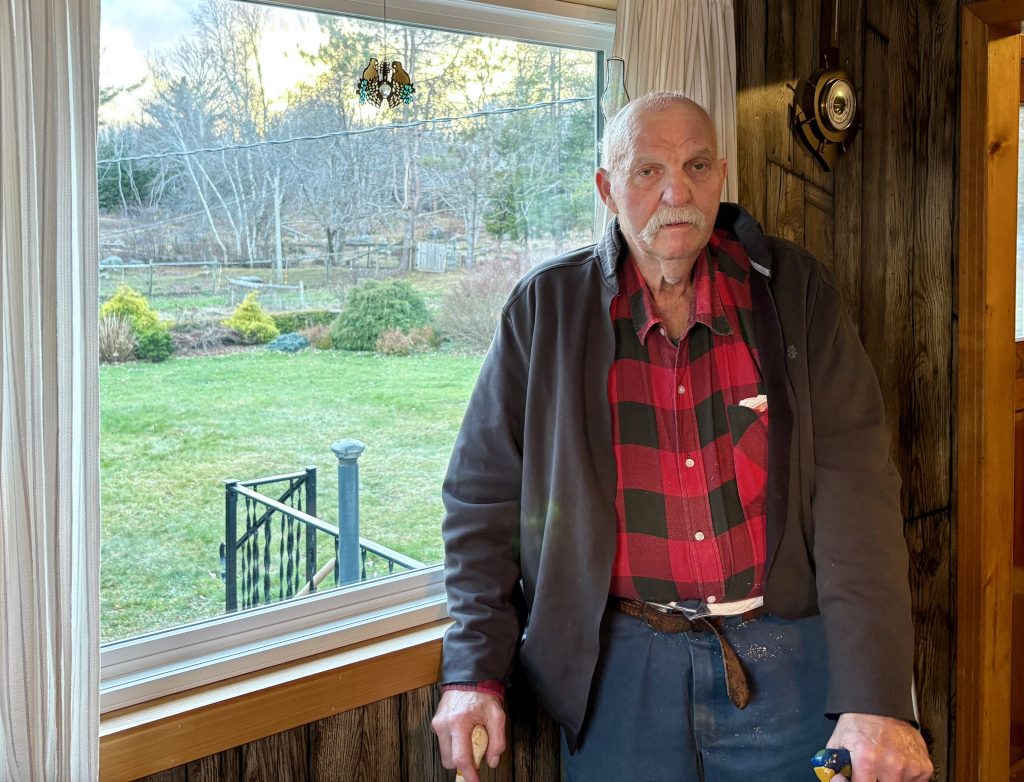
Arthur Roy says he wants the Region of Queens to honour an agreement his father signed in 1947. (Rick Conrad)
A Liverpool man says he wants the Region of Queens to honour an agreement the municipality made with his father 78 years ago.
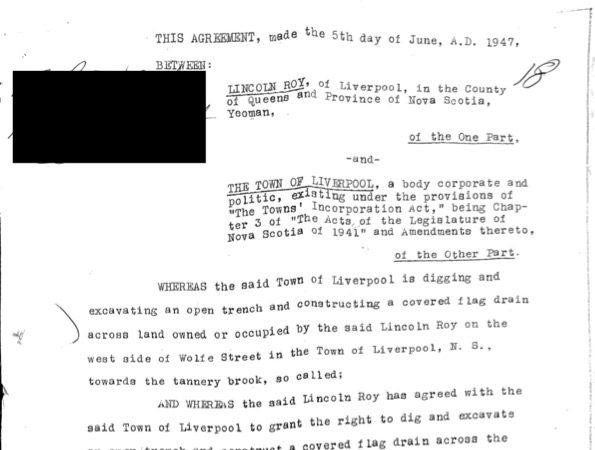
Arthur Roy’s father Lincoln signed a deal with the old Town of Liverpool for $1 in 1947 “to dig and excavate an open trench and construct a covered flag drain 115 feet in length” over his land off Wolfe Street. The town wanted to use it as a stormwater drain.
The agreement allowed the municipality to access the land to build the drain and “do other necessary work for the purposes of renewing, repairing, improving or altering the said open trench and said covered flag drain … provided that the area … is left in a good and safe condition.”
Click the image to read the original 1947 agreement (Courtesy Arthur Roy)
Roy, who now owns the land, says the problem is that the town never finished the work properly in the first place. And he’s been fighting to get the municipality to come back and make it right.
“And now the trench has got silt into it and it’s grew up with grass and it’s just a mess,” he said in an interview.
“Either the easement agreement is good or not, right? If it’s good, come and do what it says on the easement agreement. If it’s no good, come and fill it in. They had all these years, 70-some years, running that water down there and not done anything.”
Councillors discussed the issue at a recent closed-door, in-camera meeting.
Mayor Scott Christian told QCCR that the region is willing to replace a crumbling four-foot culvert on Roy’s property.
“We’re going to put a modern culvert in. It’s changed in terms of the standard and the approach to dealing with trenches and ditching. I think in ’47, they wouldn’t have had the same materials available to them, so we’re going to put in a culvert using today’s technologies and today’s approach to handling that, putting in an appropriate culvert given our requirement for access back there. ”
The drainage ditch cuts through Roy’s land. He says he can’t easily access his 10 acres of land, which he uses as pasture for his sheep. He’s had to build a small walkway over the ditch to get there.
“And you can’t take a vehicle over it, so here I have a piece of land that’s cut into where I live … and I can’t access it. I have wood over there cut in the pasture. I can’t get anything to go over because it’s not safe to go over.”
Christian says the drain on Roy’s land is part of a network of stormwater drains and trenches.
“The trench that goes on his land is a small part of a huge network of stormwater trenches that exist. … We need to make sure that culvert is safe. It’s currently unsafe and we need to make sure that that’s a safe passageway across that trench.”
In 2021, Roy contacted his local councillor at the time and former mayor Darlene Norman.
In a letter to Roy, then-CAO Chris McNeill said the municipality would replace the culvert but that Roy would be responsible for its maintenance because the region had no record of installing the culvert in the first place.
“But if they had 115 feet of flagstone, you wouldn’t need a culvert, you could get across that land 115 feet.”
The region’s CAO Willa Thorpe contacted Roy last week after councillors discussed it. She told him the region’s plan to replace the culvert.
Roy hasn’t seen anything in writing yet. And he’s waiting to meet with his lawyer this week before deciding what to do.
“I don’t want a culvert,” he says. “(The agreement) doesn’t call for a culvert. All I want them (to do) is to follow the easement agreement.”
Members of the Nova Scotia Regulatory and Appeals Board held a water rate hearing in Liverpool in November. (Rick Conrad)
A decision limiting Halifax Water rate hikes may have implications for the Region of Queens as it waits to hear a decision on its application to double water rates.
The Nova Scotia Regulatory and Appeals Board on Tuesday approved a reduced rate increase for the Halifax region’s water utility.
Halifax Water had asked for a combined 35.6 per cent rise in rates, to be implemented over the first three months of 2026. Provincial regulators called that “rate shock” for customers.
The board denied Halifax Water’s request to include deficit elimination in its application. Removing that would lower the second rate increase by about 10 per cent.
It ordered Halifax Water to return with a modified rate proposal within a week.
“The Board finds that the magnitude of the proposed rate increases, implemented over the first three months of 2026, constitutes ‘rate shock’ for its customers. For residential customers, the combined, compounded rate increase was proposed to be 35.6% from January 1 to April 1, 2026,” the regulator wrote in the decision released Tuesday.
“While Halifax Water provided a reasonable explanation about the need to increase rates to cover some of its higher costs due to inflation and other cost pressures, the Board finds that other requested costs were not justified or that the utility overestimated some of those costs.”
The Halifax and Queens water rate applications are very different. For example, Queens is asking regulators for a combined 102 per cent increase over three years. It also has equipment and infrastructure problems Halifax doesn’t.
At the Region of Queens hearing in November, municipal officials warned that without an immediate 85 per cent hike, the whole water system could be in jeopardy.
They said the Region of Queens water utility has been undercharging its 1,200 customers in Liverpool and Brooklyn for years. And because of that, the infrastructure is outdated and needs to be repaired or replaced.
The water utility is supposed to pay for itself through what it charges customers.
The region says it needs to jack up rates immediately to stem a $516,000 deficit. If rates don’t rise, that deficit is expected to swell to more than $3 million by 2027/28.
But during the hearing, board members challenged the region’s past accounting practices and their claims from the last time they asked for an increase in 2021.
Board chair Bruce Fisher opened the hearing by characterizing the region’s application as “rate shock”.
“As there’s a fairly significant rate increase, the board did issue an additional set of information requests. Essentially, we wanted to have additional information on the record in advance of this hearing so we could discuss potential options to deal with what I would say is rate shock.”
The only intervenor in the hearing, the Queens Community Health Board, opposed the region’s application, saying that granting such a large increase would be rate shock for customers.
Fisher also told the region later in the hearing that the size of their request was unusual.
“We don’t typically see 100 per cent rate increases.”
At the end of the hearing, the board had asked for more evidence from the region to support its application. That was received on Nov. 28.
The board aims to file its decisions within 90 days after they receive final evidence. So the decision in the Region of Queens water case will likely be available in late February.
Members of Queens Neighbourhood Co-operative Housing join local politicians on Monday as governments announced millions in funding for a co-op housing project in Liverpool. Pictured are QNCH’s Eric Goulden and Susan MacLeod, South Shore-St. Margarets MP Jessica Fancy, Region of Queens Mayor Scott Christian, Queens MLA Kim Masland, QNCH housing consultant Michael Blair, QNCH’s Janice Wentzell, Randi Dickie, housing consultant Earl Mielke and Queens Coun. Jack Fancy. (Rick Conrad)
As crews worked in the background, politicians from all levels of government on Monday officially announced millions in funding for a new co-operative housing development in Liverpool.
South Shore-St. Margarets MP Jessica Fancy, Queens MLA Kim Masland and Region of Queens Mayor Scott Christian were among those on hand for the announcement of $11.91 million from the federal and provincial governments for the development.
Fancy said the federal contribution of $6.96 million in low-interest loans through CMHC’s Co-operative Housing Development Program will help secure affordable housing for many in the area.
“It’s a chance for a fresh start for many, including some of our most vulnerable people in our community.”
Fancy said the Liverpool co-op housing project is one of seven approved across Canada. It’s being built by Bird Construction.
The province is contributing $4.95 million through its Department of Growth and Development.
Masland applauded the “passion, dedication, effort and grit” of the co-op’s board members to make the project a reality.
“Plain and simple, we need more affordable housing in our community, and it is because of organizations like Queens Neighbourhood Co-operative Housing that more people will have a safe and affordable place to call home.”
The co-operative got approval for the federal and provincial funding earlier this year, but Monday’s announcement was the first time they could speak about it publicly.
The Region of Queens sold four lots to the group in 2023 for $1 and rezoned the area to pave the way for the development. It also committed $203,000 for project management and architectural fees.
Other funding includes:
$175,000 from the Federation of Canadian Municipalities
$343,500 from the Nova Scotia Sustainable Communities Challenge Fund
$400,000 from Efficiency Nova Scotia
$75,000 from the Nova Scotia Community Housing Growth Fund
Mayor Scott Christian said the municipality is looking at other properties it can give to groups like QNCH to help spur more affordable housing in Queens.
“This is a step in the right direction. We all know that we need to do a lot more. We have a lot of folks who need access to affordable, accessible, barrier-free housing, and I commend these folks in terms of their environmental stewardship and working toward net-zero emissions too, because we also need to build homes in a way that’s climate resilient and is appropriate for the future.”
Planning for the project began about four years ago, with most of the work on design and funding happening in the past two and a half years.
The 30 fully accessible apartments will include one-bedroom, two-bedroom and three-bedroom units. It will be targeted toward seniors, with about 70 per cent occupancy set aside for older residents, but available for anyone who meets the application criteria.
Rents will be based on income, but the maximum charged for a one-bedroom will be $790 a month, $1,004 for a two-bedroom and $1,100 for a three-bedroom.
Queens County is in desperate need of affordable housing. Data from the 2021 census showed that 35 per cent of renters in Queens spend more than 30 per cent of their income on housing.
And 34 per cent of Queens residents have considered leaving the community due to housing issues, according to a report from the South Shore Housing Action Coaltiion.
To keep pace with population growth, the report projected that the county will need 555 new units by 2027.
On Monday, even the project’s construction foreman was interested when he heard about the rents.
Michael Blair, a housing consultant working with the co-op on the Lawrence Street project, said the group’s ultimate goal is to try to build 100 affordable units throughout Queens County.
“We’re thrilled to finally have the funding both by the CMHC through the Co-operative Housing Development Program and through the province with the Nova Scotia Department of Growth and Development announced. Now we’re able to tell the story about the exciting new neighbourhood that we’re building.”
He said the apartments’ net-zero, passive design means that tenants won’t have to worry as much about rising energy costs.
“Building with highly energy-efficient mechanical and electrical systems, triple-glazed windows, extra insulation, all those things contribute to the long-term sustainability of the co-op, of the neighbourhood, and kind of insulates it to a certain degree from increasing energy costs, which thus make (us) able to keep … (the units) affordable long-term.”
The Region of Queens adopted a winter maintenance policy this week. (Photo by Sergei Starostin via Pexels)
The Region of Queens has a snowplowing policy for the first time.
“This ensures municipal transportation infrastructure, roads, sidewalks and facilities are managed effectively during snow, ice and other winter conditions, while providing consistent, transparent and a measurable level of service throughout the community,” Adam Grant, director of infrastructure, told councillors at their regular meeting this week.
“Establishing this policy will provide clarity for staff as winter maintenance is provided, while also providing clear expectation to residents.”
The region is responsible for snow clearing mostly in Liverpool and some parts of Milton. Nova Scotia’s Department of Public Works looks after everything else.
The winter maintenance policy details priority areas and response times.
For example, at the top of the list are roads and sidewalks leading to the municipal public works garage, Hillsview Acres Home for Special Care in Greenfield, Queens Place Emera Centre, the municipal administration building and Liverpool Business Development Centre on White Point Road and the Queens Waste Management Facility.
Then it’s collector roads and sidewalks downtown, including the main parking lot and spots on Main Street. Local roads and sidewalks are next, with municipal waste collection sites, otherwise known as grey boxes, dry hydrants, Pine Grove Park, Queens Ground Search and Rescue and the Astor Theatre as lower priority areas.
Click on the map for a larger image (Region of Queens)
The service standard is to have all roads, sidewalks and parking areas accessible within 48 hours after a storm. But some areas have six-hour or 12-hour targets. For example, the goal on main roads is to have both lanes cleared to bare asphalt within 12 hours.
Grant stressed that municipal crews begin their work as quickly as possible.
“So when you look at the time, post-storm, whether it’s six hours, 12, or 48, that doesn’t mean that we’re waiting six hours to start,” he said. “It’s likely to assume that it would be completed in a shorter period of time. It just sets out a priority for us as what we tackle first, second, third, fourth, achieving always to try to have zero as the response time for residents to experience.”
Some councillors were concerned that the service standard for clearing out dry hydrants is 48 hours after a storm.
District 6 Coun. Stewart Jenkins said he wants to see a stricter standard for maintaining those areas.
“I can’t believe we would wait two days after a snowstorm to clean out fire services’ access to their dry hydrants. I think that’s a misstep and it should be done sooner than that.”
Grant said that crews usually get to those areas pretty quickly.
“We generally start dry hydrants probably 12 hours after a storm’s end and we work on them routinely overnight and the next day and they’re typically cleaned up within 24 hours,” he said.
“And I guess what this outlines is that if we can’t accomplish that within 48 hours, then we need to revisit the resources and the level of service that we’re trying to achieve, then make sure that there’s that balance in there. But in no way are we intending to not maintain dry hydrants in a timely manner.”
He also pointed out that fire departments can call municipal crews in emergency situations and they’ll respond immediately.
Mayor Scott Christian also wanted to ensure that downtown streets and sidewalks are accessible as early as possible for those with mobility challenges.
Manager of Public Works Garrett Chetwynd said main sidewalks are usually passable pretty quickly after a storm after the sidewalk plow goes through. Crews have to use shovels and other hand tools to get to the bare sidewalk, and the crosscuts (the sloped area that joins the sidewalk with the road) would be clear within 12 hours.
“That doesn’t mean that they’re not touched at all,” Chetwynd said. “When our sidewalk plow goes through, it’s clear just not to that bare sidewalk. It’s very difficult to navigate that changing slope and terrain as you get through with the machine.”
Councillors approved the new policy at their meeting on Tuesday. Christian said that staff and council could make tweaks to it if necessary as the season progresses.
The emergency department at Queens General Hospital in Liverpool will be closed until Monday. (Communications Nova Scotia)
The emergency department at Queens General Hospital in Liverpool will be closed Friday and reopen on Monday (Dec. 15) at 8 a.m.
It will also close at 1:30 Wed., Dec. 17 and reopen Thurs., Dec. 18 at 8 a.m.
The ER is usually open 24 hours a day from 8 a.m. Monday to 1:30 p.m. Friday.
The emergency department at South Shore Regional Hospital in Bridgewater will be open. Virtual urgent care, for some medical conditions, is open at Queens General daily from 8 a.m. to 8 p.m.
Patients of Queens Family Health can access the same-day clinic through the week for new, emerging health problems by calling 902-354-3322.
Chief Administrative Officer Willa Thorpe told councillors that involving residents in the process helps avoid any potential conflicts of interest.
“The committee’s work could be completed prior to council adopting the 2026-2027 operating budget, so any potential compensation adjustments would be considered during budget deliberations.”
The region is looking for three to five people to sit on the committee, preferably with experience in finance, policy, governance, legislation or related areas.
The mayor’s current annual salary is $48,533, while councillors make $24,267. The deputy mayor makes $25,667. The mayor and councillors do not participate in a benefits or pension plan.
Pay for council and the mayor is adjusted after every election. Any raises are calculated by using an amount equal to the cumulative percentage of the average salary increase of all region employees over the past four years or by the cumulative consumer price index over the same period, whichever is less.
The region has had the same policy since 2018.
This fall, regional staff contacted municipalities around the province about how they review councillor compensation.
Nine municipalities responded. Two-thirds of those included some kind of pension or health benefits.
The Municipality of the District of Lunenburg adjusts council pay annually based on the provincial consumer price index. It also includes a health and dental benefits plan, with elected officials paying 25 per cent of the premium. Since June 1, 2021, they are also enrolled in the province’s public service pension plan, which MODL belongs to as an employer.
MODL’s mayor is paid $59,377 a year, while councillors make $29,562. The deputy mayor gets $40,208.
In the Halifax region, which is Nova Scotia’s largest municipality, the mayor makes almost $205,000, with councillors at $99,402. They can also participate in a benefits and pension plan.
The citizen advisory committee in Queens would meet three times, twice in January and once in February, before delivering its report by Feb. 28.
Councillors would appoint committee members at their first meeting in January. Holly McConnell, the region’s director of people and culture, would help the committee with their work.
When asked whether three meetings is enough time for the committee to review compensation for mayor and councillors, Mayor Scott Christian told QCCR that they’ll have help.
“I guess that we will see,” he said.
“My expectation is that staff will carry most of the heavy lifting and the load in terms of actually doing the writing and development of the work. But I think it’s really important to have the citizen panel so there are opportunities from an objectivity and an impartiality standpoint and to get different perspectives around the table.”
Meetings of the committee will be open to the public. And it will be dissolved once it finishes its review.
The region is accepting applications until Jan. 2 at 4:30 p.m. Applicants should email a brief summary of their experience and a brief statement on why they want to participate to the municipal clerk at clerk@regionofqueens.com.
Ryan MacLean with UPLAND Planning and Design Studio at a public engagement session in Liverpool in July. (Rick Conrad/File)
The Region of Queens will be looking for outside help for a planned overhaul of some parts of its land use bylaw.
Councillors voted this week to hire an external firm to review the bylaw and municipal planning strategy.
The region passed an extensively reworked bylaw and planning strategy in May 2022. The process cost $140,000 and was led by UPLAND Planning from Halifax. It was also supposed to take 18 months, but ended up taking almost four years because of the pandemic.
Mayor Scott Christian said this week that it’s time for a review.
“The municipal planning strategy and land use bylaw, I think, is second only to a budget deliberation as an allocation of the public resources, and setting of the tax rate in terms of the levers that we have available to us as a council to impact our community, impact business owners, impact residents, in terms of the regulations, the protections and regulations, and avenues that residents and businesses have with respect to permitted use of property in our municipality,” Christian said.
“And I think that it’s really important to me that our land use bylaw or municipal planning strategy is reflective of the priorities and the concerns and the direction that this council wants to take the community.”
The land use bylaw returned to council’s radar earlier this year as developer Eric Fry applied to turn the dilapidated former Stedmans building on Main Street in Liverpool into apartments.
Councillors initially rejected his plan because it contained no commercial space. The rules required that at least half of a downtown building’s ground floor be devoted to businesses.
But after Fry threatened to sell the property, councillors relented. They changed the bylaw in late November to allow a modified version of Fry’s plan to go ahead, with two much smaller spaces for commercial use.
Mike MacLeod, the municipality’s director of land use, told councillors at their regular meeting this week that hiring outside consultants would be more efficient, since the region’s staff don’t have the capacity to carry out the review in a timely manner.
“There is considerable work involved in even an interim planning review,” he said.
“So if staff were to undertake it, the timeframe will be considerably lengthened to complete the review, as well as staff’s ability to carry out the day-to-day operations at the department. We would be very challenged to do it in-house.”
The region has about $50,000 set aside already for future planning review projects. MacLeod said that money could go toward the cost of this review.
Councillors want to create or review regulations regarding
Commercial uses in residential zones
Short-term rentals
Keeping of livestock in residential and rural zones
Light pollution
Additional coastal protection measures and climate resilient land use regulations
Minimum property standards
District 3 Coun. Courtney Wentzell said he was concerned about getting one firm to do all the work.
“I still have some deep concerns about one firm looking after so many different items, and the cost that will be,” he told his fellow councillors.
“And I think of our town hall meetings, and our priorities, where coastal protection and climate resilience is way up there. I didn’t see a whole lot about livestock in our planning meetings and town halls. I think there’s nothing prioritized here, and I am still leery of one contractor looking after all of this.”
MacLeod said that even though an outside company will be hired, staff would still be involved. And he added that professional planning firms are experienced in work like this.
Deputy Mayor Maddie Charlton said that the region could rely on lessons learned in other municipalities who have already addressed things like coastal protection.
Councillors will have input on details of the tender before it’s issued.
Wendell McKay and Victoria Hopkins of Capt. Kat’s Lobster Shack in Barrington Passage, winners of the 2025 Lobster Roll-Off. (Rick Conrad/File)
One of the signature events of the 2026 Nova Scotia Lobster Crawl cracks open in early February at the Quarterdeck Resort in Summerville.
Described by organizers as “marvellous mayhem with mayo”, the Lobster Roll-Off is scheduled for Tues., Feb. 3 from 6 p.m. to 8:30 p.m.
The good-natured but fierce competition invites chefs from around the South Shore to show off their lobster roll skills. The winner of the judged event will get bragging rights for their mouth-watering creation as the top roll on the South Shore.
National and international travel media make up the judging panel.
“This event is where culinary creativity, community pride, and the world’s best lobster come together,” Stephanie Miller Vincent, co-ordinator of South Shore Tourism Cooperative, said in a new release.
“It’s not a competition, it’s a spotlight. And our chefs know how to rise to it.”
About 100 guests are expected for the fun- and lobster-filled event.
Restaurants who want to compete in the 2026 Lobster Roll-Off can register now. They must be a South Shore Tourism Cooperative member, serve the same lobster in-house for the whole month of February and be located on Nova Scotia’s South Shore.
The Nova Scotia government wants to put illegal cannabis dispensaries out of business. (The Province of Nova Scotia)
The Nova Scotia government wants police to crack down on illegal cannabis sales.
Justice Minister Scott Armstrong recently asked all police agencies in the province to step up their enforcement efforts.
“Illegal dispensaries pose a real threat to consumers, to youth, and to the integrity of our regulated system,” Armstrong said.
“We have already taken steps to confront these risks, but the challenge is evolving, and so must our response. Protecting Nova Scotians means strengthening our efforts, advancing new measures, and shutting down this shadow market before it can cause more harm to public health and safety.”
The Nova Scotia Liquor Corp. is the only legal retailer of recreational cannabis in the province.
A recent government review found at least 118 illegal outlets across Nova Scotia, compared with 51 legal NSLC cannabis stores.
The province says it’s concerned that because illegal sales are unregulated, they pose threats to public health. Provincial officials are also worried about the involvement of organized crime in the cannabis trade.
RCMP charged 21 people with 50 offences in February after raids on Mi’kmaw-owned cannabis businesses in Queens, Kings, Lunenburg and Annapolis counties.
Southwest Nova RCMP’s Project Highfield began in October 2024 and involved 13 dispensaries throughout southwestern Nova Scotia.
Three people from Queens County were among those charged.
Supt. Jason Popik told QCCR at the time that organized crime is using indigenous communities to undercut the legal cannabis market, with unregulated product.
“I see (organized crime) infiltrating the legal cannabis market and they’re really exploiting the indigenous communities,” he said.
“They’re trying to utilize the treaties to find a rational way for them to sell their drugs. And they’re doing it through the people running the different dispensaries. Organized crime will exploit any opportunity they have. … They’re making a lot of money, the dispensaries are the ones taking the risk and the dispensary owners are the ones being arrested.”
In addition to asking police to step up their enforcement, the government is also asking radio stations across the province to turn down advertising from illegal dispensaries.
In a letter to advertising sales managers, Armstrong said that even though promotion of cannabis is illegal, some non-NSLC operators are advertising on credible media outlets.
“By choosing not to air or publish promotional messages for illegal cannabis operators, you will be helping to protect public health and support community safety,” Armstrong writes.
“I would urge you to support public health and safety in Nova Scotia by ensuring your outlet does not accept advertising that promotes illegal cannabis sales.”
The Micmac Rights Association, which protested the RCMP action earlier this year, said that the province has no jurisdiction over indigenous and treaty rights. They say the 1752 treaty gives them the right to sell cannabis.
The group said the province is just upset that Mi’kmaw dispensaries are undercutting the government’s “cannabis monopoly”.
In second-quarter financial results released Dec. 2, the NSLC said local cannabis sales were up by 3.8 per cent to $9.6 million.