Last week, the province’s heritage department announced that it plans to close the Perkins House Museum, in addition to 11 other museums throughout the province
A statement by the Dept of Communities, Culture, Tourisms & Heritage said some of the material and objects currently housed at the museum will be shuffled to other locations in the province-wide system, while others “may” be transferred to “other institutions” or “community organizations.” The statement did not say ‘what’ would go ‘where’ or provide a timeline for what it calls the “de-accessing” of material.
The government’s “Collection Management Policy” govern its museums. It includes a section outlining criteria for the saving of material and objects and provides guidelines on how they are to be handled. That policy can be accessed at https://museum.novascotia.ca/collections-research/policies/collection-management-policy. The section that controls access and the end-of-access to material begins on page 20 of that policy.
While general sweeping budgets cuts were announced, the impact on precise sites of arts, culture and heritage were not spelled out in detail. There are currently 28 museum sites in Nova Scotia.
Queens resident Mary Dahr shared her concern about the provincial debt and “such drastic cutbacks to everything in Nova Scotia.” Dahr added, “One of my major concerns is the Perkins House. For me, the Perkins House is a magical place, it’s something that we in Liverpool have always been really proud of…it’s almost like taking the lighthouse down at Peggy’s Cove – it’s that important…
“…and after they spent two million dollars fixing that house and then to turn around five years later and close it down!”
Local resident André Haines, speaking of the broader funding cuts, spoke of the importance of arts, culture and heritage in drawing visitors and as part of life in Nova Scotia. “We know that arts and culture and heritage have been the cornerstones of modern living throughout history.”
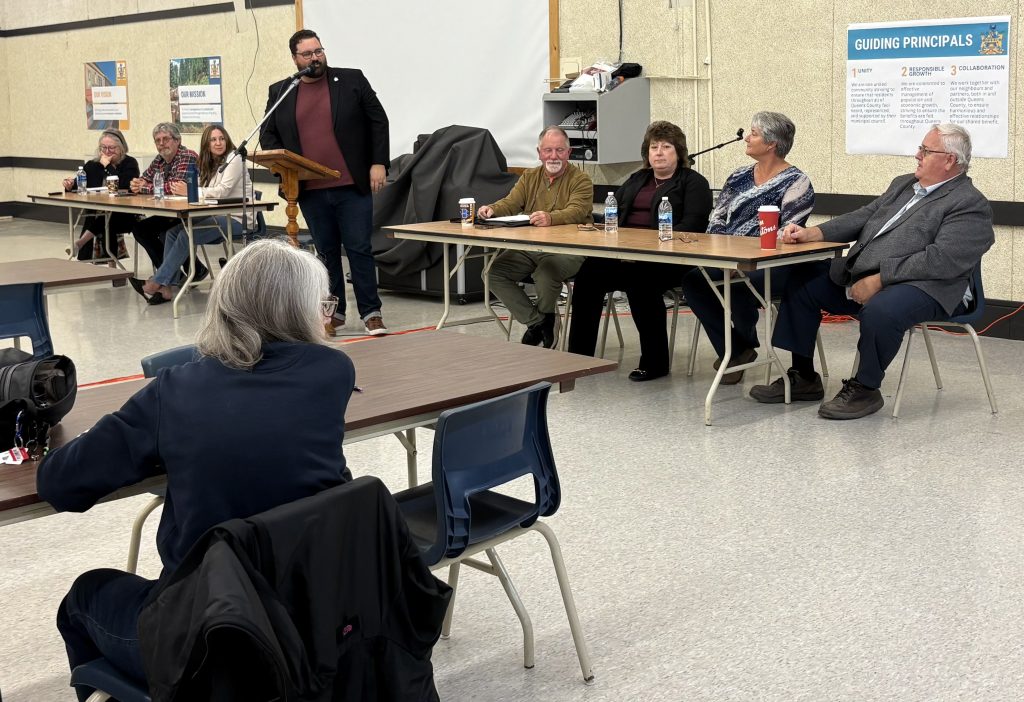
Region of Queens Mayor Scott Christian and his fellow councillors at a town hall session at the Liverpool Fire Hall in October. (Rick Conrad / File photo)
A citizens committee is considering recommending significant raises for Queens County’s mayor and councillors.
The five-person group of volunteers appointed by Region of Queens council to review elected officials’ remuneration had their second meeting on Friday.
They agreed that the mayor’s position should be considered a full-time job. They also agreed to recommend that it increase to $68,752 a year from the current $48,033.
That reflects the current salary of the mayor in the West Hants Regional Municipality.
Councillors could see a bigger percentage bump. Committee members discussed how the annual pay for a regional councillor of $24,286 is less than minimum wage, based on a 30-hour work week.
After considering the West Hants councillor rate of $34,376, they discussed raising the salary for a Queens councillor to $41,496.
Committee members split on that. Three supported the higher rate, while two others voted against it.
Kerry Morash said it would be difficult to justify that kind of increase to residents.
Pamela Brennan said she supports higher pay for councillors, especially in the age of social media.
“We live in a time when elected officials are targets for abuse, targets for frustration,” she said, adding that as an elected official, “potentially, you put your employable future at risk.”
She said that a higher rate of pay could encourage more people to consider running for municipal council. District 6 was the only area that was uncontested in the 2024 election.
Committee chair Christopher Clarke, also a former mayor, said after the meeting that it’s a balancing act.
“You fall between two stools,” he told QCCR.
“On the one hand, you want to compensate people who run for office properly. And they deserve that. On the other hand, you’ve got to be cognizant of the fact that Queens is one of the poorest municipalities in the province. You’ve got to make sure that whatever you do doesn’t add too great a burden on the taxpayer.”
The committee’s Tara Druzina said if the new salaries are recommended by the committee and approved by council, the cost would be the equivalent of an extra $24 a year per taxpayer.
It’s important to note that the committee has not yet decided on its final recommendations to council. It will meet again on Feb. 6 at 2 p.m. in council chambers. That meeting is open to the public.
Committee members are set to discuss the rate of pay for deputy mayor, among other issues.
While they focused on West Hants for much of their discussion Friday, they’re also looking at other municipalities with a similar population or budget size.
“So we’ve been using West Hants as our comparison,” Clarke said.
“It is a reasonably fair comparison. Population-wise, it’s more, they have more councillors. We’ve also been cross-referencing to the Town of Bridgewater, for example, where we’re very comparable in size, number of councillors, budget. We’ve looked at the (Municipality of the County) of Annapolis.”
The committee also briefly discussed pension options for elected officials. Some Nova Scotia municipalities allow their council members to participate in a pension plan. But the committee did not reach a consensus on that issue in their Friday meeting.
Currently, pay for Region of Queens council and the mayor is adjusted after every election.
Any raises are calculated by using an amount equal to the cumulative percentage of the average salary increase of all region employees over the past four years or by the cumulative consumer price index over the same period, whichever is less.
The region has had the same policy since 2018.
The Municipality of the District of Lunenburg’s mayor is paid $59,377 a year, while councillors make $29,562. The deputy mayor gets $40,208. Members of council can also participate in a health and dental benefits package and be part of the provincial public service pension plan, which MODL belongs to as an employer.
The committee is due to report back to Region of Queens council by Feb. 28. Councillors will have the final say on how they are compensated.
Committee members are: Christopher Clarke, Velta Vikmanis, Tara Druzina, Kerry Morash and Pamela Brennan.
Two staff members are helping them with research and background. They are Holly McConnell, the region’s director of people and culture, and Alex Wilson, the region’s policy analyst and strategic initiatives co-ordinator.
Region of Queens councillors rejected a property owner’s application to build four short-term rentals on this property on Fostertown Road in Port Medway. (Rick Conrad)
Region of Queens councillors made probably one of their easiest decisions at their regular meeting on Tuesday.
They rejected a bid to build an Airbnb that almost nobody wanted in their community.
Hans-Martin Klein, the owner of a vacant three-acre piece of land on Fostertown Road in Port Medway, wanted to build a single-family house for himself and four more single units to operate as seasonal rentals.
Listen to the audio version of this story:
Residents signed a petition against it, the region’s planning advisory committee recommended that council deny it and even the region’s planning staff said it should be rejected.
Under the municipality’s land use bylaw, fixed-roof overnight accommodations are not allowed in that part of the small village. It would require a change to the region’s land use bylaw to rezone the area.
Shelly Stevens is a Port Medway resident, who lives next door to the property.
“This area is made up of full-time residents who value safety, privacy and a quiet rural environment. Approving this rezoning would fundamentally alter the character of our community and reduce its liveability.”
Stevens told councillors that the road to the property is narrow, so it couldn’t accommodate increased traffic safely. She said the property owner’s proposal was also light on specifics.
“There’s no information on building size or sizes or layouts. There doesn’t appear to be any plan for garbage or recycling, or parking solutions, and no information on how many people the structures would accommodate.”
In addition to the petition, councillors said they also received a number of emails from residents opposed to it.
Deputy Mayor Maddie Charlton, who is a member of the planning advisory committee, said she was against the proposed development, especially since the region is planning a review of its land use bylaw and regulations around AirBnBs.
“There have been a lot of concerns raised about short-term rentals and how it affects our housing stock … this has been really problematic in Queens County. And so, we’re going to be looking at best practices to regulate those, where we want to encourage those, where we may not. And so that will have a really comprehensive review. So it didn’t make sense to entertain something like this.”
District 4 Coun. Vicki Amirault’s area includes Port Medway. She said the development would not fit with the location and characteristics of the small fishing village.
“As we have seen, many things such as the width of the road, the stone walls, the ditches, the flooding. There’s just so many points that stick out to deny this proposal.”
Councillors voted in December to hire an outside consultant to overhaul parts of its land use rules. One of those areas was the regulation of short-term rentals.
The consultant hasn’t been chosen yet, but the last time the region reviewed its land use bylaw and planning rules about eight years ago, it was expected to take about 18 months.
Region of Queens councillors passed their capital budget last week. (Rick Conrad)
The Region of Queens got a head start on a big part of its budget last week by approving its five-year, $54.3-million capital plan.
It includes more than $27 million in projects for this fiscal year alone.
Councillors wanted to approve their capital budget earlier this year so that municipal staff could work on issuing tenders before the spring.
“The purpose of bringing the capital investment plan to council at this point is so that we’ve got as much runway as possible before the fiscal year starts on April 1st,” said CAO Willa Thorpe, “so that staff have the opportunity to go to tender on projects with the runway of between January and April.”
The extension of water and sewer to the Mount Pleasant area of Liverpool accounts for almost $10 million of the 2026/27 spending.
Another $1.4 million is being set aside to upgrade and extend two kilometres of the main water transmission line from the South Queens Water Treatment Facility to Union
Street in Liverpool, and to upgrade the water main from Roy Turner Road to Mersey Avenue.
Some councillors want staff to fast track the replacement of existing water infrastructure before adding new areas.
So they voted to hire a consultant to analyze the costs and timeline of the main water line project.
Adam Grant, the region’s director of infrastructure, said it would probably take from six to nine months to get a report back.
District 6 Coun. Stewart Jenkins had many questions for staff about the capital plan.
He wanted to know why projects take so long to get done.
“Would it not be better to stop anything new and just get these projects done so we can have a fixed cost on it? … Why are we adding more projects on when we can’t get ones finished?”
Grant said staff try to strike a balance between ongoing projects and new ones added to the list.
“There are a lot of projects on there. I think each year … we try to trim them off and council would like to add some… . So we try to balance it out what we can complete. What’s pertinent, and what’s unnecessary, trying to prioritize in that fashion.”
Mayor Scott Christian said it’s council, not staff, that adds work to the list. He said Thorpe, Grant and Finance Director Joanne Veinotte have told him they’re trying to improve the process.
“There is a concerted effort to be more realistic, what we’re budgeting for the projects that we actually expect to be done, and improvements with respect to the way that we’re making decisions about what we’re doing in-house, and what we’re shopping out and subcontracting out. So it would be my expectation that moving forward, we are going to improve that in terms of achieving the work in the year that we’re funding it.”
Some of the projects that have been held over, like the wall at the Old Burial Ground or the new Gorham Street planter between Home Hardware and Celeste’s Hair Salon on Main Street, caught Jenkins’s attention.
“How do we justify a planter at in excess of $97,000 for plants?” he asked Grant.
Grant said it’s actually a vital retaining structure in the walkway from Main Street to the waterfront.
“So it’s a couple hundred metres long. It’s brick, it’s 12 feet to 16 feet high in spots, it does have plants into it. But it’s a lot more than just a planter with some shrubbery. It’s being improved, I guess, for accessibility, as well as retention purposes, to protect the pedestrians.”
Jenkins also had some work of his own to add to the list. Councillors approved his motion to add $200,000 to the capital budget this year to work on dry hydrants around Queens County.
They are vital for many of the region’s fire departments to be able to access water sources.
Jenkins said that before his concerns were addressed, he was ready to vote against the budget. But he said he would vote for it even though he still had some reservations.
Councillors voted unanimously to pass the region’s 2026-31 capital investment plan.
Next up will be the region’s operating budget. Councillors are set to begin debating that on Feb. 24. Residents can have their say by filling out a survey on the region’s website.
Some of the 2026/27 spending highlights in the Region of Queens capital investment plan:
Accessible washrooms, universal playpark at Queens Place: $425,810 (federal gas tax funding)
Gorham Street planter rehabilitation: $97,630 (municipal reserves)
Thomas H. Raddall Library renovations: $111,490 (federal gas tax)
Old Burial Ground wall rehabilitation: $173,440 (municipal reserves)
Queens Place LED light refit: $78,000 (municipal reserves)
Queens Place roof remediation: $70,000 (municipal reserves)
Sidewalk Millard to Harley Umphrey Section 1: $519,192 (municipal surplus)
Astor Theatre improvements Year 1: $1,090,499 (municipal surplus)
The Region of Queens is moving ahead with plans to impose a levy on all short-term rentals. (Photo by InstagramFotoGrafin via Pixabay)
The Region of Queens is going to introduce its own extra charge on people who stay at hotels or other short-term rentals like Airbnbs in the area.
The accommodation levy would be up to an extra three per cent per night on top of what the property already charges.
Under provincial law, municipalities can use that revenue only to promote tourism in their area.
If the region required the maximum three per cent, it would generate about $240,000 a year, Richard Lane, a project officer with the Region of Queens, told councillors at their regular meeting on Tuesday.
“Now there are some accommodation providers who are as busy as they want to be, so they’re not particularly interested in additional promotion work. There are some accommodation providers whose business relies on construction workers and such like, and they’re not interested in additional promotion,” Lane said.
“So, on the one hand, you could say the furtherance or the promotion of tourism would be something that accommodation providers are interested in, but that’s certainly not a universal view.”
It also allowed members of the public to have their say.
The survey got 97 responses, 54 of which were from owners of accommodations.
About 67 per cent of owners were strongly opposed to a levy, though the other 33 per cent said it would either have a positive or no effect on their business.
Deputy Mayor Maddie Charlton said she supports the marketing levy. She said some people may have been confused about what the extra charge was all about.
“When people don’t understand what the funds could be used for, then when you hear the word ‘tax’ again, it’s a negative context. And so I think that people didn’t understand the full picture,” she said.
“And we are one of the few who don’t have (a levy). And I think in speaking with people about this, lots of residents who go to Halifax or Cape Breton, for example, they didn’t know they even pay this. It’s on every invoice where you stay. (Halifax and Cape Breton) have had these for a long, long time.”
Charlton said that while some property owners may not need any extra business, many small businesses in Queens County would benefit from more promotion of the area.
“And I really, really want to see more events happen throughout Queens County, specifically at Queens Place. And I think that this is a way to give our residents excitement and more events at no cost to them.”
Mayor Scott Christian said he’s opposed to the levy, especially after speaking with some local hotel and property owners.
“It feels premature to me when we don’t have our economic development strategy in place. We don’t exactly know how we’re going to market the Queens County. And I’ve just heard strongly from some of those operators about some of the impact that an accommodation levy would have upon them.”
Many other Nova Scotia municipalities already have some kind of levy on hotel rooms.
Lane told councillors that the Town of Bridgewater is the only municipality on the South Shore with a charge that also covers short-term rentals. There are 30 registered properties there, compared with the current count of 165 in Queens County, Lane said.
Bridgewater relies on operators to self-report and remit the proceeds to the town monthly. Owners can be fined if they send inaccurate reports.
The Town of Yarmouth, and the municipalities of the districts of Argyle and Yarmouth contract with a third-party service from the Ontario Restaurant Hotel and Motel Association to collect the fee on their behalf. That organization already works with 35 municipalities in Ontario, collecting more than $30 million annually.
Lane said that the Association of Municipal Administrators of Nova Scotia is working on potentially coming up with a service that would collect the fee on behalf of all 49 municipalities in the province.
“If it is the will of council to have an accommodation levy in Queens County, … the likelihood is that by the time that bylaw is ready to be implemented, there may well be an automated system that we can adopt.”
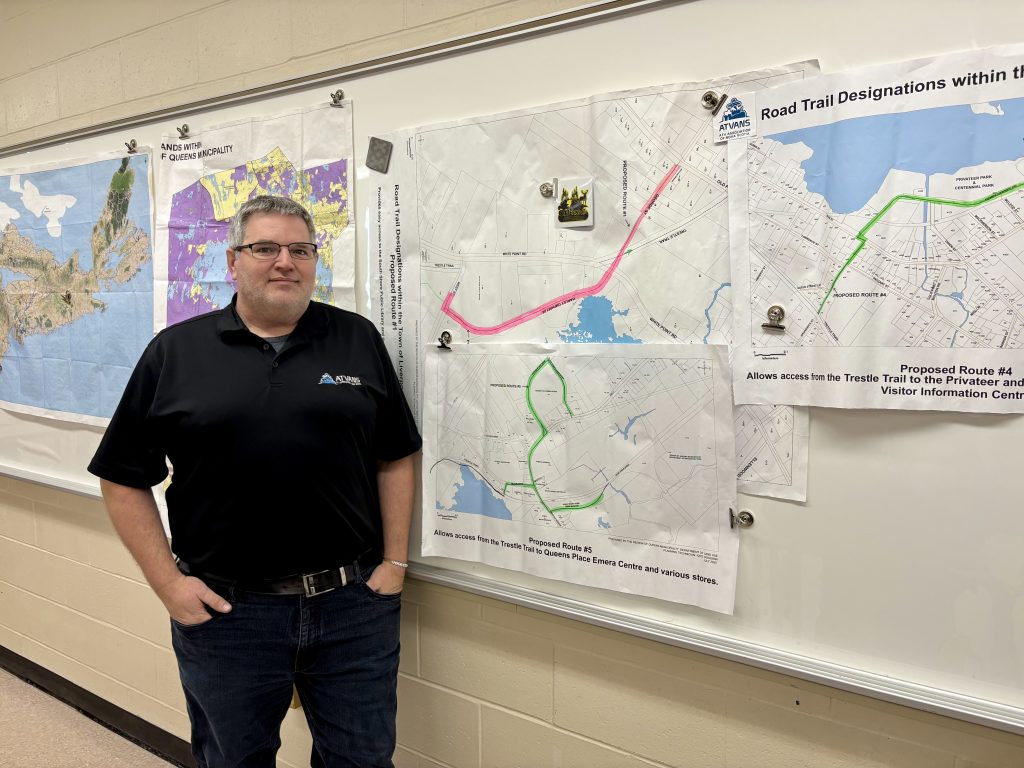
Dave White is the president of the Queens County ATV Association. (Rick Conrad)
ATV operators in Queens County will soon be able to ride their vehicles on some municipal roads in Liverpool.
Region of Queens councillors adopted a new road trails bylaw on Tuesday, paving the way for off-highway vehicles to use some roads to access trails and services.
The rules take effect Feb. 1. But Dave White, president of the Queens County ATV Association, says there’s still some work to do to get the trails ready for riders.
“It’s really important for people to note that, although it’s passed second reading today, it will not become officially open. … Things that have to be done is we have trail signage to go up as well as the region has some signage for where the trail crosses streets. So they’ve already done some preliminary work.”
White said the association, the ATV Association of Nova Scotia and the municipality will update users on when the trails are ready to use.
The bylaw designates five routes around Liverpool that riders can use to access services or other trails.
It’s been about two and a half years since the association and the Queens Rails to Trails Association approached the region to create a connected trail network similar to those that exist in neighbouring Lunenburg and Shelburne counties and in other parts of Atlantic Canada.
ATV groups say that the changes will bring more economic activity to Queens County. In 2022, ATV users said they spent $454 million in Nova Scotia.
The Nova Scotia government passed the Road Trails Act in 2023, which allows off-highway vehicles on provincial and municipal roads with certain conditions.
“It’s been a major development and a lot of work with the municipality, over the last six months, but really over almost two and a half years at this point,” White said .
“So we are exceptionally pleased with it.”
White says motorists won’t see much of a change once the rules go into effect, since the vehicles won’t be allowed everywhere.
“You will see off-highway vehicles on defined streets. That’s important, it is not all of town. It’s very specific.”
The routes are behind the municipal offices on White Point Road and at various points from the Trestle Trail that would allow access to the Visitor Information Centre, downtown shops and services like the gas stations and grocery stores around Queens Place Drive.
The association also signed an agreement with a local landowner so riders can access the former rail bed to get to the Milton Road.
“And then you’ll travel like any other vehicle down to the light, and have all of the options open to you, including the yield lane to the right to access Irving, Shell and Hank Snow Drive, which will allow us to have combined tourism events with the friends of the Hank Snow Society, which we’re very excited for, and we’re hoping to do an event with them in February.
“You will also be able to turn left at the light to access businesses like Sobeys, Superstore, McDonald’s, Dollarama, Queens Place, Best Western, which is a major win because people will be able to come in and do expanded tourism opportunities. So we’re very excited.”
White says once the trails are open, they should bring in business from off-highway vehicle users from around the province.
He says people can get more details about the routes by downloading the ATV Association of Nova Scotia’s mobile app.
Here are the routes outlined in the bylaw:
West Street from civic number 181 to the intersection with Harley Umphrey Drive, then to the intersection with White Point Road.
King Street from civic number 56 to the intersection with Lawrence Street, then to the intersection with Wolfe Street to civic number 16.
Main Street from the intersection with Central Boulevard to civic number 741.
Brunswick Street from civic number 63 to the intersection with Main Street, then to the intersection with Henry Hensey Drive to the pump station at civic number 4 Henry Hensey Drive.
Milton Road from civic number 31 to the intersection with Bristol Avenue, west to the intersection with Hank Snow Drive and east to the intersection with Queens Place Drive. Included is Hank Snow Drive to civic number 38 and the entirety of Queens Place Drive and Old Cobbs Barn Road.
After the fire, the region declared the property dangerous and unsightly and ordered Jacob to clean it up. After she failed to appeal the order, the region cleaned it up and sent her the bill.
Citing privacy, the region has refused to disclose how much that cost taxpayers.
Anyone interested in bidding on one of the properties in the tax tender has to submit a sealed bid by Feb. 10 at 2 p.m. to cover outstanding taxes, interest and expenses. If the property owner pays all outstanding taxes and fees before the deadline, the property is removed from the tax sale.
An accessible washroom at the inclusive play park in Liverpool likely won’t be finished until the end of 2026. (Rick Conrad)
Accessible washrooms at Liverpool’s universal playground and splash pad have been delayed as Region of Queens staff look into an off-grid design.
Regional councillors voted in April 2024 to speed up installation of the permanent washroom and change room facilities at the site, next to Queens Place Emera Centre.
But at a capital budget meeting just before Christmas, Director of Infrastructure Adam Grant told council that the $425,810 project has hit some roadblocks.
“We’ve done a lot of work in the background, trying to identify a feasible solution for that site. It is challenging, it’s constrained physically,” he said.
“We do not have a lot of real estate to work within next to that parcel of land. There’s no provisions put in for electricity to allow for any development… So we have maybe 30 amps of power, which is not enough to run a facility like that. There’s no water provided for a washroom facility and there’s no wastewater whatsoever at the site. So it’s those three strict parameters and combined with having not much real estate to work within, that makes it very challenging to find a solution that fits within that footprint.”
The $600,000 Etli Milita’mk playpark opened in October 2023, the result of a years-long community fundraising initiative by local members of Autism Nova Scotia. The region contributed the land and about $112,000 to the project. The province chipped in the rest.
In the meantime, the region has supplied a portable accessible toilet for users of the park and splash pad, which is closed until the spring.
In response to a question from District 5 Coun. Jack Fancy, Grant said that power, water and sewer can’t be extended from the Queens Ground Search and Rescue building nearby because of the way the playpark was built.
“Unfortunately, with the building, the splash pad and the playground, we limited any opportunity to make any kind of addition in that area by putting a perimeter fence right into the curb and sidewalk. Getting involved with the asphalt to remove it, to put power, to put sewer (and) water, is going to get extremely expensive.”
Grant said that’s why staff are looking at some kind of off-grid accessible facility, though it will likely be more expensive to maintain.
“The caution is that it’s going to probably create a lot more of an operational burden than we’d like to see, but it will fulfill council’s wish to have an accessible facility there.”
The accessible washroom and change room at the playpark and splash pad are now expected to be finished by the end of 2026.
The Nova Scotia Regulatory and Appeals Board has approved increases for customers of the Region of Queens Water Utility. (Rick Conrad)
More than 1,200 water utility customers in Liverpool and Brooklyn will see a significant spike in their bills this year.
In a decision released Dec. 22, the Nova Scotia Regulatory and Appeals Board has approved an 85 per cent increase in water bills for customers of the Region of Queens Water Utility. Once the full increases take effect, it will mean an extra $300 per year for most residential customers.
The new rates took effect Jan. 1, but the board also ordered the utility to phase in the increases to 2027 to help mitigate “rate shock”. It also ordered that interest on the utility’s debt to the municipality be eliminated, and to adjust the utility’s earnings and debt forecasts.
“The Board finds that the utility is in a difficult position,” board members wrote.
“The Board also finds that, other than the minor adjustments directed above, the required revenues in the application are just and reasonable, and necessary to produce safe, reliable water. Yet its rate increases clearly fall within the definition of ‘rate shock’.”
The average residential customer will now pay $531.28 a year, an immediate 60 per cent increase. It will eventually rise to $664.08 in 2027.
At a hearing on Nov. 19, the region said the utility needed to increase rates dramatically to deal with a mounting $1.4-million deficit.
Mayor Scott Christian told QCCR this week that the board’s decision allows the water utility to pay off some of its deficit and continue to provide good-quality drinking water to its customers.
“I think it’s a fair judgement. It gets us to a place where we can run a water utility in a sustainable way, while helping to cushion the blow a little bit to the consumer in terms of the spike in that rate.”
In November, regional councillors approved a utility assistance rebate for water customers on low incomes. People are eligible for up to a $200 annual break on their water bills.
With that rebate applied, the municipality projects less than a one per cent increase this year for people in the lowest income bracket and about a 40 per cent increase by 2027.
Christian said he understands that even with the rebate, some people will still struggle with the higher water costs.
“The utility for a long time was run in a way that didn’t position us to have a sustainable, solvent utility. I understand for sure that people are having a tough time making ends meet. Any additional cost to folks for running a household is always challenging.”
The Queens Community Health Board had opposed the rate increases at the November hearing.
Board chair Tara Druzina did not want to do an interview this week, but said in an emailed statement that the board is concerned about the size of the rate increases “and the impact they will have on households already under financial pressure.”
She applauded council’s adoption of the rebate, but said the region still needs to address affordability concerns for all users.
The review board also “strongly encouraged” the municipality to begin replacing customers’ water meters, most of which are at least 50 years old.
A 2024 report for the utility found that it was losing up to 69 per cent of its treated water, either through leaks or because the old water meters were inaccurate.
“So it was a bit of a moment of clarity for me that sure, some of it is seeping, weeping, leaking, older pipes,” Christian said.
“But then some of it too is that we’re actually delivering the water and it’s being underreported. It helps us to identify an action in addressing that and getting those metres in place that can actually more accurately report that water consumption.”
Christian said the municipality will begin working on replacing those old meters.
He said he’s not sure when the rate increases will be reflected on people’s water bills.
Deputy Mayor Maddie Charlton chaired the Dec. 19 special council meeting on the capital budget. (Region of Queens YouTube)
Region of Queens councillors had some tough questions for senior staff on Friday afternoon as they pored over their five-year, $57-million capital budget.
Elected officials were concerned about the timeline for water and sewer improvements in Liverpool as part of the $26-million Mount Pleasant extension.
They also wanted to know more about projects like the South Queens Outdoor Pool and planned upgrades at the Astor Theatre. And there were concerns about the municipality’s long-term debt.
District 3 Coun. Courtney Wentzell returned to an issue he’s brought up before about extending water and wastewater services to the Mount Pleasant area to connect two planned housing developments to the system. That project is supported with $10.7 million in provincial funding.
“With the loss of treatable water and with us … hiking the water rates, and then going ahead and starting a project to send transmissible water up Mount Pleasant Street before you fix the issue down here on (the west side of) town, … it does not make sense to me, and it never will. 28/29 before you fix the problem? No.”
The region’s current plan calls for $9.7 million in work to begin this coming year to run new water mains to the Mount Pleasant area and upgrade existing infrastructure en route. Work on other, older parts of the system is now scheduled to begin in 2028/29. The end date to finish the overall project has been pushed to 2032/2033, from the original finish date of 2028/29.
But with South Queens Water Utility reporting more than 60 per cent of its treated water lost through leaks in the system, Wentzell says he wants to see older pipes, like the lines and laterals from Roy Turner Road to Union Street, fixed first.
“Isn’t this all one big project now?” Wentzell asked.
“ Isn’t this all just one project or is the Mount Pleasant exchange separate getting up to Dauphinee Farms than the rest of Liverpool? I’m lost. I’m trying to expedite and get the old infrastructure fixed before we start driving pressureless water up a hill.”
Adam Grant, the region’s director of infrastructure, said the contracts are already awarded for the work to Mount Pleasant. And he said fixing one line won’t solve all their water woes.
“I wouldn’t expect to see 60 per cent of it be in that one segment of line. As we know, it’s spread throughout the town. So if we accomplish 10 per cent, we should be satisfied. I don’t want to set false expectations that replacing that transmission main, it’s gonna save all of our beans that are falling out of our basket.”
Councillors asked staff to return in January with options to expedite upgrades to older water and sewer lines in Liverpool.
District 6 Coun. Stewart Jenkins questioned Grant and Finance Director Joanne Veinotte about cost overruns at the $8-million South Queens Outdoor Pool.
Veinotte said that in trying to keep the project on budget, some details were missed like the $150,000 wraparound concrete bleachers.
“How can you miss $150,000 of cement bleachers?” Jenkins said. “I don’t understand it.”
Grant said many different departments rushed to finalize the pool design for tender. And some things were overlooked.
CAO Willa Thorpe, who was not with the municipality when council approved the pool plan, said that won’t happen again.
“When we, as an organization, make hasty decisions on major projects, these are how items like this get missed,” she told councillors.
“So if we were to explore a project of this magnitude again in future, staff will take a different approach.”
Jenkins also wondered why the region is planning to spend about $5 million on heating, cooling and accessibility upgrades at the municipally owned Town Hall Arts and Cultural Centre, home of the Astor Theatre.
“I can’t believe we’re going to spend $5.4 million, when we have poverty, and we have leaking pipes, and we have everything else to spend money on, but we’re going to spend $5.4 million, for something that is not used by very many people in Queens County, and many of them have never been inside. So I think we should be considering that in our budget deliberations.”
Other councillors said the municipality has put off necessary upgrades at the Astor for a while. They said the facility is used well now and it could be used more with a modern HVAC system. It’s currently limited in what it can offer in warmer months because there’s no air conditioning.
Councillors also asked staff for a list of how the $10.2-million accumulated surplus will be spent. If they approve the current capital plan, that surplus is projected to drop to $1.7 million by 2031.
And if they approve the proposed five-year capital plan, they’d also be voting to rack up the region’s long-term debt to $26 million by 2032.
Deputy Mayor Maddie Charlton, who chaired the meeting because Mayor Scott Christian was away, said council is heading in the right direction.
“And so you can say what’s working well, what’s not working well,” Charlton told QCCR. “Recognizing we have financial implications. we can’t do everything, but I think if we hear from people and there’s overarching themes or gaps and things that we’re missing, then it really positions council to make decisions about those items moving forward.”
Councillors will be back on Jan. 13 to vote on the capital budget.
The region is getting an earlier start on its budget talks this year. The plan is to approve the capital spending estimates by January so that tenders can be issued earlier in the year to get work started more quickly.
While some projects are under budget, like renovations for the library space at the Liverpool Business Development Centre and the upgrades at Beach Meadows Beach, others are running over.
For example, staff are reporting funding shortfalls with the $8-million South Queens Outdoor Pool. Overall cost overruns are estimated at about $150,000, with just over $4 million in costs to date.
The expansion of water and wastewater services to the Mount Pleasant area is running a little behind schedule and over original budget estimates.
The project, which was initially projected to cost about $22 million, is now expected to cost $26 million.
Councillors will discuss the capital budget in a special council meeting on Friday at 3 p.m. at council chambers on White Point Road.
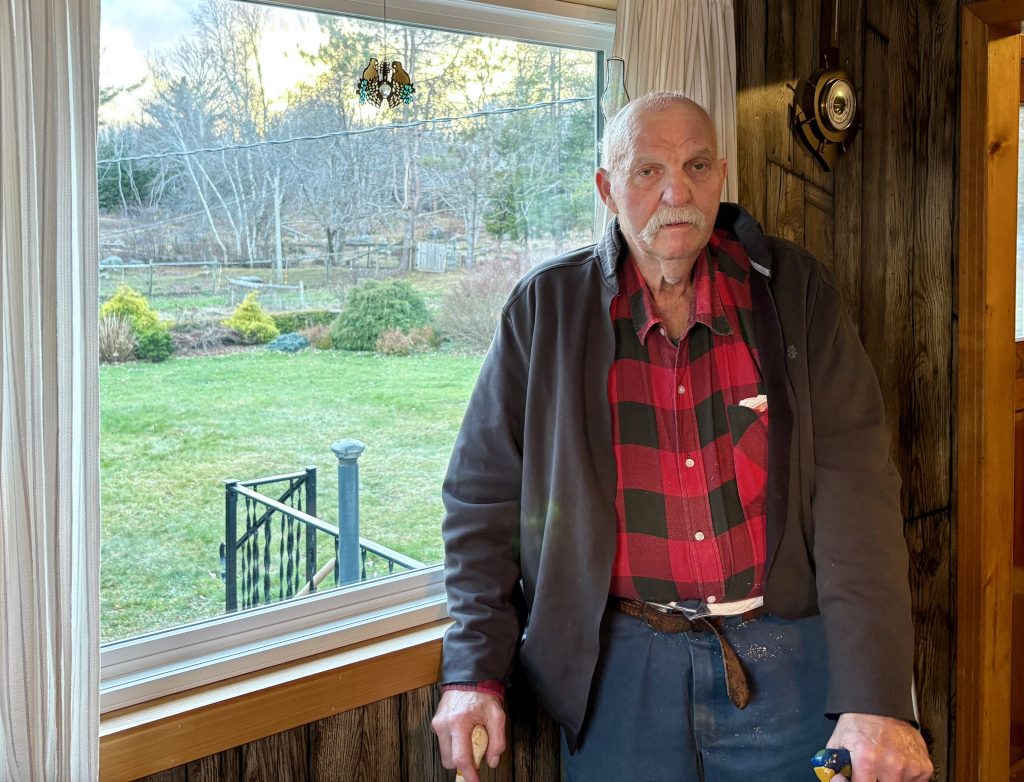
Arthur Roy says he wants the Region of Queens to honour an agreement his father signed in 1947. (Rick Conrad)
A Liverpool man says he wants the Region of Queens to honour an agreement the municipality made with his father 78 years ago.
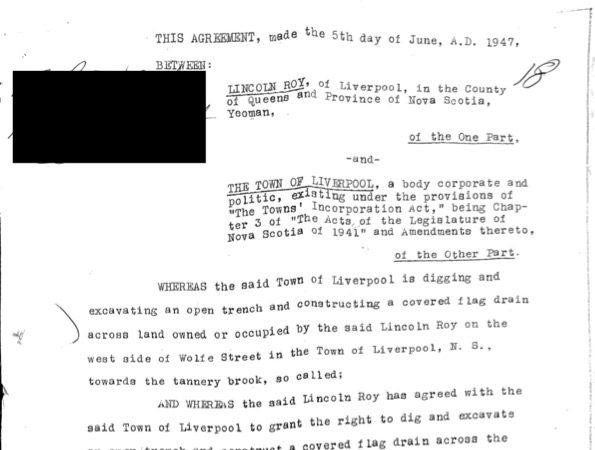
Arthur Roy’s father Lincoln signed a deal with the old Town of Liverpool for $1 in 1947 “to dig and excavate an open trench and construct a covered flag drain 115 feet in length” over his land off Wolfe Street. The town wanted to use it as a stormwater drain.
The agreement allowed the municipality to access the land to build the drain and “do other necessary work for the purposes of renewing, repairing, improving or altering the said open trench and said covered flag drain … provided that the area … is left in a good and safe condition.”
Click the image to read the original 1947 agreement (Courtesy Arthur Roy)
Roy, who now owns the land, says the problem is that the town never finished the work properly in the first place. And he’s been fighting to get the municipality to come back and make it right.
“And now the trench has got silt into it and it’s grew up with grass and it’s just a mess,” he said in an interview.
“Either the easement agreement is good or not, right? If it’s good, come and do what it says on the easement agreement. If it’s no good, come and fill it in. They had all these years, 70-some years, running that water down there and not done anything.”
Councillors discussed the issue at a recent closed-door, in-camera meeting.
Mayor Scott Christian told QCCR that the region is willing to replace a crumbling four-foot culvert on Roy’s property.
“We’re going to put a modern culvert in. It’s changed in terms of the standard and the approach to dealing with trenches and ditching. I think in ’47, they wouldn’t have had the same materials available to them, so we’re going to put in a culvert using today’s technologies and today’s approach to handling that, putting in an appropriate culvert given our requirement for access back there. ”
The drainage ditch cuts through Roy’s land. He says he can’t easily access his 10 acres of land, which he uses as pasture for his sheep. He’s had to build a small walkway over the ditch to get there.
“And you can’t take a vehicle over it, so here I have a piece of land that’s cut into where I live … and I can’t access it. I have wood over there cut in the pasture. I can’t get anything to go over because it’s not safe to go over.”
Christian says the drain on Roy’s land is part of a network of stormwater drains and trenches.
“The trench that goes on his land is a small part of a huge network of stormwater trenches that exist. … We need to make sure that culvert is safe. It’s currently unsafe and we need to make sure that that’s a safe passageway across that trench.”
In 2021, Roy contacted his local councillor at the time and former mayor Darlene Norman.
In a letter to Roy, then-CAO Chris McNeill said the municipality would replace the culvert but that Roy would be responsible for its maintenance because the region had no record of installing the culvert in the first place.
“But if they had 115 feet of flagstone, you wouldn’t need a culvert, you could get across that land 115 feet.”
The region’s CAO Willa Thorpe contacted Roy last week after councillors discussed it. She told him the region’s plan to replace the culvert.
Roy hasn’t seen anything in writing yet. And he’s waiting to meet with his lawyer this week before deciding what to do.
“I don’t want a culvert,” he says. “(The agreement) doesn’t call for a culvert. All I want them (to do) is to follow the easement agreement.”
Members of the Nova Scotia Regulatory and Appeals Board held a water rate hearing in Liverpool in November. (Rick Conrad)
A decision limiting Halifax Water rate hikes may have implications for the Region of Queens as it waits to hear a decision on its application to double water rates.
The Nova Scotia Regulatory and Appeals Board on Tuesday approved a reduced rate increase for the Halifax region’s water utility.
Halifax Water had asked for a combined 35.6 per cent rise in rates, to be implemented over the first three months of 2026. Provincial regulators called that “rate shock” for customers.
The board denied Halifax Water’s request to include deficit elimination in its application. Removing that would lower the second rate increase by about 10 per cent.
It ordered Halifax Water to return with a modified rate proposal within a week.
“The Board finds that the magnitude of the proposed rate increases, implemented over the first three months of 2026, constitutes ‘rate shock’ for its customers. For residential customers, the combined, compounded rate increase was proposed to be 35.6% from January 1 to April 1, 2026,” the regulator wrote in the decision released Tuesday.
“While Halifax Water provided a reasonable explanation about the need to increase rates to cover some of its higher costs due to inflation and other cost pressures, the Board finds that other requested costs were not justified or that the utility overestimated some of those costs.”
The Halifax and Queens water rate applications are very different. For example, Queens is asking regulators for a combined 102 per cent increase over three years. It also has equipment and infrastructure problems Halifax doesn’t.
At the Region of Queens hearing in November, municipal officials warned that without an immediate 85 per cent hike, the whole water system could be in jeopardy.
They said the Region of Queens water utility has been undercharging its 1,200 customers in Liverpool and Brooklyn for years. And because of that, the infrastructure is outdated and needs to be repaired or replaced.
The water utility is supposed to pay for itself through what it charges customers.
The region says it needs to jack up rates immediately to stem a $516,000 deficit. If rates don’t rise, that deficit is expected to swell to more than $3 million by 2027/28.
But during the hearing, board members challenged the region’s past accounting practices and their claims from the last time they asked for an increase in 2021.
Board chair Bruce Fisher opened the hearing by characterizing the region’s application as “rate shock”.
“As there’s a fairly significant rate increase, the board did issue an additional set of information requests. Essentially, we wanted to have additional information on the record in advance of this hearing so we could discuss potential options to deal with what I would say is rate shock.”
The only intervenor in the hearing, the Queens Community Health Board, opposed the region’s application, saying that granting such a large increase would be rate shock for customers.
Fisher also told the region later in the hearing that the size of their request was unusual.
“We don’t typically see 100 per cent rate increases.”
At the end of the hearing, the board had asked for more evidence from the region to support its application. That was received on Nov. 28.
The board aims to file its decisions within 90 days after they receive final evidence. So the decision in the Region of Queens water case will likely be available in late February.
The Region of Queens adopted a winter maintenance policy this week. (Photo by Sergei Starostin via Pexels)
The Region of Queens has a snowplowing policy for the first time.
“This ensures municipal transportation infrastructure, roads, sidewalks and facilities are managed effectively during snow, ice and other winter conditions, while providing consistent, transparent and a measurable level of service throughout the community,” Adam Grant, director of infrastructure, told councillors at their regular meeting this week.
“Establishing this policy will provide clarity for staff as winter maintenance is provided, while also providing clear expectation to residents.”
The region is responsible for snow clearing mostly in Liverpool and some parts of Milton. Nova Scotia’s Department of Public Works looks after everything else.
The winter maintenance policy details priority areas and response times.
For example, at the top of the list are roads and sidewalks leading to the municipal public works garage, Hillsview Acres Home for Special Care in Greenfield, Queens Place Emera Centre, the municipal administration building and Liverpool Business Development Centre on White Point Road and the Queens Waste Management Facility.
Then it’s collector roads and sidewalks downtown, including the main parking lot and spots on Main Street. Local roads and sidewalks are next, with municipal waste collection sites, otherwise known as grey boxes, dry hydrants, Pine Grove Park, Queens Ground Search and Rescue and the Astor Theatre as lower priority areas.
Click on the map for a larger image (Region of Queens)
The service standard is to have all roads, sidewalks and parking areas accessible within 48 hours after a storm. But some areas have six-hour or 12-hour targets. For example, the goal on main roads is to have both lanes cleared to bare asphalt within 12 hours.
Grant stressed that municipal crews begin their work as quickly as possible.
“So when you look at the time, post-storm, whether it’s six hours, 12, or 48, that doesn’t mean that we’re waiting six hours to start,” he said. “It’s likely to assume that it would be completed in a shorter period of time. It just sets out a priority for us as what we tackle first, second, third, fourth, achieving always to try to have zero as the response time for residents to experience.”
Some councillors were concerned that the service standard for clearing out dry hydrants is 48 hours after a storm.
District 6 Coun. Stewart Jenkins said he wants to see a stricter standard for maintaining those areas.
“I can’t believe we would wait two days after a snowstorm to clean out fire services’ access to their dry hydrants. I think that’s a misstep and it should be done sooner than that.”
Grant said that crews usually get to those areas pretty quickly.
“We generally start dry hydrants probably 12 hours after a storm’s end and we work on them routinely overnight and the next day and they’re typically cleaned up within 24 hours,” he said.
“And I guess what this outlines is that if we can’t accomplish that within 48 hours, then we need to revisit the resources and the level of service that we’re trying to achieve, then make sure that there’s that balance in there. But in no way are we intending to not maintain dry hydrants in a timely manner.”
He also pointed out that fire departments can call municipal crews in emergency situations and they’ll respond immediately.
Mayor Scott Christian also wanted to ensure that downtown streets and sidewalks are accessible as early as possible for those with mobility challenges.
Manager of Public Works Garrett Chetwynd said main sidewalks are usually passable pretty quickly after a storm after the sidewalk plow goes through. Crews have to use shovels and other hand tools to get to the bare sidewalk, and the crosscuts (the sloped area that joins the sidewalk with the road) would be clear within 12 hours.
“That doesn’t mean that they’re not touched at all,” Chetwynd said. “When our sidewalk plow goes through, it’s clear just not to that bare sidewalk. It’s very difficult to navigate that changing slope and terrain as you get through with the machine.”
Councillors approved the new policy at their meeting on Tuesday. Christian said that staff and council could make tweaks to it if necessary as the season progresses.
Chief Administrative Officer Willa Thorpe told councillors that involving residents in the process helps avoid any potential conflicts of interest.
“The committee’s work could be completed prior to council adopting the 2026-2027 operating budget, so any potential compensation adjustments would be considered during budget deliberations.”
The region is looking for three to five people to sit on the committee, preferably with experience in finance, policy, governance, legislation or related areas.
The mayor’s current annual salary is $48,533, while councillors make $24,267. The deputy mayor makes $25,667. The mayor and councillors do not participate in a benefits or pension plan.
Pay for council and the mayor is adjusted after every election. Any raises are calculated by using an amount equal to the cumulative percentage of the average salary increase of all region employees over the past four years or by the cumulative consumer price index over the same period, whichever is less.
The region has had the same policy since 2018.
This fall, regional staff contacted municipalities around the province about how they review councillor compensation.
Nine municipalities responded. Two-thirds of those included some kind of pension or health benefits.
The Municipality of the District of Lunenburg adjusts council pay annually based on the provincial consumer price index. It also includes a health and dental benefits plan, with elected officials paying 25 per cent of the premium. Since June 1, 2021, they are also enrolled in the province’s public service pension plan, which MODL belongs to as an employer.
MODL’s mayor is paid $59,377 a year, while councillors make $29,562. The deputy mayor gets $40,208.
In the Halifax region, which is Nova Scotia’s largest municipality, the mayor makes almost $205,000, with councillors at $99,402. They can also participate in a benefits and pension plan.
The citizen advisory committee in Queens would meet three times, twice in January and once in February, before delivering its report by Feb. 28.
Councillors would appoint committee members at their first meeting in January. Holly McConnell, the region’s director of people and culture, would help the committee with their work.
When asked whether three meetings is enough time for the committee to review compensation for mayor and councillors, Mayor Scott Christian told QCCR that they’ll have help.
“I guess that we will see,” he said.
“My expectation is that staff will carry most of the heavy lifting and the load in terms of actually doing the writing and development of the work. But I think it’s really important to have the citizen panel so there are opportunities from an objectivity and an impartiality standpoint and to get different perspectives around the table.”
Meetings of the committee will be open to the public. And it will be dissolved once it finishes its review.
The region is accepting applications until Jan. 2 at 4:30 p.m. Applicants should email a brief summary of their experience and a brief statement on why they want to participate to the municipal clerk at clerk@regionofqueens.com.
Ryan MacLean with UPLAND Planning and Design Studio at a public engagement session in Liverpool in July. (Rick Conrad/File)
The Region of Queens will be looking for outside help for a planned overhaul of some parts of its land use bylaw.
Councillors voted this week to hire an external firm to review the bylaw and municipal planning strategy.
The region passed an extensively reworked bylaw and planning strategy in May 2022. The process cost $140,000 and was led by UPLAND Planning from Halifax. It was also supposed to take 18 months, but ended up taking almost four years because of the pandemic.
Mayor Scott Christian said this week that it’s time for a review.
“The municipal planning strategy and land use bylaw, I think, is second only to a budget deliberation as an allocation of the public resources, and setting of the tax rate in terms of the levers that we have available to us as a council to impact our community, impact business owners, impact residents, in terms of the regulations, the protections and regulations, and avenues that residents and businesses have with respect to permitted use of property in our municipality,” Christian said.
“And I think that it’s really important to me that our land use bylaw or municipal planning strategy is reflective of the priorities and the concerns and the direction that this council wants to take the community.”
The land use bylaw returned to council’s radar earlier this year as developer Eric Fry applied to turn the dilapidated former Stedmans building on Main Street in Liverpool into apartments.
Councillors initially rejected his plan because it contained no commercial space. The rules required that at least half of a downtown building’s ground floor be devoted to businesses.
But after Fry threatened to sell the property, councillors relented. They changed the bylaw in late November to allow a modified version of Fry’s plan to go ahead, with two much smaller spaces for commercial use.
Mike MacLeod, the municipality’s director of land use, told councillors at their regular meeting this week that hiring outside consultants would be more efficient, since the region’s staff don’t have the capacity to carry out the review in a timely manner.
“There is considerable work involved in even an interim planning review,” he said.
“So if staff were to undertake it, the timeframe will be considerably lengthened to complete the review, as well as staff’s ability to carry out the day-to-day operations at the department. We would be very challenged to do it in-house.”
The region has about $50,000 set aside already for future planning review projects. MacLeod said that money could go toward the cost of this review.
Councillors want to create or review regulations regarding
Commercial uses in residential zones
Short-term rentals
Keeping of livestock in residential and rural zones
Light pollution
Additional coastal protection measures and climate resilient land use regulations
Minimum property standards
District 3 Coun. Courtney Wentzell said he was concerned about getting one firm to do all the work.
“I still have some deep concerns about one firm looking after so many different items, and the cost that will be,” he told his fellow councillors.
“And I think of our town hall meetings, and our priorities, where coastal protection and climate resilience is way up there. I didn’t see a whole lot about livestock in our planning meetings and town halls. I think there’s nothing prioritized here, and I am still leery of one contractor looking after all of this.”
MacLeod said that even though an outside company will be hired, staff would still be involved. And he added that professional planning firms are experienced in work like this.
Deputy Mayor Maddie Charlton said that the region could rely on lessons learned in other municipalities who have already addressed things like coastal protection.
Councillors will have input on details of the tender before it’s issued.
Region of Queens Mayor Scott Christian. (Rick Conrad)
NOTE: This story has been updated from the original version. The region has changed the date of their first meeting to discuss the draft capital budget to Dec. 19.
The Region of Queens is kickstarting its budget talks.
The last couple of years, the region began its budget deliberations in April and passed its operating and capital budgets in May. That’s after the fiscal year begins.
For the upcoming 2026-27 fiscal year, though, the region plans to start the process much earlier.
In April, Mayor Scott Christian told QCCR the delays in starting budget talks were due to staffing shortages. And that the next round of budget talks would begin much earlier.
“In an ideal world, I’d like to see the capital budget approved in December and have a draft of the operating budget available for public input in January,” he said.
And that’s what the region is planning, or close to it. A special council meeting has been called for Dec. 19 at 3 p.m. to review the draft capital budget, which contains big infrastructure projects like water and wastewater improvements, as well as other work on municipally owned facilities.
Christian said in April that regional council wants to be able to take a more thoughtful approach.
“We want to make it as engaging, transparent as possible for members. And we also want it to be a thoughtful, deliberate, intentional, patient approach.”
In a note on their website, the region said that passing the capital budget in the spring makes it difficult for tenders to be issued and awarded in a timely fashion. Approving it earlier means that projects can start sooner.
In May, councillors approved a five-year, $46.2-million capital investment plan, along with their $31-million operating budget.
Councillors are expected to approve the region’s 2026-27 capital plan at council’s first meeting of 2026 on Jan. 13.
The 2026-27 operating budget is scheduled to be introduced at the regular council meeting on Feb. 24. Councillors will debate it for a month, with an anticipated approval at the end of March.
The draft capital budget documents will likely be posted on the region’s website on Dec. 10.
The special council meeting about the draft capital budget will be held in council chambers on Fri., Dec. 19 at 3 p.m. It will also be livestreamed on the region’s Facebook page and YouTube channel.
The Region of Queens wants ‘clear, enforceable provisions’ around e-bike and e-scooter use. (Mercea Iancu via Pixabay)
The Region of Queens wants to figure out how to regulate e-scooters and e-bikes in the municipality.
And that could include allowing them on sidewalks.
District 4 Coun. Vicki Amirault said that at the Nov. 13 police advisory board meeting, Queens District RCMP Const. Andrew Winsor reviewed the Motor Vehicle Act provisions around e-scooters.
“We discussed the uses of these devices on all roads, but the most challenged road was Bristol Avenue,” Amirault told her fellow councillors at Tuesday’s regular council meeting.
“ The board discussed sidewalk versus roadway use for the e-scooters. Due to the narrow lanes and heavy traffic in this area, it was suggested sidewalk use for limited areas, such as these supported by signage, with expectations for reductions in speed.”
Residents told councillors at their recent town hall sessions that it’s become too dangerous as a pedestrian in some areas, with the rise in popularity of the devices.
They reported people riding e-scooters and e-bikes at high speeds and not paying attention to what they were doing.
Councillors asked staff to develop “clear, enforceable provisions regulating e-bikes and e-scooters as recommended by the police advisory board”.
They also want staff to come up with amendments to a bylaw that restricts skateboard use in downtown Liverpool.
Deputy Mayor Maddie Charlton said the 1998 bylaw prohibiting skateboards at Fort Point, on Main Street, park of Market Street and near the Visitor Information Centre is too restrictive.
“The police advisory board wanted to remedy that since we have a lovely skate park and we’re promoting activity and further engagement with our youth. So that doesn’t jibe with the council of the day.”
She said Winsor told councillors that they can’t do anything about reckless e-scooter and e-bike use without a municipal bylaw.
“Where the municipality doesn’t have bylaws with e-bikes and e-scooters, he can’t do any ticketing. So once we have a bylaw in place that covers that, if someone is going excessive speed on Bristol, he actually would be able to ticket them.”
The Motor Vehicle Act does extensively regulate the use of e-scooters. It explicitly says they should be treated like bicycles, and are not allowed on sidewalks.
Users of bicycles, e-scooters, skateboards and other similar devices are also supposed to wear helmets.
“Where a roadway has a bicycle lane for bicycles travelling in the same direction that a cyclist is travelling, the operator of an electric kick-scooter shall ride in the bicycle lane unless it is impracticable to do so,” the act says.
“An operator of an electric kick-scooter who is not riding in a bicycle lane shall ride as far to the right side of the roadway as practicable or on the right-hand shoulder of the roadway.”
The Nova Scotia government recently passed a new Traffic Safety Act, which is due to replace the Motor Vehicle Act. It has not been proclaimed yet, so the current Motor Vehicle Act stands.
Under the new act, however, much of the responsibility for regulating the use of bicycles, e-scooters and e-bikes would fall to municipalities.
Mayor Scott Christian said he’s unsure why provisions of the Motor Vehicle Act aren’t being enforced. But he said he hopes the staff report will help clarify who’s responsible.
“It seems to me that some other municipalities will have already tackled this one. So I’ll be interested to see what approaches to regulating the appropriate and safe use of those devices within a town context where there is sidewalk infrastructure in place.”
Councillors also asked staff to investigate traffic calming measures in the town of Liverpool to respond to residents’ concerns about speeding by motor vehicles.
Region of Queens councillors changed the region’s land use bylaw on Tuesday to greenlight a plan to turn 194 Main St. in Liverpool into apartments. (Rick Conrad / File)
The Region of Queens has cleared the way for a developer to turn the old Stedmans building in downtown Liverpool into apartments.
Councillors voted unanimously on Tuesday evening to change the region’s land use bylaw to remove the requirement for more than half of a property’s ground floor to be commercial space.
Developer Eric Fry originally wanted to build 16 apartments, with indoor parking and storage at 194 Main St.
When councillors rejected that plan in July, he returned with a new proposal that would include two small commercial units on the ground floor, in addition to 14 apartments.
The region’s planning advisory committee initially wanted to amend the bylaw to include a prohibition against a building owner using commercial space as an office.
But after a public hearing on the proposed bylaw changes on Nov. 12, the municipality’s lawyer told them they didn’t have the authority to dictate who uses a property.
On Tuesday evening, councillors voted for no restrictions on how the commercial areas can be used.
Under the new bylaw, ground-floor dwellings need to be at the back of the building behind the commercial space.
That commercial space must be a minimum of 12 feet deep and 300 square feet.
District 3 Coun. Courtney Wentzell, whose area includes downtown Liverpool, said he had mixed feelings about the changes.
“I have talked to some residents and some business owners and I do understand the aspect of maintaining commercial space,” he told his fellow councillors.
“And I know with the new businesses coming into town, many new businesses, there’s been a concerted effort to maintain Main Street as a commercial zone. I get that, … but I also look at that Stedman’s building with the rats playing outside and the trees growing through the roof, and I got to say that the commitment of somebody that actually wants to put money into that building and what’s the alternative, that we let it rot and let it fall down, or we tear it down?”
Denaige McDonnell, who lives on Main Street, spoke against the changes at the public hearing.
She told QCCR on Tuesday evening that council’s decision was shortsighted, especially without a comprehensive plan for the downtown.
“When we’re talking about bylaws that affect an entire region, I think that it’s flawed thinking to make a decision when it’s based on a single building,” she said.
“It seems that things really are being dealt with, I guess, maybe on a transactional basis and not having a holistic view of the overall system quite so much. … And so I would like to see a little bit more strategy around how we get those buildings up to a standard where they can be used. I think that what we’re doing here is sort of like, well, any use is better than commercial use, but we’re not going to the systemic root of the problem.”
Mayor Scott Christian said he understands those concerns and agrees that a strategic plan for the downtown is needed. But he said the region can’t wait for that process to happen.
“I’m really pleased to see that amendment to our land use bylaw because we weren’t fostering an environment that was business friendly,” he said in an interview.
“So I’m excited to see how the business community responds to a new bylaw infrastructure. And I agree that only changing the bylaw is not a magic bullet to revitalize downtown. We need a good strategy. But I think that providing for more flexibility in our bylaw in a way that’s quite innovative, you don’t see a lot of downtowns and small towns that have this level of flexibility. And so I’m hoping that it sets us apart and creates an environment where we can then pursue a robust strategy to revitalize downtown.”
The new land use bylaw hasn’t gone into effect yet.
People have 14 days to appeal council’s decision to the Nova Scotia Regulatory and Appeals Board.
The Region of Queens lifted its voluntary water conservation measures on Wednesday. (Rick Conrad)
Municipal water customers in Liverpool and Brooklyn can let their taps run a little longer.
The Region of Queens lifted its voluntary water conservation request on Wednesday.
In a Facebook post, the region said that recent rainfall “has restored the Town Lake to a level above the conservation threshold,” though it’s still not at full capacity.
The conservation directive had been in place since early October, as the region dealt with ongoing drought conditions.
The Region of Queens wants to offer residents with dug wells access to low-interest loans to convert to drilled wells. (Bluenose Well Drilling Facebook page)
Queens County homeowners who want a new drilled well will eventually have access to low-interest loans through the Region of Queens.
Councillors voted unanimously at their regular meeting last week to ask staff to draft a bylaw for a water supply and septic upgrade program.
Some Nova Scotia municipalities already offer low-interest loans for residents who want to switch from a dug well to a drilled well, sometimes at interest rates as low as two per cent.
Joanne Veinotte, the region’s director of finance, told councillors that municipal staff haven’t had calls looking for help with septic systems. But they have heard from people struggling with dry wells who want a loan or grant program to help drill a new one.
“Council will have to decide, are you satisfied with providing $10,000 of assistance, or would you like to provide $30,000 of assistance, or perhaps more?” Veinotte said.
“Because all of those things depend on how much money you are willing to loan at a low-interest rate, are you going to cover the whole bill or part of the bill? That’s a council decision that will be made through the bylaw process.”
In her report to council, Veinotte said that Queens County has received less than 40 per cent of its annual precipitation in 2025. The area is classified as having severe to extreme drought conditions.
The Municipality of the District of Lunenburg and the Municipality of the District of Barrington are two municipalities on the South Shore that offer low-interest loans for homeowners.
Lunenburg provides up to $20,000 for either well or septic upgrades at a rate of two per cent a year for a term of up to 15 years. Barrington offers a three per cent rate on loans of up to 10 years for well upgrades only. Some municipalities, like Halifax, offer help for both water and septic at prime plus two per cent.
Residents repay the loans through their tax bills.
Initially, staff recommended a program only for drilled wells. But some councillors, like Jack Fancy and Deputy Mayor Maddie Charlton, said they’d like to see septic upgrades included in the program.
“I think of in Milton in particular, there’s so many septics that are going straight into the river,” Fancy said.
‘And that’s part of the environmental issue of it we need to clean up. And if we’re going to do this, I think we need to make this all part of it.”
District 6 Coun. Stewart Jenkins said he’d like to see the cost of a water pump and water tank included in the program.
Veinotte said councillors have the ultimate authority to draft the bylaw the way they want and to hash out the details, including how much to set aside each year for the loan program.
“You guys would talk all of those things through and decide what works best for our residents,” she said. “But absolutely, you as council have the discretion to determine what goes into what pot and how much everyone can take out.”
This is just the first step toward a low-interest loan program for wells and septic systems in Queens County.
Staff will draft a bylaw for councillors to review at a future meeting. Once councillors introduce a proposed bylaw, residents will have a chance to have their say at a public hearing before anything is adopted.
Residents on Waterloo Street in Liverpool appealed to Region of Queens councillors this week to speed up work on the street. (Rick Conrad)
Residents living on and around Waterloo Street in downtown Liverpool are frustrated with water and sewer upgrades that have been going on for three years.
Christopher Clarke, a former Region of Queens mayor who lives on Bootlegger Road at the end of Waterloo, told councillors this week that the project has disrupted residents’ lives for long enough.
“It’s a disgrace. … For three years, our street has been dug up, and it now, based on a letter that we were sent, looks as though it will go into the fourth year. The construction is being done there with very little consideration to the residents. The place is a mess.”
The work begins at the corner of School and Waterloo streets and extends down the narrow residential street to the water.
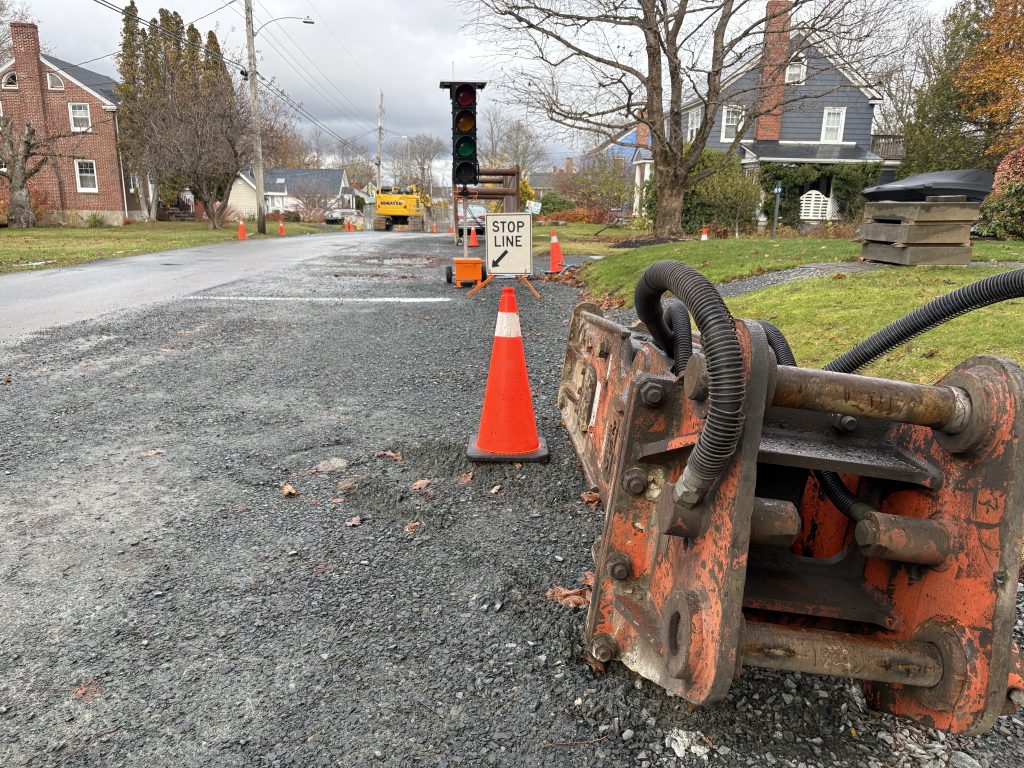
Clarke said heavy equipment has been left on the street, signs toppled on people’s lawns, pipes left lying everywhere. Also, a temporary traffic light is set up and the noise from the generator disturbs residents at night.
“Now, I don’t for one minute, criticize the employees who are working there. … This is a very, very badly managed project. And so maybe that’s where the blame should lie.”
And he said he was insulted when the region recently sent residents a letter with an update on the project and told them not to talk about the problems with anybody else but senior staff.
“I didn’t elect the manager. I helped to elect the mayor and the councillor. So if I want to come and talk to anybody, I’m going to come and do it. I’m not going to be told by staff that I’m not allowed to come and talk. But you’ve got to do something to help us. It’s a mess, it’s muddy, it’s going into next year.
“Shut the project down, you know you’re not going to get it done this year. … Fix up the street for us, get at it properly next year, do the job, and plan it. It is an absolute disgrace. I would be ashamed to sit in front of the public and tell them that I am responsible for a job like that.”
Waterloo Street resident Paula Doucet echoed Clarke’s concerns. She told councillors that the work is progressing too slowly and that crews don’t appear to be onsite full time.
She added that elderly residents and those with mobility issues also find it difficult to navigate around the work and the equipment.
“We have two big diggers on our street. One appears to be working. One isn’t working,” she said.
“We’re paying a lot of taxes and I’m getting really tired of this project. You know, I know it needs to be done, I know it will be great when it’s finished. Get it done! If you’ve got to hire more contractors to come in, get it done.”
Mayor Scott Christian said he understood the residents’ concerns.
“I appreciate your frustrations and thank you for your patience, and, yes, we do need to ensure that you have a better experience with respect to that project, so I apologize on behalf of the organization.”
Christian could not be reached for a followup interview.
The Region of Queens is asking for a lower immediate rise in water rates. (Daan Mooij via Unsplash)
The Region of Queens is no longer asking for an immediate 106 per cent increase in water rates.
But customers will still have to pay about 115 per cent more over three years if the municipality’s application to the Nova Scotia Regulatory and Appeals Board is successful.
In documents filed with the board on Nov. 7, the region is now asking for a 43 per cent increase in the first year for the 1,200 water utility customers in Liverpool and Brooklyn. The region has diverted about $1.6 million in budget reserves to blunt the first-year increase and spread it over a longer period.
“The utility did not get in its present state overnight and it cannot be restored to its proper efficient and effective state overnight, but the process has started, and it needs a sustainable rate structure to accomplish this,” Willa Thorpe, the region’s chief administrative officer, wrote in the revised rate hike request.
“If the current underfunding is not addressed now it just pushes the problem forward and adds unnecessary debt payments for future customers.”
Before the region filed its revised rate hike request, the Queens Community Health Board filed a comprehensive objection to the planned increases, calling them “unreasonable, unjust and unprecedented”.
The board is the only registered intervenor in the hearing, though it has letters of support from the Queens County Food Bank, Liverpool Curling Club, Queens Transit and the Queens Care Society.
Board chair Tara Druzina told QCCR this week that many people can’t afford to pay up to an extra $461 a year for water services.
“I think the perspective of the community health board is the shock of the increase that is coming forward,” she said.
“The municipality does need to run a balanced utility and we’re aware of that. It’s just that the 115ish per cent over three years, while there’s such a large percentage of water loss, is this concerning part we have, particularly for our vulnerable residents.”
The board will hold a public hearing on the region’s water rate request on Wed., Nov. 19 at 10:30 a.m. in council chambers at the region’s offices on White Point Road.
Druzina said it’s important for residents to have their say at the hearing.
“The board members, like at a council meeting, need to know the perspective of the community impacted.”
Anybody can speak at the hearing, but you must notify the board by Fri., Nov. 14, by email at board@novascotia.ca, by phone at 902-424-1333 or 1-844-809-0010. You can also send written comments to the board by email or by sending a letter to the Clerk of the Board at P.O. Box 1692, Unit “M”, Halifax, NS B3J 3S3 by Nov. 14.
The region says it needs to raise rates by more than 100 per cent to deal with an $800,000 deficit.
The utility has operated at a loss for five consecutive years, since 2020. It’s also been struggling to keep a lid on significant leaks in the system, losing up to 69 per cent of its water each year through faulty water mains and other unrepaired damage. In a 2024 study commissioned by the region, consultants said that leakage rate placed it in the “worst” category compared to other utilities.
“The people of Queens County face a choice made by others: pay dramatically more for a service that wastes two-thirds of its water or fight for regulatory protection,” the health board wrote in its submission.
“The (regulatory) board has both the authority and the obligation to protect ratepayers from this injustice while ensuring utility viability. We recognize the challenges faced by small rural utilities. However, four years of declining performance despite board direction and significant spending demonstrates problems beyond normal operational difficulties. We are not asking the board to let the utility fail. We are asking the board to protect the people of Queens County from bearing the full cost of that failure.”
The community health board points to the utility buying used water meters from Halifax that were already past their prime, staffing shortages, improper oversight and the ongoing system leaks.
The health board wants the provincial regulator to approve a 15 to 20 per cent increase and impose mandatory targets to reduce system leaks: 10 per cent reductions a year by 2028, with a long-term reduction goal to the industry standard of 30 per cent.
In a letter to the regulatory board after the region’s revised rate request, Druzina says the lower proposed hike in the first year is better, but “without binding performance accountability measures, however, it does not address the operational failures that created this crisis or prevent recurrence.”
And she says the region’s recently approved $200 utility assistance rebate for those on low incomes is “insufficient and unsustainable”.
In a county with a 31.5 per cent child poverty rate and where more than 30 per cent of residents are over 65, Druzina says even with the rebate, people will struggle to cope with a 43 per cent immediate increase.
Recent decisions by the regulatory board have approved water rate increases of up to 17.8 per cent in Sherbrooke on Nova Scotia’s Eastern Shore and 7.2 per cent over two years for Halifax.
The Queens proposal “represents the largest rate increase request in documented Nova Scotia regulatory history”, Druzina writes.
In addition to an interim hike of no more than 15 to 20 per cent, the health board wants future increases tied to reducing the water wasted through leaks in the system. It also wants the provincial regulator to order an independent system audit and quarterly public reporting, and to require a performance-based rate plan with accountability measures.
Eric Fry speaks during a public hearing Wednesday on proposed changes to the Region of Queens land use bylaw. (Region of Queens YouTube)
It will take a little longer to find out if the old Stedman’s building on Main Street in Liverpool will have a new life as an apartment complex.
The Region of Queens held a public hearing on Wednesday on proposed changes to the municipality’s land use bylaw that would allow for more residential space on the ground floor of buildings in the downtown commercial district.
At their meeting afterward, councillors voted to seek legal advice on whether they have the authority to make one of those changes.
Developer Eric Fry wants to turn 194 Main St. into 18 residential units, four of which would be “hotel suites”, and two main-level commercial units of 300 square feet each.
Fry bought the 30,000-square-foot building earlier this year and has been trying to get municipal approval for his apartment proposal since February. His original plan was for 16 residential units, indoor parking, storage and no commercial space. Councillors refused to change the bylaw to allow that to proceed.
After Fry listed his property for sale, the region’s planning advisory committee agreed to consider a revised a proposal and return it council.
Municipal rules require that at least half of a building’s ground floor must be commercial space.
On Wednesday, Fry spoke briefly in support of the bylaw changes. Four Liverpool residents spoke against them.
Tara Druzina said she wasn’t sure whether councillors had the authority under the Municipal Government Act to dictate who uses space in a building. A proposed change would forbid the owner or property manager from using one of the commercial spaces as an office.
“Municipalities regulate land-use types and their characteristics, but discriminating against and between identical uses based on ownership arrangements may exceed municipal jurisdiction,” she told councillors.
Denaige McDonnell said she was concerned that councillors were missing the mark in trying to change the bylaw.
“A common argument for expanding residential use is that there isn’t enough demand for commercial space, but deeper issues are at play here,” she said.
“ Many of our commercial buildings simply do not meet current building code, accessibility, or safety standards that are required for occupancy or for commercial use. And really what that’s telling us is that it’s not a demand problem, but it’s a readiness problem.”
McDonnell said the region is trying to change its bylaw to appease one property owner without having a comprehensive commercial plan.
“Structural changes like this need to be informed by clear, data-driven, county-wide strategy, not as reactions to individual development proposals.
“This proposed bylaw change may offer a short-term perception of flexibility and reward a single proponent, but it comes at a long-term strategic cost. Our commercial spaces are a very valuable part of our community. They are our most valuable assets for the future, and they deserve to be protected, planned and leveraged as part of a larger vision for economic sustainability.”
Susan McGibbon said she was worried the process is moving too quickly without a proper assessment of business in downtown Liverpool.
“I’m not saying that is your fault, council. This goes way back. There’s been no development of an economic plan for the downtown for a very long time. So there’s no research, there’s no data, and there’s been little to no expertise in the understanding of commercial and retail in the downtown.”
Paul Deveau pointed out that during public consultations in the spring, residents and business owners said that there needed to be a downtown plan that protects commercial space while adding more housing.
“But here we are a few months later, and you’re again trying to amend a bylaw without a comprehensive plan.”
Later in the meeting, councillors decided that they couldn’t make a decision on the proposed changes until they got legal advice.
Mayor Scott Christian asked whether staff sought advice on the wording around what landlords can do with the commercial space.
Staff conceded they had not.
Council asked staff to have that information ready for their next meeting on Nov. 25.
Until then, the land use bylaw remains unchanged. Any substantive changes would likely restart the process and require council to have another public hearing.
Once councillors voted for a legal opinion, Christian called a break and met with Fry in his office for about 15 minutes.
Afterward, Fry told QCCR that he appreciated residents’ comments and their passion for the downtown. He said he understands that council has to make sure they have authority to make the changes.
“It’s unfortunate that this wasn’t flushed out as maybe as thoughtfully as it should have been. So, I understand there is a process to remedy, so we’ll have to wait until we hear what those next steps are.”
A test tower collecting wind data on the site of the Mersey River Wind farm in Milton. (Renewall Energy)
The Mersey River wind farm in Milton has finally broken ground, with crews getting the site ready this fall for when turbines are delivered next year.
“We are moving forward with the construction of the wind farm,” said Dan Roscoe, CEO of Roswall Development, the company that plans to install 33 windmills on Crown land west of the Mersey River.
“What will take place over the coming weeks will mostly be work on roads and grading, and we’re going to get as much done as we can before the snow flies. It’ll probably take us into the first week or two of January until we have to shut down, and then we’ll pick things up in probably March or April.”
Once the windmills are operational, Queens County residents will be able to buy power directly from Roswall’s subsidiary Renewall Energy.
Renewall promises that its rates will be lower and more stable than Nova Scotia Power’s. Hundreds of people have already signed up to be among the first residential customers, and the company also has agreements with more than 30 commercial, industrial, and government customers. The Region of Queens Municipality is one of them.
Roscoe told QCCR this week the company is in talks with about a dozen more big users.
“We’ve been engaging commercial and larger customers for some time, and that has continued. We continue to sign up new customers.”
Renewall sent out notices this week to people on its mailing list and to other local groups to tell them they’d be working at the site in Milton.
Roscoe said they’re still on schedule to have the wind turbines delivered by fall of 2026. He says people are excited about one of the first big wind projects in Nova Scotia that will sell power directly to homeowners.
“So it’s a big milestone for us, and I think it’s a big milestone for Nova Scotia. I think there’s a lot of interest in having choice of who we can buy electricity from. So we think it’s exciting for both electricity customers in Nova Scotia and the renewable energy industry in general.”
In 2021, Renewall was the first in Nova Scotia to be awarded a licence to sell power directly to consumers under the Renewable to Retail program introduced by the provincial government in 2015. The program allows companies to supply electricity directly to consumers while paying Nova Scotia Power a tariff for use of their grid.