CIB loans $206 million towards Mersey River Wind

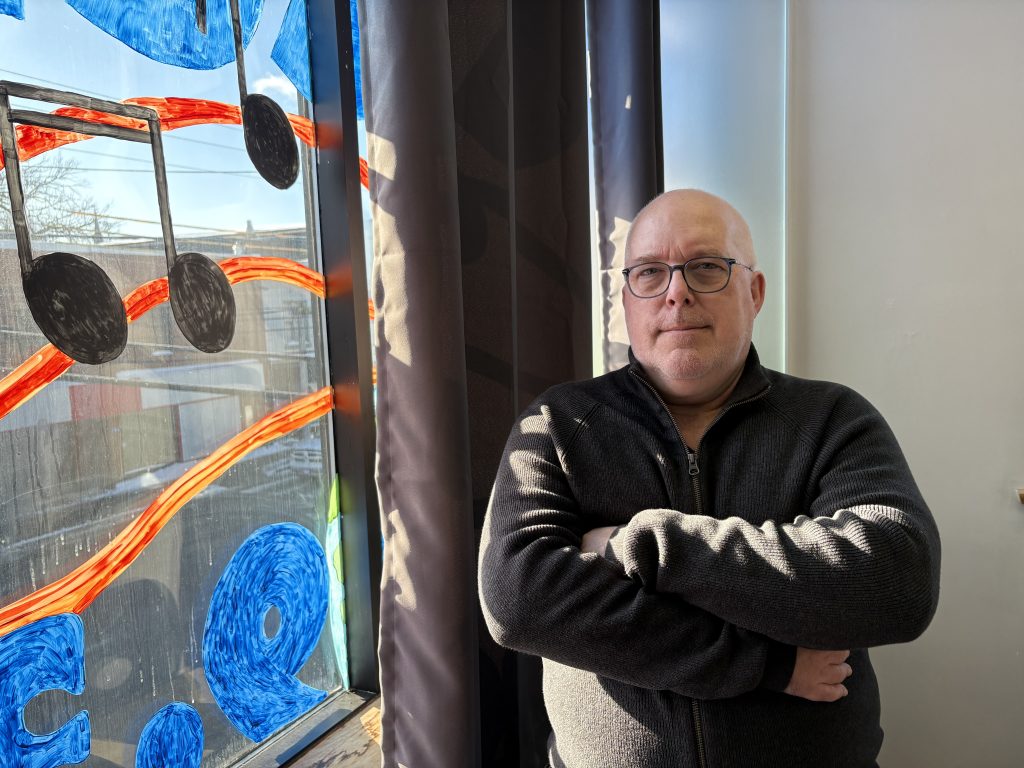
mayor

HUNTS POINT – A large crowd was on hand on Thursday, February 26th at White Point Beach Resort for the announcement of the Mersey River Wind Project, which will see construction and installation of 33 wind turbines with related grid connection infrastructure. The wind farm is expected to supply 148.5 MW of zero-emission electricity, capable of powering more than 50,000 homes.

The Canada Infrastructure Bank (CIB) is providing a $206 million loan to a partnership between Slate Asset Management and funds managed by Hamilton Lane to develop a wind farm at Mersey River. Project partner Renewall Energy Inc. will sell electricity to end customers in Nova Scotia.

The announcement was made by the Honourable Gregor Robertson, Minister of Housing and Infrastructure and Minister responsible for Pacific Economic Development Canada, and the Honourable Tim Hodgson, Minister of Energy and Natural Resources.

This large-scale project will help support the province’s energy transition, as Nova Scotia moves from coal-based electricity generation to clean electricity by 2030. The wind farm is expected to avoid approximately 220,000 tonnes of emissions per year, equivalent to 1.5% of Nova Scotia’s carbon output in 2022.

Renewall secured Nova Scotia’s first renewable-to-retail program licence to sell electricity from 100% renewable sources directly to end customers. This licence gives residents, public institutions, commercial and industrial customers the ability to achieve emissions reductions and sustainability objectives. Construction will take place in two phases, with the first phase expected to be completed in 2027. More than 200 workers are expected to be employed at the peak of construction activities.

dan roscoe

Dan Roscoe, Renewall

The project is being financed under the CIB’s Clean Power priority sector, which addresses financing gaps in low-carbon emissions projects such as renewables, district energy systems and energy storage.

Minister Hodgson also announced that NRCan will provide nearly $5 million in funding to Net Zero Atlantic for the Data Analysis and Modelling for Atlantic Offshore Wind and Transmission project, to support the next stage of offshore wind planning and the proposed Wind West and Atlantic Energy Strategy.

The Province of Nova Scotia’s contribution is both financial and in-kind support, valued at nearly $700,000.

Jessica Fancy, Member of Parliament for South Shore—St. Margarets, presided over the event, stating “Renewall is bringing greater choice and affordability to Nova Scotia electricity consumers for the very first time. With the support of the Canada Infrastructure Bank and the Government of Canada, the Mersey River Wind project will harness our province’s natural wind power advantage to provide clean renewable power to Nova Scotia families and businesses for decades to come.”

jessica fancy

MP Jessica Fancy

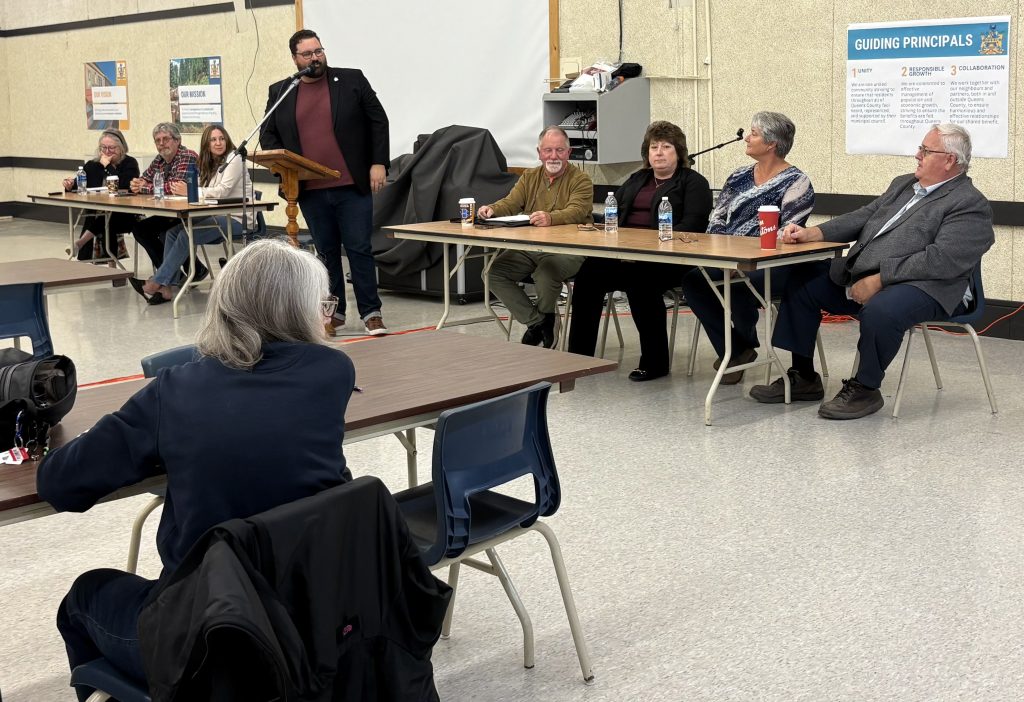
Speakers also included Mike Shoen, Director of Investments at Canada Infrastructure Bank The Honourable Tim Houston, Premier of Nova Scotia; Dan Roscoe, President of Renewall Energy Inc; and Scott Christian, Mayor of the Region of Queens Municipality.

NS Heritage Dept to close Perkins House

Perkins House

Perkins House.

Last week, the province’s heritage department announced that it plans to close the Perkins House Museum, in addition to 11 other museums throughout the province

A statement by the Dept of Communities, Culture, Tourisms & Heritage said some of the material and objects currently housed at the museum will be shuffled to other locations in the province-wide system, while others “may” be transferred to “other institutions” or “community organizations.” The statement did not say ‘what’ would go ‘where’ or provide a timeline for what it calls the “de-accessing” of material.

The government’s “Collection Management Policy” govern its museums. It includes a section outlining criteria for the saving of material and objects and provides guidelines on how they are to be handled. That policy can be accessed at https://museum.novascotia.ca/collections-research/policies/collection-management-policy. The section that controls access and the end-of-access to material begins on page 20 of that policy.

While general sweeping budgets cuts were announced, the impact on precise sites of arts, culture and heritage were not spelled out in detail. There are currently 28 museum sites in Nova Scotia.

Queens resident Mary Dahr shared her concern about the provincial debt and “such drastic cutbacks to everything in Nova Scotia.” Dahr added, “One of my major concerns is the Perkins House. For me, the Perkins House is a magical place, it’s something that we in Liverpool have always been really proud of…it’s almost like taking the lighthouse down at Peggy’s Cove – it’s that important…

“…and after they spent two million dollars fixing that house and then to turn around five years later and close it down!”

Local resident André Haines, speaking of the broader funding cuts, spoke of the importance of arts, culture and heritage in drawing visitors and as part of life in Nova Scotia. “We know that arts and culture and heritage have been the cornerstones of modern living throughout history.”

Council Transfers Land to Private Non-profit

Council Matters

COUNCIL TRANSFERS LAND TO PRIVATE NON-PROFIT

AFTER THE VOTE: WHAT LAND CONSERVATION LOOKS LIKE IN QUEENS

By Denaige McDonnell

Council has approved the transfer of municipal land at Path Lake to the Nature Conservancy of Canada, placing the property under permanent conservation stewardship for a nominal price of $1. This transfer continues a long-standing pattern in Queens, where multiple ecologically significant properties have moved into conservation ownership over the past two decades. Protected sites include Port Joli, Stuart Lake, Long Lake Bog, Shingle Mill Bog, and Toby Island nature reserves, each recognized for sensitive habitats or rare species.

From an ecological perspective, these are precisely the kinds of landscapes conservation organizations exist to protect. The value of these sites is real, documented, and in some cases nationally recognized. The question, now that the Path Lake decision is made, is not whether conservation is worthwhile — but how conservation functions in practice, and what the cumulative effect of these decisions means for local governance and long-term strategy.

Conservation and Stewardship Are Not the Same Thing

A common assumption is that land transferred to a conservation organization is actively managed on an ongoing basis. In practice, stewardship varies. Some sites have formal management plans and regular monitoring; others rely primarily on legal protection through ownership, with limited on-site presence.

Doug van Hemessen, Stewardship Manager for the Nature Conservancy of Canada in Nova Scotia, confirmed that several conservation properties in Queens do not currently have a designated on-site steward. Instead, NCC relies on a volunteer-based Property Steward Program, in which trained volunteers visit assigned sites at least annually and report observations to NCC staff, who retain overall responsibility.

In context, NCC conservation lands account for approximately 6,234 acres, or just over one per cent, of the Region of Queens Municipality’s roughly 590,000 acres.

This light-touch approach to land management can be appropriate for sensitive habitats such as bogs and wetlands. At the same time, periodic monitoring shapes how conservation is experienced locally and brings practical governance considerations into focus: how issues are identified between visits, who responds to access-related impacts, and how ecological conditions are tracked over time.

As the footprint of protected land in Queens continues to grow, these considerations become central to understanding how conservation functions in practice and how responsibilities are shared.

What Changes When Land Leaves Municipal Ownership

For residents, the Path Lake transfer may look like little has changed. The land remains accessible. The landscape remains intact. Recreation continues. From a governance perspective, however, the change is significant.

Once land leaves municipal ownership, control leaves with it. Elected officials no longer have authority over how the land is managed or adapted over time. Accountability shifts from a democratic body to an external organization, even when public access is preserved.

That tradeoff is often acceptable when the goal is permanent protection. But it also reduces municipal flexibility by permanently removing land from the public asset base. Land set aside for conservation can no longer support future community, cultural, or region-led development initiatives.

The impact of that loss is magnified by the absence of a clear long-term growth strategy. Without a shared vision for how Queens wants to grow or what it hopes to attract, land decisions are made one parcel at a time rather than as part of an integrated plan.

The Strategic Question Queens Has Yet to Answer

Taken on their own, each conservation transfer in Queens is easy to support. Taken together, they raise a larger question: how do these decisions fit within a coherent long-term strategy for municipal land?

There is no publicly articulated inventory of municipal lands and their intended purpose, nor a clear framework showing how conservation transfers are weighed alongside housing needs, recreation planning, climate adaptation, or economic development. Council does not routinely assess how much land has been permanently removed from future municipal use or what that loss of flexibility means over the long term.

Without that strategic context, land decisions risk being shaped by opportunity and goodwill rather than by a deliberate vision for how the region wants to grow and what assets it needs to retain to get there.

A Legacy Worth Managing Intentionally

The Path Lake transfer is now complete. The land is protected, and that outcome will be welcomed by many. The work ahead is not to revisit the decision, but to deepen the conversation. As Queens continues to partner with conservation organizations, clearer communication about stewardship, cumulative impacts, and long-term intent would strengthen public trust and understanding.

Conservation is a legacy decision. Its value is highest when it is guided by intention, transparency, and a clear vision for the future.

Salmon Farm Expansion

Liverpool Bay

Liverpool Bay, NS

Nova Scotia Aquaculture Review Board approves expansion of Liverpool Bay Salmon Farm

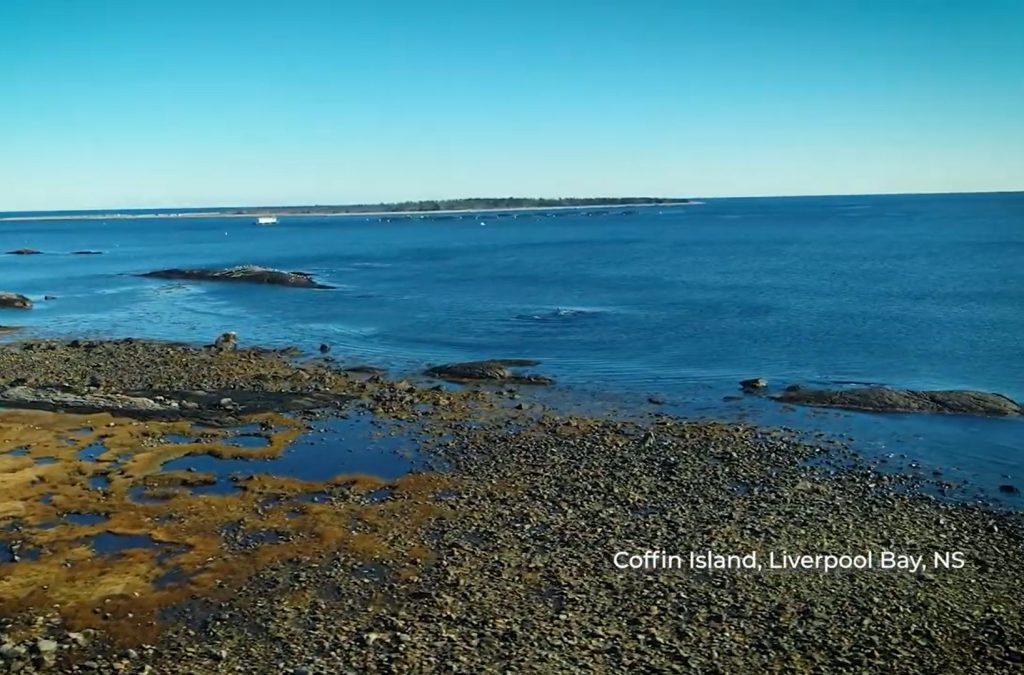
February 17, 2026 – Bridgewater, N.S.l Kelly Cove Salmon Ltd. (Kelly Cove) announced  the Nova Scotia Aquaculture Review Board’s (ARB) decision today approving the lease boundary amendment and expansion for salmon farm AQ#1205, located offshore from Coffin Island in Liverpool Bay.

Kelly Cove has operated the farm since 2011, and the approval allows 6 cages to be added to the site for the culture of Atlantic salmon bringing the total number of cages to 20.

“The week-long ARB public hearing in October was rigorous and brought together input from multiple stakeholders and intervenors,” said Joel Richardson, Vice President of Public Relations for Cooke Aquaculture Inc., parent company of Kelly Cove. “We appreciate that the Board allowed the time necessary for everyone to make presentations, ask questions and gain an understanding of how our aquaculture farming works.”

As part of the hearing, Kelly Cove exhibited this video about it’s Liverpool Bay operations: https://youtu.be/M4Ux3nXUUxk

In its decision, the ARB concluded that it is satisfied that there will be no negative, or any, impact of this amendment on any of the statutory conditions. The ARB further concluded:

– The re-drawing of the boundary to encompass the infrastructure, as well as adding six new cages, represents the optimum use of marine resources, in that the site will be used to efficiently produce thousands of kilograms of food.

– This farm makes a genuine contribution to community and Provincial economic development.

– The existing farm does not cause significant negative impacts to other fishery activities in Liverpool Bay.

– The oceanographic and biophysical characteristics of the public waters surrounding the proposed aquacultural operation are suitable for salmon aquaculture.

– The proposed expansion will not have a negative impact on the other users of the public waters surrounding the proposed aquacultural operation.

– There is no significant impact on the public right of navigation.

– The proposed expansion will not have any significant impact on the local wild salmon population and the existing farm has not had a significant impact since coming into operation in 2011.

Kelly Cove plans to install new, state-of-the-art cages, containment nets and underwater smart-farming technology which includes an integrated suite of advanced digital tools, sensors, robotics, and AI-driven systems designed to monitor fish farming in real-time.

Frustrated White Point Estates residents want Queens to crack down on Airbnbs

John Rogers says the proliferation of short-term rentals is violating his rights as a property owner. (Rick Conrad)

Imagine feeling like your neighbourhood has been turned into a party zone.

That’s what John Rogers says it’s like to live in White Point Estates, near Liverpool.

And he blames the Region of Queens for letting it happen.

He says the municipality’s zoning rules are essentially overriding property covenants that forbid short-term rentals like Airbnbs from operating in his subdivision.

“These houses are purpose-built for partying basically,” Rogers recently told QCCR in an interview.

“In the summertime, it’s like living in a campground. … It’s just people coming in and out every weekend.

“It’s frustrating. It’s disappointing. We’re being denied the right to enjoy our own property because council believes it’s better to give the rights to people who don’t live here and let them make money on their property.”

The Nova Scotia government requires short-term rentals to be registered with the province. To get that registration, property owners have to prove that land use bylaws in their municipality allow them to operate their house as an Airbnb.

In Queens, White Point Estates is in the “resort” zone, which allows short-term rentals. 

“My neighbour’s 50 feet from me, and it’s an Airbnb, I can hear them all day, all night,” Rogers says.

“One group of renters lit a house on fire so we had fire trucks and all that wailing through the night. We’ve had fireworks when they’re not allowed to have fireworks. We’ve had full-out weddings in places, so the streets have been blocked with cars, traffic, you can’t get by. 

“We have a lot of nosy renters who feel like they could just walk on other people’s property, so I’ve had people on my property filming my house. I’ve had people come into my driveway and do exercises because my driveway’s paved so they feel like, ‘Oh we can go in there and do jumping jacks and pushups.’

“So it’s a lot of nuisance and just the fact that 30 per cent of your neighbours change every weekend, … and you get new neighbours the following week and you don’t know who they are.” 

When somebody buys a property in White Point Estates, they must agree to a list of 14 restrictive covenants on what they can do with the land. The first rule states that only one single-family dwelling is allowed. That structure must be used only for residential purposes, and property owners cannot do anything that creates a nuisance for their neighbours.

Click on the image to read the covenants in White Point Estates

Rogers says he and his wife bought the land and built their house five years ago partly because of those rules.

But he says that because municipal bylaws allow short-term rentals in White Point Estates, about a third of the subdivision’s property owners are ignoring those covenants and using their houses as Airbnbs. He said the problem has only gotten worse in the past five years.

He says it’s too expensive to take all those property owners — he estimates there are about 15 or 16 rentals in White Point Estates — to court.

He says some of the properties sleep up to 10 people and aren’t even owned by residents, but by companies based in Ontario or other parts of Nova Scotia.

“The only remedy is to change the bylaw in the zone to reflect the covenants, which is to not allow short-term rentals to operate within that zone. And it’s a small zone, so we’re contained to three streets. We’re not asking them to change the rules of the county. We’re just asking them to abide by the rules in our zone, which is our subdivision.”

Rogers and some of his neighbours met with Mayor Scott Christian and District 1 Coun. Roberta Roy in July.

Christian told QCCR he understands residents’ frustration, but he said there can’t be a quick fix.

“I don’t think it would be appropriate for us to make a hasty decision about short-term rentals as it pertains to the resort zone and not take a bigger-picture look at how we’re handling short-term rentals across Queens County.”

Municipal councillors voted in December to review the region’s land use bylaw and municipal planning strategy. One of the things they want to look at is regulation of short-term rentals.

That process could take a year or more.

“I can understand and appreciate their frustrations,” Christian says, “but I do think that the way that council is going about it, the handling of it is appropriate that we do our homework and look at it with a big-picture mindset so that we land on an equitable and appropriate approach for all of Queens County.”

Councillors voted to change the land use rules in November to allow a developer to turn the old Stedman’s building on Main Street in Liverpool into apartments.

Christian said that change affected only the downtown commercial zone. Outlawing short-term rentals in White Point Estates would have bigger implications.

“Short-term rental properties are prevalent throughout all of Queens County. Not just in south Queens and not just in the White Point Estates. So this is a really complex one.”

In the meantime, residents like John Rogers will continue to press regional council to make a change so that they can enjoy their homes again.

“You know, this isn’t about me. I’m not on some glorious campaign. I’m challenging council to do the right thing. And I don’t believe council should be bestowing rights on people who don’t live in the county and trash on the rights of the people who do.

“Defend the rights of the people who live here and pay taxes here and vote here. That would be the right thing to do.”

Email: rickconradqccr@gmail.com

Committee eyes sizable pay bumps for Region of Queens mayor, councillors

Region of Queens Mayor Scott Christian and his fellow councillors at a town hall session at the Liverpool Fire Hall in October. (Rick Conrad / File photo)

A citizens committee is considering recommending significant raises for Queens County’s mayor and councillors.

The five-person group of volunteers appointed by Region of Queens council to review elected officials’ remuneration had their second meeting on Friday.

They agreed that the mayor’s position should be considered a full-time job. They also agreed to recommend that it increase to $68,752 a year from the current $48,033.

That reflects the current salary of the mayor in the West Hants Regional Municipality.

Councillors could see a bigger percentage bump. Committee members discussed how the annual pay for a regional councillor of $24,286 is less than minimum wage, based on a 30-hour work week.

After considering the West Hants councillor rate of $34,376, they discussed raising the salary for a Queens councillor to $41,496. 

Committee members split on that. Three supported the higher rate, while two others voted against it.

Kerry Morash said it would be difficult to justify that kind of increase to residents.

Pamela Brennan said she supports higher pay for councillors, especially in the age of social media.

“We live in a time when elected officials are targets for abuse, targets for frustration,” she said, adding that as an elected official, “potentially, you put your employable future at risk.”

She said that a higher rate of pay could encourage more people to consider running for municipal council. District 6 was the only area that was uncontested in the 2024 election. 

Committee chair Christopher Clarke, also a former mayor, said after the meeting that it’s a balancing act.

“You fall between two stools,” he told QCCR.

“On the one hand, you want to compensate people who run for office properly. And they deserve that. 
On the other hand, you’ve got to be cognizant of the fact that Queens is one of the poorest municipalities in the province. You’ve got to make sure that whatever you do doesn’t add too great a burden on the taxpayer.”

The committee’s Tara Druzina said if the new salaries are recommended by the committee and approved by council, the cost would be the equivalent of an extra $24 a year per taxpayer.

It’s important to note that the committee has not yet decided on its final recommendations to council. It will meet again on Feb. 6 at 2 p.m. in council chambers. That meeting is open to the public.

Committee members are set to discuss the rate of pay for deputy mayor, among other issues.

While they focused on West Hants for much of their discussion Friday, they’re also looking at other municipalities with a similar population or budget size.

“So we’ve been using West Hants as our comparison,” Clarke said. 

“It is a reasonably fair comparison. Population-wise, it’s more, they have more councillors. 
We’ve also been cross-referencing to the Town of Bridgewater, for example, where we’re very comparable in size, number of councillors, budget. We’ve looked at the (Municipality of the County) of Annapolis.”

The committee also briefly discussed pension options for elected officials. Some Nova Scotia municipalities allow their council members to participate in a pension plan. But the committee did not reach a consensus on that issue in their Friday meeting.

Currently, pay for Region of Queens council and the mayor is adjusted after every election. 

Any raises are calculated by using an amount equal to the cumulative percentage of the average salary increase of all region employees over the past four years or by the cumulative consumer price index over the same period, whichever is less. 

The region has had the same policy since 2018.

The Municipality of the District of Lunenburg’s mayor is paid $59,377 a year, while councillors make $29,562. The deputy mayor gets $40,208. Members of council can also participate in a health and dental benefits package and be part of the provincial public service pension plan, which MODL belongs to as an employer.

The committee is due to report back to Region of Queens council by Feb. 28. Councillors will have the final say on how they are compensated.

Committee members are: Christopher Clarke, Velta Vikmanis, Tara Druzina, Kerry Morash and Pamela Brennan.

Two staff members are helping them with research and background. They are Holly McConnell, the region’s director of people and culture, and Alex Wilson, the region’s policy analyst and strategic initiatives co-ordinator.

Email: rickconradqccr@gmail.com

Queens councillors reject proposal for four Airbnbs on Port Medway property

Region of Queens councillors rejected a property owner’s application to build four short-term rentals on this property on Fostertown Road in Port Medway. (Rick Conrad)

Region of Queens councillors made probably one of their easiest decisions at their regular meeting on Tuesday.

They rejected a bid to build an Airbnb that almost nobody wanted in their community.

Hans-Martin Klein, the owner of a vacant three-acre piece of land on Fostertown Road in Port Medway, wanted to build a single-family house for himself and four more single units to operate as seasonal rentals.

  • Listen to the audio version of this story:


Residents signed a petition against it, the region’s planning advisory committee recommended that council deny it and even the region’s planning staff said it should be rejected.

Under the municipality’s land use bylaw, fixed-roof overnight accommodations are not allowed in that part of the small village. It would require a change to the region’s land use bylaw to rezone the area.

Shelly Stevens is a Port Medway resident, who lives next door to the property.

“This area is made up of full-time residents who value safety, privacy and a quiet rural environment. Approving this rezoning would fundamentally alter the character of our community and reduce its liveability.”

Stevens told councillors that the road to the property is narrow, so it couldn’t accommodate increased traffic safely. She said the property owner’s proposal was also light on specifics.

“There’s no information on building size or sizes or layouts. There doesn’t appear to be any plan for garbage or recycling, or parking solutions, and no information on how many people the structures would accommodate.”

In addition to the petition, councillors said they also received a number of emails from residents opposed to it.

Deputy Mayor Maddie Charlton, who is a member of the planning advisory committee, said she was against the proposed development, especially since the region is planning a review of its land use bylaw and regulations around AirBnBs.

“There have been a lot of concerns raised about short-term rentals and how it affects our housing stock … this has been really problematic in Queens County. 
And so, we’re going to be looking at best practices to regulate those, where we want to encourage those, where we may not. And so that will have a really comprehensive review. So it didn’t make sense to entertain something like this.”

District 4 Coun. Vicki Amirault’s area includes Port Medway. She said the development would not fit with the location and characteristics of the small fishing village.

“As we have seen, many things such as the width of the road, the stone walls, the ditches, the flooding. There’s just so many points that stick out to deny this proposal.”

Councillors voted in December to hire an outside consultant to overhaul parts of its land use rules. One of those areas was the regulation of short-term rentals.

The consultant hasn’t been chosen yet, but the last time the region reviewed its land use bylaw and planning rules about eight years ago, it was expected to take about 18 months.

Email: rickconradqccr@gmail.com

Trust protects 500 acres of forest in Pleasant River, Queens Co.

Forested land in Pleasant River will be protected from development. (Nova Scotia Working Woodlands Trust)

About 200 hectares (500 acres) of ecologically significant forest in North Queens will be protected from development by the Nova Scotia Working Woodlands Trust.

The property in Pleasant River is the first one bought by the trust. The acquisition represents about 12.5 per cent of the organization’s goal to protect 4,000 acres by this spring.

Mary Jane Rodger is the executive director of the trust.

“This is a really exciting step for us, obviously, because it’s the first property we’ve ever purchased,” Mary Jane Rodger, the trust’s executive director, told QCCR, “but then also because of some of the unique habitat features and species at risk that exist in North Queens.”

Rodger says the Pleasant River property is a mixed-wood forest that’s about 35 years old. The trust will keep about 100 acres of it wild, while using the remaining land as a demonstration woodlot to help teach sustainable forestry practices.

“Our organization really has the capacity to help this property achieve its full ecological as well as economic potential. Within our model, we’re heavily vested in the working forest aspect as well as the kind of more traditional conservation aspect. So a portion of this property will be permanently protected.

She said the organizaiton will be “showing woodlot owners different ways to steward their lands or manage their woodlot in a way that you get to cut down trees, but still leave most of them standing and hopefully still be economically profitable.”

The property is also significant because it helps the trust get closer to its goal of accessing the carbon offsets market. That will help raise money to cover the long-term costs of protecting and preserving the forest. 

“Land conservation in itself is an expensive endeavor. You have to send someone out to a woodlot every year to make sure there’s no cutting over boundary lines or invasive species or impacts from climate change. So we need to make sure that as an organization, we have the stability to continue to operate into the future because the nature of what we do is very, very long-term.”

The trust bought the property from Neil Emenau for about $300,000. It partnered with the Mersey Tobeatic Research Institute, with funding from Parks Canada and the Southwest Nova Biosphere Region.

The Pleasant River plot is next to the 3,000-hectare (7,400-acre) Pu’tlaqne’katik (“shaving lake” or “shingle lake”) Wilderness Area, which is protected by the Nova Scotia Nature Trust.

The woodlands trust says the acquisition enhances an important conservation corridor around Kejimkujik National Park, which will help foster ecological diversity and strengthen wildlife habitat. The land will be protected from development and conventional clearcutting.

“We see so many lakes and rivers, in Queens County and in Lunenburg County get subdivided and you lose a lot of that ecological integrity when people clear their land all the way to the lake. Another key component of this property is there’s quite a significant river frontage along Pleasant River that will remain forested forever.”

And it will still be accessible to the public.

“So we’re hoping that we can encourage folks to access the property for hiking, snowshoeing, skiing, whatever it might be. I know the ATV community does use it as a thoroughfare as well, which we’d be happy to work with them to continue that access.”

Rodger says the trust hopes to get its charitable status this year, so that it will be more attractive for landowners to sell their properties.

Email: rickcconradqccr@gmail.com

Listen to the audio version of this story below

Queens RCMP looking for Shelburne man on Nova Scotia arrest warrant

Jonathan Robert Bennie (Nova Scotia RCMP)

Queens District RCMP is looking for a 41-year-old man from Shelburne wanted on a province-wide arrest warrant.

Jonathan Robert Bennie, who goes by John, faces charges of:

  • resisting or wilfully obstructing a police officer
  • operation of a motor vehicle while impaired
  • failure or refusal to comply with alcohol demand

Bennie is described at 6-foot-6 and 185 pounds. He has red hair and blue eyes.

Anyone with information is asked to call Queens District RCMP at 902-354-5721 or their local police. People can also call Nova Scotia Crime Stoppers toll-free, at 1-800-222-TIPS (8477), and leave an anonymous tip.

Schools, businesses close as snowstorm hits Queens County

A view of Main Street in Liverpool on Monday morning from the QCCR webcam. (QCCR)

Schools and most businesses closed for the day in Queens County, as the area was expected to get up to 35 centimetres of snow overnight Sunday and through Monday.

The snow and blowing snow began in the region late Sunday and was expected to continue all day Monday.

There were reports of the Irving and Shell gas stations in Liverpool running out of fuel.

While most places decided to close for the day, Queens Place Emera Centre was scheduled to open as a warming centre at 10 a.m.

The fitness centre was closed for the day. And staff were going to judge whether to open the rest of the facility for afternoon programming or evening ice bookings, according to a post on the Region of Queens Facebook page.

Curbside waste collection scheduled for Monday was rescheduled to Sat., Jan. 31.

Nova Scotia Power reported no widespread power outages, though the company did warn that with colder temperatures, the power grid may be stressed and that short temporary power outages may occur.

Email: rickconradqccr@gmail.com

Liverpool’s Astor Theatre to get $3 million in improvements

The historic Astor Theatre in Liverpool will undergo a multi-year facelift. (Rick Conrad / File photo)

The building that houses the Astor Theatre in Liverpool will get more than $1 million in upgrades this year, as part of a two-year, $3-million plan to modernize the historic building.

The Region of Queens owns the Town Hall Arts and Cultural Centre and leases it to the Astor Theatre Society.

Municipal councillors recently approved spending $1,050,000 this year and another $2,079,000 next year to install modern heating and cooling systems, air conditioning and long-delayed accessibility improvements.

Eric Goulden, chairman of the Astor Theatre Society, says he’s excited and grateful that the work is going ahead.

“All of these improvements are needed to update a 125-year-old building to today’s standards. … Most people don’t realize how busy we are and how much it’s needed to have a common point for people to get together and enjoy entertainment, but also learn and experience various crafts and meetings and that sort of thing. The vibe is very positive.

“We’re very, very pleased with the direction that we’re going in. We think that the next two years are going to be very positive for the Astor Theatre and a lot of the improvements that have been long overdue are going to take place.”

The Astor is limited in what it can offer in the warmer summer months, because the facility has only ceiling fans for cooling and air circulation in the theatre.

The region hired DSRA Architecture to detail what the building needs to improve operations and meet modern building codes. 

The region plans to upgrade the facility’s electrical supply and install a modern HVAC system, including heat pumps, that will allow the theatre to maintain comfortable temperatures year-round.

It also plans to install a platform lift so that people with mobility issues can access the second floor.

The washrooms will also be upgraded to comply with provincial requirements for accessibility and universality.

A new fire escape will be installed from the second-floor balcony, which will allow for wheelchair-accessible seating upstairs.

And the backstage area will be expanded by 765 square feet to allow more room for storage, a workshop and dressing rooms.

The architects also said the building’s insulation needs to be upgraded for better energy efficiency and to protect the wood structure from humidity. So far, that has not been included in the planned work.

Goulden says that the upgrades will allow the Astor to offer more to its patrons at any time of year. 

“We can’t do reliable programming in the summertime because of the lack of air conditioning, the lack of proper ventilation in the theatre. So it will give us at least another two months of programming that we can do in the summertime.”

He said the theatre is also shopping for a new movie projector to enhance its film offerings.

“Movies are going to be a big part of our growth. We will probably be the best movie experience on the South Shore.”

Councillors unanimously approved the work.

“I just have to say that I’m excited to see actually a plan for the updates at the Astor,” District 4 Coun. Vicki Amirault said. “It’s been a long time coming. 
So I’m very grateful for it.”

Mayor Scott Christian said the Astor board will continue to look for grants and other funding to try to offset some of the cost for municipal taxpayers.

Representatives from the municipality and the Astor plan to meet early next week to discuss the upgrades.

“I’m really quite excited about the future,” Goulden said. “A lot of good things happening at the Astor.”

Here’s a breakdown of the work planned at the Astor:

Year 1 (2026/27 fiscal year):

  • $245,000 – second floor platform lift (six months to install)
  • $175,000 emergency egress from balcony (three months to install)
  • $210,000 – electrical upgrades (six months to complete)
  • $420,000 – Phase 1 heating and cooling upgrades (six months)

Year 2 upgrades – 2027/28 fiscal year ($2,079,000):

  • $1.4 million – backstage addition
  • $315,000 – Phase 2 heating and cooling upgrades
  • $168,000 – second floor washroom accessibility upgrades
  • $196,000 – main floor washroom accessibility upgrades

Email: rickconradqccr@gmail.com

Listen to the audio version of this story below


Serving up comfort, community in Port Medway

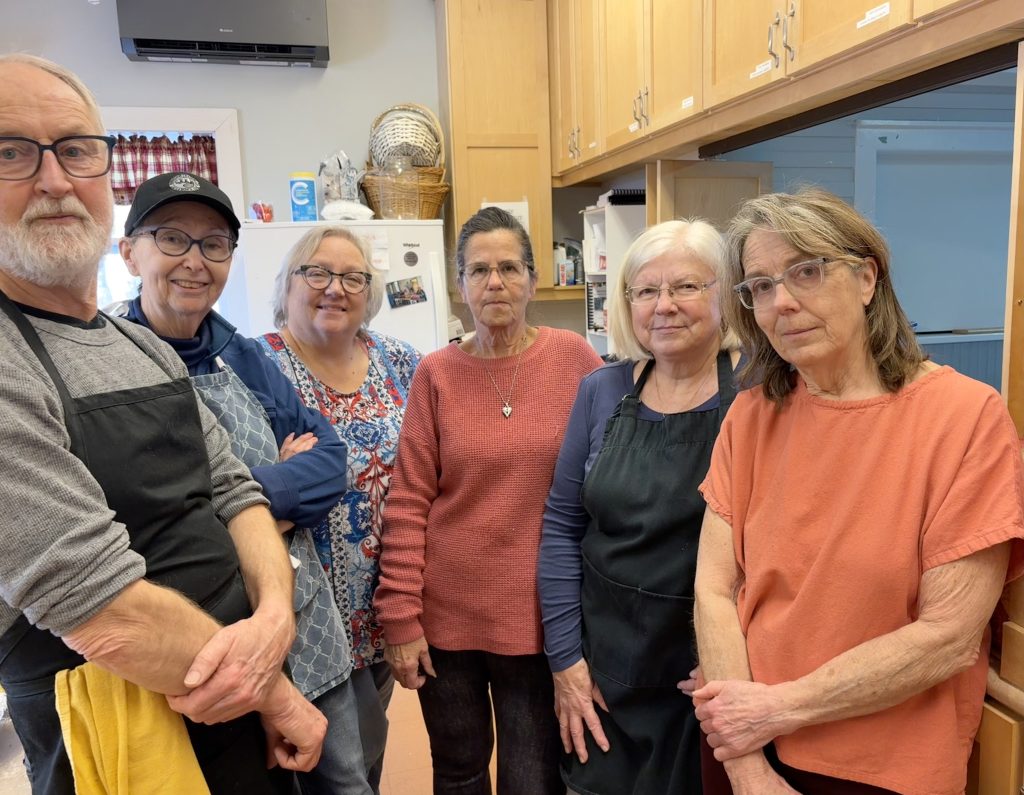
Members of the Port Medway Fire Department Auxiliary: Vincent Dieras, Deb Noble, Deb Lemon, Barbara Parnell, Sandi Simpson and Darlene Norman. (Rick Conrad)

As people around Queens County woke up Monday morning to power outages, volunteers at the Port Medway Fire Hall were busy giving people a place to warm up and get something to eat.

The Port Medway Fire Department Auxiliary opened the hall to everyone who needed it. They started preparing food at 6:30 Monday morning and still hadn’t stopped Wednesday afternoon.

“Port Medway is a very special community and for years it has always looked after itself,” says Darlene Norman, president of the auxiliary.

“Whenever there is an emergency or a power outage, this hall immediately becomes open and there’s always prepared home-cooked meals.”

“It’s open 24 hours a day until the power comes back on,” says auxiliary member Deb Lemon, “so even in the middle of the night you can come and recharge and warm up.”

Norman and Lemon are part of a team of about a dozen volunteers who have served three meals a day since early Monday, feeding up to 35 people at a time.

“We do scrambled eggs, pancakes, bacon,” Norman says.

“One day for lunch, we had pizzas, one day we did sandwiches up. We did the best spaghetti and meatballs that people said they ever had. We had homemade cheese biscuits, homemade chicken soup.”

The fire hall has a diesel-powered generator so that it can open to anyone after storms, hurricanes and power outages. A Nova Scotia Power crew even stopped in on Wednesday for lunch.

It’s a place for people to find comfort as well as community.

“Anyone without power,” Norman says. “Mill Village people were here, there were people from over in West Berlin, East Berlin, … everyone knows, when it’s open, it’s open.

“This is a real community. It’s small, everyone’s compacted because of the way this community is designed, people know each other. It’s social, people come play cards. And whether or not you’re a member of the auxiliary it really doesn’t have a bearing on if you come in and help in this kitchen.”

MIke Vandale, left, and three friends play cards on Wednesday at the Port Medway Fire Hall. (Rick Conrad)

Mike Vandale, who lives in East Port Medway, was still without power Wednesday morning, so he was at the hall for some breakfast and a game of cribbage with three friends.

“It’s been fantastic. The auxiliary have performed above and beyond all expectations. Fantastic.

“Camaraderie, food, warmth, friendship. It’s a great place to come and see everybody and catch up on the news.”

Vandale adds, laughing: “Misery loves company.”

Norman says there are a lot of younger retirees in the small fishing village who have the time and energy to pitch in when needed.

Even when they’re not offering free meals during power outages, the hall welcomes the community for a free lunch every Wednesday. That’s in addition to their regular dances, bingo nights and other events.

People show their appreciation for the free meals by leaving generous donations. And Norman and Lemon say management at the Sobeys in Liverpool has also been supportive, giving the group a $50 gift card so they could stock up on groceries this week.

“That’s the community rubbing off on everybody else around us,” Lemon says.

Most of Port Medway had been reconnected as of Wednesday afternoon. A Nova Scotia Power spokeswoman told QCCR that crews were working to restore power to more than 200 customers in Queens County as of 3:30 p.m. Wednesday.

The Port Medway Fire Hall isn’t an official comfort centre. And it wasn’t the only place in Queens County offering help during the outage. Eight other locations were offering various services. You can check out the list on the Region of Queens website here.

Email: rickconradqccr@gmail.com

Listen to the audio version of this story below

Canada-China trade deal ‘huge win’ for South Shore fishermen

Lobster fishermen leave Port Medway early on a November morning to set their traps. (Rick Conrad)

The Canada-China trade deal may be only a few days old, but it’s already having an effect on what lobster fishermen are getting for their catch, according to South Shore-St. Margarets MP Jessica Fancy.

“I’ve been talking to some of the executive directors for some of the different lobster associations in the area and they’re saying as quick as (Sunday), the price has been starting to go up. So they’re seeing this as a huge win.”

The Liberal politician spoke to QCCR on Monday about what the deal means for South Shore lobster and crab fishermen.

About $540 million worth of lobster was caught in the lucrative fishing grounds along the South Shore and around southwestern Nova Scotia last year.

And with the crab industry accounting for another $300 million, Fancy says that protecting those industries is vital for the area.

“Anytime you can get a better price, and not have to be dinged with the tariffs, that’s a good deal for me.”

Prime Minister Mark Carney and Chinese President Xi Jinping signed an agreement on Friday that would immediately reduce seafood tariffs to 15 per cent from 25 per cent. 

And on March 1, the tariffs on lobster and crab are set to disappear altogether. The deal lasts until the end of this year. The deal also affects canola, peas, steel and aluminum.

In exchange, Canada will drop its 100 per cent tariff on Chinese-made electric vehicles and allow 49,000 into the country each year.

“I was in Shelburne on Saturday night at one of the volunteer firefighter smoker events, and when I stood up to give my remarks, I had five or six men stand up and clapped for me in regards to the tariffs, and I had to stop for a second because I thought, ‘Wow, I, never thought I’d get a standing ovation in Shelburne County’, but it spoke to the importance of that deal, and the hard work that we’ve been doing, since October, in regards to trying to secure it.”

Fancy said she and her provincial counterparts, as well as representatives from the fishing industry, pushed the federal government to get a deal done.

Rick Perkins, the former MP for South Shore-St. Margarets, criticized the deal on his Facebook page. He called Chinese EVs “government-made spy machine cars” and questioned what happens to seafood tariffs next January.

“In regards to the term ‘spy machine’,” Fancy says, “I mean, we’re probably both holding a cell phone right now. So it’s kind of null and void and it’s unhelpful rhetoric in regards to the trade deal or what we are allowing in or out of the country.”

Fancy says the Canadian government plans to take the next nine months to continue talking trade with China, to try to get a longer term deal done.

“I’m going to use the analogy, as an educator, you know, when you have people in the playground, and they get upset with each other, and they have a fight, and you bring them in and you talk to them, you’re not going to repair that relationship overnight. So you’re not going to put in these lock and step long-term deals. You’re going to wait and look at how that relationship redevelops.”

She said she’ll travel to Ottawa later this week for Liberal caucus meetings where MPs will get a look at the deal in more detail. But she said she hopes this is just the beginning of more trade for South Shore fishermen.

“We’re seeing this as a huge win. … And it paves the way to resolve some of those long-standing trade barriers that were affecting different sectors.”

China is Canada’s second-largest trading partner after the United States. The government says it wants to increase exports to China by 50 per cent by 2030.

Email: rickconradqccr@gmail.com

Listen to the audio version of this story below

Queens approves $54-million infrastructure budget

Region of Queens councillors passed their capital budget last week. (Rick Conrad)

The Region of Queens got a head start on a big part of its budget last week by approving its five-year, $54.3-million capital plan.

It includes more than $27 million in projects for this fiscal year alone.

Councillors wanted to approve their capital budget earlier this year so that municipal staff could work on issuing tenders before the spring.

“The purpose of bringing the capital investment plan to council at this point is so that we’ve got as much runway as possible before the fiscal year starts on April 1st,” said CAO Willa Thorpe, “so that staff have the opportunity to go to tender on projects with the runway of between January and April.”

The extension of water and sewer to the Mount Pleasant area of Liverpool accounts for almost $10 million of the 2026/27 spending.

Another $1.4 million is being set aside to upgrade and extend two kilometres of the main water transmission line from the South Queens Water Treatment Facility to Union

Street in Liverpool, and to upgrade the water main from Roy Turner Road to Mersey Avenue.

Some councillors want staff to fast track the replacement of existing water infrastructure before adding new areas.

So they voted to hire a consultant to analyze the costs and timeline of the main water line project.

Adam Grant, the region’s director of infrastructure, said it would probably take from six to nine months to get a report back.

District 6 Coun. Stewart Jenkins had many questions for staff about the capital plan.

He wanted to know why projects take so long to get done. 

“Would it not be better to stop anything new and just get these projects done so we can have a fixed cost on it? … Why are we adding more projects on when we can’t get ones finished?”

Grant said staff try to strike a balance between ongoing projects and new ones added to the list.

“There are a lot of projects on there. I think each year … we try to trim them off and council would like to add some… . So we try to balance it out what we can complete. What’s pertinent, and what’s unnecessary, trying to prioritize in that fashion.”

Mayor Scott Christian said it’s council, not staff, that adds work to the list. He said Thorpe, Grant and Finance Director Joanne Veinotte have told him they’re trying to improve the process.

“There is a concerted effort to be more realistic, what we’re budgeting for the projects that we actually expect to be done, and improvements with respect to the way that we’re making decisions about what we’re doing in-house, and what we’re shopping out and subcontracting out. So it would be my expectation that moving forward, we are going to improve that in terms of achieving the work in the year that we’re funding it.”

Some of the projects that have been held over, like the wall at the Old Burial Ground or the new Gorham Street planter between Home Hardware and Celeste’s Hair Salon on Main Street, caught Jenkins’s attention.

“How do we justify a planter at in excess of $97,000 for plants?” he asked Grant.

Grant said it’s actually a vital retaining structure in the walkway from Main Street to the waterfront.

“So it’s a couple hundred metres long. 
It’s brick, it’s 12 feet to 16 feet high in spots, it does have plants into it. But it’s a lot more than just a planter with some shrubbery. It’s being improved, I guess, for accessibility, as well as retention purposes, to protect the pedestrians.”

Jenkins also had some work of his own to add to the list. Councillors approved his motion to add $200,000 to the capital budget this year to work on dry hydrants around Queens County.

They are vital for many of the region’s fire departments to be able to access water sources.

Jenkins said that before his concerns were addressed, he was ready to vote against the budget. But he said he would vote for it even though he still had some reservations.

Councillors voted unanimously to pass the region’s 2026-31 capital investment plan.

Next up will be the region’s operating budget. Councillors are set to begin debating that on Feb. 24. Residents can have their say by filling out a survey on the region’s website.

Some of the 2026/27 spending highlights in the Region of Queens capital investment plan:

  • Accessible washrooms, universal playpark at Queens Place: $425,810 (federal gas tax funding)
  • Gorham Street planter rehabilitation: $97,630 (municipal reserves)
  • Thomas H. Raddall Library renovations: $111,490 (federal gas tax)
  • Old Burial Ground wall rehabilitation: $173,440 (municipal reserves)
  • Queens Place LED light refit: $78,000 (municipal reserves)
  • Queens Place roof remediation: $70,000 (municipal reserves)
  • Sidewalk Millard to Harley Umphrey Section 1: $519,192 (municipal surplus)
  • Astor Theatre improvements Year 1: $1,090,499 (municipal surplus)

Email: rickconradqccr@gmail.com

Listen to the audio version of this story below

Snow day in Queens as thousands without power across Nova Scotia

Schools are closed and power is out around Queens County as the area got its first significant snowstorm of the season. (Rick Conrad)

The season’s first significant snowfall in Queens County knocked out power for many, with schools and some businesses closing for the day or delaying their opening.

About 20 centimetres of heavy snow fell, while power was out in many parts of the county, with Nova Scotia Power reporting about 130,000 outages across the province.

The outage map, however, wasn’t displaying all outages correctly. Residents reported outages throughout south Queens, including Port Medway, Eagle Head, Beach Meadows and Brooklyn. But the map was showing very few households affected.

The Port Medway Fire Department has set up a comfort centre at the fire hall for those without power.

The Region of Queens administrative offices were closed for the day. The South Shore Regional Centre for Education closed schools for the day.

If you’re in the Liverpool area, follow this link to see expected snowclearing response times.

Email: rickconradqccr@gmail.com

Queens to impose surcharge on short-term rentals

The Region of Queens is moving ahead with plans to impose a levy on all short-term rentals. (Photo by InstagramFotoGrafin via Pixabay)

The Region of Queens is going to introduce its own extra charge on people who stay at hotels or other short-term rentals like Airbnbs in the area.

The accommodation levy would be up to an extra three per cent per night on top of what the property already charges.

Under provincial law, municipalities can use that revenue only to promote tourism in their area.

If the region required the maximum three per cent, it would generate about $240,000 a year, Richard Lane, a project officer with the Region of Queens, told councillors at their regular meeting on Tuesday.

“Now there are some accommodation providers who are as busy as they want to be, so they’re not particularly interested in additional promotion work. There are some accommodation providers whose business relies on construction workers and such like, and they’re not interested in additional promotion,” Lane said.

“So, on the one hand, you could say the furtherance or the promotion of tourism would be something that accommodation providers are interested in, but that’s certainly not a universal view.”

The municipality sent a survey to 128 registered accommodation providers in Queens last April. 

It also allowed members of the public to have their say.

The survey got 97 responses, 54 of which were from owners of accommodations.

About 67 per cent of owners were strongly opposed to a levy, though the other 33 per cent said it would either have a positive or no effect on their business.

Deputy Mayor Maddie Charlton said she supports the marketing levy. She said some people may have been confused about what the extra charge was all about.

When people don’t understand what the funds could be used for, then when you hear the word ‘tax’ again, it’s a negative context. And so I think that people didn’t understand the full picture,” she said.

“And we are one of the few who don’t have (a levy). And I think in speaking with people about this, lots of residents who go to Halifax or Cape Breton, for example, they didn’t know they even pay this. It’s on every invoice where you stay. (Halifax and Cape Breton) have had these for a long, long time.”

Charlton said that while some property owners may not need any extra business, many small businesses in Queens County would benefit from more promotion of the area.

And I really, really want to see more events happen throughout Queens County, specifically at Queens Place. And I think that this is a way to give our residents excitement and more events at no cost to them.

Mayor Scott Christian said he’s opposed to the levy, especially after speaking with some local hotel and property owners.

It feels premature to me when we don’t have our economic development strategy in place. We don’t exactly know how we’re going to market the Queens County. And I’ve just heard strongly from some of those operators about some of the impact that an accommodation levy would have upon them.”

Many other Nova Scotia municipalities already have some kind of levy on hotel rooms.

Lane told councillors that the Town of Bridgewater is the only municipality on the South Shore with a charge that also covers short-term rentals. There are 30 registered properties there, compared with the current count of 165 in Queens County, Lane said.

Bridgewater relies on operators to self-report and remit the proceeds to the town monthly. Owners can be fined if they send inaccurate reports.

The Town of Yarmouth, and the municipalities of the districts of Argyle and Yarmouth contract with a third-party service from the Ontario Restaurant Hotel and Motel Association to collect the fee on their behalf. That organization already works with 35 municipalities in Ontario, collecting more than $30 million annually. 

Lane said that the Association of Municipal Administrators of Nova Scotia is working on potentially coming up with a service that would collect the fee on behalf of all 49 municipalities in the province.

“If it is the will of council to have an accommodation levy in Queens County, … the likelihood is that by the time that bylaw is ready to be implemented, there may well be an automated system that we can adopt.”

Email: rickconradqccr@gmail.com

Listen to the audio version of this story below

RCMP look for Caledonia man charged with violent offences

Nolan Conway (RCMP photo)

Queens District RCMP are looking for the public’s help finding a Caledonia man wanted on a provice-wide arrest warrant.

Nolan Conway, 21, faces five counts each of assault with a weapon and possession of a weapon for a dangerous purpose, two counts of uttering threats and one count of mischief under $5,000.

Conway is described as five-foot-nine, 165 pounds. He has brown hair and brown eyes.

RCMP say they’ve made several attempts to find him.

Anyone with information about Conway is asked to call Queens District RCMP at 902-354-5721 or their local police detachment.

People can also leave anonymous tips by calling Nova Scotia Crime Stoppers, toll-free, at 1-800-222-TIPS (8477), or submit a secure web tip at www.crimestoppers.ns.ca, or use the P3 Tips app.

Queens approves road trails bylaw, paving way for OHVs on some streets in Liverpool

Dave White is the president of the Queens County ATV Association. (Rick Conrad)

ATV operators in Queens County will soon be able to ride their vehicles on some municipal roads in Liverpool.

Region of Queens councillors adopted a new road trails bylaw on Tuesday, paving the way for off-highway vehicles to use some roads to access trails and services.

The rules take effect Feb. 1. But Dave White, president of the Queens County ATV Association, says there’s still some work to do to get the trails ready for riders.

“It’s really important for people to note that, although it’s passed second reading today, it will not become officially open. … Things that have to be done is we have trail signage to go up as well as the region has some signage for where the trail crosses streets. So they’ve already done some preliminary work.”

White said the association, the ATV Association of Nova Scotia and the municipality will update users on when the trails are ready to use.

The bylaw designates five routes around Liverpool that riders can use to access services or other trails.

It’s been about two and a half years since the association and the Queens Rails to Trails Association approached the region to create a connected trail network similar to those that exist in neighbouring Lunenburg and Shelburne counties and in other parts of Atlantic Canada.

ATV groups say that the changes will bring more economic activity to Queens County. In 2022, ATV users said they spent $454 million in Nova Scotia.

The Nova Scotia government passed the Road Trails Act in 2023, which allows off-highway vehicles on provincial and municipal roads with certain conditions.

“It’s been a major development and a lot of work with the municipality, over the last six months, but really over almost two and a half years at this point,” White said .

“So we are exceptionally pleased with it.”

White says motorists won’t see much of a change once the rules go into effect, since the vehicles won’t be allowed everywhere.

“You will see off-highway vehicles on defined streets. That’s important, it is not all of town. It’s very specific.”

The routes are behind the municipal offices on White Point Road and at various points from the Trestle Trail that would allow access to the Visitor Information Centre, downtown shops and services like the gas stations and grocery stores around Queens Place Drive. 

The association also signed an agreement with a local landowner so riders can access the former rail bed to get to the Milton Road. 

“And then you’ll travel like any other vehicle down to the light, and have all of the options open to you, including the yield lane to the right to access Irving, Shell and Hank Snow Drive, which will allow us to have combined tourism events with the friends of the Hank Snow Society, which we’re very excited for, and we’re hoping to do an event with them in February.

“You will also be able to turn left at the light to access businesses like Sobeys, Superstore, McDonald’s, Dollarama, Queens Place, Best Western, which is a major win because people will be able to come in and do expanded tourism opportunities. So we’re very excited.”

White says once the trails are open, they should bring in business from off-highway vehicle users from around the province.

He says people can get more details about the routes by downloading the ATV Association of Nova Scotia’s mobile app. 

Here are the routes outlined in the bylaw:

  • West Street from civic number 181 to the intersection with Harley Umphrey Drive, then to the intersection with White Point Road.
  • King Street from civic number 56 to the intersection with Lawrence Street, then to the intersection with Wolfe Street to civic number 16.
  • Main Street from the intersection with Central Boulevard to civic number 741.
  • Brunswick Street from civic number 63 to the intersection with Main Street, then to the intersection with Henry Hensey Drive to the pump station at civic number 4 Henry Hensey Drive.
  • Milton Road from civic number 31 to the intersection with Bristol Avenue, west to the intersection with Hank Snow Drive and east to the intersection with Queens Place Drive. Included is Hank Snow Drive to civic number 38 and the entirety of Queens Place Drive and Old Cobbs Barn Road.

Email: rickconradqccr@gmail.com

Listen to the audio version of this story below

Air, ground patrols find no plane crash as crews rush to Mill Village after reports of flares, smoke

RCMP and other emergency crews are on the scene of a possible plane crash near Mill Village. (RCMP)

UPDATED 5:35 P.M.

Emergency crews rushed to the scene of a possible plane crash on Tuesday afternoon near Mill Village.

But after extensive air and ground patrols of the area, “neither RCMP nor (search and rescue crews) observed evidence of a plane crash, a plane in distress, or a situation that required emergency response,” according to a statement from Nova Scotia RCMP on Tuesday just before 5 p.m.

Queens District RCMP received several calls at about 1:15 p.m. of emergency flares near Mill Village. One caller said they saw a plane in distress in addition to the flares, the RCMP said.

The Joint Rescue Co-ordination Centre in Halifax deployed a CH149 Cormorant helicopter and a CC295 Kingfisher airplane as part of the search. Queens RCMP officers searched on the ground through rural areas and worked with drone operators as part of the search.

Firefighters and RCMP rushed to an area off Highway 103 just before 2 p.m. after reports that flares and smoke could be seen.

The RCMP thanked members of the public who called 911.

Buyers looking for cheaper houses, as property assessment notices mailed this week

Assessment notices were sent to property owners this week. (Rick Conrad / File)

Nova Scotia property values continue to rise, but the double-digit increases seen during the Covid-fuelled buying spree are over.

Overall, total property assessments in Nova Scotia have topped $200 billion for the first time, with residential and commercial properties combining for $206.3 billion on 2026 assessments, according to numbers released Monday by the independent, non-profit Property Valuation Services Corporation.

Residential assessments rose by 8.5 per cent over 2025. That compares to an 11 per cent increase over 2024.

In Queens County, residential assessments rose by $151,836,700 or seven per cent over 2025. 

In 2025, they rose by 9.5 per cent and the 2024 assessments were 25 per cent higher than the year before.

Jeff Caddell, director of valuation standards for PVSC, told QCCR on Monday that lower-priced properties such as mobile homes are becoming more attractive. Even so, properties near the water are still popular.

“We’re starting to see a more focused demand for property. So, we’re seeing smaller, more affordable homes increasing at a faster pace from a market perspective, than higher-value homes. We’re also seeing more of those types of homes being constructed as well,” Caddell said.

“Queens County is no exception. We’re seeing a trend towards smaller homes, more moderately priced homes selling, we’re seeing good market growth, and those types of properties, manufactured homes across the province, the last couple of years we’ve seen strong market demand for those properties, and that’s continuing into this year as well. Semi-detached townhouses, duplexes, multi-units, we’re seeing market increase in those types of properties as well.”

Caddell said people are also looking for properties beyond urban areas like the Halifax region.

“So typically, provincially, much of that value increase is centred around HRM, the urban areas in the province, but we’re starting to see value shift outside of the urban cores in the province. So looking at small towns, small municipalities across the province, where there’s access to amenities. It’s these types of areas where we’re seeing good, strong market change, and as well as construction to meet the housing needs in those areas.”

2026 assessments are based on sales and financial data from 2024 and reflect a market value as of Jan. 1, 2025, and the physical state of properties as of Dec. 1, 2025.

Municipalities received the assessment roll for their region in mid-December.

The PVSC mailed 2026 assessments to more than 650,000 property accounts on Monday. 

This year’s Capped Assessment Program rate is 2.6 per cent, up from 1.5 per cent last year. About 72 per cent of residential properties qualify for the CAP, which limits the amount assessments can increase every year. Municipalities assess property taxes based on the CAP amount.

Caddell said they received about 9,000 appeals last year, with about 20 to 25 per cent of those having their assessments adjusted.

“So in many cases, the taxable doesn’t change, because it’s already lower than the market value assessment. So it’s just an important consideration, but if property owners have questions, they can certainly give us a call on that.”

The deadline to appeal your property assessment is Feb. 12.

Email: rickconradqccr@gmail.com

Listen to the audio version of this story below

Queens County man charged with theft, impersonating RCMP officer

A Liverpool man is accused of impersonating an RCMP officer. (RCMP)

A Queens County man has been charged with several offences, including stealing a dump truck and impersonating a police officer.

Christopher Allan MacLeod, 43, of Liverpool was charged after incidents on Boxing Day and New Year’s Day.

RCMP say that on Dec. 26 at about 9:20 p.m., a man approached an RCMP officer outside the Cookville RCMP detachment in Bridgewater and said he was an RCMP sergeant who had just been transferred from another province.

He drove to the detachment in a black Dodge Ram and was dressed in civilian clothes, according to an RCMP news release. He said he didn’t have any RCMP identification.

The officer confirmed that the man was not a fellow officer and arrested him.

Lunenburg District RCMP charged MacLeod with impersonating a peace officer and breach of a recognizance. He appeared in Bridgewater provincial court on Dec. 29 and was released on conditions.

On Jan. 1, at 11:45 a.m., Queens District RCMP got a call about a stolen dump truck from a garage on Devonshire Road in West Caledonia.

While officers were on their way to the scene, they saw the vehicle on Highway 3 in Liverpool.

They stopped the truck and safely arrested the driver, whom police identified as MacLeod. They allege that MacLeod entered the garage on Dec. 31 and stayed overnight before taking the truck.

Queens District RCMP have charged MacLeod with break and enter with intent, theft of a motor vehicle, possession of property obtained by crime and two counts of failing to comply with an order.

MacLeod appeared in Bridgewater provincial court on those charges on Jan. 2 and was remanded into custody. He appeared again on Jan. 7 and was ordered back to jail until his next appearance on Feb. 4.

RCMP spokeswoman Cpl. Carlie McCann asked people to contact police or Crime Stoppers if they have any information about either incident.

“At this point I don’t anticipate there being further charges related to either of these two files, but we will continue to investigate if new information is learned.”

MacLeod is listed in Nova Scotia property records as the co-owner, with Charles King, of 27 West Berlin Wharf Rd. in West Berlin. A house, truck and several outbuildings were destroyed in a fire there on Dec. 22. RCMP said at the time that one man was arrested at the scene but later released and not charged in the fire. They have not said what caused the blaze, but said they had reports of fireworks before it began.

RCMP say that anybody worried about the identity of a police officer should ask the officer for identification or contact their local detachment’s non-emergency line. In an emergency, call 911.

“Nova Scotia RCMP regularly reinforces with all of our officers the importance of self-identification,” McCann said.

“If you are in a situation where you suspect that someone might be using or planning to use real or replica police equipment or if you’re in a situation where something is concerning or seems off, please don’t hesitate to call local police or if you believe you may be in immediate danger, call 911.

“In a situation like a traffic stop, you can ask to see an officer’s badge and ID card and that will have their regimental number and the ID card will have a photo. We always want Nova Scotians to be aware of suspicious behaviour, and don’t hesitate to reach out to police to report it.”

Email: rickconradqccr@gmail.com

Listen to the audio version of this story below

Donations pour in for grieving mom as RCMP investigate fatal dog attack in Shelburne

Shelburne District RCMP continue to investigate a fatal dog attack in Shelburne County. (Vlad Vasnetsov via Pixabay)

People all along the South Shore and across Nova Scotia are showing support for a grieving mother of a 13-year-old boy who died after a dog attack in Shelburne County on Saturday.

A GoFundMe page has been set up for Dawn Nickerson, the mother of Drew Nickerson, who was a student at Shelburne Regional High School.

Drew died in a Halifax hospital after he was mauled by three dogs around 5 p.m. on Jan. 3, according to Shelburne District RCMP.

As of Wednesday afternoon, the online fundraiser had raised almost $65,000 of its $70,000 goal. 

“Our community is absolutely devastated by this loss,” organizer Trish Harris wrote on the page.

“My hope is to ease any financial burden so his mom can focus on grieving and healing during this unimaginable time. “

Shelburne District RCMP are still investigating the attack that involved two Cane Corsos and a Rottweiler.

RCMP say the three large dogs attacked Drew as he was riding his bicycle past a property on Upper Sandy Cove Road in Welshtown.

“This is an extremely distressing and tragic incident for everyone involved,” Staff Sgt. Mark Macpherson of Shelburne District RCMP said in a news release.

“Our thoughts are with the youth’s loved ones as they process their heartbreaking loss.”

The dogs were euthanized by a local veterinarian after the attack. 

No charges have been laid, though RCMP say they continue to investigate. They’re gathering and analyzing video footage of the area, going door-to-door in the community and interviewing several people about the dogs’ behaviour before the attack.

“Our team is working through several investigative steps to fully understand what happened and to determine the circumstances surrounding the attack,” Staff Sgt. Macpherson said. 

“Community members have been very supportive of our work, and the dog owners have been co-operative throughout.”

Anyone with information is asked to contact Shelburne District RCMP at 902‑875‑2490.

Region of Queens tax sale lists 16 properties

Region of Queens administration building. (Rick Conrad)

Sixteen properties are up for grabs in a Region of Queens tax sale.

The various houses and plots of land around Queens County are being sold in a tax tender by the municipality to recoup unpaid taxes.

One of the properties for sale is 15 Court St., beside the former Mersey Hotel in Liverpool.

That is owned by Rosemarie Jacob, who is also the listed owner of several abandoned properties in Queens. She was the owner of the historic Hendry House at 89 Main St. in Liverpool, which was destroyed in a May 2024 fire.

After the fire, the region declared the property dangerous and unsightly and ordered Jacob to clean it up. After she failed to appeal the order, the region cleaned it up and sent her the bill.

Citing privacy, the region has refused to disclose how much that cost taxpayers.

Anyone interested in bidding on one of the properties in the tax tender has to submit a sealed bid by Feb. 10 at 2 p.m. to cover outstanding taxes, interest and expenses. If the property owner pays all outstanding taxes and fees before the deadline, the property is removed from the tax sale.

More information is available here on the Region of Queens website.

Accessible washroom at Liverpool playpark likely won’t be ready this year

An accessible washroom at the inclusive play park in Liverpool likely won’t be finished until the end of 2026. (Rick Conrad)

Accessible washrooms at Liverpool’s universal playground and splash pad have been delayed as Region of Queens staff look into an off-grid design.

Regional councillors voted in April 2024 to speed up installation of the permanent washroom and change room facilities at the site, next to Queens Place Emera Centre.

But at a capital budget meeting just before Christmas, Director of Infrastructure Adam Grant told council that the $425,810 project has hit some roadblocks.

“We’ve done a lot of work in the background, trying to identify a feasible solution for that site. It is challenging, it’s constrained physically,” he said. 

“We do not have a lot of real estate to work within next to that parcel of land. There’s no provisions put in for electricity to allow for any development… So we have maybe 30 amps of power, which is not enough to run a facility like that. 
There’s no water provided for a washroom facility and there’s no wastewater whatsoever at the site. So it’s those three strict parameters and combined with having not much real estate to work within, that makes it very challenging to find a solution that fits within that footprint.”

The $600,000 Etli Milita’mk playpark opened in October 2023, the result of a years-long community fundraising initiative by local members of Autism Nova Scotia. The region contributed the land and about $112,000 to the project. The province chipped in the rest.

In the meantime, the region has supplied a portable accessible toilet for users of the park and splash pad, which is closed until the spring.

In response to a question from District 5 Coun. Jack Fancy, Grant said that power, water and sewer can’t be extended from the Queens Ground Search and Rescue building nearby because of the way the playpark was built.

“Unfortunately, with the building, the splash pad and the playground, we limited any opportunity to make any kind of addition in that area by putting a perimeter fence right into the curb and sidewalk. Getting involved with the asphalt to remove it, to put power, to put sewer (and) water, is going to get extremely expensive.”

Grant said that’s why staff are looking at some kind of off-grid accessible facility, though it will likely be more expensive to maintain.

“The caution is that it’s going to probably create a lot more of an operational burden than we’d like to see, but it will fulfill council’s wish to have an accessible facility there.”

The accessible washroom and change room at the playpark and splash pad are now expected to be finished by the end of 2026.

Email: rickconradqccr@gmail.com

Listen to the audio version of this story below

New year, new costs: Water bills in Liverpool, Brooklyn to jump by 85 per cent

The Nova Scotia Regulatory and Appeals Board has approved increases for customers of the Region of Queens Water Utility. (Rick Conrad)

More than 1,200 water utility customers in Liverpool and Brooklyn will see a significant spike in their bills this year.

In a decision released Dec. 22, the Nova Scotia Regulatory and Appeals Board has approved an 85 per cent increase in water bills for customers of the Region of Queens Water Utility. Once the full increases take effect, it will mean an extra $300 per year for most residential customers.

The new rates took effect Jan. 1, but the board also ordered the utility to phase in the increases to 2027 to help mitigate “rate shock”. It also ordered that interest on the utility’s debt to the municipality be eliminated, and to adjust the utility’s earnings and debt forecasts.

“The Board finds that the utility is in a difficult position,” board members wrote.

“The Board also finds that, other than the minor adjustments directed above, the required revenues in the application are just and reasonable, and necessary to produce safe, reliable water. Yet its rate increases clearly fall within the definition of ‘rate shock’.”

The average residential customer will now pay $531.28 a year, an immediate 60 per cent increase. It will eventually rise to $664.08 in 2027.

At a hearing on Nov. 19, the region said the utility needed to increase rates dramatically to deal with a mounting $1.4-million deficit.

Mayor Scott Christian told QCCR this week that the board’s decision allows the water utility to pay off some of its deficit and continue to provide good-quality drinking water to its customers.

“I think it’s a fair judgement. It gets us to a place where we can run a water utility in a sustainable way, while helping to cushion the blow a little bit to the consumer in terms of the spike in that rate.”

In November, regional councillors approved a utility assistance rebate for water customers on low incomes. People are eligible for up to a $200 annual break on their water bills.

With that rebate applied, the municipality projects less than a one per cent increase this year for people in the lowest income bracket and about a 40 per cent increase by 2027.

Christian said he understands that even with the rebate, some people will still struggle with the higher water costs.

“The utility for a long time was run in a way that didn’t position us to have a sustainable, solvent utility. I understand for sure that people are having a tough time making ends meet. Any additional cost to folks for running a household is always challenging.”

The Queens Community Health Board had opposed the rate increases at the November hearing.

Board chair Tara Druzina did not want to do an interview this week, but said in an emailed statement that the board is concerned about the size of the rate increases “and the impact they will have on households already under financial pressure.”

She applauded council’s adoption of the rebate, but said the region still needs to address affordability concerns for all users.

The review board also “strongly encouraged” the municipality to begin replacing customers’ water meters, most of which are at least 50 years old.

A 2024 report for the utility found that it was losing up to 69 per cent of its treated water, either through leaks or because the old water meters were inaccurate.

“So it was a bit of a moment of clarity for me that sure, some of it is seeping, weeping, leaking, older pipes,” Christian said.

“But then some of it too is that we’re actually delivering the water and it’s being underreported. It helps us to identify an action in addressing that and getting those metres in place that can actually more accurately report that water consumption.”

Christian said the municipality will begin working on replacing those old meters.

He said he’s not sure when the rate increases will be reflected on people’s water bills.

Email: rickconradqccr@gmail.com

Listen to the audio version of this story below