Queens councillors question water upgrades, long-term debt in capital budget talks

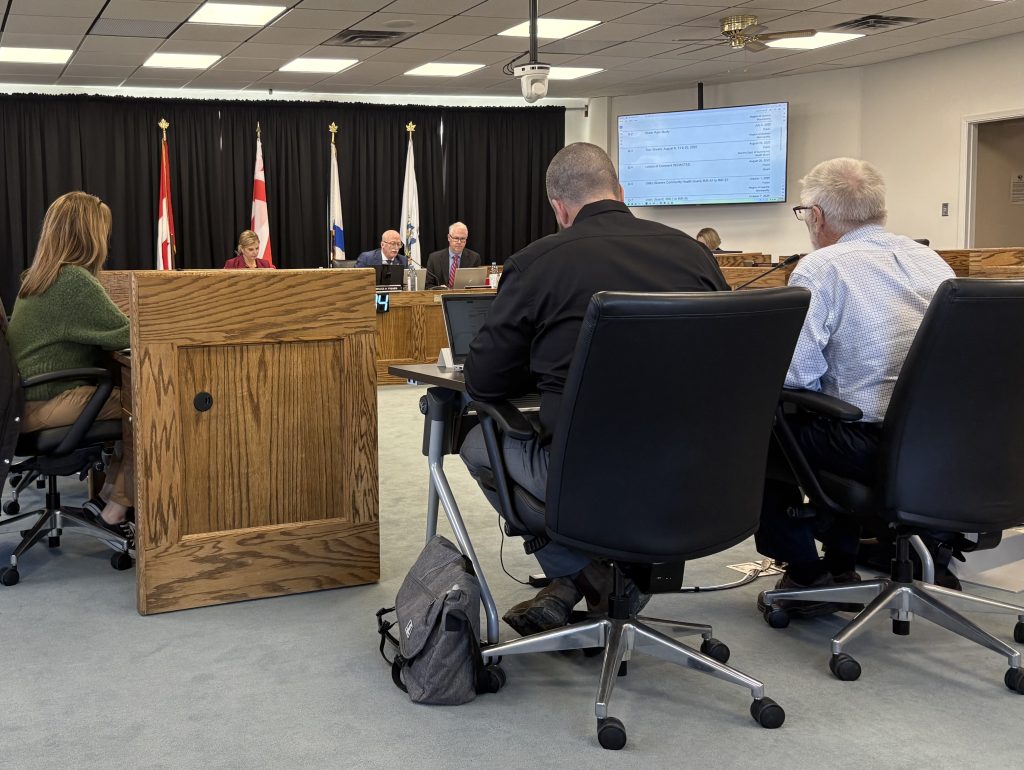
Deputy Mayor Maddie Charlton chaired the Dec. 19 special council meeting on the capital budget. (Region of Queens YouTube)

Region of Queens councillors had some tough questions for senior staff on Friday afternoon as they pored over their five-year, $57-million capital budget.

Elected officials were concerned about the timeline for water and sewer improvements in Liverpool as part of the $26-million Mount Pleasant extension.

They also wanted to know more about projects like the South Queens Outdoor Pool and planned upgrades at the Astor Theatre. And there were concerns about the municipality’s long-term debt.

District 3 Coun. Courtney Wentzell returned to an issue he’s brought up before about extending water and wastewater services to the Mount Pleasant area to connect two planned housing developments to the system. That project is supported with $10.7 million in provincial funding.

“With the loss of treatable water and with us … hiking the water rates, and then going ahead and starting a project to send transmissible water up Mount Pleasant Street before you fix the issue down here on (the west side of) town, … it does not make sense to me, and it never will. 28/29 before you fix the problem? No.”

The region’s current plan calls for $9.7 million in work to begin this coming year to run new water mains to the Mount Pleasant area and upgrade existing infrastructure en route. Work on other, older parts of the system is now scheduled to begin in 2028/29. The end date to finish the overall project has been pushed to 2032/2033, from the original finish date of 2028/29.

But with South Queens Water Utility reporting more than 60 per cent of its treated water lost through leaks in the system, Wentzell says he wants to see older pipes, like the lines and laterals from Roy Turner Road to Union Street, fixed first.

“Isn’t this all one big project now?” Wentzell asked.

“
Isn’t this all just one project or is the Mount Pleasant exchange separate getting up to Dauphinee Farms than the rest of Liverpool? I’m lost. I’m trying to expedite and get the old infrastructure fixed before we start driving pressureless water up a hill.”

Adam Grant, the region’s director of infrastructure, said the contracts are already awarded for the work to Mount Pleasant. And he said fixing one line won’t solve all their water woes.

“I wouldn’t expect to see 60 per cent of it be in that one segment of line. As we know, it’s spread throughout the town. 
So if we accomplish 10 per cent, we should be satisfied. I don’t want to set false expectations that replacing that transmission main, it’s gonna save all of our beans that are falling out of our basket.”

Councillors asked staff to return in January with options to expedite upgrades to older water and sewer lines in Liverpool.

District 6 Coun. Stewart Jenkins questioned Grant and Finance Director Joanne Veinotte about cost overruns at the $8-million South Queens Outdoor Pool.

Veinotte said that in trying to keep the project on budget, some details were missed like the $150,000 wraparound concrete bleachers.

“How can you miss $150,000 of cement bleachers?” Jenkins said. “I don’t understand it.”

Grant said many different departments rushed to finalize the pool design for tender. And some things were overlooked.

CAO Willa Thorpe, who was not with the municipality when council approved the pool plan, said that won’t happen again. 

“When we, as an organization, make hasty decisions on major projects, these are how items like this get missed,” she told councillors.

“So if we were to explore a project of this magnitude again in future, staff will take a different approach.”

Jenkins also wondered why the region is planning to spend about $5 million on heating, cooling and accessibility upgrades at the municipally owned Town Hall Arts and Cultural Centre, home of the Astor Theatre.

“I can’t believe we’re going to spend $5.4 million, when we have poverty, and we have leaking pipes, and we have everything else to spend money on, but we’re going to spend $5.4 million, for something that is not used by very many people in Queens County, and many of them have never been inside. So I think we should be considering that in our budget deliberations.

Other councillors said the municipality has put off necessary upgrades at the Astor for a while. They said the facility is used well now and it could be used more with a modern HVAC system. It’s currently limited in what it can offer in warmer months because there’s no air conditioning.

Councillors also asked staff for a list of how the $10.2-million accumulated surplus will be spent. If they approve the current capital plan, that surplus is projected to drop to $1.7 million by 2031. 

And if they approve the proposed five-year capital plan, they’d also be voting to rack up the region’s long-term debt to $26 million by 2032.

Deputy Mayor Maddie Charlton, who chaired the meeting because Mayor Scott Christian was away, said council is heading in the right direction.

And she said residents can participate in the budget process by filling out a survey on the region’s website here: https://www.regionofqueens.com/budget-engagement.

“And so you can say what’s working well, what’s not working well,” Charlton told QCCR. “Recognizing we have financial implications. we can’t do everything, but I think if we hear from people and there’s overarching themes or gaps and things that we’re missing, then it really positions council to make decisions about those items moving forward.”

Councillors will be back on Jan. 13 to vote on the capital budget.

Email: rickconradqccr@gmail.com

Listen to the audio version of this story below
Water quality will suffer if rates don’t rise significantly, Queens tells regulator

Members of the Nova Scotia Regulatory and Appeals Board held a water rate hearing in Liverpool on Wednesday. (Rick Conrad)

If the Region of Queens Water Utility doesn’t double its rates over the next three years, the whole system is in jeopardy.

That’s what a consultant hired by the region told provincial regulators on Wednesday during a hearing into the utility’s request for an immediate 85 per cent increase, part of its overall 102 per cent requested hike in rates.

Bruce Fisher, chair of the three-member Nova Scotia Regulatory and Appeals Board panel, asked Gerry Eisnor of G.A. Eisnor Consulting, what would happen if the board held the rate increases to 15 to 20 per cent.

“I don’t want to be cynical, but really, if you cut that much out of this budget, I would be buying bottled water,” Eisnor said.

“You will not have a reliable system. 
I think if you cut this back enough, you’re either going to have a water quality issue or a water delivery issue. Either way, you’re in trouble. … This utility needs to be brought up to be funded properly so it can go forward. It will not be what I would call a sustainable, successful operation.”

Eisnor and consultant Blaine Rooney wrote the water rate study that forms the region’s application for an increase for its 1,233 customers in Liverpool and Brooklyn.

Eisnor said the Queens water utility has been undercharging customers for years, especially when compared to other municipalities like Mahone Bay and Shelburne with similar water quality.

The region made its case on Wednesday for rate hikes that the Queens Community Health Board has called “unreasonable, unjust and unprecedented”.

Even the appeals board’s Fisher referred to the application as “rate shock”.

“We don’t typically see 100 per cent rate increases,” he said during Wednesday’s hearing.

Board members questioned region officials on why they need such a large rate hike, their budget assumptions, staffing, the system’s water leaks and loss, and other issues.

They heard that the municipality has been subsidizing the water utility for at least 20 years, as losses have been covered by general revenue.

And that meant that deficiencies in the system were left unaddressed.

Until 2021, the region didn’t have a good handle on the utility’s expenses. The region’s finance director Joanne Veinotte told the board on Wednesday that when she was hired, she began to implement stricter accounting measures. 

Eisnor said there had been no inventory control over things like water meters, which in many cases are 30 to 40 years old and need to be replaced.

“I don’t think the protocols and procedures were as rigorous as they should have been,” Eisnor said. 

“It was worse than we thought,” Veinotte said. “It took us a while to sort through it.”

But when Fisher asked for specifics on exactly what that means, Eisnor and Veinotte could not provide them.

The utility is also struggling with aging infrastructure, Eisnor said, with much of the piping dating from the 1880s. 

The region says it needs to jack up rates immediately to stem a $516,000 deficit. If rates don’t rise, that deficit is expected to swell to more than $3 million by 2027/28.

The Queens Community Health Board intervened in the rate hearing. It said the region’s initial first-year 106 per cent rate hike request was too high, especially for vulnerable residents on fixed incomes.

After they objected, the region lowered its Year 1 request by taking some funds from other budget reserves and smoothing out depreciation charges over a longer period.

Tara Druzina, chair of the community health board, said during the hearing on Wednesday that she doesn’t fault the current council and staff for the water utility’s problems.

“We know this is long in coming, this has been 22 years. But the 22 years has resulted in a significant burden for our vulnerable population.”

Almost 20 per cent of water utility customers are in arrears.

She welcomed the region’s recently approved utility assistance rebate of $200 a year for people with household incomes of $35,000 or less. But she said the cap should be higher, to match the low-income cutoff for a family of four in Queens County of $48,000.

After the hearing, Druzina said she’s confident the appeals board will consider the impact on low-income residents.

“We understand that the utility needs to run a balanced budget. But now I also think that the utility and the appeals board understand that there are a lot of people out there who just cannot afford a 115 per cent increase. 
So hopefully we can strike a balance. And I’m hopeful for that, and the board seems to be siding on that as well.”

Mayor Scott Christian told QCCR that the region is trying to put the utility back on solid financial ground.

“So I think that it is a mess. It’s a mess that was a long time in the making. 
It’s going to take us a while to get out of it. All we can do is make the next responsible wise decision. And I think that the experts that we’ve convened to look at this file and the commitments that we’ve made in the future of the water utility, I think we’re headed in the right direction.”

Members of the regulatory board asked the region to provide more information on five items by Nov. 28. After that, the board has 90 days to make a decision.

Email: rickconradqccr@gmail.com


Region of Queens to offer low-interest loan help for drilled wells

The Region of Queens wants to offer residents with dug wells access to low-interest loans to convert to drilled wells. (Bluenose Well Drilling Facebook page)

Queens County homeowners who want a new drilled well will eventually have access to low-interest loans through the Region of Queens.

Councillors voted unanimously at their regular meeting last week to ask staff to draft a bylaw for a water supply and septic upgrade program.

Some Nova Scotia municipalities already offer low-interest loans for residents who want to switch from a dug well to a drilled well, sometimes at interest rates as low as two per cent.

Joanne Veinotte, the region’s director of finance, told councillors that municipal staff haven’t had calls looking for help with septic systems. But they have heard from people struggling with dry wells who want a loan or grant program to help drill a new one.

“Council will have to decide, are you satisfied with providing $10,000 of assistance, or would you like to provide $30,000 of assistance, or perhaps more?” Veinotte said. 

“Because all of those things depend on how much money you are willing to loan at a low-interest rate, are you going to cover the whole bill or part of the bill? That’s a council decision that will be made through the bylaw process.”

In her report to council, Veinotte said that Queens County has received less than 40 per cent of its annual precipitation in 2025. The area is classified as having severe to extreme drought conditions.

The Municipality of the District of Lunenburg and the Municipality of the District of Barrington are two municipalities on the South Shore that offer low-interest loans for homeowners.

Lunenburg provides up to $20,000 for either well or septic upgrades at a rate of two per cent a year for a term of up to 15 years. Barrington offers a three per cent rate on loans of up to 10 years for well upgrades only. Some municipalities, like Halifax, offer help for both water and septic at prime plus two per cent.

Residents repay the loans through their tax bills.

Initially, staff recommended a program only for drilled wells. But some councillors, like Jack Fancy and Deputy Mayor Maddie Charlton, said they’d like to see septic upgrades included in the program.

“I think of in Milton in particular, there’s so many septics that are going straight into the river,” Fancy said. 

‘And that’s part of the environmental issue of it we need to clean up. And if we’re going to do this, I think we need to make this all part of it.”

District 6 Coun. Stewart Jenkins said he’d like to see the cost of a water pump and water tank included in the program.

Veinotte said councillors have the ultimate authority to draft the bylaw the way they want and to hash out the details, including how much to set aside each year for the loan program.

“You guys would talk all of those things through and decide what works best for our residents,” she said. “But absolutely, you as council have the discretion to determine what goes into what pot and how much everyone can take out.”

This is just the first step toward a low-interest loan program for wells and septic systems in Queens County.

Staff will draft a bylaw for councillors to review at a future meeting. Once councillors introduce a proposed bylaw, residents will have a chance to have their say at a public hearing before anything is adopted.

Email: rickconradqccr@gmail.com

Listen to the audio version of this story below

Queens budget surplus, lower water deficit likely won’t blunt rate hikes

Region of Queens Deputy Mayor Maddie Charlton and Mayor Scott Christian at Tuesday’s regular council meeting. (Region of Queens YouTube channel)

The Region of Queens is sitting on a $1.385-million surplus from last year, but Mayor Scott Christian says the news isn’t as great as it may sound.

“I think a lot of the surplus is on the back of major capital projects that were intended, not getting complete,” he told QCCR.

“So I certainly applaud our finance department and their approach in managing our organization’s finances. But we have this challenge where we’re budgeting money for projects that are really important for the community and we’re just not delivering in a timely way. We need to take a hard look at that and make sure that we are spending the money in the budget that’s going to lead to important projects and progress for residents and for visitors in Queens County.”

The region’s finance director Joanne Veinotte presented the audited financial statements for 2024/25 at Tuesday evening’s council meeting.

She said the region ended the fiscal year with a surplus of $1,385,705, helped along by higher-than-expected tax revenue and returns on the region’s investments. Expenses were lower because of unfilled positions and capital projects not yet finished.

Veinotte also said the Region of Queens Water Utility recorded a lower-than-expected deficit – some 42 per cent less than budgeted, for a saving of almost $185,000.

Even with a higher-than-expected budget surplus and a lower water utility deficit, Christian said he’s not sure how that will affect the region’s upcoming water rate hearing.

“The numbers that are driving the proposed increase to the water rate are modeling sort of well into the future,” he said.  

“I can’t answer if there is good reason to go back and challenge any of the assumptions that were used in generating those projected operating expenditures on the water utility. I’m not sure yet.”

The municipality has requested a 106 per cent increase for most of the 1,200 customers in Liverpool and Brooklyn who are on the municipal water supply.

Nova Scotia Regulatory and Appeals Board hearings are scheduled for Wed., Nov. 19 at 10:30 a.m. in council chambers at the region’s office.

The region hired consultants G.A. Isenor and Blaine Rooney to prepare its water rate study as part of its application to the regulatory board.

In documents filed on the board’s website, the regulator has asked the region for more information or clarification on 55 various points. 

Some are about whether the region knows if people will be able to afford the expected $348-a-year increase for most residential customers.

It also asked the region to submit a revised rate study lowering the financial impact on customers and spreading it out over three years instead of imposing most of the increase in the first year.

So far, there is one registered intervenor in the rate hearing. The Queens Community Health Board is concerned how the increased water expenses will affect the broader health and well-being of residents.

Christian said the proposed increases are important to put the water utility back on sound financial footing.

“We want to get our costs in order and run the water utility in a solvent way that’s aligned to our obligations as a water utility operator, and so the sooner that we can get our costs in order the better.”

Even so, Veinotte told councillors on Tuesday evening that by the time the hearing happens and the regulator makes its decision, any rate increases likely won’t take effect until 2026.

To look at all the documents filed so far as part of the region’s water rate application, use this link and enter M12363 in the field.

Email: rickconradqccr@gmail.com

Listen to the audio version of this story below

Architects hired to begin process to upgrade Liverpool’s Astor Theatre

The exterior of the Liverpool Town Hall Arts and Cultural Centre

Architects will spend the next six weeks assessing what kinds of upgrades are needed at the Town Hall Arts and Cultural Centre, which houses the Astor Theatre. File photo by Ed Halverson

The Region of Queens has hired architects to come up with a plan to modernize the historic Astor Theatre in downtown Liverpool.

DSRA Architecture of Halifax has experience working on heritage buildings such as the Lunenburg Academy, Province House in Halifax and Halifax City Hall. Councillors approved spending $17,500 from the accumulated budget surplus.

The region owns the Town Hall Arts and Cultural Centre, which houses the Astor. The Astor Theatre Society leases it from the region.

The Astor is limited in what kinds of events it can hold, especially in summer and fall, because it does not have a modern climate control system.

It relies on an oil-fired hot water furnace for heat and windows for ventilation.

The building also needs many upgrades to meet provincial accessibility requirements.

Elise Johnston, who is the region’s former accessibility coordinator and now its manager of capital projects, says hiring the architects will kickstart the process to assess the building’s needs. 

“As we know it can be quite stifling hot, especially in the summer,” she told councillors at a recent meeting.

“It’s very uncomfortable. So it affects their operations. It’s a big project. 
We have looked at a few independent reviews and designs, but then that didn’t take into consideration the accessibility (concerns). So if we’re going to do this, we need to do it in a holistic way.”

Johnston told councillors that the region and the Astor have discussed installing a modern HVAC system before, as well as an accessible lift to get to the second floor and a universal washroom. But those projects were discussed in isolation and not part of one overall plan.

She said hiring the architects will help get the necessary work started, “which would be to look at all the applicable codes, all the top priority needs, get some community engagement, and plan the steps forward. The main question is, what is priority, what can come first? 
How do we phase this over a period of time?”

Eric Goulden, chairman of the Astor Theatre Society, told QCCR that the much-needed upgrades could potentially be a multimillion-dollar project.

“All in all, they’re going about it in the right way,” he said.

“It needs an architect. It’s an old building. It requires a significant amount of work to protect its heritage. All good, all very, very good. And great support from the council.”

District 6 Coun. Stewart Jenkins asked whether the region gets any revenue from ticket sales at the Astor. 

Joanne Veinotte, the region’s director of finance, said a portion of each ticket sold goes into a special capital projects fund for the building.

Jenkins said that because the Astor is such a big part of downtown Liverpool, he’d like the region to develop a five-year plan.

“I think we need to do more to preserve this building and make it a viable building moving forward.”

Johnston said this project is meant to do that and to make it “a more revenue-generating building”.

She told councillors the architects plan to begin work immediately with a report back to council in about six weeks.

Email: rickconradqccr@gmail.com

Listen to the audio version of this story below

Hearing dates set for Region of Queens water rate hike

The Region of Queens Water Utility has proposed increasing water rates by more than 100 per cent. (Bluewater Sweden via Unsplash)

Hearing dates have been set for the Region of Queens water rate hike application, as customers brace for their costs to double.

Joanne Veinotte, the region’s director of finance, told councillors in June that the water utility needs to bring revenue in line with costs immediately. The Region of Queens Water Utility’s 1,233 customers in Liverpool and Brooklyn bear the costs of the service.

“These increases translate to an average annual increase of 106 per cent in the initial year, 3.8 in Year 2 and 2.7 in Year 3,” she said.

“Over the last several years, the utility has struggled operationally with staffing, and the treatment plant was heavily damaged in July 2023 during a severe thunderstorm that destroyed a large amount of sensitive and expensive instrumentation and equipment at the site.”

The Nova Scotia Regulatory and Appeals Board has scheduled a public hearing for Thurs., Oct. 9 at 10:30 a.m. in council chambers on White Point Road.

An evening session starting at 6 is also scheduled if it’s needed.

People can speak at the hearing, but they must register with the board by Sept. 17. Residents can also send written comments to the clerk of the board at PO Box 1692, Unit M, Halifax, NS B3J 3S3, by email at board@novascotia.ca, or by fax at 902-424-3919. The deadline for written submissions is also Sept. 17.

People can request formal standing as an intervenor in the hearing. That allows you to present evidence and cross-examine witnesses. The deadline for applications for intervenor status is Aug. 22.

The region hired consultants G.A. Isenor and Blaine Rooney to prepare its water rate study for the regulatory board.

They found that the water utility will rack up a deficit of just over $1 million by the end of 2025/26, if rates don’t increase immediately. That shortfall will swell to $3.344 million by 2027/28 without higher charges.

For residential customers, the average quarterly bill is now $82.61. That could rise to $169.66 this year, $174.63 in 2026/27 and $177.39 in 2027/28.

The average customer currently pays $330.44 a year. If the rate hikes are approved, that will rise to $678.64 annually in the first year and $709.56 after three years. 

The annual fire protection charge paid by the municipality, currently $201,531, could increase by 99.3 per cent to $401,599 for 2025/26, $495,931cfor 2026/27 and $503,625 for 2027/28.

Queens water customers had to endure an almost nine-week boil water order in summer 2023. That was after a lightning strike heavily damaged the water treatment plant.

The region gave a one-time 70 per cent discount on water bills, after public demand.

This time, though, customers likely won’t get a break from significant increases to their water bills.

The region claimed in a news release in June that its customers pay the lowest rates in Nova Scotia. 

The new rates would put it in line with the Town of Lunenburg, but higher than the Town of Bridgewater and the Cape Breton region.

Region of Queens Mayor Scott Christian said comparing rates in Queens to other municipalities isn’t as straightforward as it seems.

“This proposed change to the rate, it brings us into alignment with a lot of ‘like’ municipalities, a lot of our neighbouring municipalities who have water utility systems. So I think that is important to understand what we look like in comparison to a lot of the other municipal units around us.”

The regulatory and appeals board has the power to set rates as requested, order a lower increase or an even higher one.

You can read the documents filed with the region’s water rate application on the Nova Scotia Regulatory and Appeals Board website here, by entering M12363 in the field to go directly to the matter.

Email: rickconradqccr@gmail.com

Listen to the audio version of this story below

Water rates could double for Liverpool, Brooklyn customers

Customers of the Region of Queens Water Utility will see their rates rise. (Kawita Chitprathak via Pixabay)

Municipal water customers in Liverpool and Brooklyn could see their rates double.

The Region of Queens is almost ready to submit its water rate application to the Nova Scotia Regulatory and Appeals Board.

Councillors are set to discuss a report from senior staff at their meeting on Tuesday evening.

2021 was the last time rates for the region’s water utility were reviewed. They were set for the following three years until 2024. The region has been holding the line on rates since then, but it has racked up a deficit of about $516,000.

If rates don’t increase, the water utility’s deficit is projected to swell to $3.344 million by 2027/28.

According to a three-year water rate study done by G.A. Eisnor Consulting Limited and Blaine S. Rooney Consulting Limited, the utility needs revenues to jump immediately by more than $1.6 million to stem the tide of rising deficits.

The staff report for council prepared by Adam Grant, director of infrastructure, and Joanne Veinotte, director of finance, blames the heavy damage sustained at the water treatment plant by a lightning strike in July 2023. An insurance claim partially covered the damage, according to the report.

But Grant and Veinotte also point out that the utility has struggled operationally for years.

The lightning strike in summer 2023 led to a boil-water advisory for water customers that lasted almost nine weeks.

After public demand for a break on rates, the region gave a one-time 70 per cent discount on water bills in 2023.

The region has been warning for the past year that its 1,233 customers should prepare to pay much more for water.

The water rate study done for the region recommends an average increase in rates of 106 per cent immediately, 3.8 per cent in 2026/27 and 2.7 per cent in 2027/28.

Once councillors approve the rate study, it will be submitted to the Nova Scotia Regulatory and Appeals Board, which will schedule a public rate hearing.

The public will be allowed to give their input on the proposed rates at the hearing.

Email: rickconradqccr@gmail.com

Region of Queens has surplus in hand as it considers relief for low-income residents

Region of Queens Mayor Scott Christian, right, wraps up the municipality’s second budget meeting on Monday night. Also pictured is interim CAO Dan McDougall. (Region of Queens YouTube channel)

Region of Queens councillors began their 2025/26 budget discussions with some money in the bank from 2024/25, as they look to make life a little easier for people on low or fixed incomes.

Mayor Scott Christian said the region has a surplus in the million-dollar range. But he said it’s difficult to know for sure until finance staff crunch the final numbers.

Last year, council began budget deliberations with a $650,000 surplus from 2023/24. Nova Scotia municipalities are not allowed to run an operating budget deficit.

Councillors are following a different process this year. While the meetings are public, residents don’t have access to draft budget documents as they did in last year’s discussions.

“I think in past years, there was a lot of emphasis on starting with a tax rate and then working down or whittling away at that or as you add things, the tax rate implications,” Christian told QCCR.

“I think that this year we wanted to focus on funding the right things, identifying what are going to be appropriate things to include in the capital investment plan, and then get that operating budget right. 
So I think it was a conscious decision but that was staff-driven that they thought that let’s try to get it right, try to set the appropriate budget given what the needs of the community are, and then look at it on balance with revenue and see what the implications are for the ratepayer.”

In their second public budget meeting earlier this week, councillors discussed boosting the low-income property tax exemption and helping the Queens County Food Bank with its rent.

They also found out that the region has about $325,000 left over from the renovations to the new Thomas H. Raddall Library space. Councillors had approved up to $1.26 million for that work.

And revenue at Queens Place Emera Centre is forecasted to be down this year because of less advertising and sponsorship and no major full-facility rentals planned to March 31, 2026.

Heading into 2025/26, the region expects to get $20.5 million in property tax revenue, an increase of $900,000, based on the current base tax rate of $1.04 per $100 of assessment.

That increase is mostly due to higher property assessments, which rose by $86.9 million.

Director of corporate services Joanne Veinotte took councillors through the region’s preliminary operating budget.

It was a chance for councillors to request changes, more information or additional funding.

Councillors like District 4 representative Vicki Amirault want the low-income property tax exemption increased to give more relief potentially to more people. 

“I would like to up the income level,” she told councillors. “
I think we should up it $5,000 on each stage there, and up the rebate as well. I think it would be very helpful to our residents.”

Last year, the region increased the maximum income threshold to $35,000. Those in the lowest income range, up to $25,000, can get a $400 break on their taxes. Those in the top group can apply for up to $300 in relief.

Veinotte said she would report back to councillors on what relief the region could offer depending on how much more money councillors devote to the program.

District 3 Coun. Courtney Wentzell said he wants council to have a serious look at the Mount Pleasant water and wastewater extension. The region has budgeted $10.8 million toward the $21-million project. The Nova Scotia government is covering the rest.

The project would extend municipal water and sewer access to two new private housing developments in Liverpool. It would also improve existing infrastructure.

“The extension to Mount Pleasant boggles my mind when we have so much infrastructure need, including sidewalks … but not just that, with the upgrades needed in water on the west side of town, up till Union Street, I’m really having some reservations about the extension at all,” Wentzell said.

“And I’m speaking from the heart. I’m sorry if that upsets some people.”

Christian said after the meeting that councillors want to understand what exactly is involved in that project and potentially look for ways to lower the municipality’s share of the cost. 

“This council’s not OK with incurring a huge amount of debt that could potentially be paid for by the general ratepayer and/or utilizing reserves that have been accumulated from the general ratepayer to pay for that service extension. And we currently don’t have any federal monies that are committed to that project. I think that that’s problematic. What is the plan with service extension? What impacts does that have on preparing us for future growth but also what impacts does it have, attending to known and foreseeable issues associated with the existing infrastructure for our utilities?”

Councillors will resume budget talks on Tues., May 6 at 6 p.m. at council chambers on White Point Road.

Email: rickconradqccr@gmail.com

Listen to the audio version of this story below

Queens councillors approve extra cost for Hillsview Acres elevator work

Region of Queens councillors have approved an extra $33,272 in work at Hillsview Acres to prepare for elevator upgrades at the facility. (Facebook)

UPDATED 3:55 p.m. Friday

It’s going to cost a little more to upgrade the elevator at a nursing home in north Queens.

Region of Queens councillors held a special meeting on Wednesday to approve an extra $33,272 for electrical and alarm panel work at Hillsview Acres in Greenfield.

The region owns and operates the 29-bed long-term care home.

Joanne Veinotte, the region’s director of corporate services, told councillors that in 2022, the contractor responsible for maintaining and inspecting the elevator told staff “that it was nearing its end of life. Should something happen to the elevator we would not be able to replace it in a timely manner.”

Council had already approved $86,250 in their 2023/24 capital budget for the work on the facility’s elevator.

But when the elevator contractor, TK Elevator, visited Hillsview in the spring, workers found that the existing alarm panel and supporting electrical components needed to be upgraded to accommodate the work on the electrical components of the elevator.

The extra costs break down as follows:

  • Alarm panel upgrade – $21,913
  • Basement changes to accommodate new access – $2,077
  • Electrical work to install new panel $7,914.50

Veinotte told councillors that the elevator contractor is due to be at the facility in the second week of August to do the work.

“All of the panel work has to be done before they come which is why we had this sense of urgency to come and ask for council’s approval for this unbudgeted expense.”

Councillors voted unanimously to approve the extra cost and to fund it from the Hillsview Acres reserve fund, which sits at more than $800,000.

Email: rickconradqccr@gmail.com

Listen to the audio version of this story below

Region of Queens councillors to vote on play park write-off

Kids play this week at the splash pad at Etli Milita’mk, the universally designed play park in Liverpool. (Rick Conrad)

UPDATED JULY 20 at 10:30 a.m.

Region of Queens councillors will vote next week on whether to write off almost $51,000 in cost overruns and funding shortfalls at the universally designed play park in Liverpool.

Councillors voted last week to move the issue forward to their June 25 meeting for a final vote. Most of them appeared to support absorbing the cost.

District 2 Coun. Ralph Gidney was the only one against the motion to vote on the matter at their next meeting.

The provincial organization recently asked the municipality to cover $50,962 in unpaid bills on the $630,000 playground. Some $5,988.79 of that is interest on the overdue account.

Joanne Veinotte, director of corporate services, told councillors last week that Autism Nova Scotia told the municipality they believed that the region would cover any shortfalls.

“Fundraising was less than forecasted. The ACOA contribution was less than budgeted and there were cost overruns such as short-term security for surfacing materials, rescheduling of a rubber surface contract and extension of a rubber surface area. This all contributed to the overage.”

Beyond that, however, details about the overdue account were sparse. It was unclear what the outstanding bill is for or to whom, or when Autism Nova Scotia realized that there wasn’t enough money on hand to cover all the expenses of the project.

The playground is named Etli Milita’mk (pronounced ed-a-lee milly-dumk), which is Mi’kmaw for “we are playing here”. It opened last October, after years of community fundraising led by Queens County resident Debbie Wamboldt and others. It’s designed to be inclusive and accessible for everybody, regardless of ability or age. 

The community group raised about $100,000 on their own, with the region donating the land near Queens Place Emera Centre and committing $111,773 from its community investment fund. ACOA and the provincial government also contributed to the project.

Autism Nova Scotia issued charitable tax receipts and held the money in trust to pay the region for construction as invoices were submitted. The region also agreed to own, operate and maintain the playground.

QCCR tried numerous times for an interview with officials from Autism Nova Scotia. Last week, a spokeswoman said in an email that they were “unable to provide an interview at this time”.

QCCR asked the municipality this week for clarification on the account. In an email, Heather Cook, the region’s communications and engagement co-ordinator, explained that the municipality has paid all bills related to the park and no suppliers are owed money.

Because of cost overruns and funding shortfalls, she said, Autism Nova Scotia contacted the region in April to say that it would not be paying the full amount of the final invoice, which the municipality issued in January. The group did not pay any interest on overdue invoices during the term of the project, resulting in interest charges which contributed to the shortfall.

Councillors will vote on June 25 “to fund the outstanding interest charges and project overrun that (are) owed to the municipality due to the funding shortfall.”

The money would come from the municipality’s accumulated budget surplus.

District 1 Coun. Kevin Muise said last week that councillors had voted to donate the land and approve funding from the community investment fund. But he said they didn’t vote to cover any overruns.

District 3 Coun. Maddie Charlton asked if there was any additional information that staff could share with councillors before their next meeting.

CAO Cody Joudry, who took over in November, said there wasn’t.

“I don’t believe there is any other documentation to provide council. … From Autism Nova Scotia’s perspective, they’re like, ‘Well, it’s not really fair to make us cover the difference because we were just the pass-through and really the region was the one who was managing the project.’

“I think if we were doing this over again, we would have brought this to council a lot sooner, like in the construction phase and talked about these issues. But I can’t do anything about that now. So, unfortunately, Coun. Charlton, I do not believe there is any more information I can bring you.”

Councillors did not want to ask Autism Nova Scotia or the local fundraising group to cover the extra costs.

Mayor Darlene Norman said that it was nobody’s fault. Construction delays and weather last summer contributed to the extra expenses. 

She said in an interview Monday that it didn’t help that the region was without a full-time CAO for much of last year. Former CAO Chris McNeill left the job in May. 

“Remember, this was a time when we had no CAO last year, directors were shifting and taking those roles. And then we had the boil water situation happening, we had no permanent CAO. I’m not saying that’s any reason why this may have occurred, but obviously there was lack of communication between Autism Nova Scotia and Region of Queens staff.”

Norman said that in future, the region would likely approach projects like this differently.

“It was a lesson that if a project like this should ever be undertaken again there needs to be very firm rules respecting who manages what and conversations and communication between the two partners.”

The June 25 council meeting will be held at the Westfield Community Hall in North Queens.

Email: rickconradqccr@gmail.com

Region of Queens avoids tax rate hike for now while helping fire services

Fire trucks at North Queens Fire Association headquarters. (Facebook)

Region of Queens councillors and staff have found a way to help the county’s fire departments with the increased costs of buying new equipment — and all without raising the tax rate.

Councillors are currently in budget deliberations, so the final budget has not been approved. But they headed off a request for an increase to the tax rate to help fire departments pay for new trucks.

Fire chiefs and the region agreed to a new funding schedule in February to replace fire and rescue trucks. The region increased its contribution to $425,000 for pumpers, tankers and aerial trucks from $275,000. That kicks in for the 2026/27 fiscal year.

But as councillors heard on Tuesday, new trucks keep getting more expensive. And higher interest rates mean that borrowing costs for fire departments have skyrocketed.

Fire chiefs made a presentation to council on Tuesday asking for an increase of one cent to the region’s overall tax rate. 

The residential property tax rate per $100 of assessment in districts 1 to 12 is at $1.07 and $1.92 in District 13.

Chris Wolfe, chief of the North Queens Fire Association, told council that interest rates for fire departments have risen to 8.2 per cent from 3.45 per cent in 2021. On a 10-year loan of $600,000, fire departments would have to pay $170,000 more over that period than they would have in 2021.

“Basically the $275,000 that we get now for truck replacement would be just gobbled up in interest charges and wouldn’t be going to the actual principal of buying the truck,” he said.

“The interest for that 10-year term is what’s making a big difference for us in the Queens County fire services in purchasing trucks. It’s taken a drastic jump over the last three or four years.”

Wolfe said the cost of trucks has also risen in the past three years. He said a truck builder in Lantz reported that the cost of a custom fire chassis has jumped by about $120,000 since May 2022. The truck builder told Wolfe that his overall supply costs have also gone up by three per cent. 

Three trucks are due to be replaced over the next two fiscal years, but at the region’s lower contribution of $275,000.

Wolfe said that a one-cent increase in the tax rate now would help the fire departments cope with the increased costs.

Councillors appeared to be prepared to grant the chiefs’ request.

CAO Cody Joudry, however, suggested that staff might be able to find another way to grant the chiefs’ request without adding to the tax rate. 

After a break, Joanne Veinotte, director of corporate services, said that councillors could do what they did last year to help maintain the tax rate.

During last year’s discussions, they budgeted $442,000 from the accumulated surplus to prevent a tax rate increase. Councillors are also eyeing an estimated $650,000 surplus from 2023/24. 

Veinotte said the region didn’t actually need any of that $442,000 because they saved money on staffing and delayed capital projects. She suggested they could do the same thing this year, by pulling $126,772 from reserve funds for fire services to balance the tax rate.

“The fire department has their increase of a penny but yet you still have your no increase in tax rate. And that is something I can literally do in two minutes. So if that’s what council feels comfortable with to get this budget done and put to bed, then I can certainly do that.”

Joudry clarified that if they record a surplus in 2024/25, then the region likely wouldn’t have to dip into the accumulated surplus to pay for the fire departments’ increased truck costs.

Councillors will get the final draft of the budget on Thursday. They hope to approve it at their council meeting on Tues., April 23 at 6 p.m.

Email: rickconradqccr@gmail.com

Listen to the audio version of this story below

Region of Queens misses budget deadline, approves special spending

A brick building with Region of Queens Municipality administration building on the outside.

Region of Queens Municipality administration building. (Rick Conrad photo)

The Region of Queens hasn’t approved its budget yet, so councillors had to vote this week to approve interim spending limits so that the municipality’s bills will still get paid.

Council is supposed to have a budget approved by April 1 of each year.

That didn’t happen this year, so director of corporate services Joanne Veinotte asked councillors at Tuesday’s regular meeting to approve an amount of $7.59 million to provide “spending authority and business continuity” as the fiscal year begins April 1.

Veinotte said other municipalities follow a similar process.

These are operational funds and don’t apply to capital projects.

No reason was given by staff or councillors for why the budget hasn’t been presented or approved yet. Mayor Darlene Norman was not available for an interview Thursday. 

Also at Tuesday’s meeting, CAO Cody Joudry presented a tentative schedule for the region’s budget deliberations.

Under that timeline, councillors were supposed to receive a draft budget after their meeting on Tuesday, with April 2 as the deadline for councillors to submit budget questions.

The draft budget will be available publicly by April 5 at 4 p.m. in the council agenda. It will be presented at council’s regular meeting on April 9. Two special meetings to discuss the draft budget will be held April 11 and 16, with the final draft budget presented at council’s April 23 meeting for a vote.

Under Joudry’s proposed schedule, councillors would vote on the final budget at their April 23 meeting. 

Email: rickconradqccr@gmail.com

CORRECTION: An earlier version of this story had the incorrect date for the Region of Queens final draft budget to be presented and voted on by councillors. The story has been updated with the correct date.

Queens to reimburse Brooklyn Recreation Committee for financial review

Melissa Thiele-Smale, treasurer of the Brooklyn Recreation Committee, spoke to Queens regional council in January. (Region of Queens YouTube channel)

The Brooklyn Recreation Committee will be reimbursed $1,150 by the Region of Queens for the cost of a financial review.

In 2023, the committee was granted a community area rate of four cents per $100 of assessment to fund its operations. The rate provides $32,000 in revenue. 

Certain community groups can apply to the region to levy an area rate on their behalf. The group sets a proposed rate, which is calculated at cents per $100 of assessment or a lump sum.

An area rate request is subject to public consultation and a non-binding vote by those in the communities served by the group.

Queens is one of the only municipalities in Nova Scotia to offer an area rate to community groups to cover expenses. Other municipalities levy rates for assets owned by the municipality.

“There are many who apply different rates to different areas for different purposes. These rates are used to cover costs that are more specific to an area such as: fire protection based on fire service area, sidewalks, local recreation facilities, etc.,” Joanne Veinotte, director of corporate services, said in her Jan. 9 report to council.

“Staff could identify very few municipal units that use this method to support community groups that operate independently from the municipal units.”

The region changed its community area rate policy on Jan. 23, and the financial reporting requirements for community groups. 

Under the old policy, groups had to submit a financial review by a qualified chartered public accountant. 

In the new policy, only those generating revenue over $50,000 have to submit a financial review. Those groups generating revenue from the area rate over $100,000 must submit audited financial statements.

The Brooklyn Recreation Committee had a financial review done by Belliveau Veinotte, which cost $1,150. District 4 Coun. Vicki Amirault asked council at their Jan. 9 meeting to consider reimbursing that cost.

Councillors voted on the motion at this week’s meeting. It passed by a vote of 5 to 3. 

Some councillors were concerned that the group knew it would have to pay for the financial review before the policy changed, and that taxpayers shouldn’t be on the hook.

Email: rickconradqccr@gmail.com

Rate hikes loom as Queens water utility expenses balloon

A brick building with Region of Queens Municipality administration building on the outside.

Region of Queens Municipality administration building. (Rick Conrad photo)

By Rick Conrad

Residents in Liverpool and parts of Brooklyn should brace for water rate hikes but not right away, Mayor Darlene Norman said Tuesday.

 “Please be prepared for a water utility rate study and a very probable increase in water utility rates,” Norman said in an interview.

Regional council got a better picture on Tuesday of the budget impact of the boil water advisory for Queens water utility customers from Aug. 9 to Oct. 5 last year.

The municipality had already budgeted last spring for a loss of $173,700 for the water utility. The treatment station was struck by lightning on Aug. 9. Residents on the municipal water supply were under a boil water order for eight weeks.

Joanne Veinotte, director of corporate services for the Region of Queens, gave councillors a third-quarter financial review on Tuesday. As of Dec. 31, the water utility has run an extra $252,655 over budget, or $426,355 so far. 

Norman said Queens water customers pay some of the lowest rates in the province. The utility must pay for itself and not run a deficit.

Before any rate increase, however, the utility has to prepare a rate study. The Nova Scotia Utility and Review Board would have to approve any fee hike. 

Norman said she has no timeline for when that review may be done. She said council does not have the money in its current budget for the rate study. 

“The system is old, early 1900s. So it constantly needs repair and upgrading.

“It may well be the next council coming in in October that will be looking at the results of that study.”

Veinotte told councillors Tuesday that the region will be reimbursed for $82,000 from its insurance provider for the damage caused by the August lightning strike. 

“At the end of the day that claim is now finalized but we’re still dealing with some of the fallout from the lightning strike,” Veinotte told councillors.

In other positive financial news for the region, revenue from the 2.5 per cent deed transfer tax was again over budget for the third quarter.

Veinotte said the region brought in about $220,000 more than expected from the tax in the quarter and the region is expected to exceed its projection for the deed transfer tax by about 58 per cent for the whole fiscal year.

The region also got a higher-than-expected share of the Nova Scotia Power tax payout from the province of about $132,000.

Email: rickconradqccr@gmail.com