New year, new costs: Water bills in Liverpool, Brooklyn to jump by 85 per cent

The Nova Scotia Regulatory and Appeals Board has approved increases for customers of the Region of Queens Water Utility. (Rick Conrad)

More than 1,200 water utility customers in Liverpool and Brooklyn will see a significant spike in their bills this year.

In a decision released Dec. 22, the Nova Scotia Regulatory and Appeals Board has approved an 85 per cent increase in water bills for customers of the Region of Queens Water Utility. Once the full increases take effect, it will mean an extra $300 per year for most residential customers.

The new rates took effect Jan. 1, but the board also ordered the utility to phase in the increases to 2027 to help mitigate “rate shock”. It also ordered that interest on the utility’s debt to the municipality be eliminated, and to adjust the utility’s earnings and debt forecasts.

“The Board finds that the utility is in a difficult position,” board members wrote.

“The Board also finds that, other than the minor adjustments directed above, the required revenues in the application are just and reasonable, and necessary to produce safe, reliable water. Yet its rate increases clearly fall within the definition of ‘rate shock’.”

The average residential customer will now pay $531.28 a year, an immediate 60 per cent increase. It will eventually rise to $664.08 in 2027.

At a hearing on Nov. 19, the region said the utility needed to increase rates dramatically to deal with a mounting $1.4-million deficit.

Mayor Scott Christian told QCCR this week that the board’s decision allows the water utility to pay off some of its deficit and continue to provide good-quality drinking water to its customers.

“I think it’s a fair judgement. It gets us to a place where we can run a water utility in a sustainable way, while helping to cushion the blow a little bit to the consumer in terms of the spike in that rate.”

In November, regional councillors approved a utility assistance rebate for water customers on low incomes. People are eligible for up to a $200 annual break on their water bills.

With that rebate applied, the municipality projects less than a one per cent increase this year for people in the lowest income bracket and about a 40 per cent increase by 2027.

Christian said he understands that even with the rebate, some people will still struggle with the higher water costs.

“The utility for a long time was run in a way that didn’t position us to have a sustainable, solvent utility. I understand for sure that people are having a tough time making ends meet. Any additional cost to folks for running a household is always challenging.”

The Queens Community Health Board had opposed the rate increases at the November hearing.

Board chair Tara Druzina did not want to do an interview this week, but said in an emailed statement that the board is concerned about the size of the rate increases “and the impact they will have on households already under financial pressure.”

She applauded council’s adoption of the rebate, but said the region still needs to address affordability concerns for all users.

The review board also “strongly encouraged” the municipality to begin replacing customers’ water meters, most of which are at least 50 years old.

A 2024 report for the utility found that it was losing up to 69 per cent of its treated water, either through leaks or because the old water meters were inaccurate.

“So it was a bit of a moment of clarity for me that sure, some of it is seeping, weeping, leaking, older pipes,” Christian said.

“But then some of it too is that we’re actually delivering the water and it’s being underreported. It helps us to identify an action in addressing that and getting those metres in place that can actually more accurately report that water consumption.”

Christian said the municipality will begin working on replacing those old meters.

He said he’s not sure when the rate increases will be reflected on people’s water bills.

Email: rickconradqccr@gmail.com

Listen to the audio version of this story below
‘Rate shock’ cited in denial of Halifax Water hike, as Queens awaits water rate ruling

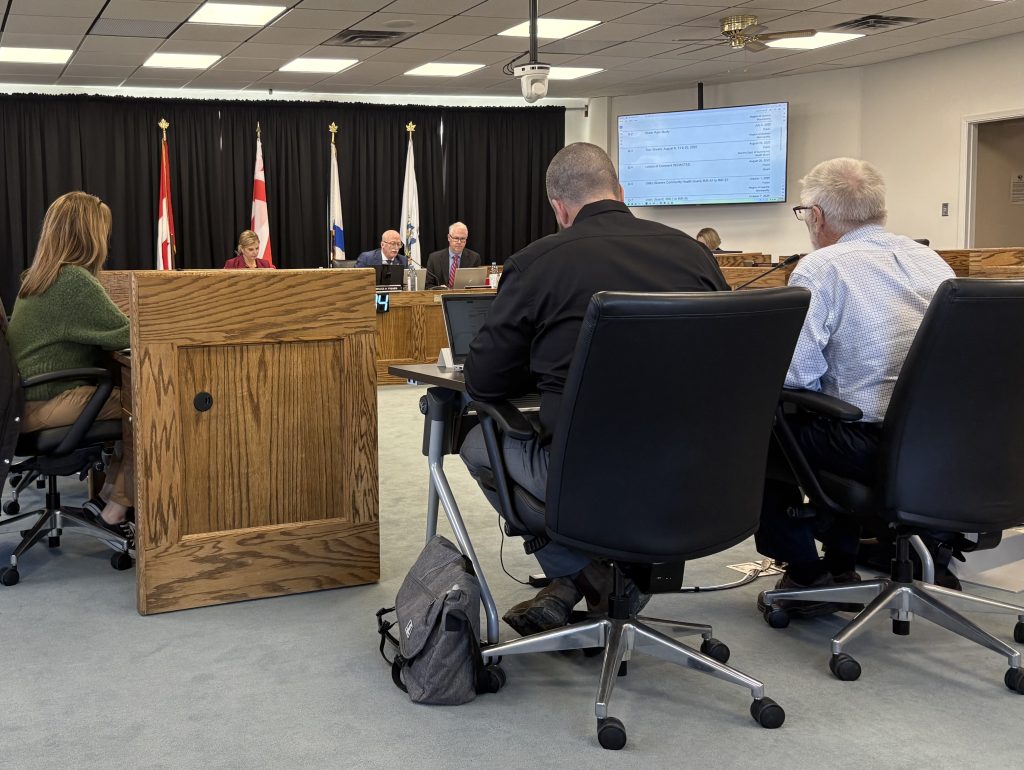
Members of the Nova Scotia Regulatory and Appeals Board held a water rate hearing in Liverpool in November. (Rick Conrad)

A decision limiting Halifax Water rate hikes may have implications for the Region of Queens as it waits to hear a decision on its application to double water rates.

The Nova Scotia Regulatory and Appeals Board on Tuesday approved a reduced rate increase for the Halifax region’s water utility.

Halifax Water had asked for a combined 35.6 per cent rise in rates, to be implemented over the first three months of 2026. Provincial regulators called that “rate shock” for customers.

The board denied Halifax Water’s request to include deficit elimination in its application. Removing that would lower the second rate increase by about 10 per cent.

It ordered Halifax Water to return with a modified rate proposal within a week.

“The Board finds that the magnitude of the proposed rate increases, implemented over the first three months of 2026, constitutes ‘rate shock’ for its customers. For residential customers, the combined, compounded rate increase was proposed to be 35.6% from January 1 to April 1, 2026,” the regulator wrote in the decision released Tuesday.

“While Halifax Water provided a reasonable explanation about the need to increase rates to cover some of its higher costs due to inflation and other cost pressures, the Board finds that other requested costs were not justified or that the utility overestimated some of those costs.”

The Halifax and Queens water rate applications are very different. For example, Queens is asking regulators for a combined 102 per cent increase over three years. It also has equipment and infrastructure problems Halifax doesn’t.

At the Region of Queens hearing in November, municipal officials warned that without an immediate 85 per cent hike, the whole water system could be in jeopardy. 

They said the Region of Queens water utility has been undercharging its 1,200 customers in Liverpool and Brooklyn for years. And because of that, the infrastructure is outdated and needs to be repaired or replaced.

The water utility is supposed to pay for itself through what it charges customers.

The region says it needs to jack up rates immediately to stem a $516,000 deficit. If rates don’t rise, that deficit is expected to swell to more than $3 million by 2027/28.

But during the hearing, board members challenged the region’s past accounting practices and their claims from the last time they asked for an increase in 2021.

Board chair Bruce Fisher opened the hearing by characterizing the region’s application as “rate shock”.

“As there’s a fairly significant rate increase, the board did issue an additional set of information requests. Essentially, we wanted to have additional information on the record in advance of this hearing so we could discuss potential options to deal with what I would say is rate shock.”

The only intervenor in the hearing, the Queens Community Health Board, opposed the region’s application, saying that granting such a large increase would be rate shock for customers.

Fisher also told the region later in the hearing that the size of their request was unusual.

“We don’t typically see 100 per cent rate increases.”

At the end of the hearing, the board had asked for more evidence from the region to support its application. That was received on Nov. 28.

The board aims to file its decisions within 90 days after they receive final evidence. So the decision in the Region of Queens water case will likely be available in late February.

Email: rickconradqccr@gmail.com

Listen to the audio version of this story below

Water quality will suffer if rates don’t rise significantly, Queens tells regulator

Members of the Nova Scotia Regulatory and Appeals Board held a water rate hearing in Liverpool on Wednesday. (Rick Conrad)

If the Region of Queens Water Utility doesn’t double its rates over the next three years, the whole system is in jeopardy.

That’s what a consultant hired by the region told provincial regulators on Wednesday during a hearing into the utility’s request for an immediate 85 per cent increase, part of its overall 102 per cent requested hike in rates.

Bruce Fisher, chair of the three-member Nova Scotia Regulatory and Appeals Board panel, asked Gerry Eisnor of G.A. Eisnor Consulting, what would happen if the board held the rate increases to 15 to 20 per cent.

“I don’t want to be cynical, but really, if you cut that much out of this budget, I would be buying bottled water,” Eisnor said.

“You will not have a reliable system. 
I think if you cut this back enough, you’re either going to have a water quality issue or a water delivery issue. Either way, you’re in trouble. … This utility needs to be brought up to be funded properly so it can go forward. It will not be what I would call a sustainable, successful operation.”

Eisnor and consultant Blaine Rooney wrote the water rate study that forms the region’s application for an increase for its 1,233 customers in Liverpool and Brooklyn.

Eisnor said the Queens water utility has been undercharging customers for years, especially when compared to other municipalities like Mahone Bay and Shelburne with similar water quality.

The region made its case on Wednesday for rate hikes that the Queens Community Health Board has called “unreasonable, unjust and unprecedented”.

Even the appeals board’s Fisher referred to the application as “rate shock”.

“We don’t typically see 100 per cent rate increases,” he said during Wednesday’s hearing.

Board members questioned region officials on why they need such a large rate hike, their budget assumptions, staffing, the system’s water leaks and loss, and other issues.

They heard that the municipality has been subsidizing the water utility for at least 20 years, as losses have been covered by general revenue.

And that meant that deficiencies in the system were left unaddressed.

Until 2021, the region didn’t have a good handle on the utility’s expenses. The region’s finance director Joanne Veinotte told the board on Wednesday that when she was hired, she began to implement stricter accounting measures. 

Eisnor said there had been no inventory control over things like water meters, which in many cases are 30 to 40 years old and need to be replaced.

“I don’t think the protocols and procedures were as rigorous as they should have been,” Eisnor said. 

“It was worse than we thought,” Veinotte said. “It took us a while to sort through it.”

But when Fisher asked for specifics on exactly what that means, Eisnor and Veinotte could not provide them.

The utility is also struggling with aging infrastructure, Eisnor said, with much of the piping dating from the 1880s. 

The region says it needs to jack up rates immediately to stem a $516,000 deficit. If rates don’t rise, that deficit is expected to swell to more than $3 million by 2027/28.

The Queens Community Health Board intervened in the rate hearing. It said the region’s initial first-year 106 per cent rate hike request was too high, especially for vulnerable residents on fixed incomes.

After they objected, the region lowered its Year 1 request by taking some funds from other budget reserves and smoothing out depreciation charges over a longer period.

Tara Druzina, chair of the community health board, said during the hearing on Wednesday that she doesn’t fault the current council and staff for the water utility’s problems.

“We know this is long in coming, this has been 22 years. But the 22 years has resulted in a significant burden for our vulnerable population.”

Almost 20 per cent of water utility customers are in arrears.

She welcomed the region’s recently approved utility assistance rebate of $200 a year for people with household incomes of $35,000 or less. But she said the cap should be higher, to match the low-income cutoff for a family of four in Queens County of $48,000.

After the hearing, Druzina said she’s confident the appeals board will consider the impact on low-income residents.

“We understand that the utility needs to run a balanced budget. But now I also think that the utility and the appeals board understand that there are a lot of people out there who just cannot afford a 115 per cent increase. 
So hopefully we can strike a balance. And I’m hopeful for that, and the board seems to be siding on that as well.”

Mayor Scott Christian told QCCR that the region is trying to put the utility back on solid financial ground.

“So I think that it is a mess. It’s a mess that was a long time in the making. 
It’s going to take us a while to get out of it. All we can do is make the next responsible wise decision. And I think that the experts that we’ve convened to look at this file and the commitments that we’ve made in the future of the water utility, I think we’re headed in the right direction.”

Members of the regulatory board asked the region to provide more information on five items by Nov. 28. After that, the board has 90 days to make a decision.

Email: rickconradqccr@gmail.com


Queens water rate ask still ‘unreasonable, unjust and unprecedented’ despite reworked numbers

The Region of Queens is asking for a lower immediate rise in water rates. (Daan Mooij via Unsplash)

The Region of Queens is no longer asking for an immediate 106 per cent increase in water rates.

But customers will still have to pay about 115 per cent more over three years if the municipality’s application to the Nova Scotia Regulatory and Appeals Board is successful.

In documents filed with the board on Nov. 7, the region is now asking for a 43 per cent increase in the first year for the 1,200 water utility customers in Liverpool and Brooklyn. The region has diverted about $1.6 million in budget reserves to blunt the first-year increase and spread it over a longer period.

“The utility did not get in its present state overnight and it cannot be restored to its proper efficient and effective state overnight, but the process has started, and it needs a sustainable rate structure to accomplish this,” Willa Thorpe, the region’s chief administrative officer, wrote in the revised rate hike request. 

“If the current underfunding is not addressed now it just pushes the problem forward and adds unnecessary debt payments for future customers.”

Before the region filed its revised rate hike request, the Queens Community Health Board filed a comprehensive objection to the planned increases, calling them “unreasonable, unjust and unprecedented”. 

The board is the only registered intervenor in the hearing, though it has letters of support from the Queens County Food Bank, Liverpool Curling Club, Queens Transit and the Queens Care Society.

Board chair Tara Druzina told QCCR this week that many people can’t afford to pay up to an extra $461 a year for water services.

“I think the perspective of the community health board is the shock of the increase that is coming forward,” she said.

“The municipality does need to run a balanced utility and we’re aware of that. It’s just that the 115ish per cent over three years, while there’s such a large percentage of water loss, is this concerning part we have, particularly for our vulnerable residents.”

The board will hold a public hearing on the region’s water rate request on Wed., Nov. 19 at 10:30 a.m. in council chambers at the region’s offices on White Point Road.

Druzina said it’s important for residents to have their say at the hearing.

“The board members, like at a council meeting, need to know the perspective of the community impacted.”

Anybody can speak at the hearing, but you must notify the board by Fri., Nov. 14, by email at board@novascotia.ca, by phone at 902-424-1333 or 1-844-809-0010. You can also send written comments to the board by email or by sending a letter to the Clerk of the Board at P.O. Box 1692, Unit “M”, Halifax, NS B3J 3S3 by Nov. 14.

The region says it needs to raise rates by more than 100 per cent to deal with an $800,000 deficit.

The utility has operated at a loss for five consecutive years, since 2020. It’s also been struggling to keep a lid on significant leaks in the system, losing up to 69 per cent of its water each year through faulty water mains and other unrepaired damage. In a 2024 study commissioned by the region, consultants said that leakage rate placed it in the “worst” category compared to other utilities.

“The people of Queens County face a choice made by others: pay dramatically more for a service that wastes two-thirds of its water or fight for regulatory protection,” the health board wrote in its submission.

“The (regulatory) board has both the authority and the obligation to protect ratepayers from this injustice while ensuring utility viability. We recognize the challenges faced by small rural utilities. However, four years of declining performance despite board direction and significant spending demonstrates problems beyond normal operational difficulties. We are not asking the board to let the utility fail. We are asking the board to protect the people of Queens County from bearing the full cost of that failure.”

The community health board points to the utility buying used water meters from Halifax that were already past their prime, staffing shortages, improper oversight and the ongoing system leaks.

The health board wants the provincial regulator to approve a 15 to 20 per cent increase and impose mandatory targets to reduce system leaks: 10 per cent reductions a year by 2028, with a long-term reduction goal to the industry standard of 30 per cent.

In a letter to the regulatory board after the region’s revised rate request, Druzina says the lower proposed hike in the first year is better, but “without binding performance accountability measures, however, it does not address the operational failures that created this crisis or prevent recurrence.”

And she says the region’s recently approved $200 utility assistance rebate for those on low incomes is “insufficient and unsustainable”.

In a county with a 31.5 per cent child poverty rate and where more than 30 per cent of residents are over 65, Druzina says even with the rebate, people will struggle to cope with a 43 per cent immediate increase.

Recent decisions by the regulatory board have approved water rate increases of up to 17.8 per cent in Sherbrooke on Nova Scotia’s Eastern Shore and 7.2 per cent over two years for Halifax.

The Queens proposal “represents the largest rate increase request in documented Nova Scotia regulatory history”, Druzina writes.

In addition to an interim hike of no more than 15 to 20 per cent, the health board wants future increases tied to reducing the water wasted through leaks in the system. It also wants the provincial regulator to order an independent system audit and quarterly public reporting, and to require a performance-based rate plan with accountability measures.

Email: rickconradqccr@gmail.com

Listen to the audio version of this story below

Water-saving bid continues as Region of Queens ponders alternatives, relief

The Region of Queens is considering using Nickersons Pond and the Herring Cove Lake watershed area as a source for non-potable water. (Rick Conrad)

Despite recent rain showers, the Region of Queens is still struggling with low water levels in the Town Lake Reservoir.

On Wednesday, it continued voluntary water conservation measures that have been in place for a month.

The region is asking its 1,200 customers in Liverpool and Brooklyn to use less water.

In an update on its Facebook page on Thursday, the region said water levels continue to drop.

Almost 47 millimetres of rain has fallen in the area in the past week, according to Environment Canada.

“At full capacity, the Town Lake Reservoir has a maximum depth of nine feet above the water intake pipe,” the region wrote in a Facebook post

“At present, the water level is at six and a half feet. If levels reach five feet, it triggers the Warning Level, where reduced water pressure could impact the entire system. While the system is operating at lower pressure, it remains functional.”

Mayor Scott Christian said that the region is investigating alternative water sources to deal with future shortages because of climate change. 

“If that means accessing the Herring Cove watershed and drawing water down from Nickersons Pond, that potentially could be something for the future. But you’re talking a multi-multi-million-dollar investment to stand up a secondary source for the water utility.”

The Nickersons Pond area (Rick Conrad)

That watershed used to supply water to the old Bowater Mersey mill and some residents in Brooklyn.

He said municipal officials are considering that as a source for non-potable water for people with dry wells.

“There’s no draw on it and there’s a dam on it. There’s a significant amount of water there. My understanding is that when it was in full operation, it was drawing in excess of 6 million gallons of water a day.”

Christian said that at their meeting next week, councillors will be considering a proposal for low-interest or no-interest loans for people to switch to drilled wells.

The Municipality of the District of Lunenburg has a program like that. And Christian said it’s been so popular that there’s a backlog of about 60 properties on a waitlist.

“We know that there are pain points there and it also adds to the overall debt load as a property owner, so it’s not a magic bullet, but we’re exploring that channel.”

In the meantime, though, he said the municipality needs to fix the leaks and water loss in its system due to old infrastructure. 

In documents filed with the region’s application for water rate increases at the Nova Scotia Regulatory and Appeals Board, it was revealed that the Region of Queens Water Utility lost 69.1 per cent of its water in 2024 through leaks.

The $21-million project to extend and upgrade water and wastewater services to the Mount Pleasant area of Liverpool will help address that, Christian said.

“We know that we need to stop losing so much water, ensuring that the water utility is viable and sustainable is making the upgrade to the existing infrastructure so that we’re not losing so much water.”

Christian said Town Lake Reservoir is reliable, despite the challenges with water levels in the past two years.

“We’re really fortunate with the watershed that we have. We actually (issued) a conservation order on our water utility quite a bit later coming than it was in a lot of our adjacent municipalities and that’s reflective of the fact that is a very strong watershed.”

Christian said the municipality will work with the provincial and federal governments to create a more reliable water supply, especially if droughts continue due to climate change.

Email: rickconradqccr@gmail.com

Listen to the audio version of this story below

Region of Queens approves low-income water rebate

The Region of Queens is asking for hefty water rate hikes. (Rick Conrad)

Some municipal water customers in Liverpool and Brooklyn will get a break on their bills.

Region of Queens councillors recently approved the utility assistance rebate for those on low incomes.

Council created the rebate program because the 1,200 customers of the municipal water supply are expected to see a huge increase.

The Region of Queens Water Utility is asking provincial regulators for a 106 per cent increase to water bills. That’s to address an $800,000 deficit.

Under the rebate program, the region will give up to a $200 credit on the applicant’s utility account.

That is expected to cover just over half (58 per cent) of the expected $342 annual increase in people’s water bills. If someone gets the full rebate, they would still be paying about 50 per cent more than they do now, or about $472 annually.

Mayor Scott Christian said he was impressed with council, given that they’re asking customers for such a hefty increase.

“And so I’m proud, I’m proud of this piece of work, and I thank the staff for your efforts in helping us with our vision to get to a place where we can feel good about the fact that these water rates are going to impact a lot of our residents.”

If the Nova Scotia Regulatory and Appeals Board grants the region’s request, most people’s annual bills will rise to $672.

The provincial regulator will hold a public hearing at council chambers on Wed., Nov. 19 at 10:30 a.m. Residents can speak at the hearing, but they must notify the board by Nov. 14. Written comments can be sent by email to board@novascotia.ca or by sending a letter to the Clerk of the Board at P.O. Box 1692, Unit “M”, Halifax, NS B3J 3S3 by Nov. 14.

Councillors approved $15,000 in this year’s budget to pay for the rebate. If more money is needed for the program, staff will return to council to approve the extra spending.

The rebate took effect last Tuesday, after council’s vote. The region will publicize the rebate and tell people how to apply for it.

It is open to all water utility customers with an annual household income of $35,000 or less. 

More information on the region’s water rate application can be found here by searching for Matter Number M12363.

Email: rickconradqccr@gmail.com

Listen to the audio version of this story below

Region of Queens asks users to cut back on water as system leaks on rise

The Region of Queens says its reservoir is getting low, so it’s asking customers to use less water. (Photo via SneakyElbow via Pixabay)

The Region of Queens is asking its municipal water customers to restrict their usage to deal with drought conditions, as system-wide leaks appear to worsen.

The municipality posted a notice on its Facebook page on Tuesday asking the 1,200 water users in Liverpool and Brooklyn to conserve water immediately.

The post said that water levels in the Town Lake Reservoir have been dropping because of months-long drought conditions. The region did not mention a chronic system-wide leak problem that outside consultants have said gives the region a poor rating of water loss volumes compared to Canadian and international standards.

Mayor Scott Christian has told QCCR that staff regularly monitor the reservoir’s levels. About two weeks ago, Christian said water levels were still fine.

The region is asking people to limit their lawn and garden watering, fix any leaky faucets, take shorter showers and run dishwashers and washing machines with only full loads.

The Region of Queens Water Utility is asking the Nova Scotia Regulatory and Appeals Board for a 106 per cent increase in water rates, or about a $348-a-year hike. In documents filed with the board, a consultant hired by the region says “there is excessive leakage within the (water) system”.

Another report done for the region in 2024 found that the water system was losing more than 611,000 cubic metres, or 611 megalitres, per year due to leaks. Customers were using about 303,000 cubic metres, or 303 megalitres per year.

That represents 69.1 per cent of total water supply. In 2021, that rate was 60.3 per cent.

Email: rickconradqccr@gmail.com

Queens budget surplus, lower water deficit likely won’t blunt rate hikes

Region of Queens Deputy Mayor Maddie Charlton and Mayor Scott Christian at Tuesday’s regular council meeting. (Region of Queens YouTube channel)

The Region of Queens is sitting on a $1.385-million surplus from last year, but Mayor Scott Christian says the news isn’t as great as it may sound.

“I think a lot of the surplus is on the back of major capital projects that were intended, not getting complete,” he told QCCR.

“So I certainly applaud our finance department and their approach in managing our organization’s finances. But we have this challenge where we’re budgeting money for projects that are really important for the community and we’re just not delivering in a timely way. We need to take a hard look at that and make sure that we are spending the money in the budget that’s going to lead to important projects and progress for residents and for visitors in Queens County.”

The region’s finance director Joanne Veinotte presented the audited financial statements for 2024/25 at Tuesday evening’s council meeting.

She said the region ended the fiscal year with a surplus of $1,385,705, helped along by higher-than-expected tax revenue and returns on the region’s investments. Expenses were lower because of unfilled positions and capital projects not yet finished.

Veinotte also said the Region of Queens Water Utility recorded a lower-than-expected deficit – some 42 per cent less than budgeted, for a saving of almost $185,000.

Even with a higher-than-expected budget surplus and a lower water utility deficit, Christian said he’s not sure how that will affect the region’s upcoming water rate hearing.

“The numbers that are driving the proposed increase to the water rate are modeling sort of well into the future,” he said.  

“I can’t answer if there is good reason to go back and challenge any of the assumptions that were used in generating those projected operating expenditures on the water utility. I’m not sure yet.”

The municipality has requested a 106 per cent increase for most of the 1,200 customers in Liverpool and Brooklyn who are on the municipal water supply.

Nova Scotia Regulatory and Appeals Board hearings are scheduled for Wed., Nov. 19 at 10:30 a.m. in council chambers at the region’s office.

The region hired consultants G.A. Isenor and Blaine Rooney to prepare its water rate study as part of its application to the regulatory board.

In documents filed on the board’s website, the regulator has asked the region for more information or clarification on 55 various points. 

Some are about whether the region knows if people will be able to afford the expected $348-a-year increase for most residential customers.

It also asked the region to submit a revised rate study lowering the financial impact on customers and spreading it out over three years instead of imposing most of the increase in the first year.

So far, there is one registered intervenor in the rate hearing. The Queens Community Health Board is concerned how the increased water expenses will affect the broader health and well-being of residents.

Christian said the proposed increases are important to put the water utility back on sound financial footing.

“We want to get our costs in order and run the water utility in a solvent way that’s aligned to our obligations as a water utility operator, and so the sooner that we can get our costs in order the better.”

Even so, Veinotte told councillors on Tuesday evening that by the time the hearing happens and the regulator makes its decision, any rate increases likely won’t take effect until 2026.

To look at all the documents filed so far as part of the region’s water rate application, use this link and enter M12363 in the field.

Email: rickconradqccr@gmail.com

Listen to the audio version of this story below

Queens water customers OK for now, region says

Region of Queens Mayor Scott Christian says municipal water customers aren’t in danger of restrictions yet. (Rick Conrad File photo)

As drought conditions continue in Nova Scotia, many municipalities are asking residents to cut down on their water consumption.

But so far in Queens County, levels in the Town Lake Reservoir are keeping up with demand.

Region of Queens Mayor Scott Christian says customers in Liverpool and Brooklyn don’t have to worry about their water yet.

“The latest briefing from staff is we’re still looking pretty good. It’s surprising, the amount of inflow to outflow on the lake is still at good, sustainable levels.”

The last significant rainfall in Nova Scotia was more than two months ago.

Municipal water utilities in the Halifax and Cape Breton regions, and towns in central and northern Nova Scotia have asked customers to conserve water.

Mandatory measures are in place in Annapolis County and Antigonish.

That’s on top of a provincewide ban on open fires and travel in the woods.

In November, the reservoir in Queens County was sinking to a critically low level. The region asked its 1,200 water utility customers in Liverpool and Brooklyn to restrict their water usage.

Even though the dry weather hasn’t affected municipal water customers in Queens yet, some residents are dealing with dry wells.

The region has opened the shower facilities at Queens Place Emera Centre to the public. It’s also reminding residents of the public Cowie Well at 733 Main St. in Liverpool.

Christian says the municipality will keep an eye on water levels in the Town Lake Reservoir.

“So we’re just continuing to monitor that very closely. But at this point, the level is good in the reservoir and still the inflow is still quite good.”

Email: rickconradqccr@gmail.com

Listen to the audio version of this story below

Hearing dates set for Region of Queens water rate hike

The Region of Queens Water Utility has proposed increasing water rates by more than 100 per cent. (Bluewater Sweden via Unsplash)

Hearing dates have been set for the Region of Queens water rate hike application, as customers brace for their costs to double.

Joanne Veinotte, the region’s director of finance, told councillors in June that the water utility needs to bring revenue in line with costs immediately. The Region of Queens Water Utility’s 1,233 customers in Liverpool and Brooklyn bear the costs of the service.

“These increases translate to an average annual increase of 106 per cent in the initial year, 3.8 in Year 2 and 2.7 in Year 3,” she said.

“Over the last several years, the utility has struggled operationally with staffing, and the treatment plant was heavily damaged in July 2023 during a severe thunderstorm that destroyed a large amount of sensitive and expensive instrumentation and equipment at the site.”

The Nova Scotia Regulatory and Appeals Board has scheduled a public hearing for Thurs., Oct. 9 at 10:30 a.m. in council chambers on White Point Road.

An evening session starting at 6 is also scheduled if it’s needed.

People can speak at the hearing, but they must register with the board by Sept. 17. Residents can also send written comments to the clerk of the board at PO Box 1692, Unit M, Halifax, NS B3J 3S3, by email at board@novascotia.ca, or by fax at 902-424-3919. The deadline for written submissions is also Sept. 17.

People can request formal standing as an intervenor in the hearing. That allows you to present evidence and cross-examine witnesses. The deadline for applications for intervenor status is Aug. 22.

The region hired consultants G.A. Isenor and Blaine Rooney to prepare its water rate study for the regulatory board.

They found that the water utility will rack up a deficit of just over $1 million by the end of 2025/26, if rates don’t increase immediately. That shortfall will swell to $3.344 million by 2027/28 without higher charges.

For residential customers, the average quarterly bill is now $82.61. That could rise to $169.66 this year, $174.63 in 2026/27 and $177.39 in 2027/28.

The average customer currently pays $330.44 a year. If the rate hikes are approved, that will rise to $678.64 annually in the first year and $709.56 after three years. 

The annual fire protection charge paid by the municipality, currently $201,531, could increase by 99.3 per cent to $401,599 for 2025/26, $495,931cfor 2026/27 and $503,625 for 2027/28.

Queens water customers had to endure an almost nine-week boil water order in summer 2023. That was after a lightning strike heavily damaged the water treatment plant.

The region gave a one-time 70 per cent discount on water bills, after public demand.

This time, though, customers likely won’t get a break from significant increases to their water bills.

The region claimed in a news release in June that its customers pay the lowest rates in Nova Scotia. 

The new rates would put it in line with the Town of Lunenburg, but higher than the Town of Bridgewater and the Cape Breton region.

Region of Queens Mayor Scott Christian said comparing rates in Queens to other municipalities isn’t as straightforward as it seems.

“This proposed change to the rate, it brings us into alignment with a lot of ‘like’ municipalities, a lot of our neighbouring municipalities who have water utility systems. So I think that is important to understand what we look like in comparison to a lot of the other municipal units around us.”

The regulatory and appeals board has the power to set rates as requested, order a lower increase or an even higher one.

You can read the documents filed with the region’s water rate application on the Nova Scotia Regulatory and Appeals Board website here, by entering M12363 in the field to go directly to the matter.

Email: rickconradqccr@gmail.com

Listen to the audio version of this story below

Queens water rates to swell by over 100 per cent

The Region of Queens is recommending that water rates should double to deal with rising deficits. (Rick Conrad)

Most residents in Liverpool and Brooklyn will likely have to pay more than double what they pay now for water.

The 1,233 customers of the Region of Queens Water Utility will be on tap to pay an average of 106 per cent more this year to stem rising deficits.

Under a rate proposal to the Nova Scotia Regulatory and Appeals Board, most customers who now pay $75.61 every three months would have to pay $170.32.

Region of Queens councillors approved the three-year water rate study at their meeting on Tuesday evening.

Mayor Scott Christian told QCCR that the large proposed increase as of Oct. 1 will help dam mounting deficits at the municipality’s water utility.

“But the biggest challenge that we were looking at was this structural, perpetual, persistent, operating deficit where the thing would be in a deficit position, more and more and more with each passing year. … 
It just put us in a position really, where we’re recovering enough revenue from the water utility to run it.”

2021 was the last time rates for the region’s water utility were reviewed. They were set for the following three years until 2024. The region has been holding the line on rates since then, but it has racked up a deficit of about $516,000.

If rates don’t increase, that deficit is projected to swell to $3.344 million by 2027/28.

The costs of the utility are borne by its users. 

The region hired two consulting firms to conduct the three-year rate study. They found that revenues have to rise immediately by more than $430,000.

The proposed average increases in years 2 and 3 are 3.8 per cent and 2.7 per cent.

Deputy Mayor Maddie Charlton said Queens water customers had been paying some of the lowest rates in the province.

“I just want to note that because 106 per cent is significant, but when you look at it as a whole, our water rates are really too low, which is what is prompting us to go through this process.”

If the proposed rates are accepted by the provincial regulator, it would put Queens in line with the Town of Lunenburg, which has an unmetered rate for residential customers.

But the new levies would be higher than those charged in the Cape Breton Regional Municipality and the Town of Bridgewater.

A staff report for council prepared by Adam Grant, director of infrastructure, and Joanne Veinotte, director of finance, partially blames the heavy damage sustained at the water treatment plant by a lightning strike in July 2023. An insurance claim covered only part of the damage, according to the report.

The lightning strike led to a boil-water advisory for water customers that lasted almost nine weeks.

After public demand for a break on rates, the region gave a one-time 70 per cent discount on water bills.

Grant and Veinotte also point out in the report that the utility has struggled operationally for years.

Knowing that water users would be on the hook for much higher rates, Queens councillors earlier this year created a $15,000 fund to give rebates to low-income residents.

Christian told councillors that regulators don’t allow separate rates for low-income households.

“But what we are trying to do is find effective and creative solutions to provide a rebate to those customers who cannot bear the financial impact of increased water rates.”

Customers will have a chance to participate in the provincial regulator’s public hearing once dates are set.

Email: rickconradqccr@gmail.com

Listen to the audio version of this story below

Water rates could double for Liverpool, Brooklyn customers

Customers of the Region of Queens Water Utility will see their rates rise. (Kawita Chitprathak via Pixabay)

Municipal water customers in Liverpool and Brooklyn could see their rates double.

The Region of Queens is almost ready to submit its water rate application to the Nova Scotia Regulatory and Appeals Board.

Councillors are set to discuss a report from senior staff at their meeting on Tuesday evening.

2021 was the last time rates for the region’s water utility were reviewed. They were set for the following three years until 2024. The region has been holding the line on rates since then, but it has racked up a deficit of about $516,000.

If rates don’t increase, the water utility’s deficit is projected to swell to $3.344 million by 2027/28.

According to a three-year water rate study done by G.A. Eisnor Consulting Limited and Blaine S. Rooney Consulting Limited, the utility needs revenues to jump immediately by more than $1.6 million to stem the tide of rising deficits.

The staff report for council prepared by Adam Grant, director of infrastructure, and Joanne Veinotte, director of finance, blames the heavy damage sustained at the water treatment plant by a lightning strike in July 2023. An insurance claim partially covered the damage, according to the report.

But Grant and Veinotte also point out that the utility has struggled operationally for years.

The lightning strike in summer 2023 led to a boil-water advisory for water customers that lasted almost nine weeks.

After public demand for a break on rates, the region gave a one-time 70 per cent discount on water bills in 2023.

The region has been warning for the past year that its 1,233 customers should prepare to pay much more for water.

The water rate study done for the region recommends an average increase in rates of 106 per cent immediately, 3.8 per cent in 2026/27 and 2.7 per cent in 2027/28.

Once councillors approve the rate study, it will be submitted to the Nova Scotia Regulatory and Appeals Board, which will schedule a public rate hearing.

The public will be allowed to give their input on the proposed rates at the hearing.

Email: rickconradqccr@gmail.com

Cut water consumption in half, Region of Queens tells customers

The Region of Queens released this graphic on Friday morning to illustrate water levels in the Town Lake Reservoir (Credit: Region of Queens Municipality)

UPDATED Nov. 22 at 10:15 a.m.

The Region of Queens is asking its municipal water users to cut their consumption in half.

The municipality first sounded the alarm on Nov. 1 about dropping water levels in the Town Lake Reservoir. 

Since then, the situation has only worsened. Officials say people have not reduced their water use enough to deal with the lack of rainfall.

The area has received only about 45 millimetres of rain since the first of October. CAO Cody Joudry told QCCR last week that the region would need at least 50 mm of rain a week to improve things.

For the past few weeks, the region has appealed to the 1,400 residential and commercial water utility customers in Liverpool and Brooklyn to conserve water. 

On Wednesday afternoon, the region issued its strongest advisory yet, asking customers to cut their usage by 50 per cent.

The advisory does not apply to the Cowie Well.

Mayor Scott Christian told QCCR on Thursday that the newest advisory was necessary because water levels continue to drop.

“We’ve just continued on the same trajectory towards a situation we don’t want to find ourselves in. The updated (communications) strategy is around giving people a target to work toward to manage their own consumption or water conservation efforts.”

The region released more information on Friday morning, explaining the current water levels in more detail, including a graphic to illustrate.

“At full capacity, the Town Lake Reservoir has a maximum depth of nine feet above the water intake pipe,” according to the release. “Currently, the water level stands at six feet. If levels reach five feet, it triggers the Warning Level, where reduced water pressure could impact the entire system. While the system is operating at lower pressure, it remains functional.”

Some people who commented on the region’s latest post on Facebook said they’re frustrated with the region’s efforts to put the word out.

Christian said he understands people’s discontent. He said council plans to discuss the region’s long-term water plans and better communication with residents at their meeting on Monday evening.

“I think those are all good and fair questions to be asking right now. … It’s something that members of the council definitely take seriously. The things that we need to right now right now, is we need to conserve water right now.”

People also wondered why the municipality is flushing some fire hydrants in certain areas. Christian said he appreciates people pointing that out, but said they need to do that to avoid contaminating the water supply. Still, he said officials will look at ways to limit the flow of water from those hydrants.

The region also responded on Friday morning to concerns about the hydrant flushing.

“These ‘flusher locations’ are essential to maintain water quality throughout the system,” the release said. “The municipality has reduced flushing rates from 40 to under 5 gallons per minute to conserve water while ensuring safe potable water distribution.”

Christian told QCCR on Thursday that the best thing to do is for all users to cut their consumption as much as possible.

“But what’s most important urgently right now is to try our best as a community to conserve water as much as possible.” 

Municipal water users have dealt with frustration before. Controversy over an eight-week boil water order in the summer of 2023 forced the Queens water utility to give customers a one-time break on their bills.

Other water utilities across the province are also struggling with dwindling water supply. The Halifax region issued water conservation notices last week.

The Region of Queens is asking people to take shorter showers and take baths less often. Flush toilets only when necessary, reduce the number of times you do laundry or dishes, fix leaky pipes and report any suspected leaks in water lines to the municipality at 902-354-7170.

Email: rickconradqccr@gmail.com

Listen to the audio version of this story below

Region of Queens lifts boil water advisory

Glass of water being filled at a tap

Photo Ed Halverson

The Region of Queens has lifted the boil water advisory for users of the water utility.

The boil-water advisory has been in place around the Liverpool area since the treatment station was struck by lightning Aug 9.

The municipality is now exploring how to compensate the affected users for the inconvenience.

A resident asked if the Region would be issuing a refund to help people offset the increased power costs of boiling water as well as account for money spent on bottled water during the public comment period of the September 12 council meeting,

Initially, Mayor Darlene Norman said the Region of Queens wouldn’t be providing a refund because the utility is its own legal entity and rates are set by the Nova Scotia Utility and Review Board. However, that stance seems to have softened at the Sep 26 council meeting.

Norman says the Region can’t simply give money back to users, they need permission from the Nova Scotia Utility and Review Board, the body responsible for regulating the water utility.

“Of course, there’s not going to be a perfect solution to any of this,” said Norman. “However, council decided that we are going to have staff request from the UARB a 70 percent reduction on the consumption rate.”

Norman says if the ask is approved then the reduction will be applied to the next bill.

“May not really indicate how much water people consumed during this period because this period crossed over two bills,” said Norman. “There’s, I believe, 23 days on the last bill that was just issued and the upcoming bill which goes out in late December, payable January, would have like, another 20 odd days on it.”

Throughout the boil-water advisory Cowie well was available to supply fresh, potable water to residents.

The boil water order was lifted just after 11:00am Thursday Oct 5 once the municipality confirmed that water quality production issues have been resolved, and the Water Utility is again meeting regulatory requirements.

To hear the broadcast of this story click play below.

E-mail: edhalversonnews@gmail.com

Queens water customers should not expect compensation for weeks long boil water advisory

Glass of water being filled at a tap

Photo Ed Halverson

Over a month after the Region of Queens issued a boil water advisory people are beginning to wonder if they’ll be compensated for the inconvenience.

Water utility customers around the Liverpool area haven’t had drinkable water since the treatment station was struck by lightning Aug 9.

Throughout the boil-water advisory Cowie well continues to be available to supply fresh, potable water to residents.

During the public comment period of the September 12 council meeting, a resident asked council if a refund would be coming to help people offset the increased power costs of boiling water as well as the money put out to buy water.

Mayor Darlene Norman says the Region of Queens won’t be providing a refund as the utility is its own legal entity and rates are set by the Nova Scotia Utility and Review Board.

Norman went on to explain the utility gets all its operating income from customers and is not part of the Region of Queens finances.

“Crediting is simply taking money out of your pocket and then hauling it back out the next month,” said Norman. “The utility must support itself from the customers within it. It’s not part of our Region of Queens bookwork. It has its own bookwork, and the utility must be supported from the users of the utility.”

Norman says the ongoing repairs are costing the utility a great deal and it is highly unlikely customers will see any rebate on their bills.

“Bills are based on water consumption, and it does not have to be potable water, it’s based on water consumption. And although many people understand and realize that this is an inconvenience,” said Norman, “it is, it is hardship for people who are boiling water, who have to travel to the well, which is free water and that is perfectly safe and potable, but it’s highly unlikely that there will be any change reflected on the bill in relation to consumption.”

The latest report from Mayor Norman indicated the utility is waiting to stabilize the power going into the plant before making the repairs to avoid any damage to the replacement equipment.

To hear the broadcast of this story click play below.

E-mail: edhalversonnews@gmail.com

Region announces $1.2 million surplus, says no refunds for water customers at latest council meeting

A long, brick building

Region of Queens Administration Building. Photo Ed Halverson

Region of Queens Council was back with a jam-packed agenda in the first meeting after summer.

Council meets just once a month during July and August and have now returned to their regular twice monthly schedule.

Council heard from the public to start the meeting. A question was raised whether water utility customers would receive a refund from the municipality considering they haven’t had drinkable water in over a month since the treatment station was struck by lightning.

Mayor Darlene Norman says the Region of Queens won’t be providing a refund as the utility is its own legal entity and rates are set by the Nova Scotia Utility and Review Board.

Next council awarded the South Shore Multicultural Association $3,000 from the Community Investment Fund to assist with National Day of Truth and Reconciliation events being held at the Hank Snow Museum at the end of the month.

Council then heard from finance staff who reported the municipality had a $1.6 million operating surplus last year. Mayor Norman says the surplus can be attributed to a number of factors including: $1.2 million in unexpected income from deed transfer tax and investment returns, as well as $400,000 that went unspent on staff positions the Region has been unable to fill.

Two contracts were then awarded following request for proposals involving an evaluation of the Region’s Information Technology systems as well as a staff and council compensation review.

Mayor Norman says it’s been many years since either was properly assessed and the municipality needs to know which IT systems work and why.

The compensation review will be undertaken to determine if staff and council pay are in line with what other municipalities and the private sector are offering.

Council went on to discuss Queens County Rails to Trails and the Queens County ATV Associations’ request to redesignate the trail corridor from West Street, behind the municipal offices building to Silver Rock Road to multi-use. Currently that trail only permits pedestrians, and the organizations would like it opened for off-highway vehicles and bicycles.

The Nova Scotia Federation of Municipalities will be hosting their fall convention and Region of Queens decided to send five members of council.

Finally, the Region will be applying for intervenor status at an upcoming hearing at the Nova Scotia Aquaculture Board regarding a site expansion at the salmon farm in Liverpool Bay.

The next council meeting will be held September 26 in council chambers beginning at 6:00pm.

To hear the broadcast of this story click play below.

E-mail: edhalversonnews@gmail.com

Boil-water advisory to remain in effect for at least another week

Glass of water being filled at a tap

Photo Ed Halverson

The Region of Queens has released more information about the event that caused the boil water advisory.

According to a release, lightning strikes from a passing electrical storm impacted the South Queens Water Treatment Facility on the morning of August 9th

Key infrastructure within the treatment facility was damaged causing disruptions to the treatment process which led to a lack of chlorine disinfection residual across the water distribution network.

Staff notified the Nova Scotia Department of Environment and a boil water advisory was issued.

The water treatment facility is operational, and Region of Queens Water Utility Staff are continuing to monitor water quality.

At the time of the incident, the municipality issued a directive for Region of Queens Water Utility Customers to conserve water. That directive was lifted on Aug 10.

Municipal officials say the boil water advisory will remain in effect until at least Aug 24. It won’t be lifted they can confirm enough disinfection residual is restored throughout the system and testing is completed as per the Department of Environment.

Consumers are advised to boil water for at least 1 minute before drinking, preparing infant formulas, preparing juices, and ice cubes, washing fruits and vegetables, cooking, dental hygiene, and any other activity of requiring human consumption.

Anyone on municipal water should monitor Region of Queens webpage and social media as well as local media for updates.

To listen to the broadcast of this story, press play below.

E-mail: edhalversonnews@gmail.com

To listen to the broadcast of this story, press play below.

Boil water advisory issued by Region of Queens

Glass of water being filled at a tap

Photo Ed Halverson

Residents of Liverpool and parts of the surrounding areas are under a boil water advisory.

The Region of Queens Municipality is advising anyone serviced by Region of Queens Water Utility to boil water for at least 1 minute before drinking, preparing infant formulas, preparing juices, and ice cubes, washing fruits and vegetables, cooking, dental hygiene, and any other activity requiring human consumption. This is to be done until further notice.

Mayor Darlene Norman says the utility was damaged during Tuesday night’s storm.

“As we all know thunder and lightning storms have been dancing all around us and lightning has been dancing around the water treatment plant and strikes have caused equipment not to be working at the levels it should,” said Norman. “So, we have no idea how long it will take to get our equipment back on the stream to which is required, so therefore a boil water advisory has been issued at this point in time.”

Norman says the storm damage has impacted capacity at the water treatment plant.Residents are asked to immediately conserve water until further notice and avoid activities that use unnecessary water, such as washing vehicles, as well as watering lawns and gardens.

The municipality is closing the Spray Pad at Etil Militam’mk Universally-Designed Play Park to conserve water until further notice.

Potable water is available from Cowie Well.

Residents are asked to follow the Region of Queens web page and social media as well as local media outlets for updates on the boil water advisory.

E-mail: edhalversonnews@gmail.com

To listen to the broadcast of this story, press play below.