‘Rate shock’ cited in denial of Halifax Water hike, as Queens awaits water rate ruling
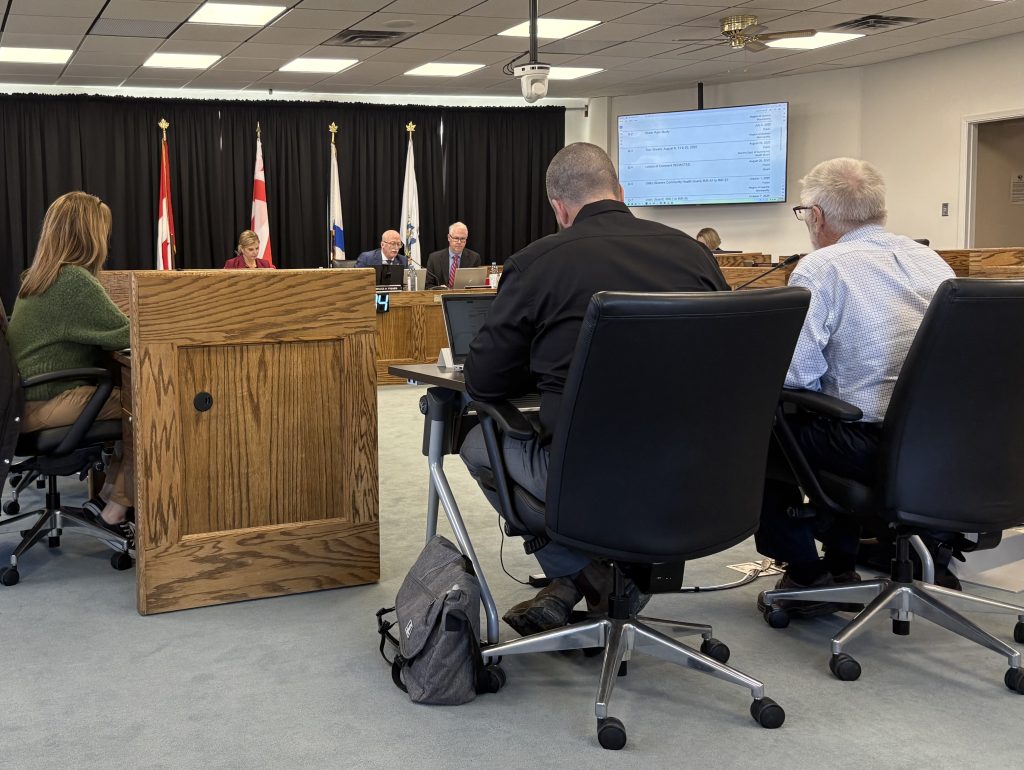
Members of the Nova Scotia Regulatory and Appeals Board held a water rate hearing in Liverpool in November. (Rick Conrad)

A decision limiting Halifax Water rate hikes may have implications for the Region of Queens as it waits to hear a decision on its application to double water rates.

The Nova Scotia Regulatory and Appeals Board on Tuesday approved a reduced rate increase for the Halifax region’s water utility.

Halifax Water had asked for a combined 35.6 per cent rise in rates, to be implemented over the first three months of 2026. Provincial regulators called that “rate shock” for customers.

The board denied Halifax Water’s request to include deficit elimination in its application. Removing that would lower the second rate increase by about 10 per cent.

It ordered Halifax Water to return with a modified rate proposal within a week.

“The Board finds that the magnitude of the proposed rate increases, implemented over the first three months of 2026, constitutes ‘rate shock’ for its customers. For residential customers, the combined, compounded rate increase was proposed to be 35.6% from January 1 to April 1, 2026,” the regulator wrote in the decision released Tuesday.

“While Halifax Water provided a reasonable explanation about the need to increase rates to cover some of its higher costs due to inflation and other cost pressures, the Board finds that other requested costs were not justified or that the utility overestimated some of those costs.”

The Halifax and Queens water rate applications are very different. For example, Queens is asking regulators for a combined 102 per cent increase over three years. It also has equipment and infrastructure problems Halifax doesn’t.

At the Region of Queens hearing in November, municipal officials warned that without an immediate 85 per cent hike, the whole water system could be in jeopardy. 

They said the Region of Queens water utility has been undercharging its 1,200 customers in Liverpool and Brooklyn for years. And because of that, the infrastructure is outdated and needs to be repaired or replaced.

The water utility is supposed to pay for itself through what it charges customers.

The region says it needs to jack up rates immediately to stem a $516,000 deficit. If rates don’t rise, that deficit is expected to swell to more than $3 million by 2027/28.

But during the hearing, board members challenged the region’s past accounting practices and their claims from the last time they asked for an increase in 2021.

Board chair Bruce Fisher opened the hearing by characterizing the region’s application as “rate shock”.

“As there’s a fairly significant rate increase, the board did issue an additional set of information requests. Essentially, we wanted to have additional information on the record in advance of this hearing so we could discuss potential options to deal with what I would say is rate shock.”

The only intervenor in the hearing, the Queens Community Health Board, opposed the region’s application, saying that granting such a large increase would be rate shock for customers.

Fisher also told the region later in the hearing that the size of their request was unusual.

“We don’t typically see 100 per cent rate increases.”

At the end of the hearing, the board had asked for more evidence from the region to support its application. That was received on Nov. 28.

The board aims to file its decisions within 90 days after they receive final evidence. So the decision in the Region of Queens water case will likely be available in late February.

Email: rickconradqccr@gmail.com

Listen to the audio version of this story below

Water quality will suffer if rates don’t rise significantly, Queens tells regulator

Members of the Nova Scotia Regulatory and Appeals Board held a water rate hearing in Liverpool on Wednesday. (Rick Conrad)

If the Region of Queens Water Utility doesn’t double its rates over the next three years, the whole system is in jeopardy.

That’s what a consultant hired by the region told provincial regulators on Wednesday during a hearing into the utility’s request for an immediate 85 per cent increase, part of its overall 102 per cent requested hike in rates.

Bruce Fisher, chair of the three-member Nova Scotia Regulatory and Appeals Board panel, asked Gerry Eisnor of G.A. Eisnor Consulting, what would happen if the board held the rate increases to 15 to 20 per cent.

“I don’t want to be cynical, but really, if you cut that much out of this budget, I would be buying bottled water,” Eisnor said.

“You will not have a reliable system. 
I think if you cut this back enough, you’re either going to have a water quality issue or a water delivery issue. Either way, you’re in trouble. … This utility needs to be brought up to be funded properly so it can go forward. It will not be what I would call a sustainable, successful operation.”

Eisnor and consultant Blaine Rooney wrote the water rate study that forms the region’s application for an increase for its 1,233 customers in Liverpool and Brooklyn.

Eisnor said the Queens water utility has been undercharging customers for years, especially when compared to other municipalities like Mahone Bay and Shelburne with similar water quality.

The region made its case on Wednesday for rate hikes that the Queens Community Health Board has called “unreasonable, unjust and unprecedented”.

Even the appeals board’s Fisher referred to the application as “rate shock”.

“We don’t typically see 100 per cent rate increases,” he said during Wednesday’s hearing.

Board members questioned region officials on why they need such a large rate hike, their budget assumptions, staffing, the system’s water leaks and loss, and other issues.

They heard that the municipality has been subsidizing the water utility for at least 20 years, as losses have been covered by general revenue.

And that meant that deficiencies in the system were left unaddressed.

Until 2021, the region didn’t have a good handle on the utility’s expenses. The region’s finance director Joanne Veinotte told the board on Wednesday that when she was hired, she began to implement stricter accounting measures. 

Eisnor said there had been no inventory control over things like water meters, which in many cases are 30 to 40 years old and need to be replaced.

“I don’t think the protocols and procedures were as rigorous as they should have been,” Eisnor said. 

“It was worse than we thought,” Veinotte said. “It took us a while to sort through it.”

But when Fisher asked for specifics on exactly what that means, Eisnor and Veinotte could not provide them.

The utility is also struggling with aging infrastructure, Eisnor said, with much of the piping dating from the 1880s. 

The region says it needs to jack up rates immediately to stem a $516,000 deficit. If rates don’t rise, that deficit is expected to swell to more than $3 million by 2027/28.

The Queens Community Health Board intervened in the rate hearing. It said the region’s initial first-year 106 per cent rate hike request was too high, especially for vulnerable residents on fixed incomes.

After they objected, the region lowered its Year 1 request by taking some funds from other budget reserves and smoothing out depreciation charges over a longer period.

Tara Druzina, chair of the community health board, said during the hearing on Wednesday that she doesn’t fault the current council and staff for the water utility’s problems.

“We know this is long in coming, this has been 22 years. But the 22 years has resulted in a significant burden for our vulnerable population.”

Almost 20 per cent of water utility customers are in arrears.

She welcomed the region’s recently approved utility assistance rebate of $200 a year for people with household incomes of $35,000 or less. But she said the cap should be higher, to match the low-income cutoff for a family of four in Queens County of $48,000.

After the hearing, Druzina said she’s confident the appeals board will consider the impact on low-income residents.

“We understand that the utility needs to run a balanced budget. But now I also think that the utility and the appeals board understand that there are a lot of people out there who just cannot afford a 115 per cent increase. 
So hopefully we can strike a balance. And I’m hopeful for that, and the board seems to be siding on that as well.”

Mayor Scott Christian told QCCR that the region is trying to put the utility back on solid financial ground.

“So I think that it is a mess. It’s a mess that was a long time in the making. 
It’s going to take us a while to get out of it. All we can do is make the next responsible wise decision. And I think that the experts that we’ve convened to look at this file and the commitments that we’ve made in the future of the water utility, I think we’re headed in the right direction.”

Members of the regulatory board asked the region to provide more information on five items by Nov. 28. After that, the board has 90 days to make a decision.

Email: rickconradqccr@gmail.com