Queens budget surplus, lower water deficit likely won’t blunt rate hikes

Region of Queens Deputy Mayor Maddie Charlton and Mayor Scott Christian at Tuesday’s regular council meeting. (Region of Queens YouTube channel)

The Region of Queens is sitting on a $1.385-million surplus from last year, but Mayor Scott Christian says the news isn’t as great as it may sound.

“I think a lot of the surplus is on the back of major capital projects that were intended, not getting complete,” he told QCCR.

“So I certainly applaud our finance department and their approach in managing our organization’s finances. But we have this challenge where we’re budgeting money for projects that are really important for the community and we’re just not delivering in a timely way. We need to take a hard look at that and make sure that we are spending the money in the budget that’s going to lead to important projects and progress for residents and for visitors in Queens County.”

The region’s finance director Joanne Veinotte presented the audited financial statements for 2024/25 at Tuesday evening’s council meeting.

She said the region ended the fiscal year with a surplus of $1,385,705, helped along by higher-than-expected tax revenue and returns on the region’s investments. Expenses were lower because of unfilled positions and capital projects not yet finished.

Veinotte also said the Region of Queens Water Utility recorded a lower-than-expected deficit – some 42 per cent less than budgeted, for a saving of almost $185,000.

Even with a higher-than-expected budget surplus and a lower water utility deficit, Christian said he’s not sure how that will affect the region’s upcoming water rate hearing.

“The numbers that are driving the proposed increase to the water rate are modeling sort of well into the future,” he said.  

“I can’t answer if there is good reason to go back and challenge any of the assumptions that were used in generating those projected operating expenditures on the water utility. I’m not sure yet.”

The municipality has requested a 106 per cent increase for most of the 1,200 customers in Liverpool and Brooklyn who are on the municipal water supply.

Nova Scotia Regulatory and Appeals Board hearings are scheduled for Wed., Nov. 19 at 10:30 a.m. in council chambers at the region’s office.

The region hired consultants G.A. Isenor and Blaine Rooney to prepare its water rate study as part of its application to the regulatory board.

In documents filed on the board’s website, the regulator has asked the region for more information or clarification on 55 various points. 

Some are about whether the region knows if people will be able to afford the expected $348-a-year increase for most residential customers.

It also asked the region to submit a revised rate study lowering the financial impact on customers and spreading it out over three years instead of imposing most of the increase in the first year.

So far, there is one registered intervenor in the rate hearing. The Queens Community Health Board is concerned how the increased water expenses will affect the broader health and well-being of residents.

Christian said the proposed increases are important to put the water utility back on sound financial footing.

“We want to get our costs in order and run the water utility in a solvent way that’s aligned to our obligations as a water utility operator, and so the sooner that we can get our costs in order the better.”

Even so, Veinotte told councillors on Tuesday evening that by the time the hearing happens and the regulator makes its decision, any rate increases likely won’t take effect until 2026.

To look at all the documents filed so far as part of the region’s water rate application, use this link and enter M12363 in the field.

Email: rickconradqccr@gmail.com

Listen to the audio version of this story below

Layoffs loom as Region of Queens to close recycling depot

The Region of Queens is closing its recycling facility, which will result in job losses. (Nick Fewings via Unsplash)

UPDATED AT 3 p.m. Wednesday

Employees at the Region of Queens materials recovery facility will be laid off when the depot closes on Dec. 1.

The region said in a news release late Tuesday afternoon that the layoffs and closure are because of provincial changes to how recyclables are handled. The region’s solid waste facility employs 13 people, but the release did not say how many employees are affected.

Mayor Scott Christian told QCCR on Wednesday that eight employees work at the recycling facility. But he said the municipality will try to move them or retrain them for other available positions with the region.

“The first step is to try to retain staff if that’s possible to keep people in the organization and if they can’t be kept then to lay them off. And then whatever is contained legally in the bargaining agreement, we’d go from there,” he said.

“It sucks, it sucks. It’s challenging times, life is tricky to afford and there’s not a lot of good paying jobs in the community. It’s certainly not a decision that we made lightly.”

Christian said waste collection won’t change in the municipality. Collection dates or methods won’t be affected. The solid waste management facility will remain open. This change affects only who sorts the recyclable material.

In August 2023, the Nova Scotia government amended the Environmental Act to make recycling packaging and paper the responsibility of the producer, otherwise known as extended producer responsibility.

“No impact to the resident experience, it’s just that now with the extended producer responsibility … the producers of the packaging waste are responsible for figuring out what’s happening to that waste,” Christian said.

“It’s now the responsibility of the Jeff Bezos and the Walmarts of the world to deal with their own packaging.”

Circular Materials is a company formed by corporations that produce packaging waste, such as Loblaw, Coca-Cola, McDonald’s and others.

Christian said that company also offered to collect the recyclables, but the region opted out of that.

Jim Sponagle, business manager for Local 1928 of the International Brotherhood of Electrical Workers, told QCCR on Tuesday that he found out about the job losses from a member of the local who works at the facility.

“The Region of Queens at no point contacted the union to advise the union what their intention was. Very disappointing,” he said in an interview.

“(We’ve) completely been blindsided by it. No discussion with the union, no conversation, we were completely in the dark.”

He said relations between the region and the union have not improved since a week-long strike in January, when almost 40 engineering and public works employees walked off the job for higher wages and improved overtime benefits.

Sponagle said Tuesday that some workplace issues are still outstanding from before the strike. He said he’d be contacting the union’s legal adviser to see how it can respond to the layoffs.

“I’m sympathetic to the members who will be losing their jobs. It’s disappointing for sure. We went through tough negotiation and we landed on a strike and I hope that wasn’t a determining factor as to why they chose to contract that work out that’s been done there for years. I can only sympathize with the members affected by the decision of the region.”

CAO Willa Thorpe said in the release that the municipality is “working directly with impacted employees at the MRF site to help them transition at this difficult time.”

Email: rickconradqccr@gmail.com

Listen to the audio version of this story below
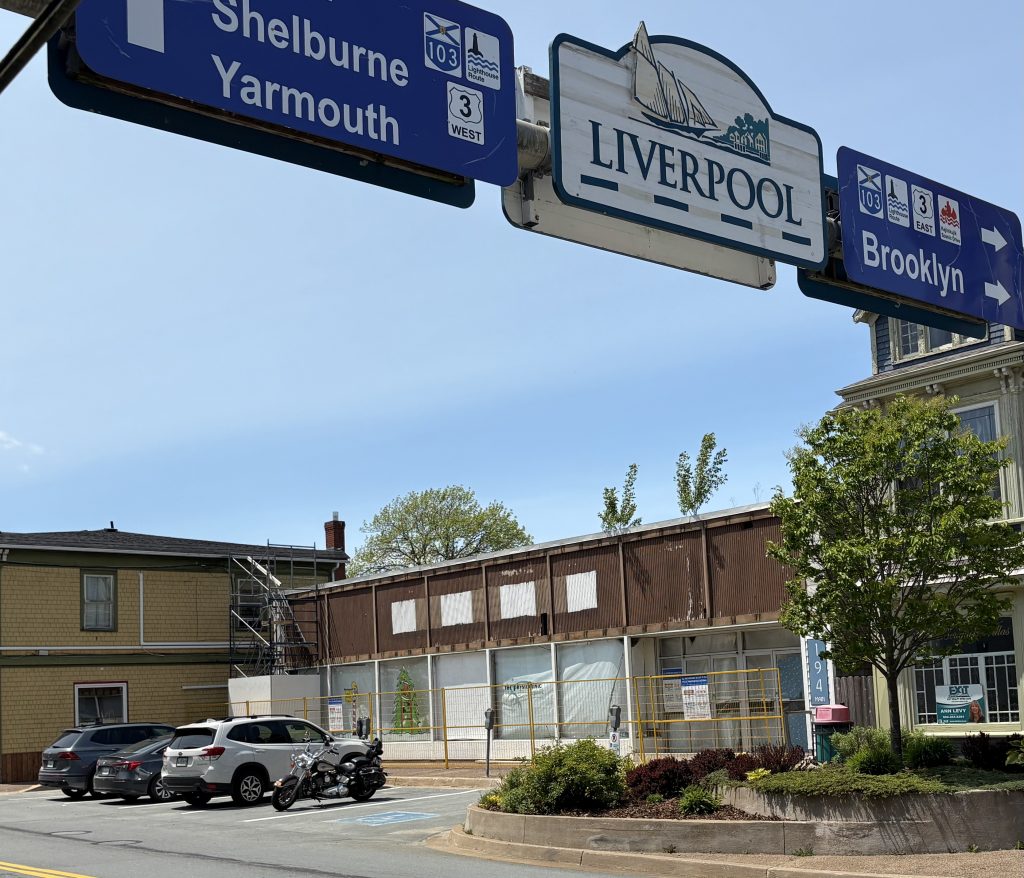
Developer Eric Fry hasn’t given up on Stedman’s building in Liverpool yet

The old Stedman’s building in downtown Liverpool may still be developed into apartments. (Rick Conrad)

There may be a second life for the old Stedman’s building on Main Street in Liverpool after all.

Region of Queens councillors in July rejected developer Eric Fry’s attempt to turn 194 Main St. into 16 apartments.

The region’s land use bylaw limits the amount of residential space on the ground floor of of buildings in the downtown commercial zone to a maximum of 50 per cent.

Fry applied to amend the bylaw so that he could have only apartments in the building, but council rejected it.

He listed the building for sale shortly after council’s decision.

But he has since returned with a new proposal that would include two commercial units on the ground floor, with the rest of the 30,000-square-foot building devoted to 14 apartments, parking and storage space.

That would still require council’s approval and a public hearing.

On Wednesday, Fry said he wasn’t ready to comment on his amended proposal to the region’s planning advisory committee. 

The committee had a look at the new plan at their August meeting.

But Mayor Scott Christian said in a recent interview that the committee wasn’t comfortable making any new recommendations to council.

“And so I think just the devils in the detail from a bylaw, from a policy perspective of how do you get to a place where you land in a spot where you’re making sure that you have the right language to facilitate those policy objectives that we want to see, which is again, maintaining the commercial storefronts in the protected commercial zone while allowing flexibility for developers to repurpose other parts of those buildings for residential purposes.”

Fry said Wednesday that he’s still working with the region on options for the building. He said there may be something new to report in the next few weeks.

Email: rickconradqccr@gmail.com

Listen to the audio version of this story below

Region of Queens to begin budget deliberations Thursday

Region of Queens Mayor Scott Christian says regional council hopes to approve its 2025/26 budget by early May. (Rick Conrad photo)

Region of Queens councillors will begin their 2025/26 budget deliberations this week, almost a month after the fiscal year has expired.

Region of Queens councillors will begin their 2025/26 budget deliberations this week, almost a month after the fiscal year has expired.

Finance staff will present the draft budget to council at a meeting on Thursday (April 24) at 6 p.m. at council chambers on White Point Road.

Mayor Scott Christian told QCCR that councillors had an initial budget orientation session on Tuesday.

“We need to get to it for sure,” he said in an interview after council’s regular meeting on Tuesday evening.

“We’re looking at approving the budget early next month so we don’t have any issues with the tax bills.” 

Councillors will have another meeting to go over the draft budget on Monday at 6 p.m., with another meeting scheduled on Tues., May 6 at 6 p.m., if required.

They’re hoping to vote on the final budget at their regular meeting on Tues., May 13 at 9 a.m.

All meetings are open to the public and livestreamed on the region’s Facebook page and YouTube channel.

The region was also late setting its budget last year. Councillors began deliberations on the 2024/25 budget in early April and finished by the end of the month. 

The 2025/26 budget has to be set in enough time to allow the region’s staff to send out property tax bills by the first of June.

Region of Queens budget talks delayed, while community groups seek help

Tara Druzina, representing the Queens County Food Bank, speaks to Region of Queens councillors at their regular meeting on Tuesday. (Region of Queens YouTube channel)

The Region of Queens will again be late setting its budget, though councillors hope to begin deliberations soon.

Mayor Scott Christian said this week that recent turnover in senior management has contributed to the delay. 

“It has been a challenge,” he said in remarks during council’s regular meeting on Tuesday.

“The organization has gone through significant churn within the senior management levels and we’re seeking to improve the organization, the functions in the organization to ensure that we can govern in ways that are accountable and transparent and engaging for our residents.”

Councillors fired CAO Cody Joudry in December, and the region terminated the employment of municipal clerk Pam Lovelace at the beginning of March, three months after she was hired. 

At their regular meeting this week, councillors approved interim spending limits until the 2025/26 budget is set.

Municipalities are expected to finalize their budgets by the end of March each year.

The region was also late last year with their budget talks, beginning the process in early April.

Christian told QCCR after the meeting that another reason for the delay is that the municipality is waiting for results of its water rate study, which will set charges for the region’s 1,400 water utility customers.

He said they’ll notify the public as soon as budget deliberations begin.

When they do, councillors are facing some challenges in a region with some of the highest poverty rates in Nova Scotia.

Officials with the Queens County Food Bank appealed to councillors this week to consider granting the group $15,500 in an annual rent subsidy for the next four years.

Before the food bank was forced out of a derelict municipal property in 2019 and began leasing space on Main Street, it paid no rent. But demand for their services has grown, as food costs have risen and donations have plummeted by about 50 per cent.

Just recently, the food bank was hit with a $10,000 repair bill on its two-year-old walk-in freezer. And it has committed to begin food pantries for elementary and high school students throughout the county, said Tara Druzina, the fundraising lead for the food bank.

“This highlights how the food bank constantly adapts for emergency community needs, not just providing food every Tuesday, but ensuring that vital support reaches the most vulnerable when and where needed,” she told councillors.

“These challenges illustrate why stable operational funding is critical. Without it, the food bank cannot effectively respond to growing community needs.”

Shelly Panczyk, chairperson of the food bank, said their client list has grown by about 30 per cent in the past few years, while the organization’s food costs have ballooned to $6,000 a month.

She says the rent subsidy is something the region provided in the past, by giving the food bank rent-free space in one of its buildings.

“Food is not all donated. 
So most of our food is bought, even though we get a truck from Feed Nova Scotia every Monday, but that’s mostly produce. But most everything else, all our canned goods and all our staples have to be bought.”

She says revenue from its thrift store has helped with those increased expenses. 

“We’ve been lucky the last four years we’ve had the thrift store open, but that can change at any time and that’s where most of our money comes from.”

Mayor Scott Christian said he didn’t want to predict how budget deliberations will go, but he acknowledged the role of local governments is becoming more complex.

“There’s an incredible amount of need in our community that we have to look at and just on balance with the pressure that puts on the ratepayer. I think all municipalities (face) significant pressure and competing priorities to figure out what to do with the limited available resources.”

Email: rickconradqccr@gmail.com

Listen to the audio version of this story below