CAO: Queens trying to keep people on the job after recycling depot closes
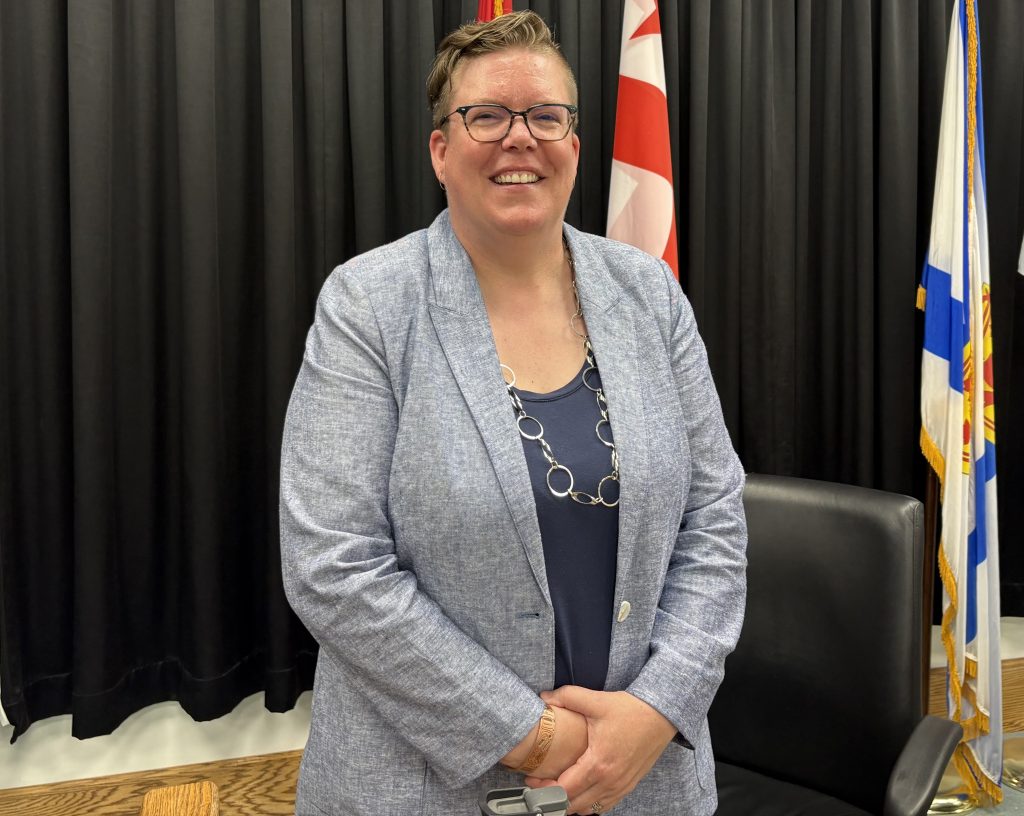
Willa Thorpe is the chief administrative officer of the Region of Queens Municipality. (Rick Conrad)

Employees facing layoff when the Region of Queens closes its recycling depot may still have a job with the municipality.

The region announced this week that it would close its materials recovery facility on Dec. 1 in response to new regulations from the Nova Scotia government.

The province is shifting the responsibility for sorting plastics and other packaging to the companies that produce it. That means municipalities won’t need their own sorting facilities anymore.

In Queens, that will affect eight unionized employees.

Willa Thorpe, the region’s chief administrative officer, told QCCR on Thursday that the municipality will try to find other jobs for those workers.

So if there’s an opportunity through current vacancies here in the organization where we have the opportunity to train folks and have them shift to a different position, we’ll do that.

“So if there’s an opportunity through current vacancies here in the organization where we have the opportunity to train folks and have them shift to a different position, we’ll do that.”

She said they’re also going to hook workers up with provincial and federal supports from Nova Scotia Works and Service Canada.

Unionized employees at the Region of Queens Waste Management Facility are represented by Local 1928 of the International Brotherhood of Electrical Workers.

The local signed a new contract with the region after a week-long strike in January.

Thorpe said the agreement requires five days’ notice of any ceasing of operation or service that will affect jobs. She said managers wanted to give the affected employees more notice, so they met with workers and their local union representative as soon as council decided to close the facility.

We think it’s important that our employees know exactly what’s going on, that their livelihood may be impacted, and so rather than follow the (basic language) of the collective agreement, we think we hold ourselves to a higher standard. So we actually met with staff a few hours after meeting with council, so the same day as opposed to waiting, so that those employees can be confident they know exactly what’s going on.”

Some workers will continue to be employed until at least Dec. 1, depending on how long it takes to wind down the facility, Thorpe said.

She said the collective agreement does not provide for severance pay. But she said “the region is actually actively working on providing some severance to those employees.”

She didn’t have details yet on what that package might be.

Jim Sponagle, the business manager for IBEW, told QCCR earlier this week that relations between the union and the region have not improved since the strike.

Thorpe, who started as CAO in June, said that’s incorrect.

“I would disagree with that statement based on the conversations I’ve heard since the labour action, the relations have improved.” 

Nothing will change for residents in how garbage and recyclables are collected, and the municipality’s solid waste facility will remain open. 

A company called Circular Materials will be taking over the sorting of recyclables from the region. That’s an organization formed by large corporations like MacDonald’s, Nestle Canada and Pepsico.

Thorpe said municipalities are still working out details of the agreement with Circular Materials, so she’s not sure yet how much money the region might save.

“What the specific impacts are to municipalities we’re still determining where the dust will settle. But the idea is that the producer would bear the lion’s share of the cost.”

Thorpe said officials with the region plan to meet with affected employees again next week.

Email: rickconradqccr@gmail.com

Listen to the audio version of this story below

Layoffs loom as Region of Queens to close recycling depot

The Region of Queens is closing its recycling facility, which will result in job losses. (Nick Fewings via Unsplash)

UPDATED AT 3 p.m. Wednesday

Employees at the Region of Queens materials recovery facility will be laid off when the depot closes on Dec. 1.

The region said in a news release late Tuesday afternoon that the layoffs and closure are because of provincial changes to how recyclables are handled. The region’s solid waste facility employs 13 people, but the release did not say how many employees are affected.

Mayor Scott Christian told QCCR on Wednesday that eight employees work at the recycling facility. But he said the municipality will try to move them or retrain them for other available positions with the region.

“The first step is to try to retain staff if that’s possible to keep people in the organization and if they can’t be kept then to lay them off. And then whatever is contained legally in the bargaining agreement, we’d go from there,” he said.

“It sucks, it sucks. It’s challenging times, life is tricky to afford and there’s not a lot of good paying jobs in the community. It’s certainly not a decision that we made lightly.”

Christian said waste collection won’t change in the municipality. Collection dates or methods won’t be affected. The solid waste management facility will remain open. This change affects only who sorts the recyclable material.

In August 2023, the Nova Scotia government amended the Environmental Act to make recycling packaging and paper the responsibility of the producer, otherwise known as extended producer responsibility.

“No impact to the resident experience, it’s just that now with the extended producer responsibility … the producers of the packaging waste are responsible for figuring out what’s happening to that waste,” Christian said.

“It’s now the responsibility of the Jeff Bezos and the Walmarts of the world to deal with their own packaging.”

Circular Materials is a company formed by corporations that produce packaging waste, such as Loblaw, Coca-Cola, McDonald’s and others.

Christian said that company also offered to collect the recyclables, but the region opted out of that.

Jim Sponagle, business manager for Local 1928 of the International Brotherhood of Electrical Workers, told QCCR on Tuesday that he found out about the job losses from a member of the local who works at the facility.

“The Region of Queens at no point contacted the union to advise the union what their intention was. Very disappointing,” he said in an interview.

“(We’ve) completely been blindsided by it. No discussion with the union, no conversation, we were completely in the dark.”

He said relations between the region and the union have not improved since a week-long strike in January, when almost 40 engineering and public works employees walked off the job for higher wages and improved overtime benefits.

Sponagle said Tuesday that some workplace issues are still outstanding from before the strike. He said he’d be contacting the union’s legal adviser to see how it can respond to the layoffs.

“I’m sympathetic to the members who will be losing their jobs. It’s disappointing for sure. We went through tough negotiation and we landed on a strike and I hope that wasn’t a determining factor as to why they chose to contract that work out that’s been done there for years. I can only sympathize with the members affected by the decision of the region.”

CAO Willa Thorpe said in the release that the municipality is “working directly with impacted employees at the MRF site to help them transition at this difficult time.”

Email: rickconradqccr@gmail.com

Listen to the audio version of this story below

Strike over as Region of Queens, workers reach deal; mayor appeals for respect

The Region of Queens has reached a deal with its striking public works employees. (Rick Conrad)

UPDATED 2:55 p.m. Thursday

The Region of Queens and its striking 38 public works employees have reached a deal.

Local 1928 of the International Brotherhood of Electrical Workers voted 32-5 around 6 p.m. Wednesday to accept the region’s latest offer.

Jim Sponagle, the local’s business manager, told QCCR Wednesday night that it was hard to turn down.

“They came back with a financial offer that certainly we couldn’t overlook, couldn’t turn away. I felt it was a significant move from where we were,” he said.

“I think overwhelmingly (union members) were pretty happy with the deal.”

The main issues in negotiations were better wages, overtime protections and keeping temporary employees in the bargaining unit. The last contract expired March 31. The new contract runs from April 1, 2024 to March 31, 2027.

The union said their members were some of the lowest paid municipal workers in Atlantic Canada.

They had been on strike since last Thursday, saying that the region’s latest offer wasn’t any better than the one members resoundingly rejected in mid-December.

Sponagle said the region improved its offer this week and it addressed much of the union’s concerns about wages. But he said the region said it needed the flexibility to call some employees in to work on weekends without paying overtime.

Sponagle said some members weren’t happy with that, but the majority supported the deal.

“At the end of the day, you can’t win every battle. … You can only do your best. I believe I left it all on the table and we couldn’t make any traction with that part of the agreement.”

About 20 supporters of the strikers showed up at Tuesday’s regional council meeting to urge councillors to tell the region’s negotiators to get back to the bargaining table and get a deal. That evening, the municipality gave the union a new offer.

Some family members of the workers told councillors they were ashamed of how the region’s negotiators had treated the employees.

“I think it had a significant impact,” Sponagle said. “The public put pressure on the mayor and council to do their job.”

It’s a three-year deal retroactive to March 31, with the first year giving raises to all members of $4 an hour or more, with 2.5 per cent increases in the second and third years of the deal.

Council ratified the deal in a closed-door session on Thursday morning. Mayor Scott Christian told QCCR that he was grateful the deal was reached.

“These folks have historically been underpaid and our council is pleased to be able to sign a deal with wages that reflect the value that these folks have for our organization and the importance of them to be able to receive a living wage and support their families and themselves.”

Christian read a statement at a short council meeting after the deal was ratified. He said that while he was happy with the deal, he was also upset by some of the comments people made about the region’s managers online.

“I’m unsettled by a number of public allegations and unsubstantiated claims and personal attacks towards some of the region’s employees,” he said.

“
Everyone in our community deserves to be respected, everyone in this organization deserves to be respected, and as your mayor, I need to ensure that all employees, including non-unionized staff and management of this organization, receive that respect, specifically, our (acting) CAO Pam Lovelace and our director of engineering and public works Adam Grant received an incredible amount of personal attacks throughout the later stages of this process as it became contentious.

“I won’t stand in silence as any employee of this organization, including my fellow councillors, are harassed, attacked or bullied.”

Christian said some comments were “pretty intense personal attacks”, with some people calling for Lovelace and Grant to be fired.

As talks broke down, tensions increased, with union members’ supporters pressuring councillors to step in and direct their negotiators to get a deal done.

Some supporters at Tuesday’s meeting were upset by comments made by Lovelace about the union refusing to return to the bargaining table. They were also upset that she tried to downplay the number of employees on strike.

“But there are going to be tough times, there are going to be unpopular decisions, there are going to be mistakes made,” Christian told QCCR, “and we all need to do better and the organization needs to do better to make sure that those appropriate channels are in place so that if there are frustrations and complaints and grievances within our community that there are good established channels to address those things.”

The region is still claiming that temporary employees are not members of the bargaining unit. The union’s unfair labour practices complaints about that are still outstanding. Dates have not been set yet for that hearing.

Christian said he believes most employees will be back on the job by Monday. And he said the region plans to hire experts to help address those tensions, calm things down and ensure that all employees return to a supportive workplace.

Email: rickconradqccr@gmail.com

Listen to the audio version of this story below

‘This is shameful’: Strikers’ supporters slam Queens mayor, councillors

Striking public works employees with the Region of Queens were back on the picket line Tuesday in Liverpool. (Rick Conrad photo)


Supporters of striking Region of Queens workers blasted elected councillors on Tuesday, demanding that they show some leadership in the dispute.

They want the mayor and councillors to tell the region’s negotiators to return to the bargaining table and settle the strike.

Thirty-eight members of Local 1928 of the International Brotherhood of Electrical Workers have been on the picket line since Thursday. The union says they are some of the lowest-paid municipal workers in Atlantic Canada.

The region does not dispute that, but says it’s been trying to address those inequities in contract negotiations that have been going on for about a year.

RELATED: Region of Queens workers strike for better wages, overtime protection

Some positions pay less than $18 an hour, with some people on Tuesday saying that they can’t afford to support their families.

Family and friends of the striking public works employees told councillors at their regular meeting on Tuesday that they were ashamed of how the region has treated the workers. Elected officials do not get involved directly with labour negotiations, but can set the tone for the region’s negotiators.

Wages, overtime protections and even who’s in or out of the bargaining unit are the main sticking points in the dispute.

Meghan MacAdams was one of the people who spoke to council during the public presentation portion of the meeting. As striking workers picketed outside, she read out the names of the 36 employees.

Her partner has worked with the region for six years. In a recent CBC story, the region’s acting CAO Pam Lovelace claimed that only 20 employees were affected.

“Here is the individual handpicked by you all, acting as a representative of your side of the line, sharing inaccurate information,” MacAdams told councillors.

“
Was this an attempt to create a calmer narrative in which this issue was smaller than it really is, or is this simply a demonstration of how uninterested and uninvested the region has become in its workforce? What that one tiny detail told me, intentionally stated or not, is that those who run our county either can’t be trusted to provide us with truthful and accurate information, or they have become so disconnected with their employees they aren’t even aware of how many livelihoods they are toying with.

“Neither of these options sit well with me. 
Unfortunately, I see this as a clear indication of just how undervalued these men have become, which is one of the key issues in my opinion that has brought us to the divide we are at today. But I remain hopeful the region, the powers that be, will step up and make a fair and honest attempt at resolution. Our men deserve better.”

Debbie Wamboldt, a longtime community advocate and volunteer who spearheaded the successful fundraising drive for the popular inclusive play park in Liverpool, also expressed her frustration with the stalled talks. 

“Most of you know me from the play park project,” she said.

“That took six years of my life to bring to this county because I was proud of where I come from. … But I have to say that I’m standing here before you as somebody who is no longer proud of where I come from. 
I’m not proud of where we’re standing.

“My husband has worked for the region for 20 years. We give our time to this community, and our community is standing behind us. And it’s your job now  to stand behind us. 
We need to get back to the table, and our workers, my family, my friends, my husband’s colleagues, deserve better.

“This is shameful. This is really shameful.”

Before the strike, the region and the union had been negotiating to adjust job classifications and wage grids to bring Queens workers’ salaries more in line with other municipalities.

The region had commissioned a compensation review of unionized and non-unionized positions more than a year ago. That review has never been made public. 

But in response, the previous council had agreed to boost salaries for some non-unionized positions.

Mayor Scott Christian says the wage parity study was the foundation for the region’s offer in the latest contract talks.

The region says adjusting salaries for some jobs would result in raises from 2.5 to 26 per cent. But talks stalled in mid-December after the region’s so-called final offer. About 97 per cent of employees voted for strike action.

Both sides met again last Tuesday with a provincially appointed conciliator. But union representative Jim Sponagle said the region’s offer hadn’t improved much from the one members had rejected. He said their wage offer amounted to about two per cent a year on top of adjusting for wage inequities.

Christian released a video on Facebook on Sunday, saying that he understands how challenging negotiations have been for employees and their families. He appealed for patience.

After Tuesday’s meeting, Christian and the rest of council were due to get an update on negotiations in a closed-door session. Before that, he said in an interview that councillors want a fair deal for workers, but one that doesn’t burden taxpayers.

He also said not all councillors have seen the wage review study, which he wants to be made public. 

“I think it should be. It was something that I was very frustrated with before I ended up in this position as a resident that that wasn’t made publicly available. And so, I’m going to be asking our our staff here. and directing our staff here as to what elements or if that can be released, in in its entirety. We’ve seen we’ve seen portions of it. … There’s going to be more of that information provided to council today.

“To be honest, I’m not that comfortable with some of the tactics that have been employed by both sides of the negotiation. I feel like it has escalated and has become more contentious than it ought to have. … We’re going to be looking for direction from council as to (how) to de-escalate this, to get back to meaningful, productive conversations.

“We need both sides to come back to the table and with some humility, I think, and a willingness to concede and find a productive way forward. I agree the tone, the nature, the spirit of the thing has become really contentious and I’m not comfortable with it. I am going to meet with council and we’re going to … determine what we think is the appropriate next step with respect to directing the negotiating team moving forward.”

The striking workers are responsible for maintaining the region’s streets, sidewalks, parks and other properties. They also work in waste and recycling facilities as well as water and sewage treatment plants.

Their last contract expired March 31. 

The region has said that services won’t be interrupted by the strike, with managers, supervisors and third-party contractors doing the work.

Email: rickconradqccr@gmail.com

Listen to the audio version of this story below

Region of Queens workers strike for better wages, overtime protection

Unionized workers with the Region of Queens went on strike Thursday morning. (Rick Conrad photo)

UPDATED THURSDAY, 4:45 P.M.

Engineering and public works employees with the Region of Queens are on strike.

About 40 members of Local 1928 of the International Brotherhood of Electrical Workers set up picket lines at three locations in Liverpool on Thursday morning.

The workers are responsible for maintaining the region’s streets, sidewalks, parks and other properties. They also work in waste and recycling facilities as well as water and sewage treatment plants.

The union and the region have been negotiating for about a year. Their last contract expired March 31. 

Jim Sponagle is the business manager of Local 1928. He was on the picket line this morning with some members near the Hank Snow Museum in Liverpool.

“There are still three outstanding issues: being forced to work weekends for straight time, no overtime, that’s one big issue. Wages still nowhere where they need to be. Wages are lower than any other municipality, jurisdiction in Atlantic Canada.

“The temporary employees are still an issue. I call it a union-busting measure where the employer has tried to carve out a work group from our collective agreement that have been in our collective agreement for decades. I don’t understand their position other than the fact that maybe they could deem them non-union and have them perform our work during a strike.”

Sponagle said both sides were back at the bargaining table on Tuesday, but he said the region’s offer hadn’t improved much from the one that members resoundingly rejected in December.

Members voted 97 per cent in favour of strike action. They have been in a legal strike position since Dec. 11.

“From our last strike mandate, the only change was they offered a half a per cent on Year 2 and a half a per cent on Year 3” of a new contract, Sponagle said.

The region issued a news release Thursday morning, saying that it filed a lockout notice with the province’s labour minister in response to the strike.

The region said all municipal services will continue as usual, including garbage collection and snow plowing.

Pam Lovelace, the acting CAO for the Region of Queens, told QCCR on Thursday that the strike took her by surprise.

“I was not informed in any way there was going to be a strike today,” Lovelace said.

“Although knowing that the union members and their leadership wouldn’t meet with us at the table on Tuesday to actually negotiate with a provincial conciliator, that was a good indication that they weren’t willing to reach a deal.”

A provincially appointed conciliator is a disinterested third party who will sometimes meet with both parties together, or meet with each side individually and communicate proposals back and forth. Each labour negotiation is unique and the conciliator generally gets a feel for whether it would be productive for both sides to meet face to face with the conciliator present.

Lovelace says that in this case, union negotiators refused to meet with the region and the conciliator together, and would meet only with the conciliator.

“And so because of that we weren’t actually able to have effective negotiations, we had to use the middle man of the conciliator rather than having constructive conversations.”

Union members are some of the lowest paid municipal employees in Atlantic Canada, at a time when regional councillors and senior staff have complained it’s difficult to fill job vacancies.

Some unionized jobs at the region pay less than $18 an hour. And some Red Seal-certified mechanics and technicians with the region make no more than $27 an hour, compared to $40 an hour in other jurisdictions. 

Both sides were working on adjusting wage grids to alleviate some of those discrepancies. But the union’s Sponagle said there still hasn’t been enough movement from the region. Their latest proposal amounted to a two per cent raise in each year of a deal, he said.

Sponagle said his members want to get back to work. But they also want a deal that keeps pace with what municipal employees in other places are making.

I dealt with other jurisdictions in P.E.I. when the employer understood. When they came with a fair wage increase it was hard to say no. It just seems this employer doesn’t want to work with the union. But somebody doesn’t like unions here at the Region of Queens.

“This is the first time since 1973 that I’m aware of IBEW Local 1928 going on strike. It’s not something we typically do. We like to do our work, we don’t complain and we go home.”

The union is still waiting to have hearing dates set for its unfair labour practice complaint against the region. It alleges that the region told some members that they still had to come to work in the event of a work stoppage or risk being fired. 

Lovelace said the region is looking for a fair deal and to get employees back to work. But that’s only if the union is willing to return to the bargaining table.

“I’m already at the table, I’m waiting for IBEW Local 1928 to arrive at the table. And we will continue to operate and the services that the residents expect and hopefully we will see the leadership of Local 1928 come back to the table.”

Lovelace said managers, supervisors and third-party contractors would make sure that services aren’t interrrupted.

Email: rickconradqccr@gmail.com

Listen to the audio version of this story below

Region of Queens workers carry strong strike mandate as talks set to resume

Unionized employees at the Region of Queens have voted to strike, if necessary. (Rick Conrad)

Engineering and public works employees with the Region of Queens have voted 97 per cent in favour of strike action.

The workers are responsible for maintaining the region’s streets, sidewalks, parks and other properties. They also work in waste and recycling facilities as well as water and sewage treatment plants.

The 36 members of Local 1928 of the International Brotherhood of Electrical Workers voted on the region’s settlement offer on Monday. Thirty-five of 36 members rejected it, voting in favour of strike action if needed.

James Sponagle, the business manager of Local 1928, said the two sides are set to return to the bargaining table with a government-appointed conciliator next Monday.

In the meantime, the union has filed an unfair labour practice complaint with the Nova Scotia Department of Labour, Skills and Immigration. 

That concerns the region’s definition of temporary employees. Sponagle says the employer has told those employees they must cross a picket line in the event of a work stoppage.

The union says they are union members and cannot be forced to work during a strike or lockout.

“They’re going to take our union members and they’ll force them to do bargaining unit work,” Sponagle said.

“If they don’t, they’ll fire them, is what they’ve been told.”

Sponagle said the union offered not to file its strike notice if the region also held off on its lockout notice until the unfair labour practice complaint is resolved.

He said the region rejected that proposal.

Sponagle said the region’s last offer didn’t satisfy union members’ main concerns. 

The IBEW members are some of the lowest-paid municipal workers in Nova Scotia. They’re seeking closer wage parity with other municipal employees in places like Shelburne and Bridgewater. And they want to protect overtime provisions for weekend work.

Mayor Scott Christian said this week that he’s hopeful a deal can be reached. The mayor and councillors get updates on negotiations, but they are not directly involved.

“We certainly value the union members, the public works employees, they’re really valuable members of the organization. We want to make sure there is a fair and good deal in place for these folks.”

The union’s last collective agreement expired in March. In that deal, which was signed in 2020, employees received raises of two per cent a year. The next year, the region gave its non-unionized staff a four per cent raise.

Email: rickconradqccr@gmail.com

Listen to the audio version of this story below