Queens to impose surcharge on short-term rentals

The Region of Queens is moving ahead with plans to impose a levy on all short-term rentals. (Photo by InstagramFotoGrafin via Pixabay)

The Region of Queens is going to introduce its own extra charge on people who stay at hotels or other short-term rentals like Airbnbs in the area.

The accommodation levy would be up to an extra three per cent per night on top of what the property already charges.

Under provincial law, municipalities can use that revenue only to promote tourism in their area.

If the region required the maximum three per cent, it would generate about $240,000 a year, Richard Lane, a project officer with the Region of Queens, told councillors at their regular meeting on Tuesday.

“Now there are some accommodation providers who are as busy as they want to be, so they’re not particularly interested in additional promotion work. There are some accommodation providers whose business relies on construction workers and such like, and they’re not interested in additional promotion,” Lane said.

“So, on the one hand, you could say the furtherance or the promotion of tourism would be something that accommodation providers are interested in, but that’s certainly not a universal view.”

The municipality sent a survey to 128 registered accommodation providers in Queens last April. 

It also allowed members of the public to have their say.

The survey got 97 responses, 54 of which were from owners of accommodations.

About 67 per cent of owners were strongly opposed to a levy, though the other 33 per cent said it would either have a positive or no effect on their business.

Deputy Mayor Maddie Charlton said she supports the marketing levy. She said some people may have been confused about what the extra charge was all about.

When people don’t understand what the funds could be used for, then when you hear the word ‘tax’ again, it’s a negative context. And so I think that people didn’t understand the full picture,” she said.

“And we are one of the few who don’t have (a levy). And I think in speaking with people about this, lots of residents who go to Halifax or Cape Breton, for example, they didn’t know they even pay this. It’s on every invoice where you stay. (Halifax and Cape Breton) have had these for a long, long time.”

Charlton said that while some property owners may not need any extra business, many small businesses in Queens County would benefit from more promotion of the area.

And I really, really want to see more events happen throughout Queens County, specifically at Queens Place. And I think that this is a way to give our residents excitement and more events at no cost to them.

Mayor Scott Christian said he’s opposed to the levy, especially after speaking with some local hotel and property owners.

It feels premature to me when we don’t have our economic development strategy in place. We don’t exactly know how we’re going to market the Queens County. And I’ve just heard strongly from some of those operators about some of the impact that an accommodation levy would have upon them.”

Many other Nova Scotia municipalities already have some kind of levy on hotel rooms.

Lane told councillors that the Town of Bridgewater is the only municipality on the South Shore with a charge that also covers short-term rentals. There are 30 registered properties there, compared with the current count of 165 in Queens County, Lane said.

Bridgewater relies on operators to self-report and remit the proceeds to the town monthly. Owners can be fined if they send inaccurate reports.

The Town of Yarmouth, and the municipalities of the districts of Argyle and Yarmouth contract with a third-party service from the Ontario Restaurant Hotel and Motel Association to collect the fee on their behalf. That organization already works with 35 municipalities in Ontario, collecting more than $30 million annually. 

Lane said that the Association of Municipal Administrators of Nova Scotia is working on potentially coming up with a service that would collect the fee on behalf of all 49 municipalities in the province.

“If it is the will of council to have an accommodation levy in Queens County, … the likelihood is that by the time that bylaw is ready to be implemented, there may well be an automated system that we can adopt.”

Email: rickconradqccr@gmail.com

Listen to the audio version of this story below
Queens approves road trails bylaw, paving way for OHVs on some streets in Liverpool

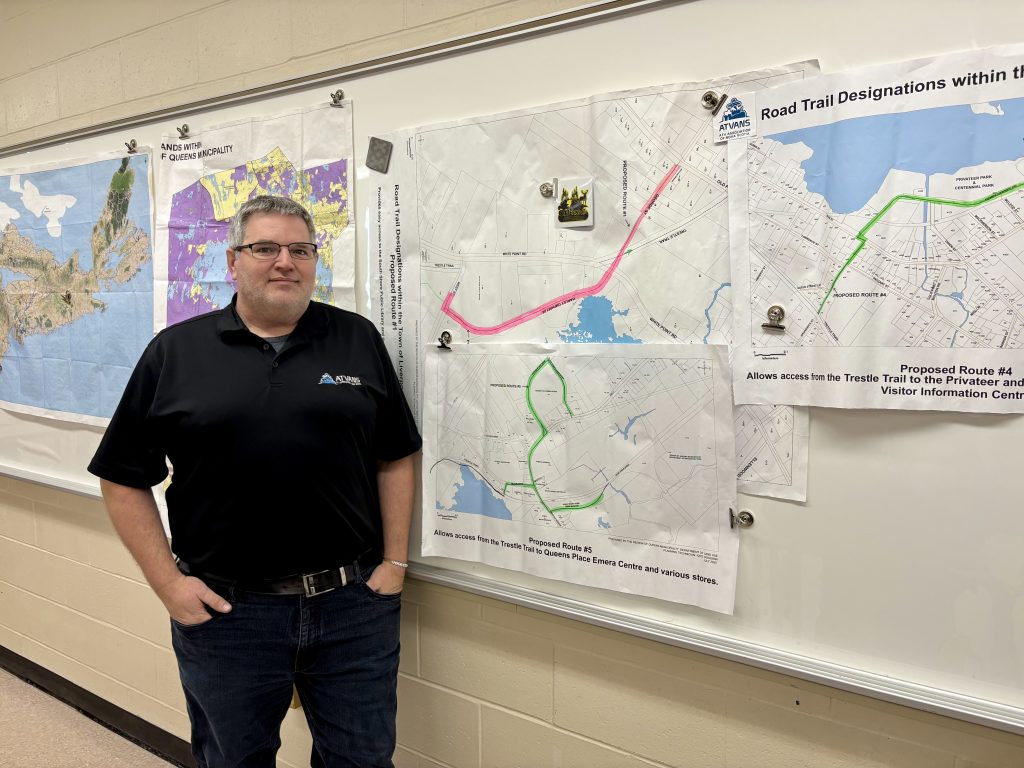
Dave White is the president of the Queens County ATV Association. (Rick Conrad)

ATV operators in Queens County will soon be able to ride their vehicles on some municipal roads in Liverpool.

Region of Queens councillors adopted a new road trails bylaw on Tuesday, paving the way for off-highway vehicles to use some roads to access trails and services.

The rules take effect Feb. 1. But Dave White, president of the Queens County ATV Association, says there’s still some work to do to get the trails ready for riders.

“It’s really important for people to note that, although it’s passed second reading today, it will not become officially open. … Things that have to be done is we have trail signage to go up as well as the region has some signage for where the trail crosses streets. So they’ve already done some preliminary work.”

White said the association, the ATV Association of Nova Scotia and the municipality will update users on when the trails are ready to use.

The bylaw designates five routes around Liverpool that riders can use to access services or other trails.

It’s been about two and a half years since the association and the Queens Rails to Trails Association approached the region to create a connected trail network similar to those that exist in neighbouring Lunenburg and Shelburne counties and in other parts of Atlantic Canada.

ATV groups say that the changes will bring more economic activity to Queens County. In 2022, ATV users said they spent $454 million in Nova Scotia.

The Nova Scotia government passed the Road Trails Act in 2023, which allows off-highway vehicles on provincial and municipal roads with certain conditions.

“It’s been a major development and a lot of work with the municipality, over the last six months, but really over almost two and a half years at this point,” White said .

“So we are exceptionally pleased with it.”

White says motorists won’t see much of a change once the rules go into effect, since the vehicles won’t be allowed everywhere.

“You will see off-highway vehicles on defined streets. That’s important, it is not all of town. It’s very specific.”

The routes are behind the municipal offices on White Point Road and at various points from the Trestle Trail that would allow access to the Visitor Information Centre, downtown shops and services like the gas stations and grocery stores around Queens Place Drive. 

The association also signed an agreement with a local landowner so riders can access the former rail bed to get to the Milton Road. 

“And then you’ll travel like any other vehicle down to the light, and have all of the options open to you, including the yield lane to the right to access Irving, Shell and Hank Snow Drive, which will allow us to have combined tourism events with the friends of the Hank Snow Society, which we’re very excited for, and we’re hoping to do an event with them in February.

“You will also be able to turn left at the light to access businesses like Sobeys, Superstore, McDonald’s, Dollarama, Queens Place, Best Western, which is a major win because people will be able to come in and do expanded tourism opportunities. So we’re very excited.”

White says once the trails are open, they should bring in business from off-highway vehicle users from around the province.

He says people can get more details about the routes by downloading the ATV Association of Nova Scotia’s mobile app. 

Here are the routes outlined in the bylaw:

  • West Street from civic number 181 to the intersection with Harley Umphrey Drive, then to the intersection with White Point Road.
  • King Street from civic number 56 to the intersection with Lawrence Street, then to the intersection with Wolfe Street to civic number 16.
  • Main Street from the intersection with Central Boulevard to civic number 741.
  • Brunswick Street from civic number 63 to the intersection with Main Street, then to the intersection with Henry Hensey Drive to the pump station at civic number 4 Henry Hensey Drive.
  • Milton Road from civic number 31 to the intersection with Bristol Avenue, west to the intersection with Hank Snow Drive and east to the intersection with Queens Place Drive. Included is Hank Snow Drive to civic number 38 and the entirety of Queens Place Drive and Old Cobbs Barn Road.

Email: rickconradqccr@gmail.com

Listen to the audio version of this story below

Nova Scotia Lobster Roll-Off set for Feb. 3 at Quarterdeck

Wendell McKay and Victoria Hopkins of Capt. Kat’s Lobster Shack in Barrington Passage, winners of the 2025 Lobster Roll-Off. (Rick Conrad/File)

One of the signature events of the 2026 Nova Scotia Lobster Crawl cracks open in early February at the Quarterdeck Resort in Summerville.

Described by organizers as “marvellous mayhem with mayo”, the Lobster Roll-Off is scheduled for Tues., Feb. 3 from 6 p.m. to 8:30 p.m.

The good-natured but fierce competition invites chefs from around the South Shore to show off their lobster roll skills. The winner of the judged event will get bragging rights for their mouth-watering creation as the top roll on the South Shore.

National and international travel media make up the judging panel.

“This event is where culinary creativity, community pride, and the world’s best lobster come together,” Stephanie Miller Vincent, co-ordinator of South Shore Tourism Cooperative, said in a new release. 

“It’s not a competition, it’s a spotlight. And our chefs know how to rise to it.”

About 100 guests are expected for the fun- and lobster-filled event.

Restaurants who want to compete in the 2026 Lobster Roll-Off can register now. They must be a South Shore Tourism Cooperative member, serve the same lobster in-house for the whole month of February and be located on Nova Scotia’s South Shore.

Tickets are available at lobstercrawl.ca 


Sunny outlook for 2024 tourism season on South Shore

Stephanie Miller Vincent is the co-ordinator of the South Shore Tourism Co-operative. The organization held its annual general meeting Tuesday at the Quarterdeck Resort in Summerville Centre. (Rick Conrad)

Tourism operators on Nova Scotia’s South Shore are looking forward to a good season, optimistic that visitors will return to the area after a disappointing 2023.

Stephanie Miller Vincent is the co-ordinator of the South Shore Tourism Co-operative, which counts almost 120 members from Peggys Cove to Barrington. 

“We’re a resilient group. We’re also a really optimistic group. And weather will play a factor, the economy will play factor, but we know we’ve got first-class product, we’ve got things to offer that nobody else has in other regions of Nova Scotia or Canada, so we’re looking forward to a really great year.”

The co-operative held its annual general meeting on Tuesday at the Quarterdeck Resort on picturesque Summerville Beach. About 40 members from hotels, restaurants, municipalities and chambers of commerce around the South Shore got an update on the group’s efforts to boost tourism and to extend the season beyond the summer and early fall.

Wildfires, floods and rain contributed to a challenging 2023 tourist season for the area’s businesses. The South Shore, the Yarmouth and Acadian Shores and Cape Breton saw declines in room nights sold compared with 2022, while accommodation numbers in the rest of the province were higher than the year before.

Hotel stays, or room nights sold, on the South Shore for the May to October 2023 period were down about five per cent over 2022.

Those at the meeting on Tuesday said early indications are that this year’s bookings are up over last year.

Jill Forrest, the general manager of the Quarterdeck, said early bookings look good.

“It’s promising for this upcoming year for sure. We are in a last-minute trend, it seems. Even last year, people tend to wait and see what the weather’s going to do and pull that final trigger on booking and knowing where they’re headed. But things are looking very good for the year.”

Susan Corkum-Greek, MLA for Lunenburg and Nova Scotia’s minister of economic development, told the co-operative’s members that she checked with the province’s tourism officials before the meeting to get an idea of what the season might bring. 

“And we have early indicators of early bookings. We know for instance that the Yarmouth ferry has a higher percentage of advance bookings, The hotel association is saying that. Room nights are not the only indicator but it shows buy-in intention and says something of length of stay.”

The co-operative’s annual lobster crawl in February always attracts a lot of attention. This year, the group says its marketing efforts resulted in more than 100 media headlines, reaching about 270 million people, with an advertising value of just under $7 million.

About 100 of the co-operative’s members held 128 events around the South Shore connected with the lobster crawl. And just under 80 per cent of those who attended a lobster crawl event were from Nova Scotia, according to a survey conducted by the co-operative.

Miller Vincent says it’s always difficult to predict what the season will be like. But she expects staycations to be big again this year.

“You’re always trying to look at the data,” she says. “We always look at the price of gas, but we’ve got more flights coming into Halifax so that’s important. The economy will probably keep people closer to home and looking to see not only what’s in their own neighborhood but what’s next door. Staycations have become more important than before Covid because we recognize what we’ve got here.”

Email: rickconradqccr@gmail.com

Listen to the audio version of this story below

Queens County businesses hurting from lower tourism numbers in 2023

Melanie Perron, co-owner of Hell Bay Brewing in Liverpool, says she hopes summer 2024 is better than the 2023 season. (Rick Conrad photo)

By Rick Conrad

Fires, floods and downpours combined last year to keep visitors away from the South Shore, according to numbers released recently by Tourism Nova Scotia.

Hotel stays, or room nights sold, for the May to October 2023 period were down about five per cent over 2022. That compares to an overall decrease of two per cent in all of Nova Scotia. The only regions that saw more people in 2023 were the Eastern Shore and the Annapolis Valley.

The South Shore was one of the hardest hit areas of the province. Yarmouth and Acadian Shores saw the biggest drop at six per cent over 2022.

Stephanie Miller Vincent, co-ordinator of the South Shore Tourism Co-operative, says the wildfires in Barrington and Shelburne, and torrential rains and floods later in the summer conspired to keep people away from the South Shore.

“We had an odd beginning to our peak season in 2023,” she said in an interview. “We had fires in the Barrington area that shut down (Highway) 103 so folks weren’t travelling this coast. So that affected numbers.

“2023 numbers are tough to look at because we’re looking at numbers that are coming the year following a couple of years of pent-up travel demand.”

The numbers aren’t really surprising to businesses and organizations in Queens County that rely on summer tourist traffic to help float them through the rest of the year.

Melanie Perron, the co-owner of Hell Bay Brewing Company in Liverpool, says she saw a lot fewer visitors from the Maritimes last year.

“We rely so much on our patio season to bring in tourism and people from the city and other places,” Perron says.

“And it seemed like it rained every weekend so those would have been when we would have had a surplus of people coming and enjoying our beaches and our parks and then coming and stopping and having a flight (of beer) or getting beer to go. So I found our numbers were way down because of the weather.”

At the Queens County Museum, which relies partly on donations from tourists, visitor numbers dropped by more than 3,000 across its four properties over 2022. Besides the main museum, Perkins House, Fort Point Lighthouse and the Queens Museum of Justice are also part of the museum complex.

Dayle Crouse, the museum’s administrative assistant, said that despite a spike in visitors in 2022 when people were doing more post-Covid travelling, the numbers still haven’t recovered to 2019 levels.

“We found that after Covid and everybody had a little bit of freedom they really spiked and everybody was spending their dollars and going out. But then I think the next year, people really started to rein in their dollars and numbers have dropped.”

Crouse says a combination of rising gas prices, bad weather and news coverage of the wildfires contributed to the decrease.

Miller Vincent says that while tourists from outside the Maritimes tend to book their vacations six months to a year in advance, those closer to home are more spontaneous.

“As Atlantic Canadians and Maritimers we look on Wednesday and say, ‘OK, what’s the weather this weekend? Should I go or should I stay?’ And if it’s calling for rain, you’ll see those accommodation numbers not pick up where they need to be.”

Perron says she hopes 2024 brings brighter weather and more people back to the area’s beaches and the brewery’s patio.

“We usually bank on the summer to get through the winter. So our summer was so dismal that we’re just scraping by to get through the winter and hopefully we’ll have a nice sunny hot summer to bring out all the beer drinkers.”

Email: rickconradqccr@gmail.com

Lucy the Lobster sees shadow, predicts six more weeks of winter

Lucy the Lobster saw her shadow in Barrington on Friday morning. (Nova Scotia Lobster Crawl photo)

By Rick Conrad

Lucy the Lobster didn’t crack a sweat when she saw her shelly shadow on the wharf in Barrington on Friday morning.

That means six more weeks of winter, at least for the South Shore of Nova Scotia.

Lucy made her prediction as the Nova Scotia Lobster Crawl Festival kicked into high gear. It’s a whole month of shellabrations along the South Shore involving the scrumptious crustacean.

Nova Scotia’s official winter prognosticator had a different prediction. Shubenacadie Sam did not see his shadow, which means spring is around the corner.

Stephanie Miller Vincent, co-ordinator of the lobster crawl, said it was prime shadow-seeing conditions in Barrington. 

“We had sunshine, I’m sorry that they didn’t in Shubenacadie. We were there. We believe what Lucy saw.”

Now, Lucy gets to hang out in a tank at Capt. Kat’s Lobster Shack in Barrington Passage for the rest of the lobster crawl.

“Lucy is spending some time at the spa. You can pop in and take a shellfie with her while she relaxes for the rest of the month of February.”

Email: rickconradqccr@gmail.com

Organizers lift lid on Nova Scotia Lobster Crawl Festival

The Nova Scotia Lobster Crawl Festival kicks off Thursday. (Nova Scotia Lobster Crawl Facebook page)

By Rick Conrad

Get your shell cracker ready, sharpen your lobster pick and loosen your belt. Thursday marks the beginning of the Nova Scotia Lobster Crawl Festival.

The month-long celebration of the succulent shellfish includes businesses all along the South Shore, from Barrington, the lobster capital of Canada, to Peggys Cove, and as far inland as Kejimkujik and New Ross.

Things really get going on Friday, when Lucy the Lobster marks Groundhog Day in her own special way. If you’re at the Cape Sable Island Causeway at 8 a.m., you’ll get to see if Lucy predicts a longer winter.

The South Shore Tourism Co-operative launched its first lobster crawl in 2018 to help bring visitors to the South Shore in a typically slow time of year.

Stephanie Miller Vincent, the co-ordinator of the co-operative and the festival, says that with more than 100 events at 80 different businesses around the South Shore, it’s a great excuse to get out of the house.

“February is the longest shortest month of the year and we all need a reason to get out and crawl,” she says.

“There are just always great reasons to either come and visit the South Shore or crawl around the South Shore if you already live here.”

The festival features five signature events — Lucy and her shadow on the 2nd, the Lobster Roll Off competition at the Michelin Social and Athletic Club in Bridgewater on Feb. 4, the inaugural Chowder Chowdown Showdown on Feb. 11 at the Black Loyalist Heritage Centre in Birchtown, the Tail End Party at the Old Fish Factory in Lunenburg on Feb. 23, and the Beachside Bingo Brunch Buffet at the Quarterdeck Inn in Hunts Point on Feb. 25.

The chowder showdown is already sold out and there are only a few tickets left for the lobster roll competition, Miller Vincent says.

But there are events all over the South Shore to tickle your lobster fancy. The Region of Queens is also getting in on the lobster-loving action with Light Up Queen’s, an outdoor nighttime party in Centennial Park on Feb. 24.

“The economic value of lobster crawl has increased every year,” Miller Vincent says. “It’s now an anticipated event. We have businesses that stay open because of lobster crawl or extend their hours because of lobster crawl.

“It’s a little bit of everything. It’s truly taken a month where hibernation might have been the most popular activity and really encouraged people to get out.”

If you’re really into the crawl, you can find something to do for all 29 days of February, Miller Vincent says. You can pick up a passport at participating businesses or on the website at lobstercrawl.ca, track your progress and enter to win prizes. 

As for Lucy, she gets to return to her bottom-dwelling ways a few days after she sees her shadow or not.

“Lucy is often a different Lucy. She does her duties, spends a couple of days at the spa at Capt. Kat’s (Lobster Shack in Barrington Passage) so you can pop by and get a ‘shellfie’ with her and then Lucy gets released,” Miller Vincent says.

“We do not eat Lucy, nor do we allow anyone else to eat Lucy. Lucy gets released.”

For a full schedule, visit lobstercrawl.ca or follow Nova Scotia Lobster Crawl on Facebook.

Email: rickconradqccr@gmail.com

Listen to the audio version of this story below

Fire equipment funding, short-term rentals on Region of Queens agenda for Tuesday

A brick building with Region of Queens Municipality administration building on the outside.

Region of Queens Municipality administration building. (Rick Conrad photo)

By Rick Conrad

Fire trucks and Airbnbs are on the agenda as Region of Queens council meets Tuesday evening in Milton.

Council has four meetings a year in a community facility in a different part of Queens County. Tuesday’s meeting begins at 6 p.m. at the Milton Community Hall, 168 Tupper St., Milton.

Councillors will discuss a policy to help the county’s five fire departments with vehicle purchases according to a set schedule.

The current schedule expired last year. And council will be discussing a new timetable that will expire in 2035. 

The Mill Village fire department has asked the region for $275,000 in loan payments over 10 years toward a new $711,810 fire truck.

Under the proposed new funding arrangment,  the maximum amounts available to fire departments for the next two fiscal years for new equipment would remain at $275,000 for pumpers, tankers and aerial trucks and $100,000 for rescue and utility vehicles.

From 2026/27 to 2034/35, those amounts would increase to $425,000 for new trucks and $200,000 for rescue vehicles.

The amounts would be reviewed with fire chiefs every two years.

Also on council’s agenda Tuesday evening, owners of short-term rentals in Queens County may get a chance to have their say on a tourism accommodation levy.

The Nova Scotia government made it possible in 2022 for municipalities to tax all tourist lodging up to a maximum of three per cent.

Since last April, all short-term rentals must sign up with a provincial registry. They must also follow municipal land-use bylaws.

According to a staff report to council, a three per cent levy could raise about $240,000 per year. The extra revenue would go toward boosting local tourism efforts.

But first, staff is suggesting that the region consult the owners of such properties.

Email: rickconradqccr@gmail.com