Farmers will get some help from the Nova Scotia government to expand their operaitons. (Nova Scotia Federation of Agriculture via Facebook)
The Nova Scotia government is devoting $5 million over the next three years to help new and existing farmers buy farmland to encourage more agriculture.
“Young farmers and growing family operations often struggle to find affordable farmland to expand their business. This program gives them a practical way to grow their farms and secure their future,” Agriculture Minister Greg Morrow said Thursday in announcing the program at the Nova Scotia Federation of Agriculture’s Farmers’ Forum in Truro.
The Program for Accessing Agricultural Land will be administered by the Nova Scotia Farm Loan Board, which is a Crown lending agency under the Department of Agriculture.
The three-year pilot program includes four streams:
a low-cost land-leasing option for new farmers and for exisiting farmers to expand their farms
a second land-leasing option that allows farmers to build equity for a future purchase
deferred financing to help grow new farms
startup loans for land, equipment and livestock to help new farmers
As of March, the Farm Loand Boardhad $314 million in loans issued to 380 clients located mainly in rural Nova Scotia, according to the Department of Agriculture. That supported 3,180 full-time-equivalent employees, $191.6 million in gross domestic product and $35.8 million in provincial tax revenue
Dale Richardson and Matthew Roy speak to the Queens Garden Club about an innovative greenhouse project in Shelburne. (Rick Conrad)
The conditions are ideal for Queens County to become a local food powerhouse just like the Annapolis Valley, advocates say.
The area’s temperate climate and natural biodiversity are two big factors in its favour, members of the Queens Garden Club heard on Thursday evening.
The club’s Mary White says it’s time to devote some resources to harnessing that potential.
“We want some green initiatives here in Queens County,” she said. “We have some very lovely spots that they could go in and that not only could it help with things like food security, it could help with our economics. There’s no reason why everybody should go to the Valley and not go here.
“We have the same resources, and we’re able to do the same sorts of things.”
About 30 people gathered at the Thomas H. Raddall Library in Liverpool on Thursday to hear how that might be done.
The garden club invited Dale Richardson, a municipal councillor in Shelburne, and farmer Matthew Roy to talk about an innovative solar-powered and geothermal greenhouse project in Shelburne. Both were involved in the project.
The volunteer-run project is about 90 per cent complete. It will produce thousands of kilograms of fresh produce year-round for the community to help combat local food insecurity.
Roy is co-owner of Coastal Grove Farm in Upper Port LaTour, Canada’s only certified organic tea grower and the country’s only certified saffron grower. The farm is also the largest commercial vegetable producer in Shelburne County.
He said communities in southwestern Nova Scotia need to start thinking seriously about becoming more food independent.
“Nova Scotia in general only has three days of food in the province,” he said. “Just digest that for a moment. … The rest of it has to get imported from other places, which isn’t bad when there’s not geopolitical issues, when there’s not climate change issues that bring dryness or droughts or interrupts transportation. … I think it’s really relevant to be thinking about where is our food coming from? And do we have the local production?”
Roy said that with only 19 registered farms in all of Queens County, there isn’t enough capacity to put food on the shelves if disaster struck.
“What has happened in Shelburne, I think would be really beneficial to have that replicated up and down the southwestern shore.”
Milton resident Kathy Chute said she’s impressed with what they’re doing in Shelburne.
“I’m jealous. I think we could do it here, no problem. and maybe even up in Milton. You know, that unused area by the swimming pool, we could put a nice greenhouse in there.”
White says farming could be as big an industry in Queens County as forestry and fishing.
“This area in particular was more about forestry and fishing, that sort of thing, and really they just let other people provide the food for them. And now it’s time for us to take that resource back. … It’s time for us to look at another natural resource that we have, and that is our outdoor space.”
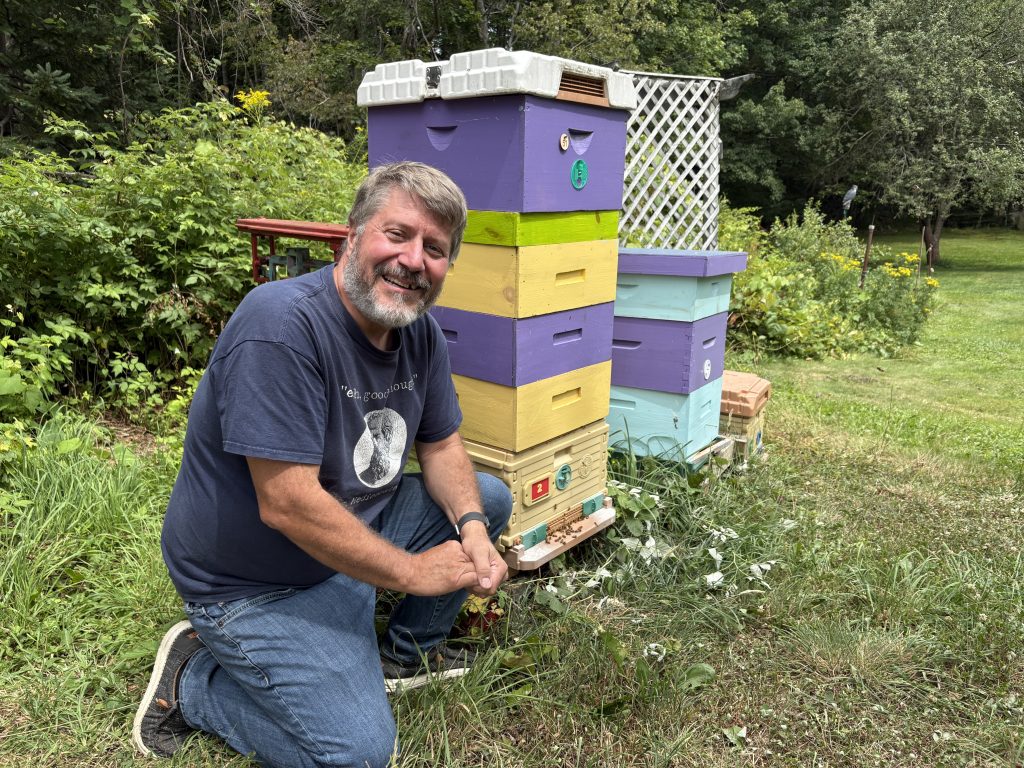
Chris Radimer, owner of Tiddley Bee Honey, near his hives in his backyard in Brooklyn. (Rick Conrad)
It’s a sunny day at the Privateer Farmers and Artisans Market in downtown Liverpool, and Chris Radimer’s table is buzzing with people looking for local honey.
Radimer, the owner of Tiddley Bee Honey in Brooklyn, sells his raw, unpasteurized honey from his property and at markets in Liverpool and Shelburne.
He also uses some of the beeswax his bees produce to make things like furniture polish and candles.
Radimer has been beekeeping since 2019 after a 33-year career in the Canadian Navy.
He explains how he arrived at his business name: “Tiddley in the navy means something that is done neatly and tidily and expertly, and so I thought, that would work pretty well because that’s what you want from your bees. You want your bees to take care with the building of the honey, building of the hives, building of the comb.”
Radimer and his wife moved to Queens County from Ontario in 2022. Since then, he’s been tending to his 26 full colonies and two half-colonies spread on his own and other properties in the area.
He keeps four colonies and two half colonies on his own property. The others are hosted by homeowners in Brooklyn, Mersey Point, Western Head, Beach Meadows, and near Lockeport.
“I retired from the the navy in 2017 and sort of didn’t know what to do or where to go,” he says.
“We were in Port Colborne, which is on Lake Erie, which has Niagara College pretty close by, and my sister, who works there, knew about this beekeeping program. And Veterans Affairs was offering to send us back to school, and I went to one of their open days, and the person that was representing the commercial beekeeping group was so incredibly enthusiastic that I just got swept into it. And after that, I was reading books and applying and spent the next full year at that school learning.”
Each of his hives has a queen and a minimum of about 20,000 other bees bringing back pollen and nectar. When it’s loaded with honey, one section of a hive can weigh up to 50 pounds.
“And if you have a very healthy colony, there’s a couple on this property here that are very healthy right now, they could go up to 60 or 80,000 bees for the summer,” he says.
“And then that number would back way down over winter.”
Without a lot of agricultural activity in south Queens, it would be difficult to have a large beekeeping operation.
“To make a living off of it, you need commercial-level agriculture, where you have a stable stream of crops to pollinate, or crops that produce nectar that you can draw from.”
Radimer says he’s happy with the number of colonies he has.
“To have a viable, small-scale honey operation, you probably need about 150, and I’m never going to do that. Thirty is probably going to be my limit, just because I’m getting a little older and it’s a lot of weight to lift.”
He’s quick to point out that beekeeping is agriculture, which is why the year-long course at Niagara College was important. You need to know how to keep your flock healthy. You also have to learn to adapt to extreme weather or other conditions.
He says the season this year began slowly, but the spring conditions soon improved, bringing a mix of rain and sun to help produce the pollen and nectar that bees need.
“It was just a very slow start, but once they got going, there was a lot of nectar for them to produce. I was really shocked at the amount of honey that was generated in late May and through June, early July, but now it’s stopped.
“So the challenge right now is that with these drought conditions, with no rain, even if we have flowers, the flowers aren’t producing nectar to the degree that the bees need.”
And because bees need the honey to keep their colonies fed and thriving, a shortage of the golden stuff creates another problem – robber bees.
“And robber bees are nasty,” Radimer says.
“They’re more aggressive and they’ll attack other hives to try and steal the honey.”
Radimer says many beekeepers will harvest only once a season, usually later in the year, but he harvested about 30 to 40 litres in July and he’s hoping for better weather for a bigger harvest this fall. The late summer plants like aster and goldenrod produce a honey that customers like, but bees, not so much.
“The problem with that honey is it’s not actually that good for bees. It’s not as nutritious as the early honey. So we like to take as much of that as we can. And then as soon as we’ve taken that honey, most beekeepers with more than one or two hives will start feeding sugar water. The (bees) can process that better. The goldenrod honey actually gives them the runs.
“So, if you’ve got bees nearby and a black truck, such as me, you notice when you’ve left too much goldenrod (honey). It’s just yellow streaks, yellow streaks (on the truck).”
And as if robber bees and the weather weren’t enough to deal with, there’s also the constant threat of predators like wasps, hornets, skunks and bears.
“What skunks do is they’ll sit at the bottom of the beehive and they’ll tap on the box with their paws. And as the bees come out, they’ll eat the bee. And a skunk can go through a beehive pretty quick. They’ll eat a lot of bees. They want protein.
“Bears too, bears don’t tend to go for the honey. They tend to go for the brood. They’ll scrape off all the eggs and the brood. Bears apparently can smell a beehive for about three kilometres.”
Radimer is constantly monitoring and maintaining his hives, especially during swarm season in May and June, when the colonies are more likely to make new queens. Every 10 days or so, he’ll suit up and open the hives to make sure everything is tiddley.
One thing’s for sure, his bees keep him buzzing.
“I like a challenge and I like puzzles. And so, you know, when something’s not going right, I can do research. I can look at what I’ve done, what others are doing and try and figure out if there’s a way to solve it. Ultimately it’s agriculture. So sometimes the solution is just walk away from it and start another colony. But usually, you can bring them back if they’re having trouble. … I was just out at one of my yards this morning and it was struggling a little bit last month. I wasn’t quite sure why. And I did a few adjustments here and there and I left it for a few weeks and it’s fabulous. It’s fantastic. Better than it was at the start of the season. So that’s what you want to see.”
Raw honey does not need pasteurization and therefore is the most nutritious honey you can eat. During processing, Tiddley Bee’s honey never reaches temperatures over 35 degrees Celsius, which is also the internal temperature the hive strives to maintain over winter to protect the queen
It’s natural for raw honey to crystallize
Honey will absorb moisture instantly. You’ll know if honey’s “gone bad” if it begins to foam. That means the moisture content is too high and it’s begun to ferment
If honey contains more than 18 per cent water, it will spoil. “But if it’s under 18 per cent, it could last 1,000 years,” Radimer says
Help pollinators like honeybees and other bee species, butterflies and moths by not using pesticides on flowering crops
Worker bees are all female; they do all the work of collecting pollen and nectar and defending the hive; drones are males and are used exclusively for reproduction. The males can’t forage or feed themselves
In winter, the colony will form a protective ball around the queen. The bees take turns on the outside of the cocoon and flap their wings constantly to generate heat. They also need a lot of honey to feed on during the winter months