Parks like Pine Grove Park in Milton will reopen after the Nova Scotia government lifted its woods ban in most counties on Thursday. (Tourism Nova Scotia)
The ban on travel in the woods has been lifted for most counties in Nova Scotia except for Annapolis County.
The Nova Scotia government allowed travel and activities in the woods to resume as of 4 p.m. on Thursday, according to a news release from the Department of Natural Resources. That includes hunting.
The change applies to Queens, Cumberland, Hants, Lunenburg, Kings, Shelburne, Digby and Yarmouth counties. Restrictions were previously lifted in the other nine counties.
Restrictions will remain for Annapolis County until Oct. 15, the end of wildfire season.
“We’ve looked at improving conditions and also at the impact these necessary restrictions have had on businesses, which we’ve tried to minimize all along,” said Natural Resources Minister Tory Rushton. “We’re at a point where, for both reasons, it’s time to lift these restrictions everywhere except Annapolis County, where crews are continuing to fight the Long Lake wildfire.”
The ban on open fires remains for the entire province until Oct. 15 or until conditions improve.
The fine for violating the burn ban is $25,000.
The woods ban was introduced on Aug. 5, while the burn ban began July 30.
Marcus Tufts of Barrington Passage with one of his oxen team at the Queens County Fair in Caledonia. (Rick Conrad)
Organizers of this year’s Queens County Fair say the annual agricultural exhibition is growing, but staying true to its roots.
Secretary-manager Doreen Holdright says more people are volunteering, and events like the horse and ox pulls are attracting even more participants.
“It’s getting bigger, we’re providing more entertainment. We do a lot of things that people just coming in off the grounds can take part in. Like Saturday, our corn cob contest. See who can eat the most corn. More like the old country fair. That’s what we’re trying to stay with and stay clear of the commercialism. ”
This is the 149th year for the fair in Caledonia, though the exhibition is more than 150 years old, and runs until Saturday. It features other livestock competitions like barrel racing, an artisans market, competitions for arts, crafts, vegetables and horticulture and lots of activities for kids. And popular events like the ladies’ toilet seat toss and the men’s frying pan toss are back for another year.
“Everybody’s interested,” Holdright says. “They all want to get involved. We’re all volunteers and three-quarters of the community volunteers.”
Despite an incident in which a horse and buggy overturned during Tuesday’s parade, Holdright says opening day was a success.
A man and his daughter were on the cart when their horse got tangled in its harness. The man suffered undisclosed injuries and is still in hospital, while his daughter hurt her leg, but was sent home after being checked out in hospital.
Holdright says the two people on the cart will be OK, and the horse was uninjured.
She says the fair is so popular this year that organizers will have to expand their camping area next year. A large part of the draw are the horse and ox pulls, with a record number of light horses at the fair this year.
“Ox pulling is growing. There’s new people coming into it. There’s new people coming into it. We have to limit because we only have 61 stalls for oxen. But at our spring pulls, we’ve had up to 80 pairs.”
Marcus Tufts of Barrington Passage brought his two teams of oxen. One of his pairs was already racking up the ribbons, winning best matched team, best gear and best exhibit of oxen in the parade.
“Queens County is where I grew up but moved away 20 years aog and it’s still my favourite exhibition to come back to. Just a hometown fair to see the people and friendly and just love the fair and to compete with the ox pulling.”
Tufts doesn’t use his oxen for much farm work anymore. But he still puts them through their paces to prepare for the ox-pulling competitions.
“It’s like bodybuilding,” he says.
“You have to work them every night to make them strong. We exercise my oxen for near an hour a night every evening at home. Just dragging a lightweight to build the muscle in their legs and their neck. And every once in a while, once a week, we put them on a heavier load just to test them to see how we’re doing.”
He bought Toby and Dan when they were three years old.
“No Bright and Lion. That’s a traditional name but we tried to stay away from that. They were actually that when we bought them.”
The six-year-old pair can haul up to 9,600 pounds, about three times their body weight. Oxen are judged by how much they can pull divided by their weight. He says the crowds love it.
“It’s a big draw. I think it’s just to see the pure strength of the animal and how well they listen to being trained. It’s an old tradition. Years ago, they used to use them in the woods and the old guys would bring them to the fair just for bragging rights of who had the strongest team. It’s kind of still the same thing today, except not many work them in the woods anymore.”
Tufts says this is the last fair of the year for his oxen. After this, they’ll head home for a rest in the pasture.
“My father always had a team. Now my kids, they come with us to all the fairs. My kids pull in the junior ox hauls and this is just my hobby. This is my four-wheelers.”
Kari-Lynne Drummond and Kevin Charlton of East Torbrook in the Annapolis Valley have been to four other exhibitions this year, in Lawrencetown, Bear River, Bridgewater and Windsor.
They said they were impressed with Caledonia.
“The barns are in excellent shape and the number of livestock is high,” Charlton said. “For the number of fairs we’ve gone to this summer, it’s probably the fair we’ve seen the largest amount of animals.”
“They’ve done a great job here as far as keeping it down home,” Drummond says.
The fair’s Holdright says the rest of the week features lots for people of all ages.
“It goes until Saturday, come check it out. Our rates to get in are the lowest and we’ve got lots for you to do and see.”
The Region of Queens is going to make Cameron’s Corner in Liverpool an all-way stop. (Rick Conrad)
Drivers in downtown Liverpool will soon encounter another three-way stop on Main Street.
The changes are being made at the intersection of Main and Old Port Mouton Road, commonly known as Cameron’s Corner.
In response to concerns from residents and councillors about safety in the area, the region’s traffic authority plans to turn it into an all-way stop.
Another busy intersection, the three-way stop at Main and Market streets, has been the scene of many close calls between pedestrians and motorists over the years.
A report prepared by consultants CBCL in June 2024 suggested a different option at Cameron’s Corner. It recommended that Main Street be turned into a throughfare, with a stop sign on Old Port Mouton Road. They also suggested narrowing the east Main Street approach and realigning parts of the intersection.
The intersection is a busy one. It has one stop sign on Main Street at the eastbound approach, but the traffic coming from Old Port Mouton Road has the right-of-way.
The consultants said that it’s more intuitive for drivers on Main Street to have the right of way, with motorists on the minor road approach of Old Port Mouton required to stop.
Adam Grant is the Region of Queens director of infrastructure. He’s also the municipality’s traffic authority.
He told councillors at their regular meeting last week that the changes suggested by CBCL would cost about $120,000, an expense not included in this year’s operating budget.
Grant said that that part of Main Street is going to be turned into a three-way stop anyway with the planned work on the $21-million Mount Pleasant services extension and housing development at the other end of Main. And CBCL’s other recommendations for realigning the intersection will be included.
“So the intention is, once it’s converted to an all-way stop, it would stay an all-way stop in perpetuity, unless it was determined through further analysis that it wasn’t necessary and that it could be reverted to a one-way stop control,” Grant said. “The geometry realignment would be incorporated into next year’s capital work, the all-way stop would stay in that mannerism.”
Councillors can make suggestions to the traffic authority, but traffic changes are an administrative matter.
Mayor Scott Christian told QCCR that with the water and sewer upgrades planned with the Mount Pleasant work next year, some of the consultants’ changes will happen anyway.
“I think it’s a good piece of decision making, not to rip up and change that sidewalk to then next year, rip it up when we’re replacing the water and sewer through there. So with the recommendations from the CBCL report, we’ll make those alterations to the curb when we do the water-sewer work.”
Grant told councillors that Cameron’s Corner will be turned into an all-way stop this fall, with the appropriate signage to give drivers advance notice of an upcoming stop. He said the region will also let people know through social media in the next few weeks.
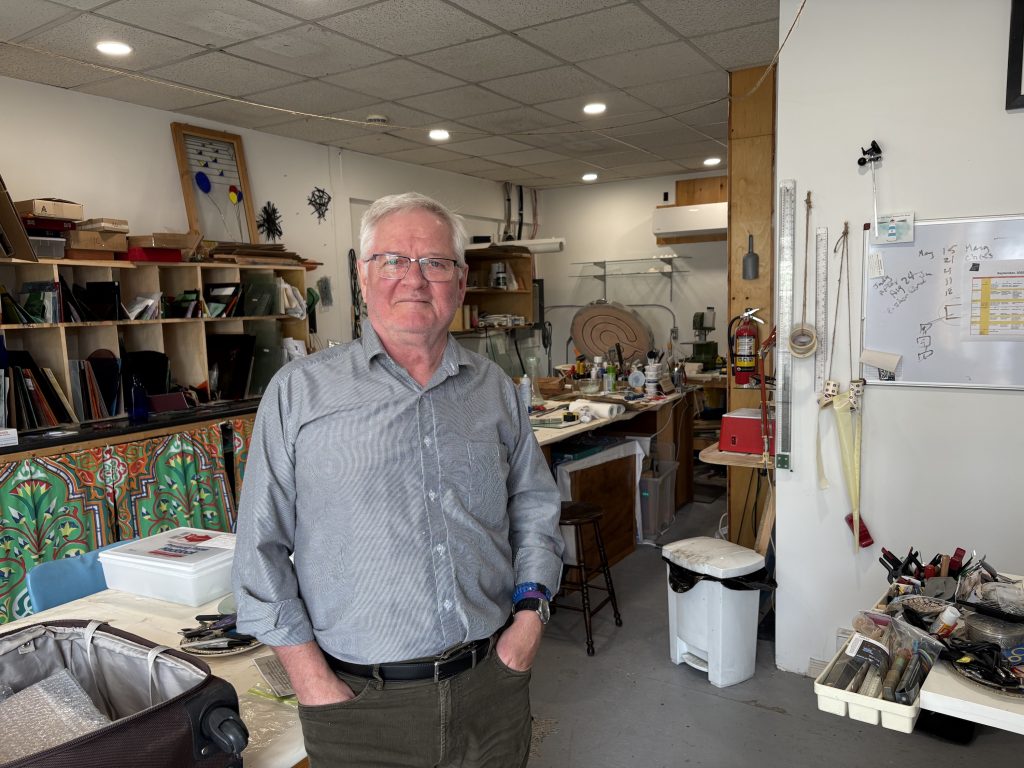
Summerville artist and retired diplomat Scot Slessor is in Arusha, Tanzania, working with a group of artisans to expand their markets. (Rick Conrad)
A Queens County artist is in Tanzania for the next two weeks, helping artisans there develop ways to get their products to more people.
Scott Slessor is a retired Canadian diplomat who lives in Summerville. He’s also the owner of SAS Glass, a stained glass studio in Liverpool. As a Canadian foreign affairs officer and consul general, he led strategic planning and training in places like India, Afghanistan and Thailand.
Since he retired, he’s done a couple of stints in places like Mongolia and Cambodia with Catalyste Plus, a Canadian NGO focused on economic development in Indigenous communities and emerging economies. This will be his first trip with Catalyste Plus working with artists in another country, as part of a project to improve economic and social well-being for women and girls.
“This one is very unlike the other stuff I’ve done,” he says.
“This is about arts and crafts. So this tacks onto a whole other part of my life. I’ve never been to Tanzania. I’ve never been to East Africa. This is all new, which is going to be really cool. … And so they wanted to, in this institute, look into, as part of their tourism program, working with craftspeople, with artisans, and sort of up their game a bit.”
He’ll be working with about 20 artists in Arusha, a city of more than 600,000, near Mount Kilimanjaro and the Serengeti. In an interview before he left for Tanzania, Slessor said he’ll be helping local artists develop ways to get their goods into the hands of more tourists and hikers.
“We’ll be talking about the market there. Who are they actually trying to sell to? Because I don’t think they’ve necessarily done a full assessment. And I have. The government of Tanzania has done some. So we have some starting points of the ages of people coming there, where they’re coming from, a lot from the U.S., Canada, Europe. … And these are people who are going to climb Kilimanjaro. These are guys who are going to have a carry-on (bag) with their hiking boots on. So how do you put something in their pocket? So we’re going to generate a whole whack of ideas. And then they’ll have to decide how they’re going to implement that.”
Slessor has been doing glass art for more than 25 years. And he’s lived in Queens County with his wife, also a retired diplomat, since 2022.
He’s one of the organizers of the Queens Coast Art Tour studio rally. He says he hopes to be able to connect some artists from his trip in Tanzania with Queens County artisans who have offered to be occasional mentors.
“You know, it’d be fun if a couple folks from here, even just an hour a month for three or four months, hook up with somebody in Tanzania just to talk about, ‘What are you making today?'”
Slessor says he hopes his two weeks with the artisans in Arusha can help set them up for success.
“If a couple of these people develop habits that help them design more appropriate stuff for the folks that are coming in, then I think that’s a real win. So I’m going to spend a bit of time with them on, who are these Westerners that are coming here with their money? And then how do you sort of represent your culture, the local techniques, and all of that in a way that satisfies you as an artisan, but also allows you to make a few bucks?”
Slessor says meeting new people and experiencing different cultures are part of why he enjoys taking on these projects.
“So for me, it’s a lot of fun. I mean, I’m going to get to meet 20 people, but then I get to see a new part of the world, which is really fun. Yeah, I think that’s a fair amount of win for me.”
Slessor says Catalyste Plus is always looking for people with experience in varied backgrounds, from marketing and finance to factory production and information technology. More information can be found on their website.
Willa Thorpe is the chief administrative officer of the Region of Queens Municipality. (Rick Conrad)
Employees facing layoff when the Region of Queens closes its recycling depot may still have a job with the municipality.
The region announced this week that it would close its materials recovery facility on Dec. 1 in response to new regulations from the Nova Scotia government.
The province is shifting the responsibility for sorting plastics and other packaging to the companies that produce it. That means municipalities won’t need their own sorting facilities anymore.
In Queens, that will affect eight unionized employees.
Willa Thorpe, the region’s chief administrative officer, told QCCR on Thursday that the municipality will try to find other jobs for those workers.
So if there’s an opportunity through current vacancies here in the organization where we have the opportunity to train folks and have them shift to a different position, we’ll do that.
“So if there’s an opportunity through current vacancies here in the organization where we have the opportunity to train folks and have them shift to a different position, we’ll do that.”
She said they’re also going to hook workers up with provincial and federal supports from Nova Scotia Works and Service Canada.
Unionized employees at the Region of Queens Waste Management Facility are represented by Local 1928 of the International Brotherhood of Electrical Workers.
The local signed a new contract with the region after a week-long strike in January.
Thorpe said the agreement requires five days’ notice of any ceasing of operation or service that will affect jobs. She said managers wanted to give the affected employees more notice, so they met with workers and their local union representative as soon as council decided to close the facility.
“We think it’s important that our employees know exactly what’s going on, that their livelihood may be impacted, and so rather than follow the (basic language) of the collective agreement, we think we hold ourselves to a higher standard. So we actually met with staff a few hours after meeting with council, so the same day as opposed to waiting, so that those employees can be confident they know exactly what’s going on.”
Some workers will continue to be employed until at least Dec. 1, depending on how long it takes to wind down the facility, Thorpe said.
She said the collective agreement does not provide for severance pay. But she said “the region is actually actively working on providing some severance to those employees.”
She didn’t have details yet on what that package might be.
Jim Sponagle, the business manager for IBEW, told QCCR earlier this week that relations between the union and the region have not improved since the strike.
Thorpe, who started as CAO in June, said that’s incorrect.
“I would disagree with that statement based on the conversations I’ve heard since the labour action, the relations have improved.”
Nothing will change for residents in how garbage and recyclables are collected, and the municipality’s solid waste facility will remain open.
A company called Circular Materials will be taking over the sorting of recyclables from the region. That’s an organization formed by large corporations like MacDonald’s, Nestle Canada and Pepsico.
Thorpe said municipalities are still working out details of the agreement with Circular Materials, so she’s not sure yet how much money the region might save.
“What the specific impacts are to municipalities we’re still determining where the dust will settle. But the idea is that the producer would bear the lion’s share of the cost.”
Thorpe said officials with the region plan to meet with affected employees again next week.
Laura Methot is president of the Greater Molega Lake Lot Owners Association. (Rick Conrad)
Region of Queens councillors dumped proposed changes to garbage collection on Tuesday after residents packed the public gallery to protest the proposals.
More than 40 property owners from the region’s cottage country showed up at council’s regular meeting on Tuesday, concerned that the municipality was trying to download responsibility for illegal dumping onto volunteer-run residents’ groups.
More than 5,700 properties in Queens County are connected to roads that aren’t maintained by the municipality or the province. Most of these roads are in the areas of Molega, Ponhook and Annis lakes. Private lot owner groups collect fees from residents to maintain those roads.
People who live on public roads in Queens County usually get regular roadside garbage collection. Those on private roads, however, have to take their waste to a central location, known as grey box sites. From there, the municipality picks it up.
But under proposed changes discussed at Tuesday’s council meeting, responsibility for the maintenance and cleanup of those grey box sites would shift from the municipality to non-profit property owner groups.
Laura Methot, president of the Greater Molega Lake Lot Owners Association, which represents more than 1,200 property owners, told councillors on Tuesday that the proposed changes won’t address the longstanding problems of people dumping their trash illegally at the grey box sites.
“It is absolutely absurd to think that private road associations, managed by volunteer boards, would be able to solve the illegal dumping problem and unsightly premises that the region has not been able to tackle for years,” Laura Methot, president of the Greater Molega Lake Lot Owners Association, told councillors.
“Worse still, this bylaw update, if passed, would result in diverting resources, both time and money, away from our primary mandate, which is keeping our roads safe and passable in good condition.”
The Molega Lake area alone covers more than 1,200 hectares and 52 kilometres of roadway. It’s the largest recreational development in Atlantic Canada, though many people live in the area year-round.
Residents say they contribute disproportionately to the region’s tax base, while getting far fewer services than most other areas.
“The proposed amendments entrench this imbalance rather than resolving it,” Methot said.
Former regional councillor David Brown, who lives in Labelle, said that nobody would volunteer for lot owner groups if they were also now expected to clean up the grey box sites.
He said that at the lot owners annual general meeting in June, Mayor Scott Christian promised more collaboration and consultation.
“That didn’t happen,” Brown told councillors.
“ What we find is this is not a discussion, it’s not presented to us as options, but it’s a downloading of responsibility. It’s over 40 private law owners associations, and they’re volunteer associations.
“This bylaw, if passed, will be the end of all residential landowners associations. Nobody’s going to go out there and volunteer for a board and pick up garbage. It’s not going to happen. So as those lawowners associations disband because they can’t get volunteers, the roads won’t be maintained, Property values are going to go down.”
About 40 property owners showed up at Tuesday’s regional council meeting to protest proposed changes to garbage collection. (Rick Conrad)
After hearing from residents, councillors voted unanimously against the proposed amendments. And they voted instead to have councillors and staff consult with the lot owners groups about potential changes in garbage collection.
Christian said after the meeting that council heard the community loud and clear.
“There was a real, strong reaction from the community. Emails came flying in. Telephone messages came flying in to all members of council,” Christian said after the meeting.
“We’re trying to get to a place, though, where we’re as transparent and open in the way that we do business as possible. … So I think we got it right and I think that it’s a tricky issue, though. It continues to be this persistent issue, but I’m hopeful that we can find good, creative solutions through broad-based engagement with everybody who’s impacted out there. Sit down, do some creative brainstorming, and figure out maybe we can pilot this solution, pilot that solution, see what works, you know, and then go from there.”
Methot of the Molega Lake lot owners group said after the meeting that she believes Christian and the rest of council are committed to working with residents.
“I am very pleased with how it turned out, and particularly with the confirmation and recommitment of the mayor and council to working collaboratively with our association and with the broader community. It was a very positive outcome for us.”
Christian said the engagement sessions are already in the works. He said he hopes that the community consultations will result in a solution to the garbage problem that residents can live with.
The Region of Queens is closing its recycling facility, which will result in job losses. (Nick Fewings via Unsplash)
UPDATED AT 3 p.m. Wednesday
Employees at the Region of Queens materials recovery facility will be laid off when the depot closes on Dec. 1.
The region said in a news release late Tuesday afternoon that the layoffs and closure are because of provincial changes to how recyclables are handled. The region’s solid waste facility employs 13 people, but the release did not say how many employees are affected.
Mayor Scott Christian told QCCR on Wednesday that eight employees work at the recycling facility. But he said the municipality will try to move them or retrain them for other available positions with the region.
“The first step is to try to retain staff if that’s possible to keep people in the organization and if they can’t be kept then to lay them off. And then whatever is contained legally in the bargaining agreement, we’d go from there,” he said.
“It sucks, it sucks. It’s challenging times, life is tricky to afford and there’s not a lot of good paying jobs in the community. It’s certainly not a decision that we made lightly.”
Christian said waste collection won’t change in the municipality. Collection dates or methods won’t be affected. The solid waste management facility will remain open. This change affects only who sorts the recyclable material.
In August 2023, the Nova Scotia government amended the Environmental Act to make recycling packaging and paper the responsibility of the producer, otherwise known as extended producer responsibility.
“No impact to the resident experience, it’s just that now with the extended producer responsibility … the producers of the packaging waste are responsible for figuring out what’s happening to that waste,” Christian said.
“It’s now the responsibility of the Jeff Bezos and the Walmarts of the world to deal with their own packaging.”
Circular Materials is a company formed by corporations that produce packaging waste, such as Loblaw, Coca-Cola, McDonald’s and others.
Christian said that company also offered to collect the recyclables, but the region opted out of that.
Jim Sponagle, business manager for Local 1928 of the International Brotherhood of Electrical Workers, told QCCR on Tuesday that he found out about the job losses from a member of the local who works at the facility.
“The Region of Queens at no point contacted the union to advise the union what their intention was. Very disappointing,” he said in an interview.
“(We’ve) completely been blindsided by it. No discussion with the union, no conversation, we were completely in the dark.”
He said relations between the region and the union have not improved since a week-long strike in January, when almost 40 engineering and public works employees walked off the job for higher wages and improved overtime benefits.
Sponagle said Tuesday that some workplace issues are still outstanding from before the strike. He said he’d be contacting the union’s legal adviser to see how it can respond to the layoffs.
“I’m sympathetic to the members who will be losing their jobs. It’s disappointing for sure. We went through tough negotiation and we landed on a strike and I hope that wasn’t a determining factor as to why they chose to contract that work out that’s been done there for years. I can only sympathize with the members affected by the decision of the region.”
CAO Willa Thorpe said in the release that the municipality is “working directly with impacted employees at the MRF site to help them transition at this difficult time.”
Deborah Herman-Spartinelli is the chair of Jane’s Place Society, a group working to bring second-stage housing to Queens County for survivors of domestic abuse. (Rick Conrad)
A new group is in the early stages of trying to create safe and secure housing for Queens County residents fleeing domestic violence.
Jane’s Place Society wants to provide second stage housing for women and families who are leaving shelters, but still need supportive places to live.
Group chair Deborah Herman-Spartinelli says Queens County needs more supports for victims of intimate partner violence.
“The plan is to buy a property and develop it into second-stage housing, which means making apartments. When you leave a transition house you go into this second-stage housing for a limited time. It gives women and their families a step in the right direction to get their finances in order and get back into the regular (housing) market eventually.”
She says a small group of Queens County residents got together about two years ago to talk about forming the society. They’ve recently been meeting with officials from all levels of government, including Queens MLA Kim Masland and South Shore-St. Margarets MP Jessica Fancy-Landry. They’ve also met with representatives from Harbour House, a transition house in Bridgewater that provides services in Queens County.
“This is new. Even though the idea was brought together two years ago it didn’t really get any feet under it till this spring,” Herman-Spartinelli says.
“I think Queens County is underserved and we felt like we needed to do something. And we have the seed money from some donors and we felt like this was the best way to (do it). After talking to Harbour House and various levels of government and so on. We’re still meeting with different levels of government again to go over this second-stage housing and how to go about it.”
The Nova Scotia government declared intimate partner violence an epidemic last September and increased funding to transition houses across the province.
The Transition House Association of Nova Scotia says its member organizations supported about 4,500 women and children in abusive situations in 2024. It says the problem is only getting worse.
Kelly Ann Hamshaw, the executive director of the South Shore Transition House Association which operates Harbour House, says there’s a critical need for second-stage housing on the South Shore.
“We desperately need access to second-stage housing,” she told QCCR earlier this year. “For women to be able to access our shelter environment, they need to be able to transition to safe and secure housing. So there’s a critical shortage of that across the entire province.”
Herman-Spartinelli, who has a background in construction, says the group will have up to nine members on its board. And it will be looking for volunteers to help in other ways.
She says they’re also planning public consultation sessions around Queens County, likely to begin in the next month.
“We’re trying to get enough people on the board from all parts of Queens County, trying to get their opinion and their thoughts because it’s a big community. It can’t just be focused on Liverpool. It might have the secondary housing in Liverpool, but it is for the whole community, and it could even house people from other communities too if there was room.”
Jane’s Place is named after Jane Hurshman, the Queens County woman convicted of killing her abusive ex-husband in 1982.
Herman-Spartinelli was a friend of Hurshman’s. She says the problem of intimate partner violence is just as prevalent more than 40 years later.
She says the group’s members know there’s a lot of work ahead of them. But they’re committed to creating safe and secure second-stage housing for women and their families in Queens County.
“We’re going to work very hard and we have positive support from the people we’ve met so far, so I think it’s not going to be quick because nothing ever is. So it’s not going to happen tomorrow, but it’s going to happen.”
If you’re interested in volunteering with Jane’s Place Society, you can email Deborah Herman-Spartinelli at dahsnseb@gmail.com.
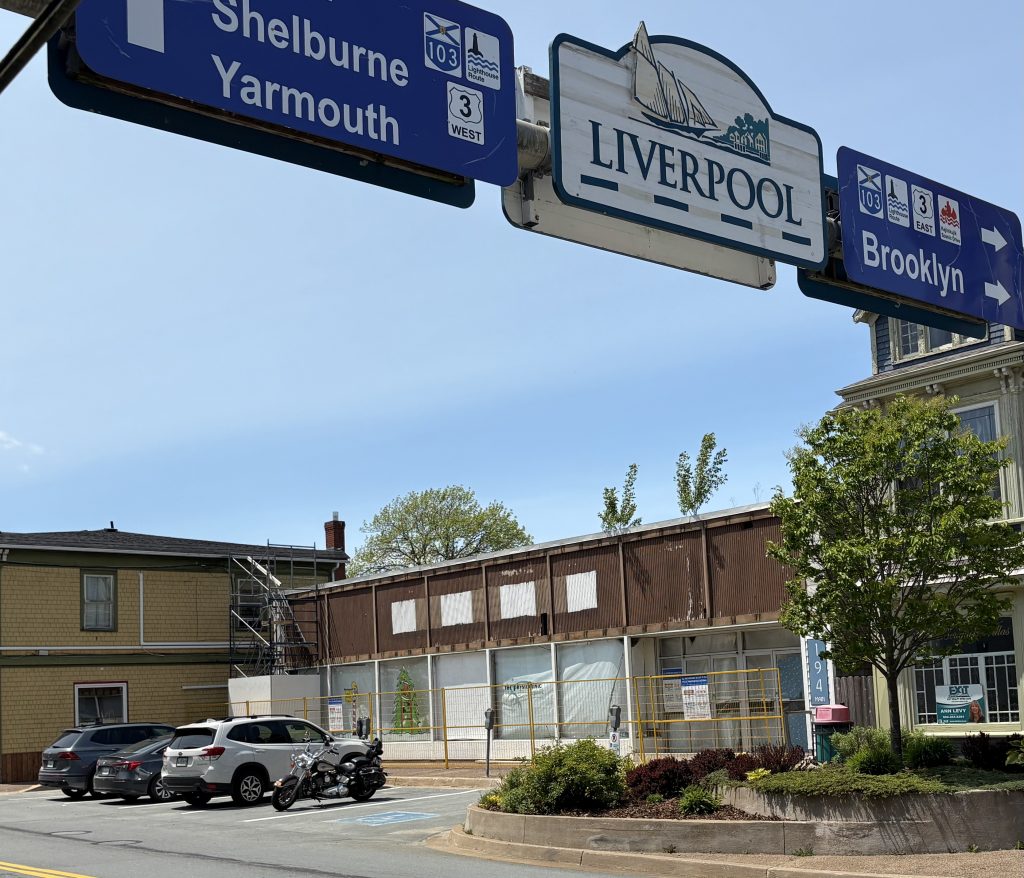
The old Stedman’s building in downtown Liverpool may still be developed into apartments. (Rick Conrad)
There may be a second life for the old Stedman’s building on Main Street in Liverpool after all.
Region of Queens councillors in July rejected developer Eric Fry’s attempt to turn 194 Main St. into 16 apartments.
The region’s land use bylaw limits the amount of residential space on the ground floor of of buildings in the downtown commercial zone to a maximum of 50 per cent.
Fry applied to amend the bylaw so that he could have only apartments in the building, but council rejected it.
He listed the building for sale shortly after council’s decision.
But he has since returned with a new proposal that would include two commercial units on the ground floor, with the rest of the 30,000-square-foot building devoted to 14 apartments, parking and storage space.
That would still require council’s approval and a public hearing.
On Wednesday, Fry said he wasn’t ready to comment on his amended proposal to the region’s planning advisory committee.
The committee had a look at the new plan at their August meeting.
But Mayor Scott Christian said in a recent interview that the committee wasn’t comfortable making any new recommendations to council.
“And so I think just the devils in the detail from a bylaw, from a policy perspective of how do you get to a place where you land in a spot where you’re making sure that you have the right language to facilitate those policy objectives that we want to see, which is again, maintaining the commercial storefronts in the protected commercial zone while allowing flexibility for developers to repurpose other parts of those buildings for residential purposes.”
Fry said Wednesday that he’s still working with the region on options for the building. He said there may be something new to report in the next few weeks.
Stephanie MacKenzie is the co-chair of the 2025 Queens General Hospital Hustle. (Rick Conrad)
A popular fundraiser for Queens General Hospital in Liverpool is back and organizers hope it will be bigger than ever.
People will be able to go to the hospital hustle in person for the first time since before the pandemic.
Stephanie MacKenzie, the co-chair of the 2025 Queens General Hospital Hustle, says the last time the fundraiser was held was an online version in 2021.
“The hospital hustle is just the community getting together to raise funds for extra equipment at our hospital. It was an annual event for 40 years until 2019,” MacKenzie explains.
“This is really important. It’s been a labour of love for us to try to bring it back and we want to make sure everybody knows it’s back, because it’s something that people really look forward to.”
The hustle this year will be held at the Liverpool Curling Club on Sept. 13 from 10 a.m. to 2 p.m. It’s organized by the Queens General Hospital Auxiliary, which also runs the hospital’s gift shop.
MacKenzie says the popular yard sale-style setup will return, along with food served by local Kiwanis Club members and doctors from the hospital. And nurses will be on hand to perform checkups on the little ones’ dolls or teddy bears.
“And we’ll have baked goods for people to buy and take home as well, and preserves, all the normal tables we have with jewelry, books, the big white elephant table, tools and we’re having a craft table as well.
“It’s hoped to be a family event and a lot of fun for the communtiy but an important fundraising event for the hospital. It’s important to show support for our hospital because it’s so very important to our community.”
Organizers are also planning a silent and live auction on the day of the hustle at the curling club. And for the first time, there will be an online Facebook auction, which will begin on Sept. 2, with items donated by local businesses.
All money raised this year will go toward buying a special cardiac monitor and a linear probe for the hospital’s new echocardiogram machine.
“This is an additional probe that will allow it to do more things. So people won’t have to go to Bridgewater to get these more specialized tests.”
MacKenzie says they hope to raise at least $20,000.
“But we think that we can raise more. In most of the recent years, we’ve raised $20,000 or more.”
They have about 30 volunteers helping out this year. But MacKenzie says they could always use more.
“Where we really need volunteers is on Sept. 7, we are moving all of the treasures that have been donated and stored at Milton Hall to the curling club. We have rented a moving truck to do that and we’re hoping to have enough people that we can stand there and pass the boxes along and just make it happen fairly quickly.”
Anyone who wants to volunteer at this year’s hospital hustle or donate any auction or sale items can email organizers at queenshospitalhustle@gmail.com.
You’ll also be able to buy raffle tickets to help. Volunteers will be selling them on Saturday at the Sobeys in Liverpool from 10 to 4.
The members of Crafternoon get together every Tuesday at the Seaside Centre in Beach Meadows. (Rick Conrad)
A group of artisans gathers at the Seaside Centre in Beach Meadows every Tuesday afternoon at 1 p.m. to work on projects, chat and make new friends.
The group began in 2021 with three women from the neighbouring community of Eagle Head. Craft novice Karen Costello got together with rug hooker Cathie Mourre and knitter Donna Sampson Dowling.
The group welcomes everyone who wants to work on their craft or learn a new one. It now counts as many as 25 people, mostly from Queens County, but some also travel from Lunenburg County.
Members say they enjoy getting together for four hours each week to bond around a shared love of creation. And they say they’re always looking for new people to drop in.
QCCR stopped in on a recent Tuesday to talk to some of the members.
Listen below
Bruno is one of the regulars at Crafternoon at the Seaside Centre in Beach Meadows. (Rick Conrad)
Rug hooking and a variety of other crafts are worked on Crafternoon at the Seaside Centre. (Rick Conrad)
The artisans group at Seaside Centre in Beach Meadows has about 25 members in total. (Rick Conrad)
The South Shore District Labour Council is holding a Labour Day event in Privateer Park on the Liverpool waterfront on Monday.
The local federation of labour unions is planning live music, kids’ games and free hot dogs and beverages. It runs Sept. 1 from 11:30 a.m. to 2 p.m. The theme this year is A Canada for Workers: Made Here! Paid Here.
More than 300 people attended last year’s Labour Day event. Barring a major storm, this is a rain or shine event. The council advises people to come prepared for the weather.
Members of the Lunenburg-Queens Special Olympics will be hosting the food booth.
Two Bluenose deckhands meet. Kate Smith of Sydney, N.S., is currently part of the Bluenose II crew. Craig Harding of Liverpool was a deckhand on the ship in the 1960s. (Rick Conrad)
The Brooklyn Marina rolled out the red carpet for Nova Scotia’s sailing ambassador on Tuesday evening.
A few dozen people turned out to meet the crew of Bluenose II at the small clubhouse as it visited the Liverpool area in its first stop on a tour of southwestern Nova Scotia.
Others drove down the small wharf in Brooklyn or towards the breakwater to get a look across Liverpool Bay to where the schooner was anchored near Port Mersey Commercial Park.
Volunteers at the marina had food and drinks ready for the crew and fans of the Bluenose.
Capt. Phil Watson was one of the dozen or so crewmembers who shuttled from the sailing icon to the marina.
“We haven’t been here in a long time and we were developing a a cruise along Southwest Nova and so Liverpool it is. There’s great alumni support here and community support and the club has always been good to us so it’s pretty easy to put Liverpool on the list.. … It’s good to come back to this side of the province again.”
The tour of southwestern Nova Scotia was hatched after the Bluenose crew cancelled an early September trip to Gloucester, Mass. Instead, they said they’d do what so many other Canadians are doing this year, stay closer to home and support local tourism.
Kate Smith, a deckhand from Sydney, N.S., is spending her third summer on the Bluenose. It was her first visit to Liverpool.
“I love it. It’s great. People are sweet. It’s super awesome,” she said of the Liverpool welcome. “We really like going around this area and we figured we’d go on a little staycation basically around the south coast.”
Liverpool’s Craig Harding sailed on the schooner as a 20-year-old from 1968 to 1969.
“I’d been on fishing boats on draggers and so on but I’d never been on a sailboat until that year and I learned to sail on it,” he said. “I’ve been connected to the Bluenose ever since. Hard not to be. Really, really happy to see the support. It was beautiful to see her come in.”
The last time the Bluenose II was in Liverpool was in 2021 when the ship celebrated 100 years of Bluenose history.
Jamie Frankel of Massachusetts just happened to be at the marina when he heard about the Bluenose’s visit. He and some others arrived on his boat The Sea Quester a couple of days before to wait for a weather window to continue their journey through the Gulf of Maine.
“None of us knew she was going to be coming at the time, so this is an incredibly welcome surprise. … As the sailing ambassador for Nova Scotia I think everyone loves her but in addition, she has beautiful lines as a ship and as a tall ship of that size I’d say that it’s always a wonderful event to be someplace where she comes in and it’s the splendor of old sailing ships and old-style sailing ships.”
Capt. Watson says the Bluenose always draws a crowd.
“It’s bringing a fishing schooner back to a fishing community. You know all these communities have shipbuilding, fishing heritage and these schooners, whether it was a fishing schooner or a cargo schooner, they all have that history there, so to be able to put a thing in place in the harbour where you can then talk about it and you can talk about, ‘oh those schooners used to be here all the time’ or ‘they used to build them over there’, it’s a chance for the community to talk about the history of their communities and share it with them themselves and hopefully they’ll come and share it with us as well.”
The Bluenose II left Liverpool on Wednesday afternoon, sailing around Port Mouton to its next stops in Clarks Harbour, Yarmouth, Digby and Lower West Pubnico.
Department of Emergency Management staff stand on top of their communications truck to view the wildfires in Annapolis County on Sun., Aug. 24. (Province of Nova Scotia)
The Nova Scotia government has announced emergency financial support for people who have been evacuated by the wildfires in Annapolis County.
The maximum amount people are eligible for is $3,000 per adult 18 and older, and $1,750 per minor.
The support is available for people who have been forced to leave their primary residence, based on the number of days they’re gone:
four to seven days – $500 per adult (18 and older), $200 per minor
eight to 14 days – an additional $500 per adult (18 and older), an additional $200 per minor
15 or more days – an additional $250 per week per adult (18 and older), an additional $200 per minor.
People evacuated from secondary homes like cottages or cabins do not qualify.
The funding will be available until the evacuation order is lifted or until the end of the wildfire season on Oct. 15, whichever comes first.
The help was announced on the same day the province confirmed that some homes have been damaged in the Long Lake wildfires. The blaze has grown to an estimated 7,780 hectares.
Premier Tim Houston told reporters at a briefing on Monday afternoon that on Sunday, five new fires broke out around the province. He said one of those fires in Cumberland County is still listed as out of control.
“The Long Lake fire in Annapolis County took a real turn over the weekend and it’s had devastating impacts,” Houston said.
“It’s now over 7,500 (hectares) in size, maybe closer to 8,000. Over 230 homes have been evacuated and there has been some loss of homes. This is a crushing feeling. We really can’t imagine what it must like, what it must feel like and also with the added anxiety of not knowing what’s happening to your home, it’s an awful time.”
In total, 330 properties have been affected by the evacuation order. The funding is in addition to other help through the County of Annapolis, the Canadian Red Cross, the Salvation Army and the Nova Scotia Guard.
Mainland Nova Scotia finally saw some rain on Monday afternoon, but officials told reporters that much more rain is needed to make a dent in the Long Lake wildfires.
Jim Rudderham, the director of fleet and forest protection with the Department of Natural Resources, said the fire grew so large and hot on Sunday that crews had to be pulled out.
“At peak burn time, … any amount of resources couldn’t have touched that fire yesterday,” he told reporters. “We certainly tried as much as we could, but at a certain point it’s not safe for anyone to be in there and we had to leave. … If you were to put water on it, there was no effect. It was just too powerful, too strong. Couldn’t get near enough to it regardless, but even if you had the biggest water bombers in the world yesterday when it was at its biggest point, dropping water on that fire, you couldn’t touch it. It just wouldn’t affect putting that fire out.”
The premier said the province hasn’t considered asking for federal help yet. He said they’re getting good support from fire departments from other communities and provinces. Firefighters from around Queens County have been helping out almost since the wildfire began.
Houston said the province will wait until after the fires are under control to consider any further compensation for residents whose houses are damaged or destroyed.
The Nova Scotia government is posting the latest information on the Long Lake wildfire on its various social media channels and at novascotia.ca/alerts.
Region of Queens councillors want more traffic enforcement in places like Liverpool and Summerville. (Rick Conrad)
Region of Queens councillors want the RCMP to crack down on traffic violations and drug crime and they say they’re willing to put up the money to hire extra officers.
Staff Sgt. Dan Archibald is the commander of the Queens District RCMP detachment. He recently provided a quarterly police report to council.
He said that having a dedicated street crime enforcement team of two officers to investigate drug complaints would free up other officers to address longstanding irritants like traffic.
“I feel that it’s too easy for individuals to sell illicit drugs from their residences with the lack of enforcement or capability in doing enforcement on our behalf. A designated street crime team or general investigations team would not only give us the resource power to do it, but it would come with the knowledge and experience that would be required to do it.
“To me, it would make (Queens County) that much better of a place to live to be able to enforce those on a routine.”
There was one charge under the controlled drugs and substances act from April to June this year. Last year, there were four in the same period.
The detachment is currently staffed with 10 constables, which includes one community policing officer. Two corporals act as shift supervisors and operations manager, in addition to Archibald himself. There are also two civilian employees.
The Region of Queens spends just under $3 million a year on policing.
District 4 Coun. Vicki Amirault said council decided more than 10 years ago to pull funding for an extra officer. And she said another officer left the area soon after that and wasn’t replaced.
“I’ve been getting a lot of complaints lately of drugs, needles, within Pine Grove Park,” she said.
“I think council has to tackle that right away. … I think now we do have the need to support that extra officer without a doubt, with what’s going on now in today’s world. And I really hope that council will support this initiative. ”
Overall, Archibald said there was no big spike in crime in Queens County over the same period last year.
But calls for assaults, extortion, harassment or threats were up to 48 from 32. There 42 calls related to intimate partner violence. Twelve people, nine male and three female, were charged in those incidents.
RCMP also dealt with 388 traffic violations, up from 250 the year before.
Archibald said the increase in traffic-related charges is the result of targeted enforcement.
“We’ve been doing some proactive traffic enforcement throughout Queens County,” he said.
“ For the two months of that first quarter, we’ve focused on North Queens, Caledonia area, and rural roads off of Caledonia, which has been great. And what that looks like is a day designated with some extra members coming in, doing strictly traffic enforcement, road safety things. People are happy to see us in places where they haven’t seen us previously. We’re looking at keeping that up every month at the very least focusing one day in various areas throughout the community.”
Some councillors want more of it.
Coun. Courtney Wentzell said he regularly gets complaints from residents in his downtown Liverpool district that they never see police.
“The lack of police presence in this community, I find quite appalling. I never see a cop. Privateer Days, I think I’ve seen five of them in the tent, but I don’t see them. And I live on the west side of Main Street, which is a drag strip. They start around around the fire hall or Cameron’s Corner, and it is a drag strip, and you can talk to anybody on that street, and they’ll tell you. And we never see a cop. We never see a radar set up.”
Archibald said that covering a large area like Queens County can be challenging.
“Policing has changed over the last however many years, (and) the demand for police presence has grown. Every time someone calls the police, whether it’s North Queens, West Queens, East Queens, wherever it is, if we have two members on during a day shift or two on night shift, a call in North Queens drags two members, whether it’s mental health, whether it’s a mischief, whether it’s a domestic, whether it’s a traffic complaint, that drags the only police officers out of Liverpool to a different area which takes them away from town for two hours. So it’s harder to designate police to the town of Liverpool when there’s other needs.”
But Archibald said they’re trying to address those kinds of concerns with their monthly traffic initiative. And he said installing more digital speed signs in some areas would also help, especially during tourist season.
Archibald told councillors that residents should report traffic violations to the detachment as soon as they see them.
“If they call us in real time, and we’ve got some new recruits here … who are gung ho on getting out there and if someone gives information as to who these people are, what they’re driving, like, they are out of the office to go look for them. So now’s a good time to report those people as well. You don’t always get that in certain detachments, but we have some young folks who who are enjoying traffic enforcement.”
Debris from the fish farm near Coffin Island on Beach Meadows Beach in 2021. (Rick Conrad file photo)
Supporters and opponents of a fish farm expansion in Liverpool Bay will get a chance to make their case in front of Nova Scotia’s aquaculture regulator after all.
The province’s aquaculture review board will hear an application in October from Kelly Cove Salmon to expand its current operation at Coffin Island, just off Beach Meadows Beach in Queens County.
Kelly Cove Salmon is owned by seafood giant Cooke Aquaculture. It applied in 2019 to expand its salmon farming operation off Coffin Island near Liverpool, and to add two new farms off Brooklyn and Mersey Point.
All three applications would have increased Cooke’s operation to 60 pens from 14 and include trout as well as salmon. It would have meant up to 1.8 million farmed salmon in Liverpool Bay, compared to about 400,000 now.
The board had scheduled hearings for those proposals for March 2024. But it indefinitely adjourned the matter that month with no explanation.
According to groups involved in the hearing, Cooke applied to the board this June for a hearing on only the Coffin Island expansion.
The review board held a conference call with Kelly Cove and some intervenors last week. Hearing dates were set for Oct. 7, 8, 9 and 10 in Liverpool.
Originally, the board had set aside only two days. But after lawyers for community group Protect Liverpool Bay objected, the board added two more hearing dates. The group is represented by environmental law charity Ecojustice.
“So there was no consultation at all in picking the dates,” said Brian Muldoon, spokesman for the group which has been fighting fish farms in the area since 2018.
“So our lawyers wrote to the ARB and said this is not reasonable and the ARB added two more dates.”
A board spokesman would not confirm the dates or comment on any upcoming hearings. He said any new information on hearings in Liverpool would be posted online.
A few days after this story was posted, the review board updated its website with the hearing notice.
The Region of Queens was one of the intervenors in the original hearings. Mayor Scott Christian told QCCR this week that the municipality still opposes the expansion at Coffin Island.
“We’re staying the course,” he said.
“Beach Meadows Beach is the beach where we have municipal amenities. That’s where we have our infrastructure, and we want to make sure that that beach continues to be a really attractive and great place for locals and for visitors to use, and so that’s certainly one element of the opposition to the expansion at that site. ”
Muldoon said he’s worried about the hearings in October.
“I believe they are not listening to the people or residents of Queens County. They’re moving forward with their agenda. They are going to put these fish farms over the areas where our local lobster fishermen lay their spring traps. This is taking income and disrupting our lobster industry. Right there, they should say, OK, we’re dismissing this application based on the data that we received that this is where lobster fishermen have been fishing for decades. And they’re going to turn around and ignore this information? It’s absurd, totally absurd.
“I have no confidence in the board listening to us.”
In the leadup to the originally scheduled hearings, more than 150 residents, businesses and community groups filed written submissions with the board. Most opposed the expansion and the new farms.
Five groups were granted intervenor status at the hearings: Protect Liverpool Bay, the Region of Queens, the Brooklyn Marina, 22 Lobster Fishermen of Liverpool Bay, and Kwilmu’kw Maw-Klusuaqn, which is representing the Acadia First Nation.
Jamie Simpson of Juniper Law in Halifax represents the lobster fishermen.
He said his clients are still concerned about how the expansion will affect their fishing grounds and how new pens will affect their ability to set and reach their traps.
“Ever since the original hearing was postponed without a date, I think everyone was hopeful that maybe the entire application would be withdrawn but that’s not the case so we’ll deal with the revised application.”
Joel Richardson, spokesman for Cooke Aquaculture, said he didn’t have time for an interview. But in an emailed statement, he wrote that the company “welcomes the opportunity to appear before the aquaculture review board to seek approval of our applications which have been in the provincial system for many years.
“At every step of the way, Kelly Cove has complied with the application process. At the aquaculture review board hearings our representatives will present how the company meets all the regulatory criteria.”
Nova Scotia Premier Tim Houston told a business luncheon in Liverpool in February 2024 that he personally opposed new fish farms in Liverpool Bay, though he said he supports the aquaculture industry.
It was shortly after that that the board postponed and then indefinitely adjourned the hearings.
The Nova Scotia government appointed a new board chair, and some other new members, in February 2024.
Architects will spend the next six weeks assessing what kinds of upgrades are needed at the Town Hall Arts and Cultural Centre, which houses the Astor Theatre. File photo by Ed Halverson
The Region of Queens has hired architects to come up with a plan to modernize the historic Astor Theatre in downtown Liverpool.
DSRA Architecture of Halifax has experience working on heritage buildings such as the Lunenburg Academy, Province House in Halifax and Halifax City Hall. Councillors approved spending $17,500 from the accumulated budget surplus.
The region owns the Town Hall Arts and Cultural Centre, which houses the Astor. The Astor Theatre Society leases it from the region.
The Astor is limited in what kinds of events it can hold, especially in summer and fall, because it does not have a modern climate control system.
It relies on an oil-fired hot water furnace for heat and windows for ventilation.
The building also needs many upgrades to meet provincial accessibility requirements.
Elise Johnston, who is the region’s former accessibility coordinator and now its manager of capital projects, says hiring the architects will kickstart the process to assess the building’s needs.
“As we know it can be quite stifling hot, especially in the summer,” she told councillors at a recent meeting.
“It’s very uncomfortable. So it affects their operations. It’s a big project. We have looked at a few independent reviews and designs, but then that didn’t take into consideration the accessibility (concerns). So if we’re going to do this, we need to do it in a holistic way.”
Johnston told councillors that the region and the Astor have discussed installing a modern HVAC system before, as well as an accessible lift to get to the second floor and a universal washroom. But those projects were discussed in isolation and not part of one overall plan.
She said hiring the architects will help get the necessary work started, “which would be to look at all the applicable codes, all the top priority needs, get some community engagement, and plan the steps forward. The main question is, what is priority, what can come first? How do we phase this over a period of time?”
Eric Goulden, chairman of the Astor Theatre Society, told QCCR that the much-needed upgrades could potentially be a multimillion-dollar project.
“All in all, they’re going about it in the right way,” he said.
“It needs an architect. It’s an old building. It requires a significant amount of work to protect its heritage. All good, all very, very good. And great support from the council.”
District 6 Coun. Stewart Jenkins asked whether the region gets any revenue from ticket sales at the Astor.
Joanne Veinotte, the region’s director of finance, said a portion of each ticket sold goes into a special capital projects fund for the building.
Jenkins said that because the Astor is such a big part of downtown Liverpool, he’d like the region to develop a five-year plan.
“I think we need to do more to preserve this building and make it a viable building moving forward.”
Johnston said this project is meant to do that and to make it “a more revenue-generating building”.
She told councillors the architects plan to begin work immediately with a report back to council in about six weeks.
Fire crews are on the scene of a fire near Round Lake in North Queens. (File photo via Province of Nova)
UPDATED 2:10 p.m., Friday, Aug. 15
Local fire and Natural Resources crews are holding a small fire near North Queens that began around suppertime on Thursday.
Firefighters from Queens and Lunenburg counties were called to an area at Durland Lake Brook, which is near Round Lake, off the Old Annapolis Road, close to the border of Queens and Annapolis counties.
According to the Canadian Wildland Fire Information System map, the blaze was about a third of a hectare in size. The wildfire burning in the Long Lake area in West Dalhousie, Annapolis County, is about 406 hectares.
North Queens Fire Chief Chris Wolfe told QCCR on Friday afternoon that the fire is being held.
The Durland Lake Brook fire is part of the Long Lake wildfire complex. According to an update from the Nova Scotia government this morning, five Natural Resources and 12 local firefighters are working on the Durland Lake Brook fire, which was at about a half hectare this morning.
The Liverpool Fire Department posted on Facebook that it will also take a break from filling residential wells so they can concentrate on fighting fires. They’ve asked people to phone the fire hall at 902-354-4530 and leave a message. They said they’ll get to the wells as soon as the wildfire threat is over.
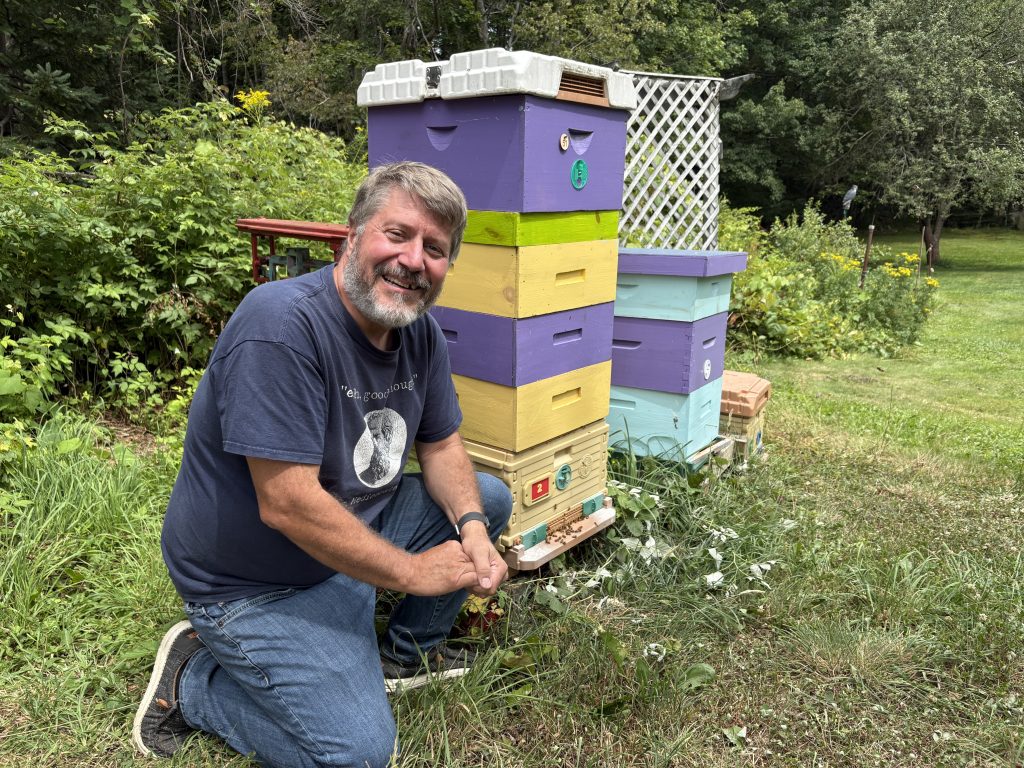
Chris Radimer, owner of Tiddley Bee Honey, near his hives in his backyard in Brooklyn. (Rick Conrad)
It’s a sunny day at the Privateer Farmers and Artisans Market in downtown Liverpool, and Chris Radimer’s table is buzzing with people looking for local honey.
Radimer, the owner of Tiddley Bee Honey in Brooklyn, sells his raw, unpasteurized honey from his property and at markets in Liverpool and Shelburne.
He also uses some of the beeswax his bees produce to make things like furniture polish and candles.
Radimer has been beekeeping since 2019 after a 33-year career in the Canadian Navy.
He explains how he arrived at his business name: “Tiddley in the navy means something that is done neatly and tidily and expertly, and so I thought, that would work pretty well because that’s what you want from your bees. You want your bees to take care with the building of the honey, building of the hives, building of the comb.”
Radimer and his wife moved to Queens County from Ontario in 2022. Since then, he’s been tending to his 26 full colonies and two half-colonies spread on his own and other properties in the area.
He keeps four colonies and two half colonies on his own property. The others are hosted by homeowners in Brooklyn, Mersey Point, Western Head, Beach Meadows, and near Lockeport.
“I retired from the the navy in 2017 and sort of didn’t know what to do or where to go,” he says.
“We were in Port Colborne, which is on Lake Erie, which has Niagara College pretty close by, and my sister, who works there, knew about this beekeeping program. And Veterans Affairs was offering to send us back to school, and I went to one of their open days, and the person that was representing the commercial beekeeping group was so incredibly enthusiastic that I just got swept into it. And after that, I was reading books and applying and spent the next full year at that school learning.”
Each of his hives has a queen and a minimum of about 20,000 other bees bringing back pollen and nectar. When it’s loaded with honey, one section of a hive can weigh up to 50 pounds.
“And if you have a very healthy colony, there’s a couple on this property here that are very healthy right now, they could go up to 60 or 80,000 bees for the summer,” he says.
“And then that number would back way down over winter.”
Without a lot of agricultural activity in south Queens, it would be difficult to have a large beekeeping operation.
“To make a living off of it, you need commercial-level agriculture, where you have a stable stream of crops to pollinate, or crops that produce nectar that you can draw from.”
Radimer says he’s happy with the number of colonies he has.
“To have a viable, small-scale honey operation, you probably need about 150, and I’m never going to do that. Thirty is probably going to be my limit, just because I’m getting a little older and it’s a lot of weight to lift.”
He’s quick to point out that beekeeping is agriculture, which is why the year-long course at Niagara College was important. You need to know how to keep your flock healthy. You also have to learn to adapt to extreme weather or other conditions.
He says the season this year began slowly, but the spring conditions soon improved, bringing a mix of rain and sun to help produce the pollen and nectar that bees need.
“It was just a very slow start, but once they got going, there was a lot of nectar for them to produce. I was really shocked at the amount of honey that was generated in late May and through June, early July, but now it’s stopped.
“So the challenge right now is that with these drought conditions, with no rain, even if we have flowers, the flowers aren’t producing nectar to the degree that the bees need.”
And because bees need the honey to keep their colonies fed and thriving, a shortage of the golden stuff creates another problem – robber bees.
“And robber bees are nasty,” Radimer says.
“They’re more aggressive and they’ll attack other hives to try and steal the honey.”
Radimer says many beekeepers will harvest only once a season, usually later in the year, but he harvested about 30 to 40 litres in July and he’s hoping for better weather for a bigger harvest this fall. The late summer plants like aster and goldenrod produce a honey that customers like, but bees, not so much.
“The problem with that honey is it’s not actually that good for bees. It’s not as nutritious as the early honey. So we like to take as much of that as we can. And then as soon as we’ve taken that honey, most beekeepers with more than one or two hives will start feeding sugar water. The (bees) can process that better. The goldenrod honey actually gives them the runs.
“So, if you’ve got bees nearby and a black truck, such as me, you notice when you’ve left too much goldenrod (honey). It’s just yellow streaks, yellow streaks (on the truck).”
And as if robber bees and the weather weren’t enough to deal with, there’s also the constant threat of predators like wasps, hornets, skunks and bears.
“What skunks do is they’ll sit at the bottom of the beehive and they’ll tap on the box with their paws. And as the bees come out, they’ll eat the bee. And a skunk can go through a beehive pretty quick. They’ll eat a lot of bees. They want protein.
“Bears too, bears don’t tend to go for the honey. They tend to go for the brood. They’ll scrape off all the eggs and the brood. Bears apparently can smell a beehive for about three kilometres.”
Radimer is constantly monitoring and maintaining his hives, especially during swarm season in May and June, when the colonies are more likely to make new queens. Every 10 days or so, he’ll suit up and open the hives to make sure everything is tiddley.
One thing’s for sure, his bees keep him buzzing.
“I like a challenge and I like puzzles. And so, you know, when something’s not going right, I can do research. I can look at what I’ve done, what others are doing and try and figure out if there’s a way to solve it. Ultimately it’s agriculture. So sometimes the solution is just walk away from it and start another colony. But usually, you can bring them back if they’re having trouble. … I was just out at one of my yards this morning and it was struggling a little bit last month. I wasn’t quite sure why. And I did a few adjustments here and there and I left it for a few weeks and it’s fabulous. It’s fantastic. Better than it was at the start of the season. So that’s what you want to see.”
Raw honey does not need pasteurization and therefore is the most nutritious honey you can eat. During processing, Tiddley Bee’s honey never reaches temperatures over 35 degrees Celsius, which is also the internal temperature the hive strives to maintain over winter to protect the queen
It’s natural for raw honey to crystallize
Honey will absorb moisture instantly. You’ll know if honey’s “gone bad” if it begins to foam. That means the moisture content is too high and it’s begun to ferment
If honey contains more than 18 per cent water, it will spoil. “But if it’s under 18 per cent, it could last 1,000 years,” Radimer says
Help pollinators like honeybees and other bee species, butterflies and moths by not using pesticides on flowering crops
Worker bees are all female; they do all the work of collecting pollen and nectar and defending the hive; drones are males and are used exclusively for reproduction. The males can’t forage or feed themselves
In winter, the colony will form a protective ball around the queen. The bees take turns on the outside of the cocoon and flap their wings constantly to generate heat. They also need a lot of honey to feed on during the winter months
A traffic study presented to Region of Queens council in July concluded that traffic lights are not needed at the Main and Market intersection in downtown Liverpool. (Rick Conrad)
A Liverpool resident wants the Region of Queens to do a more comprehensive study of safety at a busy downtown intersection.
Paul Deveau says a recent look at traffic at Main and Market streets was insufficient.
“Is the current configuration of this intersection safe?” he told councillors during the public comment portion of Tuesday’s regular council meeting.
“A proper risk assessment survey conducted at this intersection would be done under the worst-case scenario, or optimum or peak usage, when both vehicle and pedestrian traffic are at their highest. It would look at not just volume, but the behaviour of the traffic, such as the percentage of the vehicles not coming to a complete stop or a rolling stop, but also look at pedestrians, and if they’re stopping or looking before crossing.”
The three-way stop is one of the most heavily travelled intersections in Liverpool. And it’s seen its share of collisions and near-misses.
It’s viewed by many as one of the most dangerous areas for pedestrians in downtown Liverpool.
Councillors voted this past February to spend $24,000 on the traffic study after a crosswalk collision in January 2024 sent a 79-year-old woman to hospital.
An earlier study was done in 2015. No significant changes were made at that time.
Consultants CBCL presented their findings to councillors on July 8. They concluded that the intersection could handle current traffic volumes without extra measures like traffic lights.
Paul Deveau spoke to regional council on Tuesday about the Main and Market intersection. (YouTube)
Deveau, who ran as a candidate in the 2024 municipal elections, said he looked at similar studies done in 50 other Canadian municipalities and they were all conducted in either early spring or late fall. He questioned why this study was conducted in February.
He said that on July 7, as he was sitting outside Main and Mersey Dining Room and Coffee Bar on Main Street, he counted 232 vehicles in about 25 minutes travelling toward the three-way stop. That was higher than the 119 total morning trips observed by the consultants and the 148 total afternoon trips.
“Why do an assessment on traffic in one of the slowest months of the year?” he told councillors.
“It only looked at the traffic volume with the assumption that the people using that intersection would behave in a manner that is predictable and by the letter of the law. This council already knows that they do not. So my question to the council is this, will the council conduct a comprehensive risk assessment on that intersection or stick with the bare minimum and use the current half-measure results to make a decision?”
Mayor Scott Christian said after the meeting that in response to Deveau’s concerns, he’s going to ask for an update on the intersection at Main and Market streets.
“And so I’ll be looking for some further information from staff on that one.”
Deveau told councillors he hopes they take a more robust look at safety in the area.
“So when an accident happens again at this intersection, not if, but when, is this the justification that you want to stand for not making a change? Is this what you want to tell the next person whose life could be forever altered or their family, that you did what you could do with the information provided? What if the next person was your family member?”
Region of Queens Mayor Scott Christian says municipal water customers aren’t in danger of restrictions yet. (Rick Conrad File photo)
As drought conditions continue in Nova Scotia, many municipalities are asking residents to cut down on their water consumption.
But so far in Queens County, levels in the Town Lake Reservoir are keeping up with demand.
Region of Queens Mayor Scott Christian says customers in Liverpool and Brooklyn don’t have to worry about their water yet.
“The latest briefing from staff is we’re still looking pretty good. It’s surprising, the amount of inflow to outflow on the lake is still at good, sustainable levels.”
The last significant rainfall in Nova Scotia was more than two months ago.
Municipal water utilities in the Halifax and Cape Breton regions, and towns in central and northern Nova Scotia have asked customers to conserve water.
Mandatory measures are in place in Annapolis County and Antigonish.
That’s on top of a provincewide ban on open fires and travel in the woods.
Even though the dry weather hasn’t affected municipal water customers in Queens yet, some residents are dealing with dry wells.
The region has opened the shower facilities at Queens Place Emera Centre to the public. It’s also reminding residents of the public Cowie Well at 733 Main St. in Liverpool.
Christian says the municipality will keep an eye on water levels in the Town Lake Reservoir.
“So we’re just continuing to monitor that very closely. But at this point, the level is good in the reservoir and still the inflow is still quite good.”
Jean Robinson has been chosen as Queens County’s volunteer of the year for 2025. (Rick Conrad)
Part of Jean Robinson’s job more than 30 years ago was to choose Queens County’s volunteer of the year.
Now, the Brooklyn resident and consultant has received the award herself.
“I was really surprised and honoured to be selected and I’ve been thinking it’s kind of funny because I came here in the late ’80s as the recreation director for the county and part of my job was helping select the representative volunteers, so it’s a bit of full circle.”
The Region of Queens Municipality announced earlier this summer that it had chosen Robinson as its volunteer of the year for her “remarkable and diverse volunteer resume”.
She has a full-time job as president of Horizons Community Development Associates, Inc., but that hasn’t stopped her from giving much of her free time to non-profits and other groups in the community.
Originally from Beersville, N.B., near Moncton, Robinson moved to the area in 1988 and has made her mark with many organizations, whether that’s volunteering at her kids’ schools when they were younger to the Queens County Girls Choir and Queens County Seafest to her current volunteer gig as chair of the Liverpool International Theatre Festival.
She’s also helped shepherd local community theatre productions at the Astor Theatre and with the Winds of Change Dramatic Society as a producer.
She credits her parents with teaching her the importance of volunteering at a young age.
“I just think that arts and culture have a really important foundational role in community and in a healthy community, so this is my way of being part of that and it ties to my bigger value that volunteering is foundational to communities, to community development and having a healthy place to live, work and play.”
She’s been involved with the theatre festival since 2011 and it was that connection that also garnered her the prestigious King Charles III Coronation Medal in January for services to the arts.
Former Lt.-Gov. Arthur LeBlanc and his wife Patsy are big fans of the festival and he nominated Robinson for the honour.
“And that came as a complete surprise. I opened my email one day back in early January and I thought is this a real email?” she says, laughing.
“It was very special. It was a lovely ceremony. I was able to take two of my three adult children. … It was lovely to see the breadth of volunteers that were being recognized for their work, whether it was in civil society or in government or in Indigenous relations.”
She says volunteering is changing as people’s family lives and priorities shift. Many groups, especially in rural communities like Liverpool, find it challenging to recruit and retain volunteers.
“I think it is still a struggle and I think that the days of folks volunteering for many years with an organization is maybe more of the exception than the rule than it used to be and just the ongoing long-term volunteer is a little more difficult to get now.”
Robinson is bucking that trend by staying with organizations like the theatre festival for the long haul. She says volunteering has helped her form and strengthen long-lasting friendships.
“People volunteer for different reasons and so, understanding that people may want to volunteer for social connections, they may want to do it for building skills which could then even potentially help on a resume.”
She says volunteer-run groups have had to adapt to remove any barriers to bringing new people on board.
“Knowing that there aren’t financial barriers for them to being involved and understanding that as an organization. Thinking about the strengths that volunteering brings to a person in the community but also how can we break down the barriers and support people to be part of the community. How do we open the door and make them feel welcome?”
Robinson will be the Region of Queens delegate to the provincial volunteer awards ceremony on Sept. 29. She’ll be one of 70 from around the province to be honoured with the award.
The Queens volunteer of the year is chosen from nominees for the region’s Ripple Effect volunteer recognition program which allows the public to nominate fellow community members for their volunteer efforts. More information about the Ripple Effect is available here on the Region of Queens website.
Department of Natural Resources staff member Mark Shaw works to put out fires in the Upper Tantallon area on May 30, 2023. (Province of Nova Scotia / File)
UPDATED TUES., AUG. 5 at 5:20 p.m.
With drought conditions affecting most of Nova Scotia, Premier Tim Houston announced Tuesday that the province is banning all activities in the woods and on trails, with few exceptions.
“We’re hearing from rural fire departments that are worried about low water levels in the ponds and lakes that they use and really about their overall ability to respond to emergencies,” Houston said at an early afternoon news conference.
“As tinder-dry conditions continue to persist from one end of the province to the other, the risk of wildfires increases and the risk is very, very high right now.
“Effective 4 p.m. today, we’re telling Nova Scotians stay out of the woods. We are restricting travel and activities that really aren’t necessary for most of us. Hiking, camping, fishing and the use of vehicles in the woods are not permitted. Trail systems through woods are off limits. Camping is allowed but only in official campgrounds.”
Houston said the fine for violating the new restrictions is the same as flouting the burn ban — $25,000. So far this year, seven people have been fined. Officials didn’t disclose where those fines were levied.
The province implemented a provincewide ban on open fires on July 30. Hot, dry conditions are expected to last in Nova Scotia for at least two weeks.
“I know it’s inconvenient and I know it’s the height of summer vacation … but we have to stay out of the woods. It’s a small price to pay right now to avoid the kind of devastation we saw from the wildfires in 2023. And nobody wants that.
“We need all Nova scotians to help keep our firefighters safe along wih everyone else by following the measures we’ve put in place. I’m counting on you to do the right thing. Don’t light a campfire, stay out of the woods and stay safe.”
Commercial activities in the woods will also be restricted. Forestry, mining and any other work must be approved by a local Department of Natural Resources office.
Beaches and parks are still open, but any fires are banned. Private landowners may use their own properties but can’t allow others to use their wooded areas.
Fireworks are also part of the ban. In response to a reporter’s question about whether the penalty for setting off fireworks during a burn ban should also be increased to $25,000, the premier said “that sounds like a good idea to me. (It) should be.” It was unclear whether the fine would be increased.
Houston said the move to restrict activities in the woods was made based on advice from Natural Resources officials.
Minister Tory Rushton said Nova Scotia has already had about 100 wildfires so far this year. He said they were extinguished quickly, but the kind of blaze that officials have battled is different.
“The fires we’re seeing right now are burning deeper into the root system and going deep underground and that kind of fire takes a long time to put out which is exhausting our resources,” Rushton said.
“The aim is to limit unnecessary travel in the woods and activities.”
Dave White, president of the Queens County ATV Association, told QCCR on Tuesday that he supports the province’s decision.
“I think that the premier and Minister Rushton are absolutely making the right call and relying on the right people to give them good information,” White said.
“As much as I want everybody to have recreational opportunities, now is not the time.”
White said his group and others are meeting with provincial officials on Wednesday to find out what the new restrictions mean for major ongoing work on trail maintenance.
“Those are commercial practices, but I suspect that those will be suspended until conditions improve. Obviously, our priority is to protect our woods and that leads to our community, and our friends, family and our firefighters. That’s the No. 1 thing that we’re looking at right now.”
His group and the Queens Rails to Trails Association have posted on their Facebook pages that all trails are closed.
“It’s important that people follow this. The opportunity to use our trails will come again,” White said.
“Our standard line is we’re not just building rails, we’re also building community, and that means working together to keep everybody safe and happy and healthy.”
Parks Canada issued an advisory late Tuesday afternoon (read that here) detailing these closures in Queens County:
All trails in Kejimkujik National Park and National Historic Site
Backcountry camping at Kejimkujik National Park and National Historic Site
All trails at Kejimkujik National Park Seaside
Front-country camping, beaches, and day-use areas (including Jakes Landing equipment rentals) at Kejimkujik National Park and National Historic Site are still open.
The Region of Queens issued its own news release late Tuesday afternoon with details about which parks and trails are closed in the county. (Read the full news release here.)
The following municipal trails are closed:
Pine Grove Park, including Anniversary Trail which connects Pine Grove
Park to the Trestle Trail
Trestle Trail, including the extension that begins at White Point Road and
George Street and continues running parallel to George Street to connect
to the Trestle Trail, ending on Bristol Avenue
Meadow Pond Trail
Queens Place Trail
People who use the Trestle Trail or other wooded trails to get to other parts of Liverpool or Queens County should use Queens County Transit or a taxi service while the restrictions are in place, the region says in the release.
Path Lake Park and Scout Camp Park are also closed. Other non-wooded municipal parks throughout Queens such as
Tupper Park, Centennial Park, Privateer Park, Port Medway Lighthouse Park, sports fields and playgrounds remain open.
The covered picnic areas at Beach Meadows Beach Municipal Park are off limits, because they’re surrounded by wooded areas, but the beach is still open.
The municipal leaf and yard waste site in Western Head is also closed immediately. The region will be posting closure notices in those areas affected, the release said.
White pointed out that Queens County has many options for exercise, including beaches, parks, the walking track at Queens Place Emera Centre and the new all-weather outdoor track at Liverpool Regional High School.
“We still have lots of options for recreation,” White said.
Thousands of hectares and many homes were destroyed and thousands of people evacuated in wildfires in May and June 2023 in Shelburne County and Tantallon.
The restrictions announced last week and Tuesday will stay in place until Oct. 15, or until conditions improve with several days of steady rain.
Volunteers with the Queens County ATV Association explained proposed new road trails at a public information session at the Liverpool Fire Hall on Tuesday. (Rick Conrad)
More than 150 people turned out on Tuesday evening to learn about how proposed new routes for off-highway vehicles could affect Liverpool motorists, residents and businesses.
The public consultation was organized by the Queens County ATV Association at the Liverpool Fire Hall.
“So what we’re looking to do is to provide connection for off-highway vehicle users to be able to get into our commercial districts to access our restaurants, our gas stations and our accommodations, as well as to provide trail-to-trail connections,” Dave White, president of the ATV association, told QCCR on Tuesday.
“So what we’re trying to do in the larger picture is have 100 per cent connection from Lunenburg through Queens County to Shelburne. And the even bigger picture is for an eventual development of a path that would see people be able to leave Tantallon, go all the way down to Yarmouth, around to Digby, over to Middleton, back across New Germany and back up to Tantallon, which would be a route that would be very similar, actually I think a little bit bigger than one that everybody travels to Newfoundland to do.
“So this provides a massive opportunity for recreational development and also for economic development because we know from the 2022 spending survey that $454 million got spent that year by off-highway vehicle users in Nova Scotia. So part of our hope is that we can start to see our county start to recognize some of that economic growth too.”
The ATV association and the Queens Rails to Trails Association have proposed five areas around Liverpool to connect existing off-road trails with municipal roadways so that riders can access services or other trails.
The Nova Scotia government passed the Road Trails Act in 2023, which allows OHVs on provincial and municipal roads with certain conditions.
Five information stations were set up at the fire hall on Tuesday with volunteers at each to explain the routes and the laws around off-highway vehicle use on public roads.
People were asked to fill out feedback forms to say whether they oppose or support each route.
Dave White is president of the Queens County ATV Association and secretary of the Queens Rails to Trails Association. (Rick Conrad)
“We’ve had only positive feedback tonight that I’m aware of,” White said.
“We have had some questions about what the rules are. So there are speed limits, you do have to have a drivers licence, you have to be insured, you have to have your headlights on even during daylight hours. The times are restricted to daylight hours. So there are lots of rules that cover it.”
Brianna Darton and Erich Gennette traveled from Mount Uniacke to find out what it’s all about. Darton’s parents live in Liverpool.
“We’re kind of in the process of introducing my parents to the world of ATVing and if we can make things a little more convenient for them I think that would be a good start,” Darton said.
“I think it would be a great thing for them to do as they head into retirement and any encouragement with ease of access (and) they’re afraid of breaking the rules. They don’t want to drive where they shouldn’t.”
“At the moment really all we can do,” Gennette said, “is go from the No. 3 (highway) to Bridgewater and it would be really nice to do more than that. We just did it today. We’ve seen it. We’d like to do something different. So if we could go through Liverpool and go down to Shelburne that would be cool and just see a new place because this is our first time going ATVing down here and we’d like to do it more often.”
Peter Lavender of Liverpool said he wanted to find out how the proposed routes would affect traffic going into downtown.
“I was concerned mainly about Bristol (Avenue), you know, the main part of town going through Main Street but apparently they avoided that. They’re going all the way around that so it’s looking pretty good.”
White says off-highway vehicle users love visiting other areas of the province and they want to be able to travel more easily through Queens County and invite others to visit too.
“Our interest isn’t just in having it, we want it done properly, safely and to encourage good use and good economic impact.”
White says the ATV groups will work with municipal staff to collect the results of the feedback from Tuesday’s session. Regional councillors have seemed supportive of the idea of a connected road trail network in Queens County.
They would have to create a new by-law to make it happen.
White says he hopes that process can be wrapped up by the end of the year.
The Region of Queens Water Utility has proposed increasing water rates by more than 100 per cent. (Bluewater Sweden via Unsplash)
Hearing dates have been set for the Region of Queens water rate hike application, as customers brace for their costs to double.
Joanne Veinotte, the region’s director of finance, told councillors in June that the water utility needs to bring revenue in line with costs immediately. The Region of Queens Water Utility’s 1,233 customers in Liverpool and Brooklyn bear the costs of the service.
“These increases translate to an average annual increase of 106 per cent in the initial year, 3.8 in Year 2 and 2.7 in Year 3,” she said.
“Over the last several years, the utility has struggled operationally with staffing, and the treatment plant was heavily damaged in July 2023 during a severe thunderstorm that destroyed a large amount of sensitive and expensive instrumentation and equipment at the site.”
The Nova Scotia Regulatory and Appeals Board has scheduled a public hearing for Thurs., Oct. 9 at 10:30 a.m. in council chambers on White Point Road.
An evening session starting at 6 is also scheduled if it’s needed.
People can speak at the hearing, but they must register with the board by Sept. 17. Residents can also send written comments to the clerk of the board at PO Box 1692, Unit M, Halifax, NS B3J 3S3, by email at board@novascotia.ca, or by fax at 902-424-3919. The deadline for written submissions is also Sept. 17.
People can request formal standing as an intervenor in the hearing. That allows you to present evidence and cross-examine witnesses. The deadline for applications for intervenor status is Aug. 22.
The region hired consultants G.A. Isenor and Blaine Rooney to prepare its water rate study for the regulatory board.
They found that the water utility will rack up a deficit of just over $1 million by the end of 2025/26, if rates don’t increase immediately. That shortfall will swell to $3.344 million by 2027/28 without higher charges.
For residential customers, the average quarterly bill is now $82.61. That could rise to $169.66 this year, $174.63 in 2026/27 and $177.39 in 2027/28.
The average customer currently pays $330.44 a year. If the rate hikes are approved, that will rise to $678.64 annually in the first year and $709.56 after three years.
The annual fire protection charge paid by the municipality, currently $201,531, could increase by 99.3 per cent to $401,599 for 2025/26, $495,931cfor 2026/27 and $503,625 for 2027/28.
Queens water customers had to endure an almost nine-week boil water order in summer 2023. That was after a lightning strike heavily damaged the water treatment plant.
The region gave a one-time 70 per cent discount on water bills, after public demand.
This time, though, customers likely won’t get a break from significant increases to their water bills.
The region claimed in a news release in June that its customers pay the lowest rates in Nova Scotia.
The new rates would put it in line with the Town of Lunenburg, but higher than the Town of Bridgewater and the Cape Breton region.
Region of Queens Mayor Scott Christian said comparing rates in Queens to other municipalities isn’t as straightforward as it seems.
“This proposed change to the rate, it brings us into alignment with a lot of ‘like’ municipalities, a lot of our neighbouring municipalities who have water utility systems. So I think that is important to understand what we look like in comparison to a lot of the other municipal units around us.”
The regulatory and appeals board has the power to set rates as requested, order a lower increase or an even higher one.