Five new adjudicators were named to the Nova Scotia Human Rights Commission on Monday. (Photo by Markus Spiske via Unsplash)
A Queens County lawyer is one of five new adjudicators for the Nova Scotia Human Rights Commission.
Ryan Clements of Liverpool, who joined the Nova Scotia bar in January, will be part of a roster of 10 people who will chair independent human rights boards of inquiry.
Clements has practised in Toronto, British Columbia, Nunavut and the Northwest Territories.
He is the son of Ford Clements, a former lawyer in Liverpool and a retired Ontario court judge. His grandfather Lester Clements was a Nova Scotia Supreme Court judge.
Adjudicators hear cases when a claim of discrimination can’t be settled through a dispute resolution process.
On his website, Clements says he has experience in criminal and administrative law and professional discipline cases.
He says he has “defended and prosecuted criminal and professional discipline cases for over a decade”, and that he has served as an adjudicator on administrative tribunals.
The other new adjudicators announced Monday are Simeon Atunbi, Nancy Elliott and Kelly McMillan, all of Halifax, and Tuma Young of Eskasoni.
Perry Borden, chief judge of the provincial and family courts, chaired a six-member selection committee to go over the candidate after a call for applications in November.
Five other adjudicators were reappointed. They are Lynn Connors of Kentville, Dennis James of Truro, Donald Murray of Dartmouth, and Benjamin Perryman and Eric Slone of Halifax.
About 25 people showed up at Queens Place Emera Centre in Liverpool on Saturday to discuss the Winds of Change relationship with the Astor Theatre. (Rick Conrad)
The Winds of Change theatre group has voted to end a short-lived relationship with Liverpool’s Astor Theatre and re-form as an independent society.
About 25 people showed up at a meeting on Saturday at Queens Place Emera Centre and voted to reverse a February 2023 decision to become a subcommittee within the Astor.
Nick Moase was the acting chairman of the Winds of Change. He chaired the meeting on Saturday. He is also the technical director for QCCR.
“The decision is what I expected,” he said in an interview after the meeting.
“With everything going on and the comments that have been said to me privately, I was aware that people weren’t comfortable with what the Astor Theatre was doing and that they wanted to separate the Winds of Change again to re-form.
“For 25 years, this has been on the books to discuss. We gave it a try. Things didn’t go as expected, so now we just continue on as the Winds of Change as a separate entity.”
Under the arrangement, the Winds of Change was to use its $29,000 legacy fund for theatrical productions at the theatre. That fund would then be reimbursed from ticket sales, and the Astor would keep any profit.
But recently, members of the group wanted to re-examine the relationship.
Ashley-Rose Goodwin resigned as the Astor’s associate artistic director this March, shortly after the wrap of the Stephen Sondheim musical Follies. That was a Winds of Change-Astor co-production. Goodwin was the director of that show.
After her resignation, some in the community, including Winds of Change members, were upset at how the Astor was being operated by the board and recently hired executive director Jerri Southcott.
They were also annoyed when Southcott and the Astor decided not to pay for a Follies cast party at the Liverpool Curling Club. The relationship soured further when the Astor forgot to mention and thank the 70 members of the Follies cast and crew in its monthly newsletter. Southcott quickly sent out an apology the next day in another email to newsletter subscribers.
John Simmonds, the chairman of the Astor Theatre board of directors, was at the meeting on Saturday. He couldn’t comment on Saturday, but in an interview on Sunday, he said the group’s decision was unfortunate but not surprising.
“Maybe taking a long-term view, it’s probably the best for all concerned right now so that we can continue to do our thing and Winds of Change can re-form, get back and do the things that they were doing before, hopefully with the Astor. And as things cool down, we can re-examine the thing and take a look at it down the road.”
Simmonds said the Winds of Change will always be welcome at the Astor.
“We wish the Winds of Change well. That long history between the two organizations is not going to go away. Hopefully, everybody will feel comfortable working with each other again. I know I would. I was just thinking how important it would be to be able to meet people on the street, give them a smile, a handshake, a hug, whatever, and just continue on as friends as we were before.”
Moase said on Saturday that he will not remain on the board.
A slate of 10 people was nominated to form a new board for the Winds of Change. They must re-form as a legally recognized non-profit society through the registry of joint stocks.
Moase said he believes that the arrangement with the Astor for the past year worked well. But he said the Winds of Change is in good shape, especially given the level of participation in Follies.
“I think the interest is there, the people are there again. This issue with the Astor Theatre will come to a conclusion at some point and things will continue. Amateur theatre in Liverpool isn’t going anywhere. And I think we’re probably in good shape to have another production when folks are ready again.”
Premier Tim Houston speaks to reporters on Thursday about an agreement with Nova Scotia teachers. (Nova Scotia government Facebook page)
Nova Scotia will likely avoid a teachers’ strike as government and union negotiators reached an “agreement in principle” late Wednesday night.
The Nova Scotia Teachers Union entered conciliation talks with government negotiators on Monday and Tuesday with a 98 per cent strike mandate. More than 10,000 teachers and educational specialists voted last Thursday to go on strike if an agreement couldn’t be reached.
Teachers are concerned about rising levels of violence in schools, teacher recruitment and retention, and compensation for substitute and permanent teachers.
Premier Tim Houston joined the talks himself on Monday night.
Houston told reporters after a cabinet meeting on Thursday that he believes the agreement addresses many of the union’s concerns.
“I think it’s an agreement that teachers can be proud of,” he said.
“I did personally attend the bargaining table late on Monday evening and tried to make it clear at that point that we heard the voices of teachers and the NSTU and that this government shares their focus on students, student outcomes and classroom conditions. I think teachers will see significant investments in these areas in the agreement. It’s an agreement that responds to the call that students can’t wait. … Our government has great respect for teachers and our focus was on reaching a deal that was fair to teachers and ensured improved classroom conditions for students and teachers.”
Ryan Lutes, president of the teachers union, said in an interview Thursday that the premier’s presence at the bargaining table seemed to move things along.
“The premier was helpful,” Lutes said.
“Up until that point, I would say our negotiating team saw very little movement on the issues that mattered to teachers and students. The premier shared his commitment to improving classroom conditions, to improving work-life balance for teachers and his desire to invest in public schools, and I think that spurred his team along into eventually getting an agreement with teachers.”
So far, it’s only a verbal agreement. Lead negotiators for both sides are still hammering out the language. As soon as the union’s bargaining team sees and signs off on the document, they can call it a tentative agreement.
Lutes said it will likely take another week or two before teachers see something they can vote on. Details won’t be released until that happens.
“I don’t believe the premier would have spurred along his own negotiating team without the strong strike mandate. I think our members were really important. The message came through with the strong strike mandate that members aren’t going to accept an agreement that doesn’t move their priorities forward. And I think the premier heard that. He was able to pretty positively contribute to that discussion on Monday night.”
The premier said his government shares teachers’ concerns about classroom and working conditions.
“We knew the importance of the negotiations for sure. That was never diminished and that was never a second thought in our mind. So we’re really happy that we’ve been able to reach the agreement in principle. When it’s all said and done, this is an agreement that teachers can be proud of and I’m optimistic about the path forward from here.”
The government and NSTU have been negotiating since last June. Their last contract expired July 31, 2023.
Shelly Panczyk is the chairwoman of the Queens County Food Bank in Liverpool. (Rick Conrad)
More people are using the Queens County Food Bank at the same time as donations are dropping.
Shelly Panczyk, chairwoman of the food bank on Main Street in Liverpool, says the charity saw 4,993 people last year. Of those, 1,494 were children.
That’s up markedly from when she started at the charity four years ago. She said back then, they’d see 40 families a week. Now, it’s closer to 55 families a week.
“I just want people to realize that this is a very, very busy place. I call this the third grocery store in Queens County.”
“This situation (our clients are) in, they can’t help it. We’ve seen people in here, husband and wife, each of them working. This is going to get worse before it ever gets better.”
Clients can go to the food bank every 21 days to stock up on food and household items. The food bank also operates a thrift store on Main Street, about a block away.
Last year, revenue at the food bank alone was down by $107,000. But expenses climbed by $17,000. The thrift store, though, generated $82,000 in net income for the food bank.
Panczyk and the board reported those figures at the charity’s recent annual general meeting. She clarified that part of the reason for the revenue drop in 2023 was that they didn’t receive any large grants like they did the year before.
Panczyk said the food bank does have savings in the bank. But she said in an interview that without the income from the thrift store, they would be in trouble.
“Without that store, this food bank would not be running,” she said.
Both the food bank and the thrift store are run entirely by volunteers. They have as many as 50 through the year. There are no paid staff.
“It costs $140,000 a year to run this food bank, just this building. And we don’t get that in donations. That store … is our little gold mine.”
Panczyk said that older people and churches used to be among their biggest donors.
“The donors were the people that are in their 80s and 90s and now have died. Churches were always a good donation, because churches were the ones that started most food banks. Churches are closing, their parishioners are down.”
A study released in February by food rescue organization Second Harvest showed that demand for food charity in Canada is expected to rise by 18 per cent this year. The study found that on average, each charity needs an extra $76,000 to meet that increased demand.
Panczyk says monetary and food donations have dropped, though she says that the local Sobeys and Superstore are still major food donors. And they receive regular shipments from Feed Nova Scotia.
But she said she still has to buy a lot of food to serve their clients.
“My grocery bill here for a month is anywhere from $4-6,000.”
She said four years ago, the food bank would buy 200 pounds of hamburger to distribute over three months.
“I’m buying 500 pounds. They used to pay $2.99 (a pound) and I have to wait until it goes on sale and I pay almost $5 a pound. And I give out 200 pounds of that a month now.”
The food bank is also required to stock 14 staple food items such as peanut butter, crackers, pasta sauce and spaghetti. They have to buy many of those items.
And Panczyk says she has to make sure she can cater to more diverse food needs, as more families of various backgrounds move to Queens County.
She has applied for grants to begin to stock more food variety, such as halal meats or basmati rice.
“So this is a whole new scenario for food banks, especially in these smaller communities that we never had before.”
Panczyk said she’s grateful for the donors they do have and for the community support of the thrift store.
But she said they need more cash donations so that they can continue to serve a growing and more diverse clientele.
“I don’t think I want to be starting out again not what these people are going through. I think this is almost as bad as the Depression, trying to fight your way through.”
The Nova Scotia government has called off the spring bear hunt. (Pete Nuij via Unsplash)
There will be no spring bear hunt in Nova Scotia.
The Nova Scotia government says it made the decision based on public feedback.
The Department of Natural Resources and Renewables announced Jan. 24 it was considering a spring bear hunt pilot. It said it would restrict the hunt to May and June and allow only males and females without cubs to be hunted. It would be limited to one bear for the whole year.
The department asked people to fill out an online survey from Jan. 24 to Feb. 24.
More than 17,000 people responded, the department said in a news release Wednesday. About 51 per cent were opposed to the hunt, while 47 per cent were supportive. About two per cent were neutral.
Some 64 per cent of hunters, farmers and landowners who completed the survey supported the hunt. About 50 per cent of rural respondents supported it. Forty per cent of urban/suburban respondents supported it.
People who were concerned about the bear hunt said their top worries were conservation of bears, potential safety issues and potential conflict with other outdoor activities.
The department also got 134 emails and letters from people and 10 letters from organizations, most of which were against the hunt.
There are no changes to the fall bear hunt, the department said.
“The department is committed to maintaining a stable and healthy bear population living in their natural habitat without negatively affecting the ecosystem or creating safety problems in communities,” according to the release.
Officials are working with Acadia University on a research project to improve knowledge about black bears. They also plan another public consultation this year on proposed regulations on inappropriate feeding of wildlife.
Anyone who suspects illegal hunting activity should call the department at 1-800-565-2224.
Region of Queens councillors want planning for an accessible washroom at the inclusive play park in Liverpool to begin this year. (Rick Conrad)
Region of Queens councillors want to move up plans for an accessible washroom at Liverpool’s universally designed inclusive play park.
The region set aside about $400,000 for the facilities in the 2025/26 capital improvement plan. But District 1 Coun. Kevin Muise urged councillors on Tuesday to move it up a year. Otherwise, he said he’s worried it won’t get built at all.
The $600,000 play park was opened next to Queens Place Emera Centre in October 2023. It was made possible by a combination of community fundraising and municipal and provincial funding.
The region rented an accessible portable toilet for the site last year.
Muise said he’d prefer planning for the accessible washroom facilities to begin sooner than later, especially with the $21.5-million Mount Pleasant water and sewer extension work due to begin this year.
“I’m not saying that it’s going to be built this summer. I know in reality it’s not going to happen, but if we don’t start doing some planning, … it’s not going to be built next summer either. … Put it on the budget for this year. But if we leave it till next year, we’re going to be having the same argument again. It’s not going to be there for next summer.”
Mayor Darlene Norman said she was worried about overwhelming the region’s already thinly stretched public works staff.
Councillors decided to add it to the 2024/25 capital plan and get as much planning work done on it this year as possible.
Fire trucks at North Queens Fire Association headquarters. (Facebook)
Region of Queens councillors and staff have found a way to help the county’s fire departments with the increased costs of buying new equipment — and all without raising the tax rate.
Councillors are currently in budget deliberations, so the final budget has not been approved. But they headed off a request for an increase to the tax rate to help fire departments pay for new trucks.
Fire chiefs and the region agreed to a new funding schedule in February to replace fire and rescue trucks. The region increased its contribution to $425,000 for pumpers, tankers and aerial trucks from $275,000. That kicks in for the 2026/27 fiscal year.
But as councillors heard on Tuesday, new trucks keep getting more expensive. And higher interest rates mean that borrowing costs for fire departments have skyrocketed.
Fire chiefs made a presentation to council on Tuesday asking for an increase of one cent to the region’s overall tax rate.
The residential property tax rate per $100 of assessment in districts 1 to 12 is at $1.07 and $1.92 in District 13.
Chris Wolfe, chief of the North Queens Fire Association, told council that interest rates for fire departments have risen to 8.2 per cent from 3.45 per cent in 2021. On a 10-year loan of $600,000, fire departments would have to pay $170,000 more over that period than they would have in 2021.
“Basically the $275,000 that we get now for truck replacement would be just gobbled up in interest charges and wouldn’t be going to the actual principal of buying the truck,” he said.
“The interest for that 10-year term is what’s making a big difference for us in the Queens County fire services in purchasing trucks. It’s taken a drastic jump over the last three or four years.”
Wolfe said the cost of trucks has also risen in the past three years. He said a truck builder in Lantz reported that the cost of a custom fire chassis has jumped by about $120,000 since May 2022. The truck builder told Wolfe that his overall supply costs have also gone up by three per cent.
Three trucks are due to be replaced over the next two fiscal years, but at the region’s lower contribution of $275,000.
Wolfe said that a one-cent increase in the tax rate now would help the fire departments cope with the increased costs.
Councillors appeared to be prepared to grant the chiefs’ request.
CAO Cody Joudry, however, suggested that staff might be able to find another way to grant the chiefs’ request without adding to the tax rate.
After a break, Joanne Veinotte, director of corporate services, said that councillors could do what they did last year to help maintain the tax rate.
During last year’s discussions, they budgeted $442,000 from the accumulated surplus to prevent a tax rate increase. Councillors are also eyeing an estimated $650,000 surplus from 2023/24.
Veinotte said the region didn’t actually need any of that $442,000 because they saved money on staffing and delayed capital projects. She suggested they could do the same thing this year, by pulling $126,772 from reserve funds for fire services to balance the tax rate.
“The fire department has their increase of a penny but yet you still have your no increase in tax rate. And that is something I can literally do in two minutes. So if that’s what council feels comfortable with to get this budget done and put to bed, then I can certainly do that.”
Joudry clarified that if they record a surplus in 2024/25, then the region likely wouldn’t have to dip into the accumulated surplus to pay for the fire departments’ increased truck costs.
Councillors will get the final draft of the budget on Thursday. They hope to approve it at their council meeting on Tues., April 23 at 6 p.m.
Kim Masland, Queens MLA and Nova Scotia’s public works minister, announces $10.7 million in provincial funding for a $21.5-million water and sewer expansion that gives the green light to two new housing developments in the Liverpool area. (Rick Conrad)
The Nova Scotia government and the Region of Queens are teaming up on a $21.5-million project to extend and improve water and sewer services in the Liverpool area.
Queens MLA Kim Masland on Monday announced $10.7 million in provincial funding to expand water and wastewater service to the Mount Pleasant area. The region will pitch in $10.8 million.
The project means that two new private housing developments will go ahead on more than 60 acres of land. About 325 new housing units will be built for up to 1,200 people. It will be a mix of sold and rented space. About a third of those units could be affordable housing.
Masland, who is also Nova Scotia’s public works minister, made the announcement at the region’s municipal offices in Liverpool on behalf of John Lohr, the minister of municipal affairs and housing.
“We need this funding, we know our community’s growing, we certainly need affordable and more housing stock within our community,” she said in an interview after the announcement.
“We’re attracting people to our community every day, there are med professionals that want to come here. This is a great project. This will allow us to build more houses.”
Masland said a municipal housing needs assessment found that Queens County needs 555 more housing units by the end of 2027. She said it’s difficult to recruit health care staff to move to the area if there’s nowhere to live.
“We need people building faster. We need homes up, we need places for people to live. We are in a housing crisis in the province and we’re going to do whatever we can to make sure we can help.”
The funding will also improve existing water and sewer services to more than 1,200 homes and businesses in the area, and help improve the amount of water available for firefighting efforts.
Region of Queens Mayor Darlene Norman emphasized that the funding will do more than help developers build new homes.
She said the current infrastructure is at or over capacity. The project will improve service for residents in Liverpool, Brooklyn and Milton.
“There are some really crucial repairs that need to be made to our system, so it can expand in all directions. This is not case-specific for specific people.”
The provincial portion of the funding comes from the $102-million Municipal Capital Growth Program. The region applied in December for the funding.
Norman said the region’s finance staff are working now to figure out how the municipal portion will be funded. The region is currently working on its 2024/25 budget.
Adam Grant, the region’s director of engineering and public works, said Monday he hopes the work will be finished in 24 to 36 months.
“So work is already underway. Following the feasibility study, we’ve migrated into some design work preliminary and that’s underway right now, looking at having designs rolled out in the fall and construction starting in the next 12 months ideally.”
The developers behind the two housing projects said Monday they were excited by the news. They’ve lobbied the municipality for the past few years to extend water and sewer services to those areas.
Both projects are near downtown Liverpool.
Larry Cochrane plans an 87-unit development on the old Dauphinee Farm property near Queens General Hospital, which would include a 24-unit apartment building.
He said he will soon begin the design phase of the project.
“I wish it was faster of course, but we’ll take that because there’s lots of work I need to do to get ready to start a project like this.”
Graham van der Pas is a partner with Rumclo Developments. They plan a three-stage development on about 30 acres of land farther up the road from Cochrane’s project.
“We’re very, very excited. We’ve been lobbying for this for the past two years. So it’s amazing.”
The Rumclo development will feature The Point, which will have 124, two-bedroom homes for sale, The Curve, with 22 three-bedroom townhouses, and Birchwood Gardens, 82 affordable rental apartments. Van der Pas said the affordable rentals will be 80 per cent of the median market rate. A one-bedroom would be about $800 a month, a two-bedroom $1,000 and a three-bedroom would rent for $1,200.
A section of The Curve will also be reserved for staff from Queens General Hospital to rent.
“I think a community like this needs it,” van der Pas said.
“I think what our developments will bring to the town is … a significant amount of property taxes. The revenue will go up there, the economic revenue of people potentially starting businesses, new patrons for the businesses that are already existing. It’s significant.”
Ashley Christian, president of the South Queens Chamber of Commerce, said she’s happy that such a big investment is being made in Queens.
“We have been advocating through the chamber of commerce for more housing for a couple of years. So we’re so excited to see this huge investment, especially made by the municipality, really impressed by that.”
Christian said she’s especially happy that half the funding is coming from the province. She said she hopes that means the project won’t be a big burden on municipal taxpayers.
Audra Lindley played Helen Roper in the 1970s/80s sitcom Three’s Company. (IMDB)
If you see a group of women in downtown Liverpool on Saturday with frizzy wigs, colourful caftans and chunky jewelry, don’t worry.
It’s the first Mrs. Roper Romp for Liverpool. About 20 women plan to celebrate the brash and brassy Helen Roper from the corny and campy ’70s and ’80s sitcom Three’s Company.
Angie McWilliams lives in Summerville Centre. She and some friends wanted to start their own romp after they couldn’t get into the sold-out event in Halifax. The first Mrs. Roper Romp happened at the Southern Decadence parade in New Orleans more than 10 years ago.
“The actual original Roper Romp, it’s been around since 2013. A really great guy named Bud Moore started it in New Orleans for charity. And since then, it took off and it’s international now. Our little romp is only gooing to be 20 ladies. So we decied why not do it in Liverpool? And we’re going to raise money for the Queens County food bank with this romp. It’s going to be a mini romp this year but we’re hoping to grow it and just raise money and have a good time.”
It has since spread across Canada, the U.S., Mexico, South Africa, Spain and Portugal.
But why Mrs. Roper?
“Well, she’s an icon. I’m 54 years old, I grew up with Mrs. Roper. And it’s a costume, a disguise to have a really good time, wear some really, dare I say, tacky clothes and jewelry. And even preparing for it has been a lot of fun.”
Men are more than welcome to join.
“A lot of gentlemen join as Helens but they also join as Stanley Roper and the great Mr. Furley.”
The Mrs. Roper Romp starts at Route 3 Cellar Taproom and Grill at 3 p.m. on Saturday. The Helens will be going to the Legion, down Main Street depending on the weather and back to the Legion before ending up at the Cellar for glow-in-the-dark bowling “in our caftans, which will be really crazy to see.”
Ryan Lutes is the president of the Nova Scotia Teachers Union. (Nova Scotia Teachers Union YouTube channel)
Nova Scotia teachers and educational specialists have voted 98 per cent in favour of strike action, on the eve of conciliation talks with the Nova Scotia government.
The Nova Scotia Teachers Union released the results Thursday evening of the provincewide electronic vote by 10,313 NSTU members.
Ryan Lutes is the teachers union president. He called the strike vote a “resounding wakeup call to government.”
“The potential of job action is not something that teachers take lightly,” he said in a video statement posted to the NSTU website.
“Nobody wants a strike. But teachers are frustrated by rapidly declining conditions inside our schools and by government’s lack of attention to provide safe and healthy learning environments for students.”
Negotiations began last June.
Lutes said teachers would prefer not to strike, but they will take job action unless the Nova Scotia government addresses their concerns.
In a union survey by 2,534 members in March and April 2023, 55 per cent said they had been the victim of a violent act or threat at work, while 92 per cent said that they’d witnessed violence “first-hand at school.” Nova Scotia’s auditor general is investigating the issue of school violence.
A union survey of 3,519 members in February found that 84 per cent of teachers have considered leaving the profession in the past five years because of burnout, high workload, lack of resources, lack of respect from government and concerns about school violence.
“Teachers want to see an end to the escalating levels of violence they and their students are experiencing,” Lutes said.
“They want to see resources allocated to help solve the mental health crisis inside our schools. They want to see a plan to eliminate the teacher shortage that focuses on retention and ensures our substitutes aren’t amongst the lowest paid in Canada. And teachers want the government to come to the table and be prepared to negotiate a fair contract in the best interest of students and teachers but so far that just hasn’t been the case.”
The union has not revealed what kind of a salary increase they’re seeking. According to Statistics Canada, the median hourly wage for secondary school teachers in Nova Scotia in 2022 was $41.76. The national median hourly wage was $45.30.
Becky Druhan, Nova Scotia’s minister of education and early childhood development, said in a statement released Thursday evening that she is disappointed by the vote result, but not surprised.
“Teachers were put in the difficult position today of voting while bargaining is ongoing and before they know what is on the table,” Druhan said.
“Today I want to reassure parents that the outcome of this vote has no impact on school operations and does not trigger a strike. This vote is only a distraction that has caused confusion and anxiety for students and their families.”
Lutes said the union has shared the government’s opening offer with teachers. He said their offer has gotten worse since negotiations began.
“It’s time to fix our schools, and our kids deserve better. It’s my sincere wish that government will see the results and come back to the table prepared to engage in meaningful discussions.”
Druhan said the province is committed to getting a deal done while keeping teachers and students in school.
“The government’s energy remains focused on working toward a negotiated agreement on the terms and conditions of teachers’ employment during our next meetings with the NSTU.”
Negotiators for the government and the union return to the table on Monday and Tuesday with the help of a provincial conciliator.
Nick Moase is the acting chairman of the Winds of Change theatre group. (Rick Conrad)
The Winds of Change theatre group is holding a meeting on April 20 to discuss whether to end its year-long merger with Liverpool’s Astor Theatre.
Nick Moase, acting chairman of the Winds of Change, said in an interview Wednesday that he called the meeting in response to concerns about recent controversy around the Astor. Moase is also the technical director for QCCR.
“I really want to make sure the community either wants to rescind this motion to become a part of the Astor Theatre and re-form as a society or if we are still comfortable going ahead and finishing up the merger with the Astor Theatre.”
Winds of Change Dramatic Society members voted to merge with the Astor Theatre Society in February 2023. The idea was that the group would become a subcommittee of the Astor and bring along its $29,000 legacy fund to be used for theatrical productions at the theatre.
But recently, members and former members of the group wanted to re-examine the relationship. Ashley-Rose Goodwin resigned as the Astor’s associate artistic director this March, shortly after the wrap of the Stephen Sondheim musical Follies. Goodwin was also the director of that show.
After her resignation, a group of people lobbed several accusations about how the Astor was being run. One of them was a concern about what would happen to Winds of Change and its legacy fund.
“I do want to make it clear, some of the concern that came out of the community was that the Astor took off with our money after the Follies. And that’s not the case,” Moase says.
“I have assurances from the operations manager of the theatre that the money was replenished to what it was. So the Follies up to and just after the production, actually I think was a success in terms of the merger. The name was used properly, the money was used properly, we didn’t have to pay rental for the space.”
The idea of Winds of Change merging with the Astor had been discussed for years.
Moase says the group’s legacy fund was kept in a separate line item on the Astor balance sheet and used for paying expenses in mounting productions at the theatre, such as costumes, sets and securing rights to plays. The Astor would then reimburse the fund from ticket sales and pocket any profit.
The Winds of Change would benefit by no longer having the expenses of running a non-profit society, such as insurance and renting the Astor for its productions.
After the decision to merge with the Astor, the Winds of Change Society stopped operating as a separate entity. It has no bank account, and it is not a recognized society on the Nova Scotia’s Registry of Joint Stock Companies.
Moase says it’s not a problem to relist the society with the registry, if the group’s membership decides to rescind the merger with the Astor.
“This meeting, it is the community telling us, the Winds of Change, what they want. And if they want to re-form as a society, get some names of people who are interested in joining, and then we start the process of getting everything squared away with the joint stocks … and then once that’s done we need to open a bank account again, we need to get directors insurance again. Then we can start (signing up) official members, making motions and getting back to the process of making plays at the Astor.”
Moase says that he planned to work on the terms of reference to complete the merger after Follies was over.
“The merger it’s been a little slow, it has been on my shoulders and due to some things going on in my own personal life, and the fact that I was the lead set designer and builder for Follies, things have been a bit slow so we hadn’t finished all of the merger process, the terms of reference, that sort of thing.”
He says the Astor board has told him they would like to continue with the merger. But that depends on what is decided at the April 20 Winds of Change meeting.
Moase said he also wanted to address two other issues that arose after Goodwin resigned and Follies wrapped.
Some members were upset that the Astor would not pay for a party at the Liverpool Curling Club. And they were irked that the Astor forgot to mention and thank the Follies cast and crew in its monthly newsletter, sent April 2.
“In isolation they’re minor, but as a part of the whole of what’s going on, people have really latched on to it a bit,” Moase said.
“I do think they are things we can work through. This is our first production as a sub-committee under the Astor. Of course we’re going to have things we need to iron out.
“And if you look at the framework that we’ve drawn up for our merger, we never talked about cast parties. So it’s something that we’ve usually had in the past, we’ve usually funded out of our profits that we made out of the shows, but we never mentioned it to the Astor that this is what we do. Again, I think this is something we could have overcome in the future.”
When asked if it could be seen as an honest mistake, he said: “In my view, it is.”
Jerri Southcott took over as the Astor’s executive director on Feb. 5. In a special newsletter to subscribers on April 3, she issued her “sincerest apologies” for the omission of Follies in the newsletter the day before.
“This oversight was in no way intentional, and I want to take this opportunity to express my deepest regret for any disappointment or frustration it may have caused. The dedication and talent of everyone involved in Follies deserved to be celebrated and recognized, and I am truly sorry for failing to do so.”
As for the cast party, Southcott says her personal philosophy is that she doesn’t believe it was an appropriate way to spend donated money, and that in her experience with non-profits, she prefers to see most of the money returned to the organization.
She says she consulted with the board at the time. Because she is new in the job, she says, she hasn’t been making any significant decisions without consulting them first.
Moase says he doesn’t know if he will continue on the board of the Winds of Change. He says he believes the merger with the Astor is still worth pursuing.
“I really have to see how this meeting goes and see how the community feels. I have to admit, everything that’s been going on, it’s caught me off guard. I didn’t expect it and I’ve had trouble keeping up with everything that’s been going on.
“I don’t know what the sentiment is. I’m not even sure what people think of me as part of this because i’ve been working on this merger for so long. Nobody’s messaged me or has messaged me very little directly to confront me about any problems. I genuinely don’t know what direction we’re going, so I really have to see what happens at that meeting.”
The Winds of Change meeting is scheduled for Sat., April 20 at 1 p.m. at Queens Place Emera Centre in Liverpool.
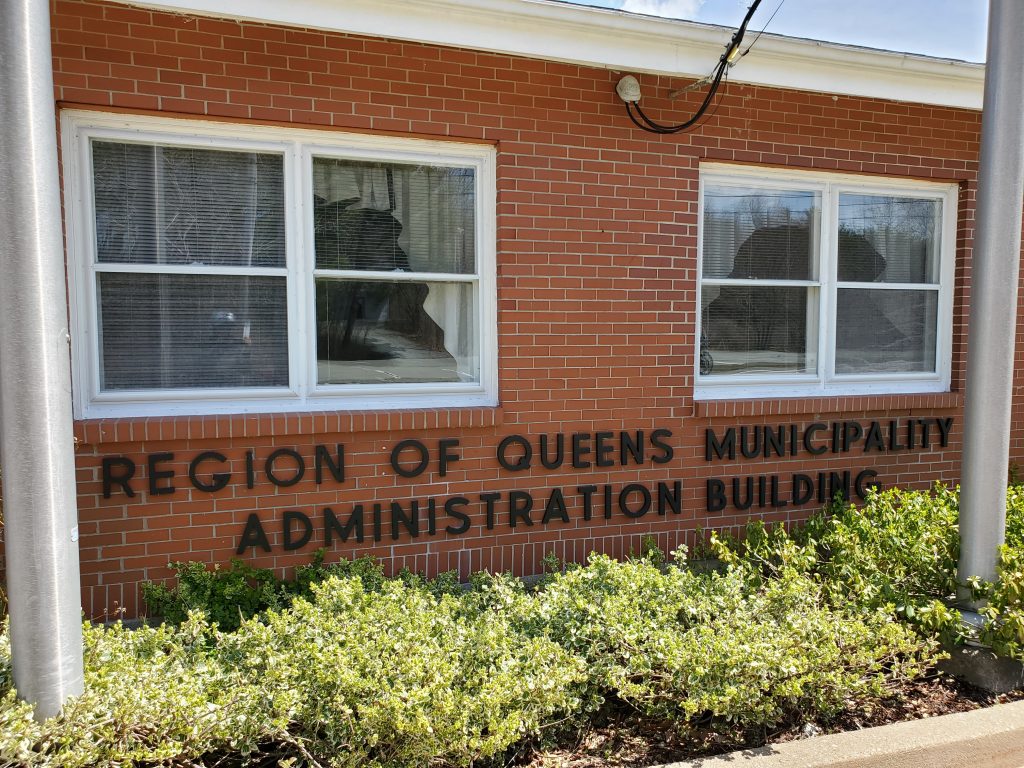
Region of Queens administration building. Photo Ed Halverson
The Region of Queens is expecting a budget surplus of $650,000 for the 2023/24 fiscal year, largely attributed to unfilled jobs, higher property assessments and a higher than expected take from the deed transfer tax.
Mayor Darlene Norman says the surplus isn’t all good news.
“Everyone’s a bit unhappy over that large surplus from last year, because that means we have staffing vacancies which is putting great pressures, especially on our Planning and our Public Works departments,” Norman said in an interview Wednesday.
“They are the two departments that have the greatest effect on people. Public Works we have projects that we were not able to do last year, such as the Liverpool bridge rail. The Old Burial Ground wall is in drastic need of a repair. The staffing vacancy is highly alarming. We hear as elected people from people who are waiting for the building permits, who are waiting for their inspections, who are having subdivision waits. That causes difficulty for our residents when they’re building and planning, be they commercial or residential.”
Queens councillors began their 2024/25 budget deliberations on Tuesday. Staff sent them details of the draft budget a few weeks ago. Councillors had a chance on Tuesday to ask questions about the proposed budget.
The budget process was delayed this year. All municipalities are supposed to have their budgets approved by March 31.
Norman said other municipalities in Nova Scotia have missed the March 31 deadline as well. Now that the region has filled the CAO position, she said she expects a more timely approach next year.
The proposed budget is just under $30 million, with an $8.5-million capital plan. There are no proposed tax rate increases at this time. But councillors are just beginning the process.
Councillors are set to offer additions or deletions to the budget at a meeting on Thursday at 6 p.m.
Next Tuesday (April 16) at 9 a.m., Norman said the region’s fire services are scheduled to make a presentation to council where they’re expected to ask for a boost in funding.
The vote on the final budget is scheduled for April 23 at 6 p.m. All meetings are open to the public and are held at council chambers on White Point Road. And they will also be livestreamed on the region’s Facebook page and YouTube channel.
The region’s assessment roll increased by about 14 per cent or $148 million. That led to an estimated tax revenue increase of $1.6 million. But that meant that the amount the region pays the province for education services also went up by $500,000, for a net gain to the region of $1.1 million.
The higher-than-expected deed transfer tax revenue was about $340,000.
Staff are also budgeting a $440,000 vacancy allowance to try to account for the difficulty in filling positions.
“The thought is we are not going to be able to staff all those positions right away and there may be up to $440,000 of money that we have budgeted for this year that does not get spent on staffing,” Norman said.
“So we’re actually planning to be able to put that money into revenue rather than see it as an end-of-the-year surplus. It’s a tricky thing to do, because if there’s a miracle and we suddenly fill those vacant positions, then we’re going to be short that money on our revenue line on the budget. However, the last several years have not been conducive to filling some of those staff positions.”
Norman said that a couple of big capital expenses are not in the 2024/25 capital budget. The region is still working on funding for the proposed $8-million outdoor pool at Queens Place. And it is still doing studies and investigating funding for the requested $21-million extension of water and sewer services to the Mount Pleasant area.
The Region of Queens was testing its livestream on Wednesday on its YouTube channel. (YOUTUBE)
The Region of Queens will begin livestreaming its council meetings on April 11.
Councillors voted unanimously on Tuesday to begin the new service, which will be broadcast simultaneously on the municipality’s Facebook page and YouTube channel.
Comments will be disabled on the livestream. Staff said that it would take tax staff resources to moderate the comments in real time. The meetings would be available for replays on the region’s YouTube channel, and possibly its Facebook page.
All public meetings in council chambers are currently recorded and uploaded to the region’s YouTube channel, usually the day after the meeting.
In February 2023, councillors asked about the possibility of livestreaming their meetings once a new audio-video system was installed. That new system was installed last April.
Councillors asked staff to investigate the possibility of livestreaming. Staff consulted with 17 other municipalities who currently livestream their meetings.
Livestreaming on Facebook and YouTube is free. But the region may have to spend some money on a mixing board so that pauses in the meeting for breaks or in camera sessions would not interrupt the live broadcast.
Staff have estimated it would cost about $3,000 for that equipment.
Councillors are currently in budget discussions. If they went for that option, they would have to add that to next year’s budget.
The April 11 meeting which is scheduled to be livestreamed will be one of the budget meetings. Councillors are set to discuss the preliminary draft of the budget from 6 to 9 p.m. this Thursday.
More than 100 people attended a meeting at Liverpool Regional High School on Monday evening to address community concerns about the Astor Theatre. (Rick Conrad)
Updated April 10, 9:05 a.m.
Community members finally got some answers on Monday night about the recent conflict that has engulfed the Astor Theatre in Liverpool.
More than 100 showed up at a meeting at Liverpool Regional High School called by supporters of former Astor employee Ashley-Rose Goodwin.
The two-and-a-half-hour-long meeting was at times raucous, revealing the rifts that have rocked the Astor over the past month since Goodwin resigned as associate artistic director.
The meeting was originally called to dissolve the current board and elect an interim one until the annual general meeting in May.
The first 45 minutes of the meeting were consumed with arguments between the organizers, who claimed it was a legitimate meeting of the Astor Theatre Society, and board members, who said it wasn’t. The meeting went ahead anyway.
Goodwin has led many popular youth-focused theatre camps, workshops and productions at the theatre over the past few years.
She resigned from the Astor in March. That was shortly after the large-scale adult musical Follies wrapped. Goodwin directed that production.
Her resignation upset many parents whose kids participated in her workshops and productions. It quickly erupted into a sometimes very personal and public fight.
They alleged that the Astor board and recently hired executive director Jerri Southcott made it impossible for Goodwin to stay.
Other people claimed that the Astor was “changing direction” under Southcott and alleged she was trying to engineer a merger with her Mahone Bay-based South Shore Summer Theatre.
At a town hall meeting on Sunday, Astor board members and Southcott refuted those allegations. They said the direction of the Astor has not changed and that they are still committed to involving the local community. The board also said that talks with South Shore Summer Theatre predated Southcott’s hiring, but that they are now off the table.
On Monday evening, it was obvious that many parents and others want Goodwin back at the theatre. Parents spoke about how their kids have benefited from being involved in Goodwin’s productions, how great she is with youth and how she ensures all kids feel respected and included.
Also on Monday evening, it became obvious that many of the issues around Goodwin’s employment and eventual departure were festering long before Southcott even applied for the job.
Goodwin has been silent publicly since her resignation. But she broke that public silence on Monday, explaining why she left the Astor.
Long before Southcott was hired, Goodwin was asking the board for more money. She said her productions were generating a lot of revenue for the Astor and her salary did not reflect that extra benefit to the theatre.
She was also holding private voice and music lessons at the Astor as part of her Mersey Rose Theatre Company
She told the crowd Monday she was being paid $1,200 every two weeks, and that as a single mother, that wasn’t enough to support herself and her four sons.
“Money was being brought in and all that was from my students that I made relationships with, that I brought in, and they wouldn’t put it on top of my salary, even though I was begging for them to give me more money because it wasn’t enough to live off of.”
Late last year, Goodwin mounted a winter solstice show at the Astor, which she created with her youth theatre group.
“I didn’t see any of those donations at the door. Nothing. And I was the one that wrote the show, I wrote the show with the kids. It was all me, I did it by myself. And I don’t see any of that. And I don’t think it’s fair that an entrepreneur who agrees to work at the Astor doesn’t see any of the money that comes in to boost her salary. How is that OK? It’s not OK.”
After Southcott was hired, Goodwin claims she was told she could no longer give private lessons at the Astor.
It appears the breaking point finally came near the end of the Follies run. Goodwin and the Astor planned another youth production, Oliver, Jr. Goodwin says the Astor wanted a quick turnaround. To have the show ready in three months, they wanted auditions to begin before Follies wrapped.
The Astor disputes this, and says their staff were working with Goodwin on her schedule to make sure she wasn’t overwhelmed during Follies.
Goodwin said she told them that was a short timeframe to get kids ready for a show. But she agreed to do it. Unfortunately, she got sick. She says she asked Southcott to hold off on auditions until she was feeling better.
“I begged her not to do the callbacks because I wanted to be there for the kids. She did them without me, and she cast the show without me. And then she told me what the rehearsal schedule would be. Monday to Thursday, 3 o’clock to 5:30 every day for a full cast of kids, that is crazy and that is not how you direct children. And that is why I quit.”
Liverpool parent Crystal Doggett speaks at a public meeting on Monday evening about recent controversy surrounding the Astor Theatre in Liverpool. (Rick Conrad)
John Simmonds, chairman of the Astor board, was also at the meeting on Monday and responded to Goodwin’s claims.
He said he and Goodwin had been talking about her role at the Astor in January and February.
“And the salary that you are receiving, we have it from every possible source that is very competitive in this field, in this area. So to say that we need to give you more money because you need it, unfortunately, as a businessman, as an employer, that shouldn’t enter into the equation. We did talk about down the road finding some way of bonusing you, profit-sharing, whatever. But that was still in discussion.”
Simmonds said Goodwin was also worried about a clause in her contract that she interpreted to be a non-compete clause. He said it was actually permission to work outside the theatre.
“You and a couple of your colleagues that you had spoken to said that’s a hard and fast non-compete. That’s not how we saw it. Those same people asked you to contact me or Jerri to discuss that clause. You failed to do that. I called you twice on that Friday afternoon when this whole thing blew up. You didn’t call me back. We’ve been asking to have a meeting with you since then.”
Simmonds said that most of the furor around the Astor happened when Goodwin resigned.
“The whole community rallied behind her and became totally outraged. We received 100 (Facebook) posts, emails, letters, at the Astor. We were totally overwhelmed and we couldn’t understand why. We’ve come to realize it’s support for Ashley and what she’s done. We appreciate all of that. We want her back. All of this rhetoric is not conducive to making that happen. If you want Ashley back and Ashley wants to come back, let’s talk sensibly about what the future holds and not what the past is.”
Others who attended the meeting said they just want both groups to come to terms and stop all the public bickering. Some criticized the group that called the meeting, saying that threatening to dissolve the board only inflamed tensions further.
The board and Goodwin’s supporters agreed to meet as a smaller group to hash out the concerns raised over the past month. The board pledged to hold a special meeting before the annual general meeting, which is scheduled for May 9.
“We’re looking forward to getting seven or eight from the different viewpoints in a room, talk about the issues and most importantly, moving forward, what do we do?”
Rebecca Smart was one of the organizers of Monday’s meeting. She said in an interview after the meeting that it was unfortunate it took a threat to dissolve the board to have her and others’ concerns heard.
“So I feel it was productive overall. Even though it was rough, but it was cleansing in a way because so much that’s been unaddressed and unspoken finally got out there.”
But it may take some time for the rifts around the Astor to heal. Southcott left the meeting early because she was upset by some of the accusations being hurled by one of the parents, who claimed they were threatened with legal action.
Simmonds said in an interview after the meeting that as somebody new to the community and as a new employee at the Astor, she has been unfairly targeted.
“She’s been under tremendous pressure because she recognizes from the get go that as much about Ashley it’s about her. People were out to trash her career.
“Give the lady a chance. We all make mistakes when we’re in a new job. I’m sure you have. I know I have. Let’s figure out what needs to be done to make things better in the future so everybody’s more comfortable.”
About 70 people turned out to the Astor Theatre in Liverpool on Sunday for a community town hall meeting. (Rick Conrad)
Updated April 10, 9:12 a.m.
The board and staff of the Astor Theatre in Liverpool held a community town hall on Sunday afternoon to try to clear up some of the controversy that has recently swirled around the historic theatre.
About 70 people showed up for the two-hour long session. It was at times heated, with some very pointed questions from audience members. Others were supportive of the board, while others showed up to get more specifics on what has apparently divided the Astor community.
Five board members as well as recently hired executive director Jerri Southcott and employee Malcolm Freeman took questions from the audience.
Chairman John Simmonds tried to clear up some things off the bat.
“We see no change in the direction of the Astor Theatre in terms of our instructions to Jerri. There’s been no change in our strategic plan or our mission or values,” he said.
“So we think that things have been going along well and will continue to go along well. And we would hope that the community would trust that whatever has occurred is just something that happened along the way. It’s not a pattern. It’s not a change in direction. There’s no regime change. So we hope to continue what has been the success of the Astor using community members, volunteers, as many people who are interested in coming in and joining in that.”
Simmonds also reminded people that Southcott has been on the job for only two months, and appealed to people for patience.
Astor Theatre Society board members Lynn Cochrane, Loris Azzano, Tina Tucker and Anne Espenant, employee Malcolm Freeman and executive director Jerri Southcott took questions from the audience at the Astor Theatre on Sunday. Chairman John Simmonds is shown standing. (Rick Conrad)
The misunderstandings and concerns appeared to start shortly after the musical Follies wrapped in early March. The director of that play, Ashley-Rose Goodwin, announced that she would be mounting another youth production, Oliver Jr.
Goodwin had produced numerous youth productions at the Astor in the past few years, both in her duties with the Astor and under her own company, Mersey Rose Theatre Company. She also led many youth theatre workshops and summer camps.
But shortly after the announcement of Oliver, Goodwin resigned as associate artistic director of the Astor.
That appeared to set off a cascade of events that eventually led to the resignations of two Astor board members.
Many parents and other community members were upset that Goodwin was no longer with the theatre.
A group of community members created the ad hoc group Queens County Community Theatre Advocates to “hold the board accountable,” according to a Facebook post. They said they were concerned about the “new direction” of the Astor.
They sent an open letter to the Astor board, saying they were shocked and dismayed at recent alleged decisions by the board and executive director Southcott.
They claimed that there was a sudden change in direction, that the local community was being shut out of Astor productions, that certain people were being paid to work on Astor productions instead of using community volunteers, and that Southcott was trying to engineer a “merger” between her Mahone Bay-based company South Shore Summer Theatre and the Astor. The group offered few specifics publicly about their concerns.
Things soon got heated and personal, with many people accusing the Astor or Southcott of various things on the Astor’s Facebook page. Members of this group also made accusations on their own public Facebook posts.
The group encouraged people to become members of the Astor Theatre Society so they could vote in a new board at an upcoming annual general meeting.
They have also organized a special meeting for Monday at 7 p.m. at Liverpool Regional High School. Their original purpose was to elect an interim board of directors and to set a date for the annual general meeting.
At the meeting on Sunday, however, Astor board members said that they will be at that meeting and that chairman John Simmonds will chair it.
The Astor board called the community meeting on Sunday to explain what has happened in the past month and to answer any questions from residents and Astor supporters.
“One of the questions that was asked online, ‘What is so heinous about the things that are going on that we need to replace the board?’” Simmonds said Sunday.
“And we would question and say, we don’t know. We don’t know. So we were hoping to sort of reveal these things now and bring them out into the light so people can make their decisions as to what direction they would like the Astor and this board and our current staff to go in.”
Betsy Hartt said she was upset at Goodwin’s departure, saying the “magic changed in this theatre when Ashley was running those programs”. She said she was also worried about rumours that the Astor would no longer be dedicated to community theatre.
“The concern I have is if there is going to be a refocus on spreading our wings, that’s great. But the centre of the focus still has to be on the activities in this building. So, Winds of Change, local theatre. And I’m hearing that that’s not the case.”
Southcott replied to Hartt that the Astor’s focus hasn’t changed.
“There are no changes in direction planned. There were no changes made. We did have a change in personnel. When Ashley resigned, we respectfully accepted her resignation and then we did our best to get the show on the road by posting positions, filling them, and putting together a production team. We have a group of kids that’s really excited. We have a production team that’s working really well together. But we are wide open to more volunteers, more cast members, all of the people here in Liverpool and Queens County are more than welcome to be involved. We were simply getting the next production on the go.”
Liverpool resident Sandra Atkinson speaks at the community meeting at the Astor Theatre in Liverpool on Sunday. (Rick Conrad)
As for the supposed merger with South Shore Summer Theatre, board member Anne Espenant said that was not the intent.
Espenant said the Astor had already been in discussions with that theatre company before Southcott was hired. South Shore Summer Theatre brought a play to Liverpool each of the past two summers that generated $10,000 in revenue for the Astor.
Espenant said the board hoped to bring that company under the Astor umbrella in the same way Liverpool theatre group Winds of Change had been part of the Astor.
“I just want to make it clear that that was not Jerri coming in and saying I’m going to bring in South Shore Summer Theatre. It was us talking to her about that. We were just having initial conversations with their board about whether they thought, just like with the Winds of Change board, that might be something they want to consider. Now it’s off the table. But that (discussion is) not on Jerri. It’s on us.”
Queens County resident Kristopher Snarby, who is the vocal coach for the upcoming musical Seussical, also sat on the Astor board for 12 years.
He echoed many in the audience on Sunday when he said he wasn’t clear what the online “uproar” was about. Snarby said the group of community members who wrote the letter to the Astor kept deflecting questions about their specific concerns.
“Like so many of you, I don’t think anybody really knows exactly what the problems are or were. And that’s a big problem in itself. … You read the letter and it says, I don’t know. It just says we’re mad, we’re angry.”
He said the accusations that the Astor or Southcott are trying to exclude local residents from productions is wrong, especially what he’s experienced since he’s been involved with Seussical.
“When I walked into this place, every kid who wanted to be there were there on the stage. There were no auditions. It’s the first show I’ve done where there were no auditions. So how can you be more inclusive than saying, ‘Come on the stage, we’re going to have fun. We’ll figure out the parts along the way.’ I’ve never seen that before. It’s the first time. You can’t get more inclusive than that.”
Snarby also said that another concern he saw online was that people are being paid for some productions.
He reminded people that when Winds of Change produced Les Miserables at the Astor in 2013, the musical director was paid and the musicians were given an honorarium. And he said they brought in actors from Halifax and Windsor to play two of the leading roles. They did not pay those actors, Snarby clarified later.
“There has been a history in this community of paying professionals for their time to do the job,” Snarby said. “Sometimes you have to pay professionals to do the job.”
Liverpool parent Lori Smyth said her two kids have attended the Astor theatre camps and they are also in Seussical. She says the apparent divide over the Astor has her kids worried.
“I just want to say that as a parent I’m very impressed with the team,” she said. “I am very grateful that there is a group of people that want to develop community theatre for the youth in this town. I think some of the parents are concerned, our kids are stressed. They love the theatre, and they love the Astor. With meetings happening tomorrow, and meetings all over the place, how is this going to affect their ability to finish the production that they have started?”
Southcott said the past month has taken a toll on her and the board.
“But even more importantly, I’m realizing the effects it’s having on your children,” she said.
“And it’s heartbreaking. I can tell you that we are committed as a production team to the kids and committed to providing this type of programming free of charge to everybody. I come to rehearsal and I feel better. I feel better because these kids are so incredibly talented, they’re nice, they are working together really well as a team. And I am committed to continuing that, so I hope that all of this can be resolved quickly.”
Board members and many in the audience said they’re also hopeful the rift can be repaired soon.
Liverpool resident Sandra Atkinson, who appeared in Follies, applauded the board for holding the information session.
“I just want you to fix it. I applaud you for being truthful, sharing your information, letting us know, letting us talk. And I applaud all the people for coming up here and saying whatever they felt they wanted to say. Thank you for doing this. And really just get to the table and fix it, please.”
The Astor recorded the town hall meeting and plans to post it on its Facebook page.
The Astor Theatre Society is holding a town hall information session at the Liverpool theatre on Sunday at 3 p.m.
In a statement released to their newsletter subscribers and posted on their Facebook page on Saturday afternoon, the Astor board and staff said they are organizing the public session to address “concerns in the community raising questions about what is happening. The purpose of this Town Hall is to identify concerns raised and provide factual and transparent answers.”
One board member, Kevin Colwell, recently resigned, shortly after the musical Follies wrapped up.
In a public post on Facebook, he said “I could no longer support, and was unable to change, decisions made by the Board regarding the direction of the Astor Theatre.”
He and others formed the ad hoc group, Queens County Community Theatre Advocates, and urged people to become members of the Astor Theatre Society and attend the upcoming annual general meeting scheduled for May 9 at 5 p.m.
Colwell and others signed a letter addressed to the board, alleging many things, including a change in direction for the theatre. He had included a link to it in his original Facebook post, but it has since been removed.
“Over the past six weeks,” the letter read in part, “we have observed, with shock and dismay, the radical shift in philosophy that seems to be taking place at the Astor – moving away from our cherished community-based approach to one that appears to be disregarding the heritage and values that have made the Astor such a beloved institution and a treasured and inclusive hub for the arts.”
The letter claimed that recent decisions made by the board and recently hired executive director Jerri Southcott “regarding programming choices, community engagement, and the future direction of the Astor suggest that Jerri has not undertaken any meaningful consultation with the community and instead is implementing her personal vision and agenda for the Astor.”
The others who signed the letter were former board member Annette Burke, Nathan and Rebecca Smart, Craig and Crystal Doggett and Paula Colwell.
The group had asked for a meeting with the Astor board. That was set for April 4, but the group called it off.
Instead, a group of seven members of the Astor Theatre Society have called a special meeting on Mon., April 8 at 7 p.m. at Liverpool Regional High School. They say the purpose of the meeting is to set a date for the annual general meeting and to elect an interim Astor board.
The Astor’s bylaws state that a general or special meeting can be held at any time and must be called if requested by the chair, requested by a majority of the board or requested in writing by five Astor Theatre Society members. The bylaws state that general or special meetings must be publicized seven days in advance.
The group calling the special meeting is upset that the Astor’s annual general meeting is scheduled more than three months after its fiscal year end, which is Dec. 31. The bylaws state that the annual general meeting must be held within three months of Dec. 31.
For its part, the Astor posted on Facebook shortly after Colwell’s post and comments from others on Astor posts that “the Astor Theatre Society Board of Directors, Executive Director and staff are aware of the hurtful comments and misinformation initiated by a few uninformed individuals and being circulated on social media.
“While we have tried to remain focused on our vision and mission for the Astor, which has not changed in any way, it has become increasingly apparent that this situation is having a negative and stressful impact on the Astor staff and volunteers.”
Colwell posted again, claiming that Southcott had threatened him and others with legal action.
In its notice Saturday of a town hall information session, the Astor said:
“The current Board of Directors and staff are working tirelessly in the best interests of the tradition and history of The Astor. It has been expressed in many circles that the theatre is in the best shape it has ever been, both operationally and financially. We have a full calendar of events in both the theatre and Town Hall Arts and Cultural Centre.
“Whether you are currently a member of the Astor Theatre Society or not, if you are passionate and care about the future of The Astor, we strongly encourage you to attend. This is your theatre and we pledge to continue to make it the welcoming icon of our community.”
Melanie Perron is the co-owner with Mark Baillie of Hell Bay Brewing Company in Liverpool. The craft brewery recently celebrated 13 years in business. (Rick Conrad)
They started out small in a barn in Cherry Hill, and have survived an early cease-and-desist order, floods, a pandemic and just recently celebrated their 13th year in business.
Hell Bay Brewing Company in Liverpool marked that milestone on April 1.
When Melanie Perron and Mark Baillie began their craft brewery in 2011, they were one of only five or six in Nova Scotia. Now, there are more than 50 craft brewers, from nanobreweries to brew pubs to microbreweries.
“That was a nanobrewery then,” Perron said in an interview at the brewery on Thursday.
“We didn’t know where to start or how to start, so we just started very small in our home and quickly grew out of that space and moved here.
“We were just doing it as a hobby, so it was just for fun. And I was on maternity leave at that time. And Mark was always brewing beer and sharing it with friends. And he was to the point where he was brewing so much that we couldn’t consume it all, we couldn’t share it all. So, I just thought, ‘What would it take to do this as a business?'”
Back in 2011, they were known as Rusty Anchor Brewing Company and started out with an English Ale. But three months after they started labelling their beers, they got a cease-and-desist letter from Anchor Brewing Company in San Francisco, telling them they couldn’t use the word “anchor” in their name.
So, the former husband and wife team had to come up with a new name and Hell Bay was born.
A couple of years later, they moved into the old Hoggie’s Buy and Sell space in downtown Liverpool. At that time, Perron says, they were focused mainly on selling kegs and bottles to bars in Halifax.
“When we first started out, it was just so busy because we had full reign of everything. It was easy to send 80 kegs to Halifax in a week and then the NSLC, we would send them three or four pallets of beer in a week. So at that time, we were employing probably six or seven staff.”
As more craft breweries opened, however, the market changed drastically. And Hell Bay had to change with it.
“When you think of all these breweries fighting for the same tap space and then the NSLC there’s only so much shelf space there. That’s why we had to put more concentration into our store and our pub and doing music and trying to attract more local people.”
While Nova Scotia craft beer sales increased overall by 6.1 per cent over the past three months, many breweries say the past few years have been a struggle.
In early March, FirkenStein Brewing in Bridgewater posted on its Facebook page that it was having trouble paying its rent. The brewery said if business didn’t pick up, it may have to close.
Other Nova Scotia craft breweries have closed or announced they will restructure. Uncle Leo’s near Pictou, Serpent Brewing, Off Track Brewing have closed or announced they’re closing. Brightwood Brewery in Dartmouth is closing its tap room, while Harbour Brewing in Musquodoboit Harbour is selling.
Perron says she hates to see other breweries in trouble.
“It hurts my heart because I know we’re in that boat every day. We’re just like, ‘Do we keep going or do we just sell out and close’, just because it’s not as profitable as people think. I always think it’s a good thing that I’m not a person who needs a lot in life. I don’t need a paycheque. I survive off very little. I have two staff who work here. So, my goal is to get my staff paid first. And my paycheque comes after that.
“It’s a hurting industry and I knew there was going to be a bubble. Everybody thought it was a multimillion-dollar business, adn I’m sure it would be if there were only 20 of us. But the market right now is just so saturated.”
Perron says that like with other businesses, Covid changed the landscape for microbreweries in Nova Scotia.
“Everything went to hyper-local. We lost all our accounts in Halifax, so all the bars dropped us. … So as of now, all of the bars we do have are on the South Shore.”
Perron says they’ve worked hard over the years to keep on top of what customers want. She says that’s why they started making more ready-to-drink beverages, like their popular hard lemonades, which often outsell their beer in the summertime.
And they recently made rum for the first time. It was a small batch but sold 72 bottles in two weeks.
She says that even though the past few years have been “up and down”, they’ve had great support from the local community.
“We wouldn’t be here without them, 100 per cent, especially since Covid. … So I am relying a lot on local business.”
Perron says she’s looking forward to the summer, when tourists return. The brewery plans to bring back its hot dog cart and offer some specialty hot dogs, and maybe even some food nights.
“I’m excited for the summer because I think it’s going to be super busy. I just have this feeling especially with all the new people moving here. The South Shore, it’s so beautiful and people are finally discovering it.”
In the past three months, sales at the brewery are more than double what they were this time last year.
Perron says the secret to their staying power is pretty simple.
“My perseverance. I’m not a quitter. I live a lot on hope. You know, next year can only be better. Since Covid, things are getting better.
“Just staying true to what you believe, I guess, and what your passion is and lots of hope.”
And that San Francisco brewery that sent Perron and Baillie that cease-and-desist letter 13 years ago?
It closed last year, but Hell Bay is still going.
“We try to keep our beer natural and true to what beer is. Just keeping the hops and barley and water. We don’t use preservatives. It’s all unpasteurized. It’s just the way beer should be.”
A second water main break at the Halifax Infirmary site of the QEII Health Sciences Centre has left the hospital without running water. (Wikipedia)
Nova Scotia’s biggest hospital has no running water for a second day in a row, as a second water main break occurred at the Halifax Infirmary overnight Wednesday.
That means the Infirmary, Veterans Memorial Building, Abbie J. Lane and the power plant have no running water for flushing toilets or drinking.
It’s affecting services at multiple sites at the QEII Health Sciences Centre complex and beyond.
Patients with surgeries at the Infirmary, the Victoria General and Dartmouth General hospitals may have their procedures rescheduled. Nova Scotia Health says emergency and time-sensitive surgeries will go ahead.
Outpatient blood collection at the Infirmary site is closed for Thursday. Patients can go to the Bayers Road blood collection facility.
The Infirmary’s emergency department is open but patients are being asked to visit another site if their issue isn’t an emergency.
Nova Scotia Health says patients with other scheduled appointments Thursday will be contacted to relocate, reschedule or offer a virtual option. And visitors and support people for patients at the Halifax Infirmary site will be limited.
Officials are working on the problem. Portable hand-washing stations and portable washrooms are available. And bottled water is on site.
Workers with Nova Scotia Health had been fixing the original water main break in the steam plant on Wednesday, when the second one occurred.
The Department of Communities, Culture, Tourism and Heritage has developed an online tool to help non-profits, businesses and others find more information about grants. (Tourism Nova Scotia / Acorn Art & Photography)
The Nova Scotia government is launching a new online grant finder tool to help make it easier for non-profits, businesses and others to find government funding.
The new tool will help Nova Scotians apply for provincial grants supporting arts, culture, tourism, sport, recreation, cultural identity and languages through the Department of Communities, Culture, Tourism and Heritage.
“Nova Scotians have told us that navigating the large number of grant programs can be challenging, particularly for organizations with volunteers working in their spare time,” Allan MacMaster, minister of communities, culture, tourism and heritage, said in a news release.
“This one-stop entry will help people quickly match their needs with the programs that we have available.”
The province gave about 2,600 grants to hundreds of communities, groups and organizations for arts, culture and recreation initiatives in the past year.
Thomas Raddall Provincial Park. (Tourism Nova Scotia)
Campsite bookings at provincial parks in Nova Scotia are now open.
Reservations for parks in the western part of the province opened on Wednesday.
Campers can book spots at Thomas Raddall Provincial Park in Port Joli, Rissers Beach, The Islands in Shelburne, Blomidon, Ellenwood Lake in Deerfield or Valleyview in Bridgetown.
Reservations for other areas of the province, including the Eastern Shore and Cape Breton open on Thursday and Friday.
You can book a spot by calling 1-888-544-3434 or online at parks.novascotia.ca.
Prime Minister Justin Trudeau was in Dartmouth on Tuesday to announce more than $6 billion in funding for housing initiatives. Sean Fraser, minister of housing, infrastructure and communities, is in the background. (CPAC)
Prime Minister Justin Trudeau unveiled more funding on Tuesday for affordable housing across the country.
Trudeau was in Dartmouth to announce the federal government will include more than $6 billion in the April 16 budget for housing initiatives.
The Canada Housing Infrastructure Fund would help speed up construction or upgrade needed infrastructure to build more homes for Canadians.
“If we want build more homes faster, we also need to be upgrading critical water and wastewater infrastructure. … We’ll launch the Canada Housing Infrastructure Fund with a billion dollars available to be allocated in the short term for municipalities to support needs that will directly create more housing, and $5 billion for agreements with provinces and territories to support investments in long-term priorities paired with key provincial and territorial actions to boost housing supply.”
The $5 billion would go to provinces over a longer period. Federal and provincial officials would have to negotiate the terms for that funding.
According to The Canadian Press, provinces and territories would have to agree to a set of conditions, including a renters’ bill of rights. The deadline for provinces to reach a deal with Ottawa would be Jan. 1, 2025.
And provinces would have to freeze development charges for three years. They would also have to adopt changes to the national building code and automatically approve homes that follow designs from the federal government’s housing design catalogue.
Trudeau said the government also plans to add another $400 million to the Housing Accelerator Fund to help make it easier at the municipal level to build more housing.