About 25 people showed up at Queens Place Emera Centre in Liverpool on Saturday to discuss the Winds of Change relationship with the Astor Theatre. (Rick Conrad)
The Winds of Change theatre group has voted to end a short-lived relationship with Liverpool’s Astor Theatre and re-form as an independent society.
About 25 people showed up at a meeting on Saturday at Queens Place Emera Centre and voted to reverse a February 2023 decision to become a subcommittee within the Astor.
Nick Moase was the acting chairman of the Winds of Change. He chaired the meeting on Saturday. He is also the technical director for QCCR.
“The decision is what I expected,” he said in an interview after the meeting.
“With everything going on and the comments that have been said to me privately, I was aware that people weren’t comfortable with what the Astor Theatre was doing and that they wanted to separate the Winds of Change again to re-form.
“For 25 years, this has been on the books to discuss. We gave it a try. Things didn’t go as expected, so now we just continue on as the Winds of Change as a separate entity.”
Under the arrangement, the Winds of Change was to use its $29,000 legacy fund for theatrical productions at the theatre. That fund would then be reimbursed from ticket sales, and the Astor would keep any profit.
But recently, members of the group wanted to re-examine the relationship.
Ashley-Rose Goodwin resigned as the Astor’s associate artistic director this March, shortly after the wrap of the Stephen Sondheim musical Follies. That was a Winds of Change-Astor co-production. Goodwin was the director of that show.
After her resignation, some in the community, including Winds of Change members, were upset at how the Astor was being operated by the board and recently hired executive director Jerri Southcott.
They were also annoyed when Southcott and the Astor decided not to pay for a Follies cast party at the Liverpool Curling Club. The relationship soured further when the Astor forgot to mention and thank the 70 members of the Follies cast and crew in its monthly newsletter. Southcott quickly sent out an apology the next day in another email to newsletter subscribers.
John Simmonds, the chairman of the Astor Theatre board of directors, was at the meeting on Saturday. He couldn’t comment on Saturday, but in an interview on Sunday, he said the group’s decision was unfortunate but not surprising.
“Maybe taking a long-term view, it’s probably the best for all concerned right now so that we can continue to do our thing and Winds of Change can re-form, get back and do the things that they were doing before, hopefully with the Astor. And as things cool down, we can re-examine the thing and take a look at it down the road.”
Simmonds said the Winds of Change will always be welcome at the Astor.
“We wish the Winds of Change well. That long history between the two organizations is not going to go away. Hopefully, everybody will feel comfortable working with each other again. I know I would. I was just thinking how important it would be to be able to meet people on the street, give them a smile, a handshake, a hug, whatever, and just continue on as friends as we were before.”
Moase said on Saturday that he will not remain on the board.
A slate of 10 people was nominated to form a new board for the Winds of Change. They must re-form as a legally recognized non-profit society through the registry of joint stocks.
Moase said he believes that the arrangement with the Astor for the past year worked well. But he said the Winds of Change is in good shape, especially given the level of participation in Follies.
“I think the interest is there, the people are there again. This issue with the Astor Theatre will come to a conclusion at some point and things will continue. Amateur theatre in Liverpool isn’t going anywhere. And I think we’re probably in good shape to have another production when folks are ready again.”
Shelly Panczyk is the chairwoman of the Queens County Food Bank in Liverpool. (Rick Conrad)
More people are using the Queens County Food Bank at the same time as donations are dropping.
Shelly Panczyk, chairwoman of the food bank on Main Street in Liverpool, says the charity saw 4,993 people last year. Of those, 1,494 were children.
That’s up markedly from when she started at the charity four years ago. She said back then, they’d see 40 families a week. Now, it’s closer to 55 families a week.
“I just want people to realize that this is a very, very busy place. I call this the third grocery store in Queens County.”
“This situation (our clients are) in, they can’t help it. We’ve seen people in here, husband and wife, each of them working. This is going to get worse before it ever gets better.”
Clients can go to the food bank every 21 days to stock up on food and household items. The food bank also operates a thrift store on Main Street, about a block away.
Last year, revenue at the food bank alone was down by $107,000. But expenses climbed by $17,000. The thrift store, though, generated $82,000 in net income for the food bank.
Panczyk and the board reported those figures at the charity’s recent annual general meeting. She clarified that part of the reason for the revenue drop in 2023 was that they didn’t receive any large grants like they did the year before.
Panczyk said the food bank does have savings in the bank. But she said in an interview that without the income from the thrift store, they would be in trouble.
“Without that store, this food bank would not be running,” she said.
Both the food bank and the thrift store are run entirely by volunteers. They have as many as 50 through the year. There are no paid staff.
“It costs $140,000 a year to run this food bank, just this building. And we don’t get that in donations. That store … is our little gold mine.”
Panczyk said that older people and churches used to be among their biggest donors.
“The donors were the people that are in their 80s and 90s and now have died. Churches were always a good donation, because churches were the ones that started most food banks. Churches are closing, their parishioners are down.”
A study released in February by food rescue organization Second Harvest showed that demand for food charity in Canada is expected to rise by 18 per cent this year. The study found that on average, each charity needs an extra $76,000 to meet that increased demand.
Panczyk says monetary and food donations have dropped, though she says that the local Sobeys and Superstore are still major food donors. And they receive regular shipments from Feed Nova Scotia.
But she said she still has to buy a lot of food to serve their clients.
“My grocery bill here for a month is anywhere from $4-6,000.”
She said four years ago, the food bank would buy 200 pounds of hamburger to distribute over three months.
“I’m buying 500 pounds. They used to pay $2.99 (a pound) and I have to wait until it goes on sale and I pay almost $5 a pound. And I give out 200 pounds of that a month now.”
The food bank is also required to stock 14 staple food items such as peanut butter, crackers, pasta sauce and spaghetti. They have to buy many of those items.
And Panczyk says she has to make sure she can cater to more diverse food needs, as more families of various backgrounds move to Queens County.
She has applied for grants to begin to stock more food variety, such as halal meats or basmati rice.
“So this is a whole new scenario for food banks, especially in these smaller communities that we never had before.”
Panczyk said she’s grateful for the donors they do have and for the community support of the thrift store.
But she said they need more cash donations so that they can continue to serve a growing and more diverse clientele.
“I don’t think I want to be starting out again not what these people are going through. I think this is almost as bad as the Depression, trying to fight your way through.”
Kim Masland, Queens MLA and Nova Scotia’s public works minister, announces $10.7 million in provincial funding for a $21.5-million water and sewer expansion that gives the green light to two new housing developments in the Liverpool area. (Rick Conrad)
The Nova Scotia government and the Region of Queens are teaming up on a $21.5-million project to extend and improve water and sewer services in the Liverpool area.
Queens MLA Kim Masland on Monday announced $10.7 million in provincial funding to expand water and wastewater service to the Mount Pleasant area. The region will pitch in $10.8 million.
The project means that two new private housing developments will go ahead on more than 60 acres of land. About 325 new housing units will be built for up to 1,200 people. It will be a mix of sold and rented space. About a third of those units could be affordable housing.
Masland, who is also Nova Scotia’s public works minister, made the announcement at the region’s municipal offices in Liverpool on behalf of John Lohr, the minister of municipal affairs and housing.
“We need this funding, we know our community’s growing, we certainly need affordable and more housing stock within our community,” she said in an interview after the announcement.
“We’re attracting people to our community every day, there are med professionals that want to come here. This is a great project. This will allow us to build more houses.”
Masland said a municipal housing needs assessment found that Queens County needs 555 more housing units by the end of 2027. She said it’s difficult to recruit health care staff to move to the area if there’s nowhere to live.
“We need people building faster. We need homes up, we need places for people to live. We are in a housing crisis in the province and we’re going to do whatever we can to make sure we can help.”
The funding will also improve existing water and sewer services to more than 1,200 homes and businesses in the area, and help improve the amount of water available for firefighting efforts.
Region of Queens Mayor Darlene Norman emphasized that the funding will do more than help developers build new homes.
She said the current infrastructure is at or over capacity. The project will improve service for residents in Liverpool, Brooklyn and Milton.
“There are some really crucial repairs that need to be made to our system, so it can expand in all directions. This is not case-specific for specific people.”
The provincial portion of the funding comes from the $102-million Municipal Capital Growth Program. The region applied in December for the funding.
Norman said the region’s finance staff are working now to figure out how the municipal portion will be funded. The region is currently working on its 2024/25 budget.
Adam Grant, the region’s director of engineering and public works, said Monday he hopes the work will be finished in 24 to 36 months.
“So work is already underway. Following the feasibility study, we’ve migrated into some design work preliminary and that’s underway right now, looking at having designs rolled out in the fall and construction starting in the next 12 months ideally.”
The developers behind the two housing projects said Monday they were excited by the news. They’ve lobbied the municipality for the past few years to extend water and sewer services to those areas.
Both projects are near downtown Liverpool.
Larry Cochrane plans an 87-unit development on the old Dauphinee Farm property near Queens General Hospital, which would include a 24-unit apartment building.
He said he will soon begin the design phase of the project.
“I wish it was faster of course, but we’ll take that because there’s lots of work I need to do to get ready to start a project like this.”
Graham van der Pas is a partner with Rumclo Developments. They plan a three-stage development on about 30 acres of land farther up the road from Cochrane’s project.
“We’re very, very excited. We’ve been lobbying for this for the past two years. So it’s amazing.”
The Rumclo development will feature The Point, which will have 124, two-bedroom homes for sale, The Curve, with 22 three-bedroom townhouses, and Birchwood Gardens, 82 affordable rental apartments. Van der Pas said the affordable rentals will be 80 per cent of the median market rate. A one-bedroom would be about $800 a month, a two-bedroom $1,000 and a three-bedroom would rent for $1,200.
A section of The Curve will also be reserved for staff from Queens General Hospital to rent.
“I think a community like this needs it,” van der Pas said.
“I think what our developments will bring to the town is … a significant amount of property taxes. The revenue will go up there, the economic revenue of people potentially starting businesses, new patrons for the businesses that are already existing. It’s significant.”
Ashley Christian, president of the South Queens Chamber of Commerce, said she’s happy that such a big investment is being made in Queens.
“We have been advocating through the chamber of commerce for more housing for a couple of years. So we’re so excited to see this huge investment, especially made by the municipality, really impressed by that.”
Christian said she’s especially happy that half the funding is coming from the province. She said she hopes that means the project won’t be a big burden on municipal taxpayers.
Audra Lindley played Helen Roper in the 1970s/80s sitcom Three’s Company. (IMDB)
If you see a group of women in downtown Liverpool on Saturday with frizzy wigs, colourful caftans and chunky jewelry, don’t worry.
It’s the first Mrs. Roper Romp for Liverpool. About 20 women plan to celebrate the brash and brassy Helen Roper from the corny and campy ’70s and ’80s sitcom Three’s Company.
Angie McWilliams lives in Summerville Centre. She and some friends wanted to start their own romp after they couldn’t get into the sold-out event in Halifax. The first Mrs. Roper Romp happened at the Southern Decadence parade in New Orleans more than 10 years ago.
“The actual original Roper Romp, it’s been around since 2013. A really great guy named Bud Moore started it in New Orleans for charity. And since then, it took off and it’s international now. Our little romp is only gooing to be 20 ladies. So we decied why not do it in Liverpool? And we’re going to raise money for the Queens County food bank with this romp. It’s going to be a mini romp this year but we’re hoping to grow it and just raise money and have a good time.”
It has since spread across Canada, the U.S., Mexico, South Africa, Spain and Portugal.
But why Mrs. Roper?
“Well, she’s an icon. I’m 54 years old, I grew up with Mrs. Roper. And it’s a costume, a disguise to have a really good time, wear some really, dare I say, tacky clothes and jewelry. And even preparing for it has been a lot of fun.”
Men are more than welcome to join.
“A lot of gentlemen join as Helens but they also join as Stanley Roper and the great Mr. Furley.”
The Mrs. Roper Romp starts at Route 3 Cellar Taproom and Grill at 3 p.m. on Saturday. The Helens will be going to the Legion, down Main Street depending on the weather and back to the Legion before ending up at the Cellar for glow-in-the-dark bowling “in our caftans, which will be really crazy to see.”
Nick Moase is the acting chairman of the Winds of Change theatre group. (Rick Conrad)
The Winds of Change theatre group is holding a meeting on April 20 to discuss whether to end its year-long merger with Liverpool’s Astor Theatre.
Nick Moase, acting chairman of the Winds of Change, said in an interview Wednesday that he called the meeting in response to concerns about recent controversy around the Astor. Moase is also the technical director for QCCR.
“I really want to make sure the community either wants to rescind this motion to become a part of the Astor Theatre and re-form as a society or if we are still comfortable going ahead and finishing up the merger with the Astor Theatre.”
Winds of Change Dramatic Society members voted to merge with the Astor Theatre Society in February 2023. The idea was that the group would become a subcommittee of the Astor and bring along its $29,000 legacy fund to be used for theatrical productions at the theatre.
But recently, members and former members of the group wanted to re-examine the relationship. Ashley-Rose Goodwin resigned as the Astor’s associate artistic director this March, shortly after the wrap of the Stephen Sondheim musical Follies. Goodwin was also the director of that show.
After her resignation, a group of people lobbed several accusations about how the Astor was being run. One of them was a concern about what would happen to Winds of Change and its legacy fund.
“I do want to make it clear, some of the concern that came out of the community was that the Astor took off with our money after the Follies. And that’s not the case,” Moase says.
“I have assurances from the operations manager of the theatre that the money was replenished to what it was. So the Follies up to and just after the production, actually I think was a success in terms of the merger. The name was used properly, the money was used properly, we didn’t have to pay rental for the space.”
The idea of Winds of Change merging with the Astor had been discussed for years.
Moase says the group’s legacy fund was kept in a separate line item on the Astor balance sheet and used for paying expenses in mounting productions at the theatre, such as costumes, sets and securing rights to plays. The Astor would then reimburse the fund from ticket sales and pocket any profit.
The Winds of Change would benefit by no longer having the expenses of running a non-profit society, such as insurance and renting the Astor for its productions.
After the decision to merge with the Astor, the Winds of Change Society stopped operating as a separate entity. It has no bank account, and it is not a recognized society on the Nova Scotia’s Registry of Joint Stock Companies.
Moase says it’s not a problem to relist the society with the registry, if the group’s membership decides to rescind the merger with the Astor.
“This meeting, it is the community telling us, the Winds of Change, what they want. And if they want to re-form as a society, get some names of people who are interested in joining, and then we start the process of getting everything squared away with the joint stocks … and then once that’s done we need to open a bank account again, we need to get directors insurance again. Then we can start (signing up) official members, making motions and getting back to the process of making plays at the Astor.”
Moase says that he planned to work on the terms of reference to complete the merger after Follies was over.
“The merger it’s been a little slow, it has been on my shoulders and due to some things going on in my own personal life, and the fact that I was the lead set designer and builder for Follies, things have been a bit slow so we hadn’t finished all of the merger process, the terms of reference, that sort of thing.”
He says the Astor board has told him they would like to continue with the merger. But that depends on what is decided at the April 20 Winds of Change meeting.
Moase said he also wanted to address two other issues that arose after Goodwin resigned and Follies wrapped.
Some members were upset that the Astor would not pay for a party at the Liverpool Curling Club. And they were irked that the Astor forgot to mention and thank the Follies cast and crew in its monthly newsletter, sent April 2.
“In isolation they’re minor, but as a part of the whole of what’s going on, people have really latched on to it a bit,” Moase said.
“I do think they are things we can work through. This is our first production as a sub-committee under the Astor. Of course we’re going to have things we need to iron out.
“And if you look at the framework that we’ve drawn up for our merger, we never talked about cast parties. So it’s something that we’ve usually had in the past, we’ve usually funded out of our profits that we made out of the shows, but we never mentioned it to the Astor that this is what we do. Again, I think this is something we could have overcome in the future.”
When asked if it could be seen as an honest mistake, he said: “In my view, it is.”
Jerri Southcott took over as the Astor’s executive director on Feb. 5. In a special newsletter to subscribers on April 3, she issued her “sincerest apologies” for the omission of Follies in the newsletter the day before.
“This oversight was in no way intentional, and I want to take this opportunity to express my deepest regret for any disappointment or frustration it may have caused. The dedication and talent of everyone involved in Follies deserved to be celebrated and recognized, and I am truly sorry for failing to do so.”
As for the cast party, Southcott says her personal philosophy is that she doesn’t believe it was an appropriate way to spend donated money, and that in her experience with non-profits, she prefers to see most of the money returned to the organization.
She says she consulted with the board at the time. Because she is new in the job, she says, she hasn’t been making any significant decisions without consulting them first.
Moase says he doesn’t know if he will continue on the board of the Winds of Change. He says he believes the merger with the Astor is still worth pursuing.
“I really have to see how this meeting goes and see how the community feels. I have to admit, everything that’s been going on, it’s caught me off guard. I didn’t expect it and I’ve had trouble keeping up with everything that’s been going on.
“I don’t know what the sentiment is. I’m not even sure what people think of me as part of this because i’ve been working on this merger for so long. Nobody’s messaged me or has messaged me very little directly to confront me about any problems. I genuinely don’t know what direction we’re going, so I really have to see what happens at that meeting.”
The Winds of Change meeting is scheduled for Sat., April 20 at 1 p.m. at Queens Place Emera Centre in Liverpool.
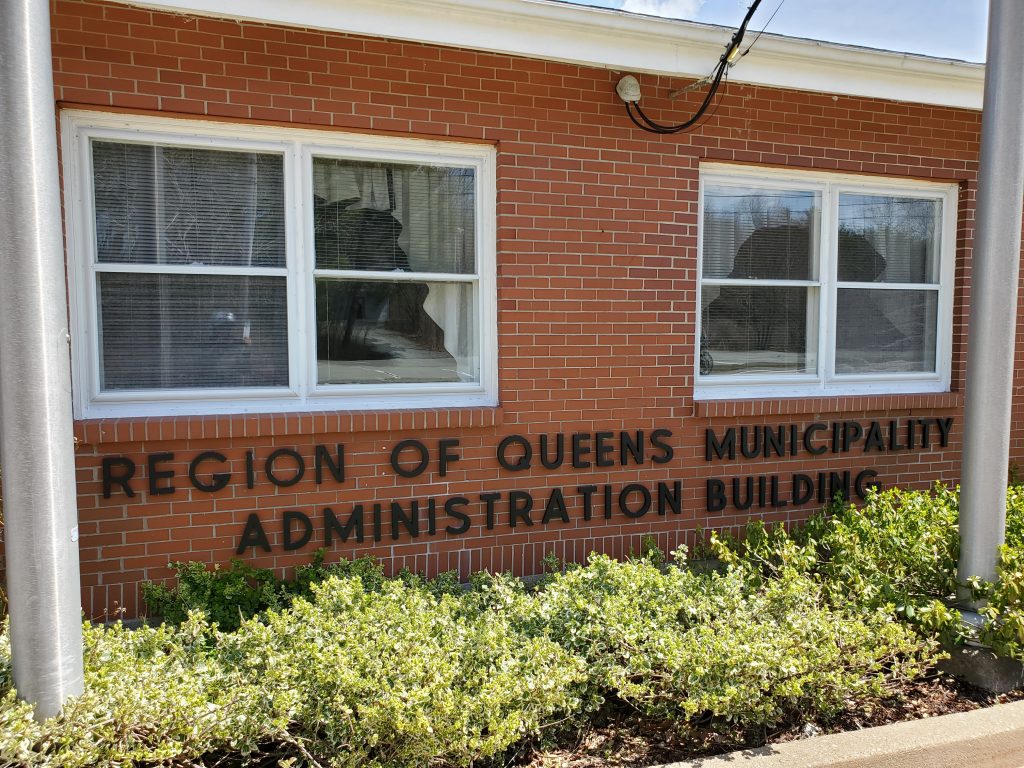
Region of Queens administration building. Photo Ed Halverson
The Region of Queens is expecting a budget surplus of $650,000 for the 2023/24 fiscal year, largely attributed to unfilled jobs, higher property assessments and a higher than expected take from the deed transfer tax.
Mayor Darlene Norman says the surplus isn’t all good news.
“Everyone’s a bit unhappy over that large surplus from last year, because that means we have staffing vacancies which is putting great pressures, especially on our Planning and our Public Works departments,” Norman said in an interview Wednesday.
“They are the two departments that have the greatest effect on people. Public Works we have projects that we were not able to do last year, such as the Liverpool bridge rail. The Old Burial Ground wall is in drastic need of a repair. The staffing vacancy is highly alarming. We hear as elected people from people who are waiting for the building permits, who are waiting for their inspections, who are having subdivision waits. That causes difficulty for our residents when they’re building and planning, be they commercial or residential.”
Queens councillors began their 2024/25 budget deliberations on Tuesday. Staff sent them details of the draft budget a few weeks ago. Councillors had a chance on Tuesday to ask questions about the proposed budget.
The budget process was delayed this year. All municipalities are supposed to have their budgets approved by March 31.
Norman said other municipalities in Nova Scotia have missed the March 31 deadline as well. Now that the region has filled the CAO position, she said she expects a more timely approach next year.
The proposed budget is just under $30 million, with an $8.5-million capital plan. There are no proposed tax rate increases at this time. But councillors are just beginning the process.
Councillors are set to offer additions or deletions to the budget at a meeting on Thursday at 6 p.m.
Next Tuesday (April 16) at 9 a.m., Norman said the region’s fire services are scheduled to make a presentation to council where they’re expected to ask for a boost in funding.
The vote on the final budget is scheduled for April 23 at 6 p.m. All meetings are open to the public and are held at council chambers on White Point Road. And they will also be livestreamed on the region’s Facebook page and YouTube channel.
The region’s assessment roll increased by about 14 per cent or $148 million. That led to an estimated tax revenue increase of $1.6 million. But that meant that the amount the region pays the province for education services also went up by $500,000, for a net gain to the region of $1.1 million.
The higher-than-expected deed transfer tax revenue was about $340,000.
Staff are also budgeting a $440,000 vacancy allowance to try to account for the difficulty in filling positions.
“The thought is we are not going to be able to staff all those positions right away and there may be up to $440,000 of money that we have budgeted for this year that does not get spent on staffing,” Norman said.
“So we’re actually planning to be able to put that money into revenue rather than see it as an end-of-the-year surplus. It’s a tricky thing to do, because if there’s a miracle and we suddenly fill those vacant positions, then we’re going to be short that money on our revenue line on the budget. However, the last several years have not been conducive to filling some of those staff positions.”
Norman said that a couple of big capital expenses are not in the 2024/25 capital budget. The region is still working on funding for the proposed $8-million outdoor pool at Queens Place. And it is still doing studies and investigating funding for the requested $21-million extension of water and sewer services to the Mount Pleasant area.
The Region of Queens was testing its livestream on Wednesday on its YouTube channel. (YOUTUBE)
The Region of Queens will begin livestreaming its council meetings on April 11.
Councillors voted unanimously on Tuesday to begin the new service, which will be broadcast simultaneously on the municipality’s Facebook page and YouTube channel.
Comments will be disabled on the livestream. Staff said that it would take tax staff resources to moderate the comments in real time. The meetings would be available for replays on the region’s YouTube channel, and possibly its Facebook page.
All public meetings in council chambers are currently recorded and uploaded to the region’s YouTube channel, usually the day after the meeting.
In February 2023, councillors asked about the possibility of livestreaming their meetings once a new audio-video system was installed. That new system was installed last April.
Councillors asked staff to investigate the possibility of livestreaming. Staff consulted with 17 other municipalities who currently livestream their meetings.
Livestreaming on Facebook and YouTube is free. But the region may have to spend some money on a mixing board so that pauses in the meeting for breaks or in camera sessions would not interrupt the live broadcast.
Staff have estimated it would cost about $3,000 for that equipment.
Councillors are currently in budget discussions. If they went for that option, they would have to add that to next year’s budget.
The April 11 meeting which is scheduled to be livestreamed will be one of the budget meetings. Councillors are set to discuss the preliminary draft of the budget from 6 to 9 p.m. this Thursday.
More than 100 people attended a meeting at Liverpool Regional High School on Monday evening to address community concerns about the Astor Theatre. (Rick Conrad)
Updated April 10, 9:05 a.m.
Community members finally got some answers on Monday night about the recent conflict that has engulfed the Astor Theatre in Liverpool.
More than 100 showed up at a meeting at Liverpool Regional High School called by supporters of former Astor employee Ashley-Rose Goodwin.
The two-and-a-half-hour-long meeting was at times raucous, revealing the rifts that have rocked the Astor over the past month since Goodwin resigned as associate artistic director.
The meeting was originally called to dissolve the current board and elect an interim one until the annual general meeting in May.
The first 45 minutes of the meeting were consumed with arguments between the organizers, who claimed it was a legitimate meeting of the Astor Theatre Society, and board members, who said it wasn’t. The meeting went ahead anyway.
Goodwin has led many popular youth-focused theatre camps, workshops and productions at the theatre over the past few years.
She resigned from the Astor in March. That was shortly after the large-scale adult musical Follies wrapped. Goodwin directed that production.
Her resignation upset many parents whose kids participated in her workshops and productions. It quickly erupted into a sometimes very personal and public fight.
They alleged that the Astor board and recently hired executive director Jerri Southcott made it impossible for Goodwin to stay.
Other people claimed that the Astor was “changing direction” under Southcott and alleged she was trying to engineer a merger with her Mahone Bay-based South Shore Summer Theatre.
At a town hall meeting on Sunday, Astor board members and Southcott refuted those allegations. They said the direction of the Astor has not changed and that they are still committed to involving the local community. The board also said that talks with South Shore Summer Theatre predated Southcott’s hiring, but that they are now off the table.
On Monday evening, it was obvious that many parents and others want Goodwin back at the theatre. Parents spoke about how their kids have benefited from being involved in Goodwin’s productions, how great she is with youth and how she ensures all kids feel respected and included.
Also on Monday evening, it became obvious that many of the issues around Goodwin’s employment and eventual departure were festering long before Southcott even applied for the job.
Goodwin has been silent publicly since her resignation. But she broke that public silence on Monday, explaining why she left the Astor.
Long before Southcott was hired, Goodwin was asking the board for more money. She said her productions were generating a lot of revenue for the Astor and her salary did not reflect that extra benefit to the theatre.
She was also holding private voice and music lessons at the Astor as part of her Mersey Rose Theatre Company
She told the crowd Monday she was being paid $1,200 every two weeks, and that as a single mother, that wasn’t enough to support herself and her four sons.
“Money was being brought in and all that was from my students that I made relationships with, that I brought in, and they wouldn’t put it on top of my salary, even though I was begging for them to give me more money because it wasn’t enough to live off of.”
Late last year, Goodwin mounted a winter solstice show at the Astor, which she created with her youth theatre group.
“I didn’t see any of those donations at the door. Nothing. And I was the one that wrote the show, I wrote the show with the kids. It was all me, I did it by myself. And I don’t see any of that. And I don’t think it’s fair that an entrepreneur who agrees to work at the Astor doesn’t see any of the money that comes in to boost her salary. How is that OK? It’s not OK.”
After Southcott was hired, Goodwin claims she was told she could no longer give private lessons at the Astor.
It appears the breaking point finally came near the end of the Follies run. Goodwin and the Astor planned another youth production, Oliver, Jr. Goodwin says the Astor wanted a quick turnaround. To have the show ready in three months, they wanted auditions to begin before Follies wrapped.
The Astor disputes this, and says their staff were working with Goodwin on her schedule to make sure she wasn’t overwhelmed during Follies.
Goodwin said she told them that was a short timeframe to get kids ready for a show. But she agreed to do it. Unfortunately, she got sick. She says she asked Southcott to hold off on auditions until she was feeling better.
“I begged her not to do the callbacks because I wanted to be there for the kids. She did them without me, and she cast the show without me. And then she told me what the rehearsal schedule would be. Monday to Thursday, 3 o’clock to 5:30 every day for a full cast of kids, that is crazy and that is not how you direct children. And that is why I quit.”
Liverpool parent Crystal Doggett speaks at a public meeting on Monday evening about recent controversy surrounding the Astor Theatre in Liverpool. (Rick Conrad)
John Simmonds, chairman of the Astor board, was also at the meeting on Monday and responded to Goodwin’s claims.
He said he and Goodwin had been talking about her role at the Astor in January and February.
“And the salary that you are receiving, we have it from every possible source that is very competitive in this field, in this area. So to say that we need to give you more money because you need it, unfortunately, as a businessman, as an employer, that shouldn’t enter into the equation. We did talk about down the road finding some way of bonusing you, profit-sharing, whatever. But that was still in discussion.”
Simmonds said Goodwin was also worried about a clause in her contract that she interpreted to be a non-compete clause. He said it was actually permission to work outside the theatre.
“You and a couple of your colleagues that you had spoken to said that’s a hard and fast non-compete. That’s not how we saw it. Those same people asked you to contact me or Jerri to discuss that clause. You failed to do that. I called you twice on that Friday afternoon when this whole thing blew up. You didn’t call me back. We’ve been asking to have a meeting with you since then.”
Simmonds said that most of the furor around the Astor happened when Goodwin resigned.
“The whole community rallied behind her and became totally outraged. We received 100 (Facebook) posts, emails, letters, at the Astor. We were totally overwhelmed and we couldn’t understand why. We’ve come to realize it’s support for Ashley and what she’s done. We appreciate all of that. We want her back. All of this rhetoric is not conducive to making that happen. If you want Ashley back and Ashley wants to come back, let’s talk sensibly about what the future holds and not what the past is.”
Others who attended the meeting said they just want both groups to come to terms and stop all the public bickering. Some criticized the group that called the meeting, saying that threatening to dissolve the board only inflamed tensions further.
The board and Goodwin’s supporters agreed to meet as a smaller group to hash out the concerns raised over the past month. The board pledged to hold a special meeting before the annual general meeting, which is scheduled for May 9.
“We’re looking forward to getting seven or eight from the different viewpoints in a room, talk about the issues and most importantly, moving forward, what do we do?”
Rebecca Smart was one of the organizers of Monday’s meeting. She said in an interview after the meeting that it was unfortunate it took a threat to dissolve the board to have her and others’ concerns heard.
“So I feel it was productive overall. Even though it was rough, but it was cleansing in a way because so much that’s been unaddressed and unspoken finally got out there.”
But it may take some time for the rifts around the Astor to heal. Southcott left the meeting early because she was upset by some of the accusations being hurled by one of the parents, who claimed they were threatened with legal action.
Simmonds said in an interview after the meeting that as somebody new to the community and as a new employee at the Astor, she has been unfairly targeted.
“She’s been under tremendous pressure because she recognizes from the get go that as much about Ashley it’s about her. People were out to trash her career.
“Give the lady a chance. We all make mistakes when we’re in a new job. I’m sure you have. I know I have. Let’s figure out what needs to be done to make things better in the future so everybody’s more comfortable.”
About 70 people turned out to the Astor Theatre in Liverpool on Sunday for a community town hall meeting. (Rick Conrad)
Updated April 10, 9:12 a.m.
The board and staff of the Astor Theatre in Liverpool held a community town hall on Sunday afternoon to try to clear up some of the controversy that has recently swirled around the historic theatre.
About 70 people showed up for the two-hour long session. It was at times heated, with some very pointed questions from audience members. Others were supportive of the board, while others showed up to get more specifics on what has apparently divided the Astor community.
Five board members as well as recently hired executive director Jerri Southcott and employee Malcolm Freeman took questions from the audience.
Chairman John Simmonds tried to clear up some things off the bat.
“We see no change in the direction of the Astor Theatre in terms of our instructions to Jerri. There’s been no change in our strategic plan or our mission or values,” he said.
“So we think that things have been going along well and will continue to go along well. And we would hope that the community would trust that whatever has occurred is just something that happened along the way. It’s not a pattern. It’s not a change in direction. There’s no regime change. So we hope to continue what has been the success of the Astor using community members, volunteers, as many people who are interested in coming in and joining in that.”
Simmonds also reminded people that Southcott has been on the job for only two months, and appealed to people for patience.
Astor Theatre Society board members Lynn Cochrane, Loris Azzano, Tina Tucker and Anne Espenant, employee Malcolm Freeman and executive director Jerri Southcott took questions from the audience at the Astor Theatre on Sunday. Chairman John Simmonds is shown standing. (Rick Conrad)
The misunderstandings and concerns appeared to start shortly after the musical Follies wrapped in early March. The director of that play, Ashley-Rose Goodwin, announced that she would be mounting another youth production, Oliver Jr.
Goodwin had produced numerous youth productions at the Astor in the past few years, both in her duties with the Astor and under her own company, Mersey Rose Theatre Company. She also led many youth theatre workshops and summer camps.
But shortly after the announcement of Oliver, Goodwin resigned as associate artistic director of the Astor.
That appeared to set off a cascade of events that eventually led to the resignations of two Astor board members.
Many parents and other community members were upset that Goodwin was no longer with the theatre.
A group of community members created the ad hoc group Queens County Community Theatre Advocates to “hold the board accountable,” according to a Facebook post. They said they were concerned about the “new direction” of the Astor.
They sent an open letter to the Astor board, saying they were shocked and dismayed at recent alleged decisions by the board and executive director Southcott.
They claimed that there was a sudden change in direction, that the local community was being shut out of Astor productions, that certain people were being paid to work on Astor productions instead of using community volunteers, and that Southcott was trying to engineer a “merger” between her Mahone Bay-based company South Shore Summer Theatre and the Astor. The group offered few specifics publicly about their concerns.
Things soon got heated and personal, with many people accusing the Astor or Southcott of various things on the Astor’s Facebook page. Members of this group also made accusations on their own public Facebook posts.
The group encouraged people to become members of the Astor Theatre Society so they could vote in a new board at an upcoming annual general meeting.
They have also organized a special meeting for Monday at 7 p.m. at Liverpool Regional High School. Their original purpose was to elect an interim board of directors and to set a date for the annual general meeting.
At the meeting on Sunday, however, Astor board members said that they will be at that meeting and that chairman John Simmonds will chair it.
The Astor board called the community meeting on Sunday to explain what has happened in the past month and to answer any questions from residents and Astor supporters.
“One of the questions that was asked online, ‘What is so heinous about the things that are going on that we need to replace the board?’” Simmonds said Sunday.
“And we would question and say, we don’t know. We don’t know. So we were hoping to sort of reveal these things now and bring them out into the light so people can make their decisions as to what direction they would like the Astor and this board and our current staff to go in.”
Betsy Hartt said she was upset at Goodwin’s departure, saying the “magic changed in this theatre when Ashley was running those programs”. She said she was also worried about rumours that the Astor would no longer be dedicated to community theatre.
“The concern I have is if there is going to be a refocus on spreading our wings, that’s great. But the centre of the focus still has to be on the activities in this building. So, Winds of Change, local theatre. And I’m hearing that that’s not the case.”
Southcott replied to Hartt that the Astor’s focus hasn’t changed.
“There are no changes in direction planned. There were no changes made. We did have a change in personnel. When Ashley resigned, we respectfully accepted her resignation and then we did our best to get the show on the road by posting positions, filling them, and putting together a production team. We have a group of kids that’s really excited. We have a production team that’s working really well together. But we are wide open to more volunteers, more cast members, all of the people here in Liverpool and Queens County are more than welcome to be involved. We were simply getting the next production on the go.”
Liverpool resident Sandra Atkinson speaks at the community meeting at the Astor Theatre in Liverpool on Sunday. (Rick Conrad)
As for the supposed merger with South Shore Summer Theatre, board member Anne Espenant said that was not the intent.
Espenant said the Astor had already been in discussions with that theatre company before Southcott was hired. South Shore Summer Theatre brought a play to Liverpool each of the past two summers that generated $10,000 in revenue for the Astor.
Espenant said the board hoped to bring that company under the Astor umbrella in the same way Liverpool theatre group Winds of Change had been part of the Astor.
“I just want to make it clear that that was not Jerri coming in and saying I’m going to bring in South Shore Summer Theatre. It was us talking to her about that. We were just having initial conversations with their board about whether they thought, just like with the Winds of Change board, that might be something they want to consider. Now it’s off the table. But that (discussion is) not on Jerri. It’s on us.”
Queens County resident Kristopher Snarby, who is the vocal coach for the upcoming musical Seussical, also sat on the Astor board for 12 years.
He echoed many in the audience on Sunday when he said he wasn’t clear what the online “uproar” was about. Snarby said the group of community members who wrote the letter to the Astor kept deflecting questions about their specific concerns.
“Like so many of you, I don’t think anybody really knows exactly what the problems are or were. And that’s a big problem in itself. … You read the letter and it says, I don’t know. It just says we’re mad, we’re angry.”
He said the accusations that the Astor or Southcott are trying to exclude local residents from productions is wrong, especially what he’s experienced since he’s been involved with Seussical.
“When I walked into this place, every kid who wanted to be there were there on the stage. There were no auditions. It’s the first show I’ve done where there were no auditions. So how can you be more inclusive than saying, ‘Come on the stage, we’re going to have fun. We’ll figure out the parts along the way.’ I’ve never seen that before. It’s the first time. You can’t get more inclusive than that.”
Snarby also said that another concern he saw online was that people are being paid for some productions.
He reminded people that when Winds of Change produced Les Miserables at the Astor in 2013, the musical director was paid and the musicians were given an honorarium. And he said they brought in actors from Halifax and Windsor to play two of the leading roles. They did not pay those actors, Snarby clarified later.
“There has been a history in this community of paying professionals for their time to do the job,” Snarby said. “Sometimes you have to pay professionals to do the job.”
Liverpool parent Lori Smyth said her two kids have attended the Astor theatre camps and they are also in Seussical. She says the apparent divide over the Astor has her kids worried.
“I just want to say that as a parent I’m very impressed with the team,” she said. “I am very grateful that there is a group of people that want to develop community theatre for the youth in this town. I think some of the parents are concerned, our kids are stressed. They love the theatre, and they love the Astor. With meetings happening tomorrow, and meetings all over the place, how is this going to affect their ability to finish the production that they have started?”
Southcott said the past month has taken a toll on her and the board.
“But even more importantly, I’m realizing the effects it’s having on your children,” she said.
“And it’s heartbreaking. I can tell you that we are committed as a production team to the kids and committed to providing this type of programming free of charge to everybody. I come to rehearsal and I feel better. I feel better because these kids are so incredibly talented, they’re nice, they are working together really well as a team. And I am committed to continuing that, so I hope that all of this can be resolved quickly.”
Board members and many in the audience said they’re also hopeful the rift can be repaired soon.
Liverpool resident Sandra Atkinson, who appeared in Follies, applauded the board for holding the information session.
“I just want you to fix it. I applaud you for being truthful, sharing your information, letting us know, letting us talk. And I applaud all the people for coming up here and saying whatever they felt they wanted to say. Thank you for doing this. And really just get to the table and fix it, please.”
The Astor recorded the town hall meeting and plans to post it on its Facebook page.
The Astor Theatre Society is holding a town hall information session at the Liverpool theatre on Sunday at 3 p.m.
In a statement released to their newsletter subscribers and posted on their Facebook page on Saturday afternoon, the Astor board and staff said they are organizing the public session to address “concerns in the community raising questions about what is happening. The purpose of this Town Hall is to identify concerns raised and provide factual and transparent answers.”
One board member, Kevin Colwell, recently resigned, shortly after the musical Follies wrapped up.
In a public post on Facebook, he said “I could no longer support, and was unable to change, decisions made by the Board regarding the direction of the Astor Theatre.”
He and others formed the ad hoc group, Queens County Community Theatre Advocates, and urged people to become members of the Astor Theatre Society and attend the upcoming annual general meeting scheduled for May 9 at 5 p.m.
Colwell and others signed a letter addressed to the board, alleging many things, including a change in direction for the theatre. He had included a link to it in his original Facebook post, but it has since been removed.
“Over the past six weeks,” the letter read in part, “we have observed, with shock and dismay, the radical shift in philosophy that seems to be taking place at the Astor – moving away from our cherished community-based approach to one that appears to be disregarding the heritage and values that have made the Astor such a beloved institution and a treasured and inclusive hub for the arts.”
The letter claimed that recent decisions made by the board and recently hired executive director Jerri Southcott “regarding programming choices, community engagement, and the future direction of the Astor suggest that Jerri has not undertaken any meaningful consultation with the community and instead is implementing her personal vision and agenda for the Astor.”
The others who signed the letter were former board member Annette Burke, Nathan and Rebecca Smart, Craig and Crystal Doggett and Paula Colwell.
The group had asked for a meeting with the Astor board. That was set for April 4, but the group called it off.
Instead, a group of seven members of the Astor Theatre Society have called a special meeting on Mon., April 8 at 7 p.m. at Liverpool Regional High School. They say the purpose of the meeting is to set a date for the annual general meeting and to elect an interim Astor board.
The Astor’s bylaws state that a general or special meeting can be held at any time and must be called if requested by the chair, requested by a majority of the board or requested in writing by five Astor Theatre Society members. The bylaws state that general or special meetings must be publicized seven days in advance.
The group calling the special meeting is upset that the Astor’s annual general meeting is scheduled more than three months after its fiscal year end, which is Dec. 31. The bylaws state that the annual general meeting must be held within three months of Dec. 31.
For its part, the Astor posted on Facebook shortly after Colwell’s post and comments from others on Astor posts that “the Astor Theatre Society Board of Directors, Executive Director and staff are aware of the hurtful comments and misinformation initiated by a few uninformed individuals and being circulated on social media.
“While we have tried to remain focused on our vision and mission for the Astor, which has not changed in any way, it has become increasingly apparent that this situation is having a negative and stressful impact on the Astor staff and volunteers.”
Colwell posted again, claiming that Southcott had threatened him and others with legal action.
In its notice Saturday of a town hall information session, the Astor said:
“The current Board of Directors and staff are working tirelessly in the best interests of the tradition and history of The Astor. It has been expressed in many circles that the theatre is in the best shape it has ever been, both operationally and financially. We have a full calendar of events in both the theatre and Town Hall Arts and Cultural Centre.
“Whether you are currently a member of the Astor Theatre Society or not, if you are passionate and care about the future of The Astor, we strongly encourage you to attend. This is your theatre and we pledge to continue to make it the welcoming icon of our community.”
Melanie Perron is the co-owner with Mark Baillie of Hell Bay Brewing Company in Liverpool. The craft brewery recently celebrated 13 years in business. (Rick Conrad)
They started out small in a barn in Cherry Hill, and have survived an early cease-and-desist order, floods, a pandemic and just recently celebrated their 13th year in business.
Hell Bay Brewing Company in Liverpool marked that milestone on April 1.
When Melanie Perron and Mark Baillie began their craft brewery in 2011, they were one of only five or six in Nova Scotia. Now, there are more than 50 craft brewers, from nanobreweries to brew pubs to microbreweries.
“That was a nanobrewery then,” Perron said in an interview at the brewery on Thursday.
“We didn’t know where to start or how to start, so we just started very small in our home and quickly grew out of that space and moved here.
“We were just doing it as a hobby, so it was just for fun. And I was on maternity leave at that time. And Mark was always brewing beer and sharing it with friends. And he was to the point where he was brewing so much that we couldn’t consume it all, we couldn’t share it all. So, I just thought, ‘What would it take to do this as a business?'”
Back in 2011, they were known as Rusty Anchor Brewing Company and started out with an English Ale. But three months after they started labelling their beers, they got a cease-and-desist letter from Anchor Brewing Company in San Francisco, telling them they couldn’t use the word “anchor” in their name.
So, the former husband and wife team had to come up with a new name and Hell Bay was born.
A couple of years later, they moved into the old Hoggie’s Buy and Sell space in downtown Liverpool. At that time, Perron says, they were focused mainly on selling kegs and bottles to bars in Halifax.
“When we first started out, it was just so busy because we had full reign of everything. It was easy to send 80 kegs to Halifax in a week and then the NSLC, we would send them three or four pallets of beer in a week. So at that time, we were employing probably six or seven staff.”
As more craft breweries opened, however, the market changed drastically. And Hell Bay had to change with it.
“When you think of all these breweries fighting for the same tap space and then the NSLC there’s only so much shelf space there. That’s why we had to put more concentration into our store and our pub and doing music and trying to attract more local people.”
While Nova Scotia craft beer sales increased overall by 6.1 per cent over the past three months, many breweries say the past few years have been a struggle.
In early March, FirkenStein Brewing in Bridgewater posted on its Facebook page that it was having trouble paying its rent. The brewery said if business didn’t pick up, it may have to close.
Other Nova Scotia craft breweries have closed or announced they will restructure. Uncle Leo’s near Pictou, Serpent Brewing, Off Track Brewing have closed or announced they’re closing. Brightwood Brewery in Dartmouth is closing its tap room, while Harbour Brewing in Musquodoboit Harbour is selling.
Perron says she hates to see other breweries in trouble.
“It hurts my heart because I know we’re in that boat every day. We’re just like, ‘Do we keep going or do we just sell out and close’, just because it’s not as profitable as people think. I always think it’s a good thing that I’m not a person who needs a lot in life. I don’t need a paycheque. I survive off very little. I have two staff who work here. So, my goal is to get my staff paid first. And my paycheque comes after that.
“It’s a hurting industry and I knew there was going to be a bubble. Everybody thought it was a multimillion-dollar business, adn I’m sure it would be if there were only 20 of us. But the market right now is just so saturated.”
Perron says that like with other businesses, Covid changed the landscape for microbreweries in Nova Scotia.
“Everything went to hyper-local. We lost all our accounts in Halifax, so all the bars dropped us. … So as of now, all of the bars we do have are on the South Shore.”
Perron says they’ve worked hard over the years to keep on top of what customers want. She says that’s why they started making more ready-to-drink beverages, like their popular hard lemonades, which often outsell their beer in the summertime.
And they recently made rum for the first time. It was a small batch but sold 72 bottles in two weeks.
She says that even though the past few years have been “up and down”, they’ve had great support from the local community.
“We wouldn’t be here without them, 100 per cent, especially since Covid. … So I am relying a lot on local business.”
Perron says she’s looking forward to the summer, when tourists return. The brewery plans to bring back its hot dog cart and offer some specialty hot dogs, and maybe even some food nights.
“I’m excited for the summer because I think it’s going to be super busy. I just have this feeling especially with all the new people moving here. The South Shore, it’s so beautiful and people are finally discovering it.”
In the past three months, sales at the brewery are more than double what they were this time last year.
Perron says the secret to their staying power is pretty simple.
“My perseverance. I’m not a quitter. I live a lot on hope. You know, next year can only be better. Since Covid, things are getting better.
“Just staying true to what you believe, I guess, and what your passion is and lots of hope.”
And that San Francisco brewery that sent Perron and Baillie that cease-and-desist letter 13 years ago?
It closed last year, but Hell Bay is still going.
“We try to keep our beer natural and true to what beer is. Just keeping the hops and barley and water. We don’t use preservatives. It’s all unpasteurized. It’s just the way beer should be.”
A rendering of the Queens Neighbourhood Co-operative Housing development planned for Liverpool. (QNCH)
An affordable housing development for Liverpool could break ground by this fall.
Queens Neighbourhood Co-operative Housing is planning a 26-unit development off Lawrence Street that will include one-bedroom, two-bedroom and three-bedroom units in two separate buildings.
It’s passive design, net zero-ready housing that will welcome tenants from all income groups.
The group was formed as a result of consultations by the Queens Care Society, which identified transportation and housing as vital for Queens County’s older population.
The Region of Queens sold the land to the group for $1 and rezoned the area. It also committed $203,000 toward the project.
Initially, the group expected to start construction this spring. But now they hope to break ground later this year.
Earl Mielke, with Inclusive Homes Consulting, has been working with the Queens Neighbourhood Co-operative Housing board. He said Monday that there have been some delays in the initial work on design and preparation.
But he said they’re at the final stages of the design, and are working now with a cost consultant, before they make funding requests to the province and the Canada Mortgage and Housing Corporation. CMHC requires groups to use a cost consultant because it wants a good idea of the final project cost.
“We hope to have our funding in place and a contractor hired, realistically late fall. Early fall, late fall, it all depends on how quickly the funders turn the funding over. And the availability of contracts is a big factor.
“Realistically, we really hope to get something started there by the end of this year.”
He said the group expects the whole project to be in the $6-$7-million range, though that could change as the project progresses.
“A lot of it will depend on the funders. But what we’re getting from the feds and the province, they’re really anxious to get some wins for affordable housing. The initial discussions we’ve had are very positive. We’re seen as one of the more shovel-ready on this scale. Things are going well.”
Mielke said rent for the units will be based on a mixed-income approach. Rents will be at or below the median market rate.
He said that could mean the highest rent would be about $1,200 a month. But he cautioned that that could change depending on final construction costs.
“A mix of incomes, the rents are all basically the same across the board. It’s just a matter of what types of rent supplement or income testing assistance will be available. And a lot of that is negotiated with the province.
“If you have a single pensioner on old age pension, they can’t afford $1,200 a month. So there will be units that will be designated for people on lesser incomes.”
Mielke says this is just the first of what the group hopes will be more affordable housing developments in other areas of Queens.
“The intent is do this one, do it really well and then move into another neighbourhood. Initially, it was like 100 units over three years. Now it’s more like 100 units over three to five years. … We’re just looking at ways to … get more affordable housing.”
Cineplex Cinemas Bridgewater will close on April 29. (Rick Conrad)
While moviegoers on the South Shore may be mourning the impending closure of Cineplex Cinemas in Bridgewater, Liverpool’s Astor Theatre is getting ready to welcome film fans back.
Bridgewater Mayor David Mitchell confirmed online rumours late last week that Cineplex will close its seven-screen multiplex on April 29.
No one from Cineplex was available for an interview on Tuesday, but the company sent the following statement to QCCR:
“We’ve made the difficult decision not to renew our lease and to close our Cineplex Bridgewater location, the last day of shows will be April 29.
“We are grateful to our team and the community for their support over the past 11 years.”
Mitchell said he’s contacted Cineplex to see if they would remain in town at a different location or in a smaller venue. He said Tuesday he hasn’t heard back from the company.
“Other than the date, I have no additional information from Cineplex,” he said in an interview.
“It’s a huge loss just because it’s an entertainment venue, it’s a place where all ages could go out and socialize. It’s a loss in terms of that social aspect in the community.”
But Bridgewater’s loss could be Liverpool’s gain.
The Astor Theatre has regularly shown movies in its 200-seat space. It just recently got a new sound system installed. Executive director Jerri Southcott says they plan to begin showing movies again by mid-April. She said it may keep more Queens County moviegoers at their hometown theatre.
“Personally, I think it’s sad. The timing is really interesting. While it’s not going to make a huge difference, because we’re not sure people will make the trip here, but it might help.
“We will certainly be looking at the opportunities that it will have for us as a functioning theatre.””
News of the Cineplex Bridgewater closure comes amid a few tough years for the movie theatre industry. Since the Covid-19 pandemic, theatres have struggled to bring people back. Competition from streaming services has also bitten into the bottom line.
According to a 2023 study by Telefilm Canada on Canadian movie consumption, 95 per cent of Canadians watch feature films. But 98 per cent of that movie watching was happening at home.
Big budget action movies are still a draw to the multiplex, the study found. But many older and rural consumers watch a majority of movies at home. Fewer than a third of people made two or more trips to cinemas in the previous 12 months.
“High spectacle genres are the preferred lures to cinemas, especially for younger moviegoers,” the report found. “By contrast, many older and more rural consumers watch an overwhelming portion of their movies in the home.”
Ironically, Cineplex has been reporting better audience numbers in the past year, though box office receipts are still lagging behind 2019.
Smaller theatres like the Astor, which are considered second-run movie houses, had been restricted in what kinds of movies they could show. They had to wait until new releases cycled through Cineplex.
With the Bridgewater theatres closing, Southcott isn’t sure how that will affect what the Astor can offer.
“We tended to be a place where they could see movies that they wouldn’t necessarily be able to see at a big cineplex anway. We’re excited about getting it up and running again. I’ts a great venue. Seeing a movie here is a really great experience.”
Mitchell said he thinks there’s still a great moviegoing market in Bridgewater.
“I don’t think this is the end of movies in Bridgewater. You can watch a movie in Liverpool and you can watch a movie in Chester at the two playhouses, which is great. But regionally, this is the only multiplex. There is a market here for the multiplex.”
In the meantime, an online petition has been created to convince Cineplex to reverse its decision. It has more than 800 signatures so far.
Myrna Gillis, CEO of Aqualitas. The cannabis producer, based in Brooklyn, has been sold to a British firm. (Aqualitas photo)
Queens County cannabis producer Aqualitas has been sold to a British company.
The Brooklyn-based firm has been bought by the London-based Cannaray Limited. Aqualitas will become part of Cannaray’s medical cannabis division, Therismos, which operates in Germany and the UK.
Co-founder and CEO Myrna Gillis said Thursday the deal started being hashed out three years ago. She said jobs are safe at the plant in Brooklyn.
“It’s a great thing for the plant here in Brooklyn,” she said in an interview.
“We have expansion plans that had been on the books for a while, because we effectively had more demand than we had supply or capacity to meet. And we have funds that are earmarked now under this agreement for expansion, so we’re going to have expansion in the Liverpool facility. It enhances our position in relation to jobs and we don’t have any expectation of any layoffs. We expect to be in a position of expansion and growth because of it.”
Gillis would not disclose the value of the deal. But she said the two companies combined for sales last year of $75 million.
Gillis was a lawyer in Bedford when she co-founded Aqualitas in 2014. The company set up its grow-op shop in the Port Mersey Commercial Park, at the site of the former Bowater Mersey pulp and paper mill in Brooklyn in 2017. It employs between 75 and 85 people.
It quickly became recognized around the world for its environmentally friendly aquaponic growing system that uses the nutrient-dense waste of more than 3,000 koi carp fish as fertilizer.
Its products can be found around the world, in the U.S., Australia, Israel, Germany, Portugal and Poland.
The privately held company is certified organic and has won numerous awards and certifications since it was founded. It has also been on the forefront of research into PTSD, insomnia and pain.
“When I look back at that and I think of everything that we’ve accomplished, it’s an incredible story,” Gillis says. “So I’m really proud of what we’ve done, I’m really proud of what I was able to contribute to the team.”
Gillis said the time was right for the marijuana merger. Prices domestically have been going down, while export markets are still paying top dollar for their product. And Germany is set to legalize marijuana on April 1, opening up the international market even more.
“When we got into this industry we were licence No. 87. Now there are more than 950 licences with Health Canada. We had too many companies, too much supply in the domestic market, too many people doing the exact same thing.
“I always had the vision that I wanted to do an exit with a global company because you need to be globally competitive to guarantee your growth and access to markets.”
Gillis will continue as chairwoman of Aqualitas and she will be a member of Cannaray’s board.
Chief operating officer Josh Adler will take over the daily operation of Aqualitas and the current management team will stay in place, Gillis says.
“I think this is good for the community, it’s good for Aqualitas and it’s good for the industry.”
As for Gillis herself, she says she will still be busy with the company she founded with friends almost 10 years ago.
“I have a third act, I’m sure. But right now, there’s a lot happening here during my tenure. But there’s a third act for sure.”
The emergency department at Queens General Hospital in Liverpool will be closed for the rest of Thursday and will reopen at midnight and be open on Friday.
It will close again for the weekend at 5 a.m. Saturday and reopen on Tuesday at 8 a.m.
Nova Scotia Health is setting up a mobile primary care clinic at the hospital on Saturday from 9 a.m. to 2 p.m. It will be at the Queen’s Family Health location.
It is a drop-in clinic, so you don’t have to call ahead.
The emergency department at South Shore Regional Hospital in Bridgewater will be open. Patients of Queens Family Health with new or emerging problems can access the same-day clinic through the week at 902-354-3322.
Rosalee Smith is one of the Queens County residents participating in the YourHealthNS app pilot project. (Rick Conrad)
It’s been about six weeks since the Nova Scotia government launched a pilot project to allow some Nova Scotians to check their medical records through the YourHealthNS app.
Some 12,000 patients at four clinics around the province were given early access to their lab and X-ray results, list of medications, and visits to the ER and their primary care provider.
Nova Scotia Health says it’s part of giving people more involvement and control over their care, and to help them make more informed decisions.
About 3,700 patients at Queens Family Health in Liverpool are eligible to participate. The other project sites are in New Waterford, Westville and Greenwood.
For some, it’s been a frustrating experience.
Rosalee Smith of Eagle Head said she was eager to sign on to the app when she heard about the pilot project.
“I found it frustrating, because I guess my original understanding (was) perhaps there was going to be a little more information available than maybe what there is.”
Smith says she seems to get different information every time she checks the app.
“I’m not sure how valuable that piece will be until I understand what the information’s supposed to provide. I’ve gone on to the app several times. And sometimes there’s records there and sometimes there isn’t. I’ve never seen any records of my primary care visits, never seen any records of my blood work results.”
A week after initially speaking to QCCR, Smith said she could see a partial list of her medications, her lab results, ER visits, but no bloodwork results and no primary care visits.
Her mother, who has a different primary care provider, was able to see all of her health visits, but her medications and lab results were incomplete.
She says friends of hers had the same experience — sometimes their records were there and sometimes they were incomplete. She said other people told her their records were complete.
Smith filled out three feedback surveys through the app. When she didn’t get a response, she contacted Nova Scotia Health directly and sent a two-page form to correct her medical record.
She even left a comment on a sponsored Facebook post on the weekend from Nova Scotia Health about the app.
No one had responded to any of her concerns, until Wednesday afternoon, when she got a reply in response to her Facebook comment. She was told her complaint was forwarded to the department’s technology department and that someone would contact her directly.
“I think it’s a good app,” Smith says.
“I think the features and the types of things that we’re trying to put out here for information, it’s good. But let’s do it right. And if we’re in the pilot project, listen to us when we make the comments.”
Andrew Danylewich of Liverpool checked the app when the pilot project launched. He said he was able to see only a list of his hospital and health visits. And that hasn’t changed since.
“But I haven’t been able to see my labs and medications. I did check to see if my prescriptions were up and they weren’t there yet. It’s not terribly useful yet, but I can see potential in the future once they get it rolling properly.”
Officials with Nova Scotia Health said this week that patients are giving them some good feedback on the app, and that people seem eager to use it.
Scott McKenna, chief information officer with Nova Scotia Health, said in an interview on Monday that if people send their questions or concerns via the survey, someone is supposed to follow up.
“We need to ensure that we’re getting back to every citizen,” he said.
“Our teams are doing a really good job at that. Obviously, there are some individuals who we need to get back to on that. The intention of our staff is to look into every issue. … Because we have to make sure it works as it’s intended to work.”
Dr. Tara Sampalli is Nova Scotia Health’s senior director of implementation science and evaluation and global health systems planning.
She said department staff review the feedback every week so they can address concerns as they come up.
“Everybody is reviewing everything. Nothing is going unnoticed. We improve in real time. And that’s part of this. We want to hear. You’re providing us some really good information from the community and what people are seeing or not seeing.”
McKenna says that overall, response to the app has been positive. And that it seems to working for the majority of participants. But he urges people to keep sending feedback on the app, even though they may be frustrated.
He said staff are trying to consolidate records from disparate parts of the health care system, and that they’d rather give an incomplete record than an incorrect one.
The pilot project runs to the end of March. Those who have access to their records now won’t lose it when the pilot is over.
Sampalli says the department is working on a broader information update for Nova Scotians.
Rosalee Smith says she looks forward to that.
“I don’t want it to be political. This is about our health. So I think it’s good progress. I’m not here to bash. My point is if it’s not going to work right or if it’s got issues, then let’s figure out how to fix the issues.”
Earl Mielke, a coach with Special Olympics Lunenburg/Queens, and his stepdaughter Rebecca Delaney recently returned from the national winter games in Calgary, where Delaney won a gold and a bronze medal. (Rick Conrad photo)
It may have been so cold that the first day had to be rescheduled, but for Liverpool athlete Rebecca Delaney, competing in her first national winter games was an experience she won’t forget.
Delaney, 27, won gold in the 100-metre snowshoe event at the Special Olympics Canada Winter Games in Calgary. She also won bronze in the 4 x 100 snowshoe relay.
“It was very cold but I still did it,” she said in a recent interview.
“It was amazing. Let’s just say when I got to the end, I cried.”
Delaney was one of four Queens County athletes competing at the games, which were held Feb. 27 to March 2. Jillian Young was on Delaney’s relay team that snagged the bronze. Young also won silver in the 100-metre event. Michael Moreau won silver in the 4 x 100 men’s relay, and Ben Theriau captured silver as a member of the curling team.
The athletes from Special Olympics Lunenburg/Queens were part of Team Nova Scotia’s 45-athlete contingent which won 30 medals overall in Calgary.
Delaney has racked up medals in national summer games and provincial competitions before. But it was her first time kicking up the snow at a national event.
Her time was so good in the 100-metre event that she was bumped up to another division in the 200-metre race, where she competed with the fastest snowshoers in Canada. She finished fifth in that race.
“That was fast. I went like a rock star.”
Team Nova Scotia was supposed to go for a visit to Banff National Park after the events were over. But the weather grounded their bus. So, instead, they took in an AHL game.
While Delaney is proud of how she did on the snowshoe track, she says the game and the closing dance were highlights. She says going to Calgary was about more than winning.
“I met new friends and I had fun and that’s all that matters.”
Delaney’s mother Susan Inglis is the snowshoe team’s assistant coach and Inglis’s partner Earl Mielke is the head coach.
Betty Ann Daury is the other snowshoe coach, who put the Queens athletes through their paces as much as three days a week leading up the games.
Mielke says they held practices at Queens Place Emera Centre and Privateer Park on the Liverpool waterfront.
“There were days when it was colder in the park than it was at nationals. And the wind coming across down the Mersey River, I wanted to get in the truck, I wanted to go hide. But they kept going and Betty Ann pushed them. And that really got them ready for Games.”
Delaney is already looking forward to her next competition. That will be the provincial games in Wolfville this summer, where she’ll be running in the 100-, 200- and 400-metre races, and competing in the standing long jump and the shot put.
Mielke says they’ll start training in April.
“We have a number of other athletes who won’t go to provincials but enjoy the social part and the athletic part. … And they’re already asking now, when can we start. Probably April we’ll get back out and start training for the (summer) events.”
In the meantime, Delaney is doing her part as an ambassador for Special Olympics to get more people involved.
“We need more athletes. We just need more athletes, so please bring more athletes out to Special Olympics.”
And Mielke says they also need coaches. If you’re interested in joining Special Olympics Lunenburg/Queens, you can reach out to them through their Facebook page.
Debris from the fish farm near Coffin Island on Beach Meadows Beach in 2021. (Rick Conrad photo)
April hearings into a proposed fish farm expansion in Liverpool Bay have been cancelled.
The Nova Scotia Aquaculture Review Board posted on its website last Wednesday that “all sessions of the hearing have been adjourned until further notice. Timeframes for submissions to the Board remain unchanged and are closed.”
It’s the latest surprising turn of events for the review board. In early February, Premier Tim Houston announced at a business luncheon in Liverpool that he personally opposes the expansion in Liverpool Bay. He added that he respects the independence of the review board.
Kelly Cove Salmon, which is owned by Cooke Aquaculture, applied in 2019 to expand its existing operation off Coffin Island. It also wants to add two new site off Brooklyn and Mersey Point.
On Feb. 20, groups involved in the hearing got a “high priority” email telling them the hearings scheduled for March 4 to 8 were cancelled. They were also told that board chairwoman Jean McKenna was no longer with the board.
Lawyers were told that other dates that had been scheduled for early April were still a go.
A new chairman was appointed. Tim Cranston was appointed to the board in February 2023. He also ran for the Tories in the last provincial election in Halifax.
Houston told reporters that McKenna’s term had expired and that there was nothing inappropriate about Cranston’s appointment.
And then last week, the board posted on its site that the April dates were now cancelled.
The board has been mum about all the recent changes and hearing cancellations, saying only that when new information is available, it will be posted on its website.
There is no indication when or if they will be rescheduled.
Athletes Sarah Mitton, Michael Moreau, Rebecca Delaney, Abigail Smith and Jillian Young were honoured with a homecoming meet and greet at Queens Place Emera Centre on Thursday. Earl Mielke (right) is the head coach of the snowshoe team for Special Olympics Lunenburg/Queens. (Rick Conrad)
Queens County celebrated some of its most successful athletes on Thursday as national and international medallists were honoured at Queens Place Emera Centre.
Four athletes from Special Olympics Lunenburg/Queens were joined by judo athlete Abigail Smith and recent world indoor shot put champion Sarah Mitton.
More than 100 people showed up to cheer on the athletes at a homecoming meet and greet organized by the Region of Queens.
Jillian Young, Michael Moreau and Rebecca Delaney made up half of Nova Scotia’s medal-winning snowshoe team at the Special Olympics Canada Winter Games which wrapped up this past weekend in Calgary. And Ben Theriau of Hunts Point was on the silver-medal-winning curling team.
Young won silver in the 100 metres and bronze in the 4 x 100-metre relay; Moreau captured the silver in the 4 x 100 men’s relay; and Delaney won gold in the 100 metres and bronze in the 4 x 100 relay.
Only six athletes were selected from across the province for the snowshoe team. And three of them are from right here in Queens.
“These are three snowshoe athletes that made it by competing at provincial games to get to national games,” said Earl Mielke, assistant coach with Special Olympics Lunenburg/Queens.
“That tells you something about the program and the commitment and the coaching.
“A huge thanks to the Region of Queens and the wonderful community we have being so welcoming and inclusive. It’s really important and this community is behind these athletes. They know it, we know it and it’s wonderful to be a part of it.”
It was a sentiment shared by all the athletes on Thursday.
Sarah Mitton of Brooklyn won the gold last Friday in the shot put at the World Athletics Indoor Championships in Glasgow, Scotland, breaking her own Canadian record twice in the final round on the way to the win.
She said having such solid hometown support has motivated her throughout her whole career.
“It means a lot,” she told the crowd. “So much of who I am is where I came from. And this community and where I grew up, I’ve learned so much. … Everybody that has been a part of my journey has shaped me into the human being I am and most of that comes from here.”
Mitton said financial support was also crucial when she was starting out. And she said that she hopes the community continues to be giving and supportive of athletes like the Special Olympians and fellow Brooklyn athlete Abigail Smith.
“There’s so much talent in this community on every level,” she said in an interview afteward. “And I think with Abigail, she’s up and coming and I think she’s going to be the next really big thing for Queens County. I just always want to make sure we’re continuing to support the next generation. Some day I’m going to retire and these athletes will be the ones carrying Queens County on their backs. And with the Special Olympians, their joy for the sport makes me remember that sport is supposed to be fun.”
Brooklyn judo athlete Abigail Smith is only 16, but she’s already made a mark on the national and international stage, placing on the podium at national competitions and at a recent meet in Denmark. She will be travelling to Germany this month representing Team Canada in an international tournament there.
She said that even though she and Mitton grew up near each other, Thursday was the first time they had actually met.
“It’s pretty cool and pretty crazy. Sarah came up to me and said, ‘Do you mind if I sit by you?’ And I was like, ‘Oh yeah, of course.'”
Smith said it was great to see all the support from the community for all the athletes.
“It’s really nice. Of course, I always know that my community’s been behind (me) supporting me, donations, constant messages and posts. But today was very real, it was very nice, everyone is here to help me and Sarah and our Special Olympics athletes. So it was really nice.”
Mike Ferguson of Milton was one of the people who turned out to show their support.
“They’re providing inspiration to other young people to get involved in their community, in athletics or in arts, or whatever it is that makes them happy,” he said.
“It’s about working together and doing something you love doing and having happy fun at it. That’s what I think is the most important message here. Yes, you can win. There are always winners. But it’s all the rest of it. The way they all talked was so wonderful and they showed that wonderful inspiration.”
If you couldn’t make it to the event in person, you can catch a replay of the livestream on the Queens Place Facebook page.
Local historian Kathy Stitt told the stories of three Queens County women on Wednesday at the Thomas H. Raddall Library in Liverpool. (Rick Conrad)
An internationally renowned hunting and fishing guide, a celebrated historian and educator, and an African missionary. They all travelled and made their mark on the world.
And they were all women from Queens County.
Local historian Kathy Stitt was at the Thomas H. Raddall in Liverpool on Wednesday to tell the stories of these three remarkable women. Stitt worked for 27 years at Perkins House Museum and the Queens County Museum before retiring last year.
She began the series in 2022 to highlight some of the local women who made their mark on history, and to celebrate International Women’s Day on March 8.
“A community, whether it’s made of people that have been here all their lives, or somebody that arrived yesterday, they can’t be part of a community if you don’t know where it comes from,” Stitt said in an interview afterward.
The three women Stitt talked about on Wednesday were internationally known outdoorswoman Laura Wamboldt, noted historian and author Janet Mullins, and educator and missionary Diadem Bell.
Wamboldt was born in 1915 in Molega Mines. She and her husband Laurie opened the Ponhook Lodge and Cabins in 1947, now known as Ponhook Lodge Campground. But before that, they made names for themselves at outdoor living shows in the U.S.
Laura Wamboldt was a passionate outdoorswoman, hunter and fisher.
“And she was an international star,” Stitt told the group at the library. “People used to go to these from different parts of the United States to see Laura Wamboldt. This amazing woman. She was like the Annie Oakley of the outdoor shows. She could do all these sports that the men were doing.”
Between the ages of 22 and 32, she won four consecutive shooting competitions at these annual shows, beating men every time.
She was also one of the first licensed women guides in Nova Scotia.
Her husband died in 1968 at age 57. But Laura continued to guide, hunt and fish into her 80s. She died in 2006 at 90 years old.
“And this woman had a passion for the outdoors, which she shared with her family, which she shared with her husband and fortunately in the ‘30s and ‘40s, she shared with the world.”
Janet Mullins, who was born in 1863, was a passionate educator and historian who was still teaching into her 70s.
She was a friend of Thomas Raddall and one of the people who began the Queens County Historical Society in 1929. She also wrote a history column for the Liverpool Advance from 1935 to 1941.
“At the age of 27, she goes to Dalhousie University and gets her full teaching certificate. It was the highest level of teaching you could get and she brings her knowledge back to Liverpool. She becomes a female vice-principal which was very unusual back then. Her great triumph happened in 1941 when she wrote her book called Some Liverpool Chronicles.”
The third woman Stitt talked about was Diadem Bell. But she was also the most difficult to get a complete picture of, Stitt said, until she found an old 16-page pamphlet titled Miss Diadem Bell: As We Knew Her in a thrift store in Lunenburg.
“And there was her story. This is a woman’s story and it’s a complete story.”
The 16-page pamphlet on the life of Diadem Bell.
Born in Milton in 1870, Bell was precocious but driven. She grew up to be a physically strong woman who became a much-loved teacher in Western Head.
“By 1902, she had explored everything she could do in Canada. And she joined the mission service” to Angola. In the early 1900s, travel was a trial. And getting to Africa was no easy feat. But she returned for almost 20 years, even during the First World War.
From 1902 to 1923, she worked at schools in the African country, where she also “made an intense effort” to learn the local language.
She would return to Canada for regular breaks from her work and to raise money for the missions. By 1923, she was travelling in Cobourg, Ont., where she died from appendicitis.
Stitt says she’s fascinated by Bell’s story and her thirst for adventure.
“Travel was really hard. We didn’t get a railway until 1897. You were born in this area, you stayed in this area, you worked in this area, you married somebody in this area, you died in this area. And even to get to Ontario was amazing. But Ontario, London, Portugal, and then to Africa, it’s wow, it’s absolutely amazing.”
Debbie Ripple of Liverpool was one of the people at the afternoon talk. She said she loved hearing the women’s stories.
“It’s just really great to hear where they started from and how long ago and what their lives were like and how different but how similar it can be to us today, these experiences that they have. There are strong women everywhere, … great stories.”
Kathy Stitt will be giving another local history session at the library on April 10, on the history of the cookbook, from cuneiform tablets to modern books like Company’s Coming.