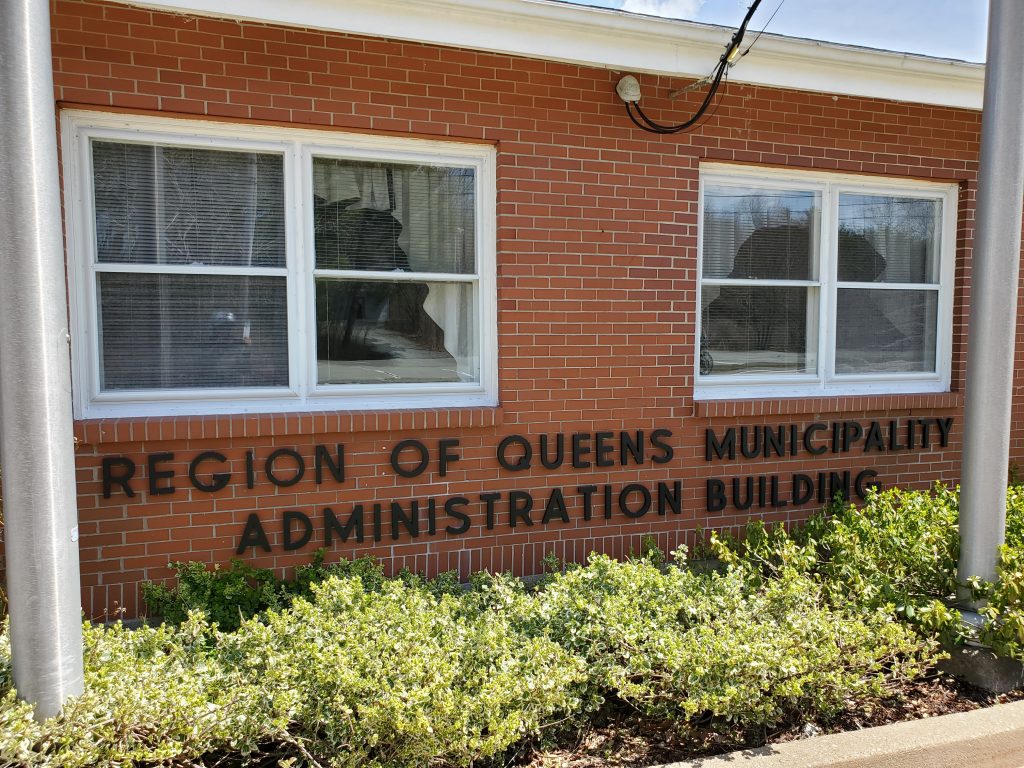
Region of Queens approves $31m budget that adds staff, helps low-income residents

Dan McDougall, interim CAO of the Region of Queens, and Mayor Scott Christian on Tuesday as councillors voted on their 2025/26 budget. (Region of Queens YouTube channel)

Region of Queens councillors approved a $31-million budget on Tuesday that held the line on tax rates while boosting support for people on low incomes.

The 2025-26 spending plan of $31.1 million is about $1.3 million higher than last year.

Councillors also approved a five-year, $46.2-million capital investment plan. That includes projects like the South Queens outdoor pool and the multimillion-dollar upgrades and extensions to water and sewer systems in Liverpool.

Mayor Scott Christian said it was a challenging process, but he’s happy with what this council helped accomplish in their first budget since the 2024 municipal election.

The municipality will add new staff positions that they say will help increase the region’s effectiveness. Those include a new human resources manager, a deputy chief administrative officer and a person dedicated to looking for funding opportunities for the region and non-profit groups. They’ve also made the senior safety co-ordinator a municipal employee.

“It’s frustrating because we have so much that we want to do outwardly in the community, but it’s challenging when you need to address this stuff inside the organization first,” Christian said after the meeting.

“I think that the approach was looking at what’s important, what’s a priority for us, and what improvements to the organization are required and then working from there.”

Councillors were helped again by rising property assessments, which increased by about $87 million, and generated $900,000 more in tax revenue.

That gave councillors room to raise the low-income tax exemption rebate by about 25 per cent. Those who qualify can now get up to a $500 discount on their property taxes.

They’ve also set up a $15,000 fund to help low-income water ratepayers deal with expected hikes.

And community groups are also getting more than $50,000 in extra help, including an annual rent subsidy for the Queens County Food Bank, more funding for Queens County Transit’s vehicle replacement fund and more help for Greenfield Recreation’s operations.

“Just recognizing the need, recognizing the affordability, making the changes that we did to the low-income tax piece, carving out money … around the big increase that we’re going to see to the water rate, trying to protect against the impacts of that on low-income households and then making investments like with the the food bank and some of those other groups. I think those are the highlights for me,” Christian said.

Residents on the municipal water and sewer system should brace for a significant jump in their bills in the coming year.

The municipality’s water utility is projecting a deficit of $813,099 for 2025-26, and shortfalls of $708,039 in 2026-27 and $745,280 in 2027-28.

Consultants are reviewing the region’s water rates. The results of that study are expected soon and will be submitted to the province’s Utility and Review Board for approval.

“We do know we are expecting a considerable increase to the water rate,” Christian said. 

“With respect to that north of $800,000 deficit on the utility, … we need to pay down that deficit and then accumulate a bit of a reserve so that when maintenance and repairs need to be performed to the water utility, that there is a reserve to pull from and that we don’t have to take money from the general revenue that’s provided by all taxpayers across the municipality. 
It’s supposed to be the water rate users who pay for the water utility.”

Councillors began their public budget deliberations on April 24. Christian has said that he hopes next year to begin budget talks as early as January, and to involve more public consultations.

Other highlights from the budget:

  • Adding protective services co-ordinator to provide leadership and support for police, fire, emergency management and occupational health and safety
  • Two new water/wastewater operators
  • Creating full-time programmer/aquatics co-ordinator
  • Increased budget for street sweeping and catch basin clearing
  • Grey box site reconfiguration and signage in north Queens
  • South Queens water/wastewater upgrades and Mount Pleasant extension – two kilometres of piped infrastructure to be replaced, eliminating overflows and addressing sea-level rise effects
  • Caledonia wastewater system upgrades
  • Dry hydrant installation
  • Walking track fees waived at Queens Place Emera Centre
  • Floating dock replacement on Henry Hensey Drive
  • Creation of $1-million operating capital project reserve to fund smaller capital projects

Email: rickconradqccr@gmail.com

Listen to the audio version of this story below

Queens County Transit fundraiser ‘huge success’

Queens County Transit says the success of a recent fundraiser will help them keep their vans running. (Rick Conrad)

A recent fundraiser for Queens County Transit roared past all the group’s expectations.

The rural transit charity based in Liverpool held its first major fundraiser last Saturday. They teamed up with the Yuk Yuk’s standup comedy tour for a show at the Astor Theatre.

Gil Johnson, chairman of the Queens County Transit board, said it was a “huge success.”

“We had a good turnout and everybody seemed to enjoy the show and now the end result was is that we made a little over $13,000.”

Organizers were hoping to raise $10,000 from the show and a 50/50 draw. Johnson thanked the sponsors and community for their support. And he credited fellow board member Tara Smith with making it all happen.

Tara Smith has been the driving force behind this fundraiser and if it wouldn’t have been for her, it wouldn’t have happened. She put a team together of volunteers and made this the success that it is, so the rest of us were just along for the ride.”

The service began seven years ago with one used accessible van and a team of volunteers. Its fleet has grown to eight vans, five of which are accessible. It also employs 11 people. Nine of those are drivers.

It’s one of 23 rural transit services in Nova Scotia.

Johnson says the success of the fundraiser shows people appreciate the services that Queens County Transit provides.

“It is now part of the infrastructure of Queens County. That service of moving people, keeping people connected one ride at a time. And people are starting to understand that we are there to serve.”

Johnson says the money raised will go toward their vehicle replacement fund. 

Right now, we have an immediate need to replace one of our older vehicles that’s costing us as much in the garage as it does to get it down the road.”

​​If you need a ride on Queens County Transit, they ask that you contact them at least 24 hours in advance by contacting them at 902-356-2670, by email at info@queenscountytransit.ca or message them on Facebook.

Email: rickconradqccr@gmail.com

Listen to the audio version of this story below

No joke: Queens County Transit leader in reasonable rural rides in Nova Scotia

Donna Croft and Gil Johnson of Queens County Transit in Liverpool are gearing up the group’s Yuk Yuk’s fundraiser at the Astor Theatre on Saturday. (Rick Conrad)

Queens County Transit got on the road seven years ago with one used wheelchair-accessible van catering mostly to seniors in Liverpool.

“When we started out, we had one old used wheelchair-accessible van that we got from over in Clare. And I think it was in the garage more than it was on the road,” says chairman Gil Johnson.

Now, the community organization based in Liverpool provides affordable transportation around Queens County and beyond.

It’s one of 23 rural transit services around Nova Scotia.

The Queens County Transit fleet has grown to eight vans, five of which are accessible. And it employs 11 people, nine of whom are drivers.

Ridership is up too, by almost 30 per cent over the past two years. In 2023/24, the service completed 8,218 trips. About three-quarters of those were for seniors. Ridership so far this year is up by more than 1,000, with only half of overall passengers seniors.

But with increased popularity come increased costs. 

“Without community support we would be dead in the water, we wouldn’t be operating,” Johnson says.

“Seven years ago, Queens County was one of four counties in the province that did not have a transit system. Today, we’re one of the leaders and we’re proud of that and we want to be able to keep going but we can’t do it without funding partners, fundraisers. ”

That’s why Queens County Transit has organized its first major fundraiser at the Astor Theatre for this Saturday, May 3. They’ve teamed up with the Yuk Yuk’s standup comedy tour for a show at the historic theatre at 7:30. 

Comedians Francois Weber, Andrew Evans and Ian Black are set to hit the Astor stage.

“That’s going to be a good event,” Johnson says. “It’s going to be something new. Yuk Yuk’s haven’t been to Liverpool in quite some time.”

They’re also planning a silent auction at the event.

Queens County Transit gets about 35 per cent of its operational funding from the province and some other funding from the Region of Queens. 

That funding and community support are vital so that the service can continue to offer rides to residents at reasonable rates.

A round trip within Liverpool, Brooklyn or Milton costs $10. That goes up to about $15 for longer rides to other areas of the county.

But the service also offers much-needed subsidized rides for medical trips to Queens General Hospital in Liverpool or to Halifax.

Manager Donna Croft says that through funding from the Queens General Hospital Foundation, it can offer a round-trip to an appointment in Halifax for as little as $100. The full cost is usually $160.

“It’s not only the seniors we’re catering to,” Croft says. “We’re catering to all ages. Say a mom with an infant has to go to the city to the IWK and she has no means of getting there or she has to wait for an ambulance to take them through. We have the monies through (the hospital foundation) that we can do that drive for them to get her to the IWK.

“That’s a huge piece of the mandate of community transit, is to be able to get people to those appointments in an affordable fashion because it goes back to our funding partners,” Johnson says. “They’re the ones who help us subsidize those rides. But if you wanted to rent Queens County Transit to go shopping just on your own or to go for a drive, that’s available as well. It wouldn’t be subsidized. It would be fully funded out of pocket.”

Tickets are still available for the Yuk Yuk’s comedy fundraiser through the Astor Theatre box office or Ticketpro.ca.

And if you need a ride on Queens County Transit, they ask that you contact them at least 24 hours in advance by contacting them at 902-356-2670, by email at info@queenscountytransit.ca or message them on Facebook.

Email: rickconradqccr@gmail.com

Listen to an audio version of the story below


Queens County Transit adds vehicles with funding from Ottawa, Nova Scotia

Bill Smyth and Alex Doggett of Queens County Transit with one of the new hybrid SUVs the non-profit society bought with funding from the federal and provincial governments. (Queens County Transit Facebook page)

Queens County Transit has received government funding to expand its fleet and to keep up with the growing demand for its service.

The non-profit based in Liverpool has bought two new hybrid SUVs, thanks to $116,293 in funding from the federal and provincial governments.

Alex Doggett is the chairman of the Queens County Transit Society.

“It came at a very opportune time for us. We were in this condition where we were refusing rides because we didn’t have enough vans and drivers.”

The new vehicles have been on the road since early April, Doggett said. The service now has eight vehicles, five of which are wheelchair-accessible vans.

“By having the two vehicles, we’re able to keep up with most of the requests, not all of them,” he said.  “It’s quite amazing how busy the vans are.”

Queens County Transit gave more than 8,000 rides last year. In April alone, their fleet was out 700 times.

The service has been operating since 2018, when it started with three vehicles. It provides a relatively low-cost transportation option for anyone in Queens County. But it’s become an important resource for seniors and those on low incomes.

The federal government chipped in $93,034 through the Rural Transit Solutions Fund with the Nova Scotia government contributing the remaining 20 per cent, or $23,259.

Kim Masland, Nova Scotia’s public works minister and the MLA for Queens, said at an announcement on Friday that the funding will make a big difference in the community.

“I am so proud to support you. I have never been more proud and humbled to be the MLA for an area that is just growing more and more every day. And the big thing we take away every night is our hearts. The people’s hearts in this community are absolutely incredible and they open them up and do the right thing every day for the people that surround them.”

Doggett said the service survives thanks to government funding like this and support from the community. The Region of Queens municipality also committed $48,500 in funding to the service for this fiscal year.

“What it means is that we didn’t have to go into a fundraising situation, going to the public,” he said. “Where we’re non-profit, it gets very tight at the end of the fiscal year for us and it’s always great to have these types of programs.”

He said the cost of gas has doubled in the past year and maintenance costs have also risen.

“It’s really been quite an undertaking and hopefully it will continue into the future.”

Doggett said Queens County Transit is always looking for new volunteers and board members to help ensure the service thrives for a long time.

“We’re at the point a number of us are seniors and it’s time to get some younger blood in to carry on with this. Some of us are getting to the point where we’re probably going to be stepping down and hopefully get other people to come in and take over.”

The society has its annual general meeting scheduled for June 18 at 10 a.m. at their headquarters at 31 Milton Rd. in Liverpool.

To book a ride with Queens County Transit, call 902-356-2670 or message them through their Facebook page.

Email: rickconradqccr@gmail.com

Listen to the audio version of this story below

Queens County Transit asks for funding boost from region

Queens County Transit has asked the Region of Queens for more funding. (Rick Conrad)

Queens County Transit has asked the Region of Queens for an extra $12,000 in funding for the 2024/25 fiscal year.

The region gave the ride service $38,000 last year.

Queens County Transit launched in 2018. It now has eight vehicles in its fleet, including five accessible vans.

In 2023, they transported 6,729 people over a distance of 218,000 kilometres.

Alex Doggett, chairman of Queens County Transit, appealed to councillors at their Tuesday meeting for a boost in funding. 

He said the service is adding two new vehicles this year to handle increased demand. And with that come extra costs.

“When you’re involved with a community program you don’t want to see it fail. And that is the key thing here that we are working with our board trying to make ends meet and keep it going.”

Councillors agreed to add the request to this year’s budget deliberations. 

Email: rickconradqccr@gmail.com

Community calling on province and feds to help pay for new indoor pool at Queens Place

Exterior of a recreational facility

The fitness room side of Queens Place is a potential site for a new outdoor pool. Photo Ed Halverson

Support for an indoor pool in Queens is growing.

At the Jan 24 Region of Queens Council meeting held in Brooklyn several people stood to say they would like to tie the construction of an indoor pool to the build of a new library.

The Region has received an anonymous donation, alleged to be worth $3 million to be used for the construction of an outdoor pool.

One of the proponents of an indoor pool, Kristopher Snarby says pooling that with the $3 million council has set aside for the new library would give the municipality around $6 million which they could use to leverage matching contributions from provincial and federal levels of government for a total of up to $18 million.

“But maybe they would each cough up $6 million, which does happen for certain projects where they cost share a third, a third, a third. So, part of it was like, why haven’t we even asked those questions?” wonders Snarby. “Why aren’t we rallying to try to get other levels of government to help support these projects?”

Mayor Darlene Norman says she is a huge fan of indoor pools as she put herself through university working at one.

She understands the health benefits and the community’s desire to have such a facility but questions the long-term affordability of operating an indoor pool.

It’s a discussion she had recently with the mayor of the Municipality of the District of Lunenburg about their own pool, the Lunenburg County Lifestyle Centre (LCLC) which they operate in partnership with the Town of Bridgewater.

Mayor Norman says as Nova Scotia looks to double its population over the next 40 years the move will be to regionalize services and with the LCLC, Queens has access to a pool 35 minutes up the road.

“We should be helping support the LCLC,” said Norman. “And I believe that as a regional government what we could do is we could talk with Queens County Transit, we could talk with the LCLC, we could see if we could offer subsidized to say swimming lessons and transportation throughout the winter months.”

Snarby says he understands the Region has a couple of million dollars set aside to assist in the development of the outdoor pool and that money could be the start of an ongoing fund to mitigate long-term operational losses.

“And my point was like, if we can fund the building through the federal and provincial government, take that two and a half million dollars to start an operating nest egg and then start building this fund in the next four to five years, which is probably how long it would take to build the facility,” said Snarby.

He is aware assessed home values are going up over the next couple of years which will mean increased revenue for the municipality.

Snarby suggests shifting some of that excess to the operating fund then combing the community to try and raise another $4-5 million while construction takes place over the next few years.

But it’s talk like that that raises concerns for Norman around how long it could take to see a combined indoor pool/library built.

It’s widely acknowledged the existing Milton pool is on its last legs and the Rossignol Centre which houses the Thomas Raddall Library is up for sale, putting the library’s future in jeopardy as well.

Norman is concerned any delay in the construction of either a new library or outdoor pool could leave the area without either service.

“It is my viewpoint that the longer we drag on this the longer we will be without pool facilities and the people in this county, the 10,000 people in this county cannot afford to own and operate a large indoor year-round pool,” said Norman.

Snarby says while the area could be without a pool for a short time, it could be worth it if the community gets the indoor pool they’ve been talking about for the last 40 years.

“Do you rush and say afterwards, oh shoot, we should have done it differently or do you wait and do it right and I don’t know the answer to that,” said Snarby. “It’s a question the community has to decide.”

Norman says the Region will speak with the provincial and federal governments to find out if they’re interested in funding an indoor pool.

In the meantime, council will be voting on motions suggested by the outdoor pool committee at upcoming meeting.

E-mail: edhalversonnews@gmail.com
Twitter: @edwardhalverson

To listen to the broadcast of this story, press play below.

Queens County Transit keeping fares down thanks to government funding

A group of people standing in front of transit vans

Queens MLA Kim Masland with members and users of Queens County Transit. Photo Ed Halverson

Queens County Transit will not increase their fares despite rising inflation thanks to a one-time funding bump from the federal and provincial governments.

The organization received $46,617 as part of $10.9 million being distributed to transit operators in Nova Scotia.

Chairperson of Queens County Transit Tara Smith says the money couldn’t come at a better time as they’ve just added a sixth vehicle to their fleet.

“We do have a little bit of money there to hold us through during tough times because gas is probably going to go up and down and we have to be ready for that, and we have to still be able to provide our service,” said Smith. “We do have six vehicles now on the road so we’ve had an increase in insurance, increase in tires, our vehicles are on the road constantly so, we were really happy to be able to provide that service but we don’t want it to cost the people of Queens county anymore, so really good news.”

Queens MLA and Public Works Minister Kim Masland made the announcement outside the Queens County Transit office.

As the former Seniors Safety Coordinator with the RCMP, Masland remembers speaking with organizers as they were developing Queens County Transit about how so many people need reliable and affordable transportation .

“I hear daily from constituents within Queens that are sharing their stories with me that they’ve used Queens County transit to take them to their dialysis employments weekly, that they’ve used Queens County transit to take them to medical appointments in Halifax. I’ve heard stories about needing to use Queens County transit to get to the airport to go visit gravely ill relatives,” said Masland. “It just plays such an important role in our community and it’s so valuable and I’m just so proud of where we are with our transit system here in Queens County.”

The federal government is investing $750 million to help municipalities across the country maintain transit service levels as ridership declines due to the pandemic.

To access the funding, provinces had to match the federal contribution in transit investments and support improvements in housing supply.

Of the $10.9 million, the largest operator in the province Halifax Transit received $8.65 million with the remainder divided among 20 community transit operators and seven other fixed-route operators.

The funding was distributed based on overall transit ridership, but the province was permitted some discretion so that all operators received a nominal amount.

Smith says during the height of the pandemic they had to reduce the number of people travelling in a vehicle but since people have become more comfortable living with COVID-19 Queens County Transit has seen their ridership increase dramatically.

“In March of this year, we were pleased to see that our ridership reached 5,000 people, 5,000 rides within our last year, so that’s great,” said Smith. “When we had talked about our projection over the course of our future in Queens County, we had looked at 10 years we would have a ridership of 5,000 people and you know, we did that in one year.”

From humble beginnings around a table as an idea in 2018 Queens County Transit now has six vehicles including what Smith believes to be the first hybrid gas/electric wheelchair accessible vehicle in a transit fleet in Nova Scotia.

Smith is pleased that in such a short span of time, Queens has gone from the last county in Nova Scotia without transit to one with a reliable and supported transit organization that will continue to grow to meet the needs of its residents.

E-mail: edhalversonnews@gmail.com
Twitter: @edwardhalverson

To listen to the broadcast of this story, press play below.

Safe Re-start money throws municipalities a lifeline

Region of Queens administration building

The Region of Queens is getting help from two levels of government with their bottom line.

The federally funded Nova Scotia Safe Re-start program is putting $590,735 into municipal coffers.

Mayor Darlene Norman said the funding is welcome as COVID-19 has upset this year’s budget plans.

“The bulk of the money will be going on the bottom line of this year’s budget in order to meet that projected budget,” said Norman.

The pandemic forced the region to stop operating many of the programs and facilities that make money including closing Queens Place for several months.

“There was no fitness memberships, there was no ice rentals, there were conferences that would’ve been booked there, so that’s lost revenue,” said Norman. “This money will help cover that lost revenue.”

The region estimates losses at Queens Place will be in the neighbourhood of $300,000 this year.

That number could go up as, since this funding was announced, another source of revenue for Queens Place has been shelved. The province has banned sports teams from travelling to and from Halifax. With many of their players coming from the city, the Liverpoool Privateers hockey games have been cancelled for now and with them goes the money that comes along with game nights.

According to Norman, Queens Place has never been profitable but the Region backstops the losses as part of the common good the facility brings to the community.

“Municipalities build these facilities for the social enjoyment, the physical enjoyment of people, to stimulate economic growth in your county, that’s what those are built for,” said Norman.

The Safe Re-start funding will also do some good in the community. As a condition of the funding, the province insisted a portion had to support local transit.

Queens County Transit is the beneficiary of that condition and will receive $27,674.

Another stipulation will see $2020 divided equally between the Nova Scotia Federation of Municipalities and the Association of Municipal Administrators. The two groups represent municipal interests to the provincial government and have also been unable to hold conferences, which would provide their funding, during the pandemic.

Norman said historically, the Region of Queens has a strong record of managing their finances and meeting their responsibility to the province to produce balanced budgets.

So much so, that even without this funding the municipality would have been okay.

“We would pay our bills. There’s no question of that,” said Norman. “Taking from reserves to meet that would probably be, I’m going to say the first time since amalgamation that that would have ever happened.””

Norman said the Safe Re-start funding should keep the region from dipping into their savings.

Reported by Ed Halverson 
E-mail: edhalversonnews@gmail.com
Twitter: @edwardhalverson