COVID-19 immunization clinic setting up. Photo: Nova Scotia Government
Nova Scotians at the highest risk for severe illness from Covid-19 can now book their spring dose.
The booster will be available from March 25 to May 31.
The groups eligible to book right now are those 65 or older, people 18 or over in long-term care, nursing homes or residential care facilities; people who are moderately or severely immunocompromised and those 50 or older who are indigenous or black.
Dr. Robert Strang said in a news release that cases are steady in Nova Scotia. But he urged people at the highest risk of infection to get their spring booster.
People who did not get a dose in the fall or winter can get the spring dose, even if they are not part of the specific groups mentioned.
Queens County residents who haven’t received their latest COVID booster or influenza vaccine will get another shot at it on Tuesday.
Nova Scotia Health is organizing a COVID-19 and influenza immunization clinic at Queens Place Emera Centre on Jan. 9, from 11:30 a.m. to 5 p.m.
The public health mobile unit will be offering the following vaccines: COVID-19 Moderna XBB.1.5, the influenza vaccine for people from 6 months to 64 years old and the high-dose influenza shot for those 65 and over.
Officials are encouraging people to book their appointments ahead of time, though some limited drop-ins may be available.
COVID-19 rapid test kits will also be available.
According to Nova Scotia’s online vaccine booking page, the next available appointments in the Liverpool area after Tuesday are on Jan. 16.
Public Health officials have urged Nova Scotians to make sure they are up to date on their vaccinations, as COVID-19 and other respiratory viruses are still hospitalizing people across the country.
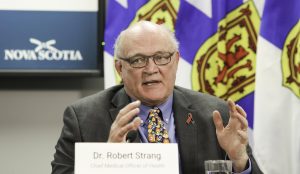
Dr. Robert Strang speaks at COVID briefing February 23, 2022. Photo Communications Nova Scotia
Nova Scotia has announced the availability of new COVID-19 and influenza vaccines.
Chief Medical Officer of Health Dr. Robert Strang provided details about the rollout at a press conference Tuesday.
Nova Scotians aged 65 and older can get the high-dose influenza vaccine now. All Nova Scotians will have access to Moderna’s updated COVID-19 vaccine during the week of October 16. The standard-dose influenza vaccine is arriving in the province the week of October 23 and Pfizer’s updated COVID-19 vaccine will be available sometime in late October or early November.
The high-dose flu vaccine will be available at local pharmacies and medical clinics across the province starting this week.
Strang emphasized the importance of vaccination, stating, “This fall, we encourage everyone to roll up their sleeves and get both recommended vaccines to protect their health. It’s the best way to limit the spread of both influenza and COVID-19.”
The province is advising Nova Scotians that they can receive both flu and COVID vaccines at the same time. Anyone wishing to receive a vaccine can do so at a nearby pharmacy or outreach clinic by signing up online at Nova Scotia Immunization. Alternatively, people can book their shots through their family doctors or nurse practitioners.
Nova Scotia Health is reminding people that vaccines do not cause influenza or COVID-19 and that symptoms for both illnesses can overlap, including fever, headache, and fatigue.
Anyone who has already received their primary series of COVID-19 vaccines are eligible for an updated dose if six months have passed since their last vaccination or known COVID-19 infection. And officials are recommending children aged six months to nine years should receive two doses of the influenza vaccine four weeks apart this fall if they have never been vaccinated before.
Health authorities are urging all Nova Scotians to prioritize their health by getting vaccinated against both influenza and COVID-19 to protect themselves, their loved ones, and their communities.
To hear the broadcast of this story click play below.
Nova Scotia Health is reminding people that COVID-19, influenza, and RSV are still active and must be considered when visiting loved ones this holiday season.
In a release, they say masks must be worn at all times in all provincial health facilities and the number of visitors patients can have will depend on where they are being treated and what they are being treated for.
Only people identified by a patient as an essential care partner (support person, caregiver) can visit a patient in hospital.
Only one Essential Care Partner/ Support Person at a time for:
children and youth under 19 in outpatient settings
hospital inpatients
patients in emergency departments
prenatal visits, including ultrasounds
ambulatory care clinics, appointments, or procedures
patients with COVID-19 infection (additional measures may be required)
Two Essential Care Partners/ Support Persons at a time for:
children and youth under 19 admitted to hospital, or having day surgery
patients in intensive care units and critically ill patients in emergency departments
patients in labour and giving birth
Three Essential Care Partners/Support Persons at a time for:
palliative care and other patients nearing end of life
patients receiving medical assistance in dying (MAiD)
In a release, Nova Scotia Health says people with compromised immune systems are relying on the facilities to ensure a safe and healthy place in which to receive treatment, rest and recover.
And that health care workers take precautions every day to prevent getting sick or passing illness onto patients.
Nova Scotia Health asks when visiting loved ones under provincial care this holiday season to bear in mind that general masking requirements create a healthier environment, reducing the strain on care teams, and the health care system as a whole.
Liverpool Regional High School. Photo credit Ed Halverson
Supporters of Liverpool Regional High School graduates will continue to do so online this year.
For close to 25 years, organizers have held a dinner and auction to raise money for the LRHS scholarship fund.
Each year, the fund distributes around 20 $1,000 awards to roughly a third of the graduating class in support of their post-secondary schooling.
Fundraising efforts moved to an online auction when the COVID-19 pandemic hit in 2020, cancelling the in-person dinner.
Fundraising committee member Kim McPhail says uncertainty surrounding how lifting COVID restrictions would impact the live event made staying online the most viable option this year.
“We just kind of had to say, okay, we don’t know what’s going to happen in the future. We’re going to have to do the online one to make sure that we can provide the kids with the best option we can,” said McPhail.
Instead of serving patrons dinner as they normally would, 40 student volunteers are headed into the community to ask residents and businesses to donate items to be auctioned off.
So far, those items include donations of everything from gift certificates to a load of gravel ranging in value from $25 up to $500.
McPhail doesn’t know how many items will be up for auction as donations are still pouring in but says bidding opens for each item in a block at 8:00am and closes at 8:00pm three days later.
She says the auction will end May 31 so the money raised can be turned over to the LRHS Scholarship Foundation by June 1.
McPhail says the group has set a goal of raising $22,000 this year.
“It’s a big goal but we do have a lot of community support.”
Since the auction began 24 years ago, the LRHS Foundation has awarded almost half a million dollars to over 400 students.
Parents are upset schools are not telling them about COVID in classrooms.
As public health moves away from contact tracing, parents must rely on each other to find out if their kids have been exposed in schools.
One of those parents is Matthew Verge whose two stepchildren aged seven and eight attend Centre Scolaire du la Rive Sud in Cookville.
Verge became concerned when he learned one of his children’s close friends contracted COVID but no one from the school let his family know.
“We not only didn’t receive a notification that there was a case,” said Verge. “We didn’t receive a notification that we wouldn’t be receiving notifications.”
Verge says the school community is tight and parents do a good job of informing each other what is happening in classes but argues it shouldn’t be up to parents to contact each other about a potentially serious illness.
“I think it’s doubtful that a parent would end up just simply not knowing that there was a COVID case because there’s such a strong network. But that said, it’s not their responsibility,” said Verge. “And frankly, you could be the most involved parent that you could possibly be and you still wouldn’t have every contact information of every person.”
Verge’s concern is echoed across Nova Scotia.
Stacey Rudderham speaks for Nova Scotia Parents for Public Education, a Facebook group of over 20,000 parents from all over the province.
Her members are angry that school administrators are ordered not to share information about COVID cases in their schools with parents.
Rudderham understands the need to protect people’s privacy but says if a parent is willing to come forward and reveal their child has COVID to prevent classmates from contracting or spreading the virus, school officials should be allowed to get that message out to other parents.
“The message would be clear and it would be correct and people would feel like they were being informed. That’s the big thing,” said Rudderham. “We know from lots of experience that parents just; they want to be informed.”
Verge says that information is important for families to have when dealing with immunocompromised relatives.
“Do we not send them to school, do they never see their grandmother, do we risk the kids getting COVID themselves? Supposedly it’s okay with kids, but it’s not always. I don’t see why it’s such a big deal to just tell us,” said Verge.
No one from Public Health or the Department of Education and Early Childhood Development replied for a request to comment on whether the policy preventing administrators from contacting parents would be reviewed.
Dr. Robert Strang. Photo Communications Nova Scotia
The province’s top doctor says staff and students are welcome to share their COVID status, but schools won’t aid in getting the word out.
Dr. Robert Strang says the omicron variant is so widespread that there is little value in providing contract tracing.
“The risks of relying on being notified and then the false assumption that if you’re not notified, you’re somehow not at risk just don’t work anymore with the widespread of omicron,” said Strang.
While he recognizes the change is a significant psychological shift that will cause anxiety for some staff and parents, Strang says previous attempts at contact tracing have shown they may cause more harm than good.
“What we learned when we were doing this close contact tracing in November and December, particularly, was that doing that close contact tracing and then the subsequent isolation of people who were identified classroom contacts was incredibly disruptive to our school system and to families. So, we’re not going to be isolating people anymore.”
During Wednesday’s COVID briefing, Strang was asked why school officials have been told they are not permitted to share COVID cases.
Strang says it’s up to individual parents and teachers if they want to share their own personal information and schools would not distribute that information to protect the privacy of the people involved.
But he insisted reports of school officials being told not to share information is untrue.
“In fact, that is misinformation that’s been put out there by various groups that there’s somehow a ban or a gag order. That’s not true,” said Strang. “However, the school system and individual teachers need to be aware that there’s legislation that governs how somebody else’s personal health information is actually disclosed.”
Strang was provided with a copy of a letter issued to parents by a principal in which the principal says they have been specifically told they are not permitted to share COVID information with the school community.
Strang responded that is not the message that has come out of discussions he has had with education officials over the past few days.
“That has been clarified and that is not actually the appropriate phrasing and language that has been most recently shared with school administration.”
How the message has been clarified was not identified as the update was cut off abruptly following Dr. Strang’s response.
A series of follow up correspondence with the South Shore Regional Centre for Education, the Department of Education and Early Childhood Development and the Department of Health and Wellness all confirm the information provided by the principal was accurate.
The official policy from the education department echoes earlier comments from Dr. Strang that teachers and parents are free to share their own personal COVID information if they choose, but school administration will not make that information public.
The latest COVID numbers from public health show three more Nova Scotians have died, 11 people have been admitted to hospital and five have been discharged.
Strang says while public health is moving away from rigorous contact tracing, how people prevent the spread of COVID-19 remains the same.“The message for everybody is get vaccinated, follow all the personal protective measures, especially and if you’re sick with new cold and flu-like symptoms stay home,” said Strang. “That message doesn’t change just because somebody has been a close contact.”
Public health officials are asking Nova Scotians to change their COVID-19 testing habits.
At Wednesday’s COVID-19 briefing, Premier Tim Houston acknowledged Nova Scotian’s commitment to testing is the envy of public health officials across the country.
“To be totally honest, I’ve been a regular for months at either stopping at a clinic for a PCR or a rapid test at home. It’s always been something I’ve been doing during the pandemic, and it’s always provided a great deal of comfort. So, I get it,” said Houston. “I get that the change is difficult, but we have to start moving away from the way we’ve been testing.”
Houston says approximately 830,000 tests are distributed across Nova Scotia each week.
The province has ordered 2 million tests above the amount they receive from the federal government, but like the rest of the provinces they’re waiting on supply to arrive.
The province’s chief medical officer of health Dr. Robert Strang says before anyone can get a PCR or rapid test, they need to do the self-assessment online.
“This is the reality of dealing with limited supply and while you may not be happy about this, we all need you to understand and accept that others may need to be a higher priority than ourselves,” said Strang. “ Please do not get angry at frontline staff or try and find a workaround. Put others ahead of yourself and be kind to those who have been caring for you for over the past two years. They deserve nothing less than this.”
Public health announced 12 new hospital admissions and seven discharges Wednesday.
They also reported a woman in her 60s from the Western Zone has died.
Strang says Nova Scotians should be confident that vaccines are working.
While people are still dying from the virus, Strang says vaccines are preventing serious illness in most.
In a release, Nova Scotia Health said there are currently 600 staff and physicians off work due to COVID-19 infections, or self-isolate requirements.
As a result, only urgent and emergent surgeries, including time sensitive cancer surgeries, will be performed at this time
Strang says the omicron virus has seriously impacted the ability of hospitals to maintain staffing levels.
“There’s no doubt we are in a very serious situation. The most serious we’ve been in during this entire pandemic, given all the pressures on our health care system,” said Strang. “This is different than other waves. We’ve never before had hundreds of healthcare workers not able to work or so many cases that public health is no longer able to identify and closely manage each case and all their contacts.”
Strang urges everyone to reduce their contacts and follow the masking and social distancing requirements to keep themselves and the people around them safe.
Christmas holidays are over for students across Nova Scotia as they return to online classes Monday.
The measures will last a week, giving schools and public health officials time to prepare the buildings, students, and staff for a safe return during the omicron outbreak.
Regional Director at South Shore Regional Centre for Education Paul Ash says the move to online learning will be very familiar to the school community.
“This isn’t new territory for us. We’ve learned a lot over the last two years in terms of online learning and other ways of engaging our students when they’re not in classrooms,” said Ash. “Obviously, we still believe that schools are safe and they’re the best place for our students to be.”
Getting fresh air into classrooms in some schools across the province has been a struggle.
Some buildings do not have mechanical ventilation systems and must rely on natural ventilation, in other words, opening a window.
North Queens Community School in Caledonia is one of eight schools across the region which will install HEPA filters to improve the air quality.
The province has also said 3-ply masks will be made available to students upon their return to in-class learning.
Ash says students and staff in this region have always had access to three-ply masks.
“Those are the masks that are available to our students in our schools right now. At the outset [we] made sure we had more than enough masks available. We have masks available, and they continue to be available to any students and staff that would like those,” said Ash.
SSRCE Executive Director Paul Ash. Photo Ed Halverson
The province also announced test kits will be distributed to schools once they’ve been received from the federal government.
Parents have raised concerns about communication from the schools, in particular, how they will be notified if a classmate has contracted COVID.
Ash says schools will follow the lead of public health regarding how and when those notifications will be made.
“So, we’re part of a mechanism. We don’t make those decisions and I’d be a little concerned being the person to say this is what I think they should do when really, they’ve done such a great job,” said Ash. “Our role is to implement the directives, not actually to create those. So, we’re part of those conversations but at the end of the day, we take the advice of public health and implement as directed.”
He says discussions will take place with public health over the next week so students, staff and parents will know exactly how they are to be notified of COVID cases in schools.
Ash praised families and staff for their hard work and sacrifice to keep COVID cases in regional schools low since the start of the pandemic.
“I do want to thank members of the community in South Shore for their fantastic work over the last couple of years that has allowed us to continue to work with our students in such a positive way.”
Astor Theatre, Liverpool, Nova Scotia. Photo Credit: Ed Halverson
Astor Theatre management was hoping for a better start to 2022.
The popular Liverpool theatre has been effectively closed since the province announced restrictions just before Christmas to limit the spread of the omicron variant.
General Manager Jean Robinson-Dexter says safety measures such as checking for vaccination, masking, and having ushers escort patrons directly to their seats encouraged a good turnout at many of the shows before they were shut down.
“People told us that they felt safe, they felt welcome and so we will just continue to do that once we’re able to welcome folks back here,” said Robinson-Dexter.
The province announced those restrictions have been extended until the end of January and Robinson-Dexter is still unsure what will happen after that.
She’s been reaching out to promoters and performers scheduled to play in February to decide if they will go ahead with their dates with the risk of more potential restrictions cancelling those shows as well.
“We’re just, kind of in wait and see, hoping that we can reopen and I’m not expecting that it’s going to be at full capacity for a while.”
Astor theatre interior. Photo Ed Halverson
Opening for 50 to 100 people is not economically viable for the theatre or performers according to Robinson-Dexter.
She hopes the community understands that leaves the theatre in a precarious position.
The Astor receives annual grants to help cover some of the operating costs and the federal and provincial governments have come forward with more money to help the theatre weather the pandemic.
But it takes funding from multiple sources, including fundraising and ticket sales to keep the Astor afloat.
Robinson-Dexter says the theatre has just wrapped its annual December donation campaign, but she hasn’t seen the totals yet.
She looks forward to reopening the Astor as soon pandemic conditions permit because the theatre is more to the community than entertainment.
“And it’s so important for people, both, I think, for social connection, to get folks out in the community, seeing friends again, and just for their mental health and well-being,” said Robinson-Dexter. “Music can fill you up.”
The MLA for Queens sat down with reporter Ed Halverson just before Christmas to discuss a busy 2021.
Kim Masland was re-elected and moved to the government side of the legislature when the PC’s won a majority, was appointed Minister of Public Works and government house leader shortly afterwards and contracted COVID-19 .
The interview is broken into four parts.
In part one, Masland discusses the quick learning curve when forming government.
Another challenge for Masland was contracting COVID, discussed in the second part of the interview.
Healthcare and long term care were hot button topics on the doorstep during the election campaign. The PCs promised to fix the system and Masland describes how her party is working to do so.
The interview wraps up with issues Masland is working to address in Queens including resolving long-standing concerns at Carter’s Beach and the affordable housing crisis.
Students across Nova Scotia will enjoy an even longer December holiday as the province announced the break will start Friday instead of next Tuesday the 21.
Minister of Education and Early Childhood Development Becky Druhan says the decision was not based on public health direction but is designed to relieve staffing pressures.
“We’re very grateful and pleased that Nova Scotians are following the public health directions to self-isolate when they’re close contacts. But some of those people are people who are in the school system and that means they’re unavailable to come in to teach, to support the school or to drive buses, if those are their roles. So, as a result of the numbers of people who are on self-isolation due to being close contacts, there are challenges with operating school,” said Druhan.
The department announced just last week that students would return to class two days later than planned, on January 6.
The reasoning was to allow families to monitor students for COVID-19 before they return to school, for public health to assess COVID-19 in the province, and staff to undertake further professional development to support their teaching, while also allowing more time for families to book vaccination appointments for their children.
Druhan says the extra time will allow public health officials to make the best plans for a safe return to school.
“One of the reasons for that is about giving public health some additional time to be able to make a determination about the epidemiology and what the situation is and to ensure we have that time to have really good decisions around what measures need to be in place coming back.,” said Druhan. “And so public health will be taking the time over the holidays to make those assessments. We’ll be working very closely with them to make sure that whatever new measures need to be in place when we come back in January are ready to go.”
The announcement to extend the school break comes as the province reports 178 new cases of coronavirus.
In a release issued Wednesday, Kim Masland confirms the diagnosis and says she is unsure how she may have picked it up.
Masland who is also minister of Public Works and House Leader, says she is fully vaccinated and is tested regularly, most recently on Remembrance Day.
She began to feel unwell Sunday and was tested Monday.
The Queens MLA was scheduled to attend the official opening of the new infant care centre at Queens Daycare Tuesday but cancelled as a precaution.
Masland received the positive test result Wednesday morning.
In her statement Masland says, “This shows how contagious this virus is and how important it is to be vaccinated and follow public health measures. I am not feeling well, but thankfully my symptoms are mild and I know that the vaccine is preventing me from becoming seriously ill.”
She expressed concerns for those with whom she has recently been in contact.
Masland says this is a reminder that COVID-19 is still with us and it is critical to continue to follow public health protocols.
She urged people to continue to get vaccinated and to stay home if they are feeling unwell.
Masland says she will continue to work with public health and requests privacy as she recovers.
Her office remains open to address constituent concerns.
A jubilant mood outside Queens Place as proud parents, grandparents and members of the community gathered to celebrate the 2021 Liverpool Regional High School graduates.
For the second year in a row, the LRHS community had to find another way to acknowledge graduates as pandemic restrictions have forced the cancellation of traditional proms, safe grads and public graduation ceremonies.
Deborah Raddall says she and her fellow organizers simply followed the plan parents laid out last year.
Students were permitted to be seated six feet apart in front of Queens Place while their loved ones drove past to acknowledge their accomplishments.
Deborah Raddall looks on as the community rolls by in a drive-thru graduation celebration. Photo Ed Halverson
“It’s a simple concept,” said Raddall. “We didn’t ask for more than they were prepared to give and I think that’s really why we got the okay. It was a reasonable, well, thought-out plan, safety was the primary thing.”
Graduate Jamie Dunn is one of many students who appreciates the efforts so many put in to give them a public celebration.
LRHS Graduate Jamie Dunn. Photo Ed Halverson
“It’s really nice that we have classmates with really caring parents that could organize this for us,” said Dunn. “I’m really grateful that everyone is here tonight, together.”
Parent Todd Wilms was on hand to cheer on his daughter Piper. He was glad to see so many people come out to celebrate the graduates.
“This is the epitome of a small community getting together, despite the circumstances here now with the pandemic. Wonderful,” said Wilms.
The excitement of the evening was tempered for some. Graduate Chris Bowers says he appreciates the effort but is a bit disappointed the pandemic has prevented students celebrating the end of their time together in a more traditional way.
“It’s not as exciting as I thought it would be but it’s better than nothing,” said Bowers.
LRHS Graduate Chris Bowers. Photo Ed Halverson
When asked what he was hoping for, Bowers responded, “More together, more than just an hour with everyone. Safe grad is what I’m going to miss the most, not having that.”
Volunteers from Queens County Search and Rescue directed traffic as car after car, loaded with supporters, circled Queens Place several times, honking horns, waving signs and blowing bubbles.
Raddall’s daughter Ellen is among the 2021 graduating class. She was impressed with the turnout from the community and the resilience shown by her fellow graduates.
LRHS Graduate Ellen Raddall. Photo Ed Halverson
“It’s so incredible to see so many people out here today and seeing people who have driven from Bridgewater, like our teachers, just to come and celebrate us. It kind of makes up for the lack of grad we get because of COVID. It really didn’t crack our spirit at all,” said Raddall.
Ellen’s mom Deborah says the support from the community and the turnout really made all the effort worthwhile.
“It’s more than I envisioned. It’s so exciting. I’m trying to hold myself together from having lots of tears, you know, momma tears but it’s excellent,” said Raddall. “The kids are all excited. We’re across the parking lot and you can see them grinning from ear-to ear.”
The province has announced further easing of COVID restrictions in Nova Scotia.
Beginning Wednesday, malls, retail operations and fitness centres can once again operate at 100 percent capacity so long as people are social distancing.
And anyone arriving from Newfoundland and Labrador will no longer need to self-isolate for 14 days.
The province will also ease up on restrictions for sports practices, training and games, and arts and culture rehearsals and performances to allow 75 people to participate.
Spectators will continue to be permitted at those activities except at schools.
Restrictions will remain in place for other parts of the service industry.
Nova Scotia’s chief medical officer of health Dr. Robert Strang says after recently extending opening hours to 11:00pm the soonest he will look at easing restrictions for bars and restaurants will be the summer.
Strang says those restrictions can be credited for helping the province avoid the spread of the COVID variants that has plagued other parts of Canada.
“I have to ask myself why. Is it just because we’re lucky? I don’t think so. I think it’s also because we have adhered to, even with very safe epidemiology, we’re still hanging onto these public health protocols, the restrictions, and Nova Scotians are following them,” said Strang.
He says it would be premature to look at relaxing those measures while the COVID variants are all around us.
“I’m very nervous about the next couple of months and we’re not going to relax something beyond where we consider it safe to do that while we are looking at how the variant is playing around in other parts of Canada.”
Strang says Nova Scotians still need to be careful about socializing in groups whether it is in their homes or in public.
The changes are being made as the province announces six new cases of COVID-19.
Premier Iain Rankin says the pace of vaccination in Nova Scotia continues to ramp up as supply increases with almost 10,000 receiving their immunization from Thursday through Monday.
Rankin says this weekend’s vaccination efforts only paused for Easter Sunday and he’s grateful to the workers who are making this possible.
“Thank you to everyone who was working or came out to get vaccinated,” said Rankin. “We are not slowing down. In fact, this week we’ll have 47 pharmacies operating with the Pfizer and Moderna vaccines and I’m pleased to say, all appointments are booked.”
Rankin says that equates to another 40,000 vaccinations this week.
To date, over 116,000 doses of vaccine have been administered in the province and almost 30,000 Nova Scotians have received their second shot.
Dr. Robert Strang. Photo Government of Nova Scotia
Nova Scotians may not have to endure the stricter COVID conditions announced last week for as long as previously announced.
The province’s chief medical officer of health Dr. Robert Strang says the fact new case counts have stayed in the low single digits for the past several days may allow restrictions to be eased.
“If the pattern continues that we’re seeing, we may be in a position to lift restrictions much earlier than March 26. I know that will be welcome news,” said Strang.
The one new case of COVID-19 being reported in the Northern zone is a close contact of a previously announced case.
Strang said public health will continue to examine the epidemiology and will have more to say on the subject at Friday’s briefing.
Strang also addressed comments he’s heard questioning why the restrictions were put in place for some activities but not others. He’s concerned people are trying to compare two things that are not comparable.
“There is a science on how the virus is transmitted. Players at hockey games or other sports are not masked and they’re making contact with other players on the ice. There’s no physical distancing,” said Strang. “At an arcade, people are wearing masks, they’re staying physically distanced, they’re handwashing and equipment is frequently cleaned. So the reality is that this is a much safer environment than playing hockey or other sports.”
The chief medical officer said making recommendations to government to limit activities and place restrictions on businesses is something he doesn’t take lightly.
“I’m fully aware of whether it’s limiting hours in restaurants, reducing opportunities for sport or theatre activities, I’m fully aware of what that means to people, so it’s not easy,” said Strang. “But I’m also fully aware of what happens when you allow COVID-19 to spread widely in a community.”
Strang said when it comes to the pandemic; he is always going to err on the side of caution.
“I’d much rather have to come forward and say we acted early and nothing happened and then look at how we can relax, perhaps earlier than we thought and explain that, rather than to sit here and explain why we didn’t act when we should have and have significant spread of the illness and all the impacts that will have,” said Strang.
Premier Iain Rankin also announced support is coming for some small businesses.
Premier Iain Rankin. Photo credit Government of Nova Scotia
A $7 million rebate program launched today will provide service sector owners a one-time rebate of a portion of their paid property taxes.
Nearly 3,300 businesses are eligible, including dine-in restaurants and drinking establishments; gym and fitness establishments; hair salons and barber shops, spas, nail salons and body art establishments.
Rankin said he understands the sacrifices being made by restaurants and many other small businesses and hopes Nova Scotians can follow their lead.
“They have stepped up and continue to do so,” said Rankin. “ I’m sure you’ve all read the reports of some pubs deciding not to open, for example, on St. Patrick’s Day. Obviously a tough decision but one that speaks volumes about our business owners being leaders and helping to contain the spread of the virus.”
Public health officials are warning Nova Scotians not to think we’re out of the woods with the coronavirus.
The province’s chief medical officer of health Dr. Robert Strang says people are becoming complacent around social distancing and other measures to prevent the spread of COVID-19.
“Even though we talk about a pandemic, we’re acting like we’re not in a pandemic in Nova Scotia. That’s important that we remind ourselves we need to be cautious. I recognize that COVID fatigue is real,” said Strang. “We’ve been at this for almost a year but as tired as everyone is, public health measures are as important now as they were last March and April.”
Three new cases of the coronavirus are being reported bringing the total number of active cases to 21.
Strang cautioned people to keep their socializing and social circles to a minimum.
“We need people to slow down for the next two to three months,” said Strang. “We need to still stay very focused on limiting our social activities, limiting the number of people, ideally [to] only a single social group of 10.”
Strang says the province expects to receive 14,700 doses of vaccine this week and vaccine deliveries are back on track to meet targets that were expected when deliveries were first announced.
“Vaccine supply is expected to be steady with weekly shipments of at least 10,000 doses of the Pfizer vaccine until the end of March,” said Strang. “Meaning that we are on target to meet the outcomes for the first 90 days of our vaccine strategy.”
Strang says he’s heard requests for Nova Scotia to develop a vaccine passport to allow those that have been inoculated to be exempt from some of the COVID protocols. He says the province will not be issuing proof of immunization cards or vaccine passports until more is known about the effectiveness of the vaccines.
“We know that they’re very effective against preventing clinical and symptomatic illness but we don’t know yet whether they prevent asymptomatic transmission.”
Premier Stephen McNeil. Photo Nova Scotia Government
Friday marked the final time Premier Stephen McNeil would provide a COVID update to Nova Scotians.
McNeil noted the milestone was significant as it was the 100th time he and the province’s chief medical officer Dr. Robert Strang appeared together to give the latest update on the pandemic and vaccinations.
The premier was asked to reflect on the last eleven months and if there is anything he would like to have done differently.
McNeil said it was important for officials to recognize what they didn’t know about the virus, such as the asymptomatic transmission but overall, was proud of the response by Nova Scotians.
“When we started early on, there were so many unknowns for us. That’s why we acted very quickly and aggressively in shutting down parts of our economy. I think those decisions early on, with the acknowledgement of what we didn’t know, allowed us to be in a position where good parts of our economy are functioning as long as people continue to follow the public health protocols,” said McNeil.
Dr. Strang announced new precautions for travellers from Newfoundland who aren’t required to self-isolate such as long-haul truckers.
Beginning Sunday, COVID-19 testing will be mandatory for anyone arriving by ferry.
Strang also unveiled the locations of 10 community based vaccination clinics, which will be rolled out beginning March 8 in Halifax, New Minas, Sydney and Truro.
Residents of the South Shore will wait to rollup their sleeves until March 22 when a clinic will be opened in Bridgewater.
Seniors 80 years of age and older are the first eligible to receive the injection. MSI will contact those selected by letter to book an appointment.
The province is reporting two new cases of COVID-19, one in the Eastern and one in the Central zone to bring the total to 15 active cases in Nova Scotia.
McNeil said getting to know Dr. Strang was something good that came out of this pandemic.
“Good male role-models are hard to find and last March I found one. He’s an extraordinary Nova Scotian who I think, all of us, owe a great debt of gratitude to. I’m really proud, not only of what he’s been able to do here, but I’m really proud of the fact that I got to know the man,” said McNeil. “I want to say to all Nova Scotians, he may be a great public health doctor but he’s an even better man.”
Premier Stephen McNeil and Dr. Robert Strang. Photo Nova Scotia Government
Strang was equally complimentary of McNeil.
“The premier’s been on the hot seat for a lot of things and I’ve learned a lot in the last year and I can understand why the premier is tired after seven years. But what I’ve seen is somebody who is principled and honest and as I said in my remarks, always, throughout the past year, has put the health of Nova Scotians first and foremost and I have great respect for the premier for that,” said Strang.
Incoming premier-elect Iain Rankin will replace Premier McNeil on Tuesday. McNeil addressed Nova Scotians directly in his final remarks.
“I can’t tell you what it has meant to me over the last 11 months, for you generosity of spirit and your kindness towards me and your thoughtfulness of supporting me and asking me how I’m doing. At the same time you wrapped your arms around each other,” said McNeil. “You know, we take for granted sometimes this beautiful province we live in. We have beautiful scenery, we have magnificent views, we don’t often look back and say you know, the people are pretty good too. You demonstrated that in spades over the last 11 months and I am deeply grateful. My family and I are deeply grateful for the kindness that you’ve shown.”
McNeil asked Nova Scotians to continue to show that kindness and support to Iain Rankin when he takes office next week.
The province is taking baby steps in easing off pandemic restrictions.
Beginning Monday February 7 Nova Scotians will be able to attend events and gatherings in higher numbers.
People still need to maintain their bubble groups of 10 but they can now do so in gatherings of up to 100 inside and 150 people outside.
That includes social, arts and culture events or sport and recreation activities. Faith gatherings, weddings with receptions, and funerals with visitation and receptions can also meet under the new limits.
Retail outlets and fitness facilities can now open to 75 percent of their capacity as well.
The province’s chief medical officer of health Dr. Robert Strang says there’s good reason why there will be no change in the restrictions for bars and restaurants.
“Evidence tells us that late night social gatherings where alcohol and other substances may be involved present much higher risks than a youth club or a business meeting. That is why we can open up many types of gatherings but not all,” said Strang.
Bars and restaurants will need to maintain their existing gathering limits and stop service at 10pm and close by 11pm.
Sports teams can also continue to play against other teams they would routinely face but spectators can now be in the stands under the new limits.
However, Strang says when it comes to school sports and concerts, families still need to stay home
“Keeping the number of people in our school low has been an important part of our success in keeping our schools COVID safe,” said Strang. “Therefore we have to maintain the restriction that non-essential adults cannot be allowed into our schools at this time.
No new cases of COVID 19 are being reported today and, Nova Scotia currently has eight active cases. Two people are being treated in hospital and one of those is in the ICU.
In one of his last messages as premier of Nova Scotia, Stephen McNeil cautioned people to continue to be responsible.
“This is a test for all of us,” said McNeil. “We’re keeping our cases down but the moment that we see a shift or a surge, a change in the number of cases, we will not hesitate to bring back restrictions. It really is up to all of us.”
Co-chair of the organizing committee Jessica Smith says they couldn’t go ahead with the capacity limits required to meet social distancing rules and the uncertainty around the vaccine rollout.
“We need to have as many people as we usually have in an arena,” said Smith. “There’s just no safe way for us to have that many people together, especially if the vaccine still isn’t done.”
Smith says they’ve already informed the musical acts and suppliers of the postponement.
She says everyone is very understanding and headliner Carroll Baker has already committed to performing next year.
The cancellation is the latest in a string of festival that have announced they will be postponing their events until 2022, including the Apple Blossom Festival in the valley and Liverpool’s Privateer Days.
Money raised from the tribute show accounts for the lion’s share of funding to keep the Hank Snow museum operating year-round.
Smith says the museum has been closed through the pandemic but is aiming to reopen in the coming weeks.
Going without their largest source of revenue has meant the museum has had to come up with other ways to raise money.
“We did a couple of different things. We partnered with South Shore Drive In. We started building the drive-in theatre and we opened in September. We were, kind of, thinking to the future because we knew that COVID wasn’t going to be something that came and went quickly,” said Smith.
Along with opening their parking lot for the drive-in, the Hank Snow Society also offered barbeques each Wednesday and partnered with QCCR in a 50/50 draw.
Smith expects to continue those projects and hopes to see the drive-in open as early in the season as possible.
She’s optimistic the 2022 edition of the Hank Snow Tribute Show will go ahead.
“Obviously people are disappointed. There’s a lot of people that enjoy going to the tribute every year and seeing old friends and camping and just having a good weekend in general. We’re hoping we can continue on with that and 2022 will be better.”
Privateer Days has been called off again this summer.
The annual event, normally held near the last weekend in June, once again fell victim to the effects of the coronavirus.
Privateer Days Commission chair Terrena Parnell says the organizers are heartbroken to cancel the event, but they had to put public safety first.
“We have thousands of people coming to Privateer Days every year and there’s absolutely no way that we can have people in there volunteering, chasing people around saying, wear your masks, social distance, that type of thing. It’s just impossible to try to deal with something on that large of a scale,” said Parnell.
Like almost every other festival in 2020, Privateer Days was cancelled last year because of the restrictions put in place to prevent the spread of COVID-19.
Parnell says many of the performers and suppliers scheduled to be part of last year’s event were waiting for the phone call to go ahead with this year’s event.
The commission has been keeping a close eye on the restrictions and the way the vaccine is rolling out across Nova Scotia and didn’t see how enough would change to allow the event to go ahead this year.
Parnell said, “We don’t think things are going to go back to normal for a while yet, and just felt that it was best for everyone involved, both spectators and the participants, to cancel early instead of waiting until the last minute and saying, oh, no, we’re not going to have it and have to turn everyone away.”
Parnell is aware some people think the event was cancelled too early but points out the logistics involved in mounting a festival of this size require time.
She says suppliers need to line up equipment and transportation to and from Liverpool. Uncertainty around border crossing rules between provinces could mean some suppliers, such as New Brunswick-based East Coast Amusement Rides may not be able to cross into Nova Scotia.
“With the restrictions and the bans in place, you don’t know what’s going to happen in the future,” said Parnell. “It may seem like we cancelled early, but it’s only six months away and those six months can go very quickly.”
Parnell says as the organization looks ahead to 2022 they are in a stable financial position. The commission is constantly looking for new sources of revenue, such as grants to fund the event.
But for next year, she would like to see locals dig in and show what the event means to them.
“I’m hoping that with everything being closed down for two years, that next year we’ll have the community and the business support when we do start our fundraising again to help us make a larger event a reality.”
The COVID-19 vaccine is now being administered to frontline healthcare workers across Nova Scotia.
The Northern Zone was the final area to establish a vaccination clinic today at the Colchester-East Hants Health Centre.
Public Health is reporting four new COVID-19 cases today. One is close contact of a previously reported case in the Northern Zone. The other three are in the central zone and are related to travel outside Nova Scotia.
The province is also expanding the program to immunize residents of long term care facilities by adding two more homes in Sydney.
The expansion comes as the federal government announced provinces will be getting much less Pfizer vaccine than they had previously been told because of the manufacturer’s plan to revamp one of their production facilities.
Chief medical officer of health for Nova Scotia Dr. Robert Strang says the province was set to receive 13,500 doses this month and is still waiting to hear from Ottawa how much of that we will actually receive.
Strang called it short-term pain for long-term gain.
“And we continue to be told that any reduction we’re getting for February will be added to the supply we can expect in March.”
Strang says their vaccine rollout plan is flexible to allow for increases or decreases in supply.
Since the first vaccines arrived December 15, 8,520 doses have been administered and 2,215 of those have received their second doses to complete their immunization.
Another 5,850 doses arrived in Nova Scotia this week bringing the total number of doses received to 28,850.
The Nova Scotia College of Nursing recently announced retired nurses will receive a conditional license, at no cost, as a measure to increase the number of people available to administer the vaccine injections.
Strang is pleased to see the number of people stepping up to help get the vaccine into Nova Scotians arms.
Based on the number of people who volunteered to assist with pop-up COVID testing clinics, the province is offering people the opportunity to again help out with the upcoming vaccination clinics.
“There was significant buy-in from communities putting their hand up and saying we want to come and help out in some way,” said Strang. “I really think that many Nova Scotians would be more than willing to come forward and say I’m prepared to volunteer my time to help support and run a COVID immunization clinic in my community; knowing, by doing that, they are contributing to their collective safety in that community.
Dr. Robert Strang provides COVID-19 update. Photo Nova Scotia Government
Nova Scotia’s chief medical officer of health says until they can establish a stable supply of COVID-19 vaccine they will continue to hold back the second doses.
Dr. Robert Strang was commenting on news that the manufacturer of the two-dose vaccine Pfizer has said it will reduce the amount of vaccine being shipped to Canada.
That will allow Pfizer to temporary close one of their facilities in Belgium in order to expand production to meet demand.
Premier Stephen McNeil says the province has set up their vaccine schedule to protect against these kind of interruptions.
“We are continuing to give the first shot and hold back the second shot to guarantee people a full vaccination,” said McNeil. “We will continue to do this until we are guaranteed there will be no interruption in supply.”
The province has been allocated 140,000 doses of vaccine for the first 90 days of the year, 13,000 of which have already been received and administered or have been designated to be administered.
First in line in Nova Scotia are frontline healthcare workers and nursing home residents. The second phase will see the vaccine enter the general population starting with the most elderly.
“We’re hopeful to be able to, not January but maybe February or March, to pilot a couple of clinics, one in Halifax, one in Truro,” said Dr. Strang.
He calls the COVID-19 vaccination program the most complex ever rolled out in Nova Scotia.
The province announced two new COVID-19 cases today. Since the start of the second wave in October there have been 461 confirmed cases of COVID-19 in Nova Scotia. Four hundred twenty-nine are resolved and there are currently 32 active cases, none of which require hospitalization.
The low case numbers indicate the public health measures have been working according to Dr. Strang.
He is concerned some people have not been completely forthcoming when contacted by public health officials. He and the premier assured Nova Scotians their information is kept confidential and it can help stop the spread of the coronavirus.
Dr. Strang says he is pleased to see the majority of people are following protocols to keep each other safe and he had a message for those who don’t.
“I would ask any Nova Scotians who think that public health measures don’t apply to them, to think again and to stop. And think about the rest of the province, the rest of Nova Scotians and the sacrifices that so many of us have made.”
Dr. Strang was blunt when asked when he expected life to return to normal.
“That’s a million dollar question,” said Dr. Strang. “Public health people like myself, experts on the virus, I think we’re all on the same page that most of 2021, we need to continue to be following COVID restrictions and COVID protocols.”
Dr. Strang says officials need time to get vaccine out and get enough people vaccinated to create herd immunity. The also need to learn if the vaccine will keep people from spreading the virus even if they don’t show any symptoms.
He expects it will be six to nine months before we’ll begin to know how a post-COVID world will look.
COVID-19 has spurred home sales in Queens. Photo: Ed Halverson
A hot housing market in Queens shows no signs of slowing down.
Kristopher Snarby, owner of Exit Realty in Liverpool and Bridgewater says the pandemic created a wild ride for sellers and buyers alike.
“It’s been a crazy year in a lot of ways. We started off, pretty normal winter, last January, February, March and then the pandemic hit and things slowed down for the early spring. Then May and June came and things really took off,” said Snarby.
Kristopher Snarby, owner EXIT Realty in Liverpool/Bridgewater. Photo submitted by Kristopher Snarby
Snarby says Nova Scotia and the South Shore in particular have been getting a lot of attention from buyers outside the province.
“We just saw a lot of people from Ontario wanting to get out. Partly because of COVID,but also partly because they want a slower pace of life and the real estate prices here are so much cheaper,” said Snarby. “So we found a lot of people were choosing to sell their properties in Ontario and then buy something here, equally nice or nicer, at a fraction of the cost.”
That attention has gobbled up the inventory of available housing.
Snarby says many of those buying from Ontario are doing so without ever setting foot in the home before signing. Buyers will arrange to either have a friend look at the property or view it virtually through online videos. Snarby estimates he has sold 25 homes since May in this manner.
Because of the increase in demand, Snarby says he’s had to be proactive in finding homes for buyers.
“I’ve been making calls to people who I know who have been thinking of selling. I’ve been putting calls out on Facebook. A lot of our agents have been doing the same thing and through that we have had some people say, yeah, I’d like to sell,” said Snarby. “But the big challenge for them though, is that, a lot of times, there’s nothing for them to go to.”
Snarby says savvy sellers are watching the market for the home they want to become available before listing their houses.
When they do manage to find the right place, they’re paying 10 to 15 percent more than last year.
“It used to be that you could get a decent house in Queens County for $100,000 to $125,000. I would say, now you’re looking in the $150,000 to $200,000 range for the same kind of house,” said Snarby.
That’s consistent with the trends in selling prices across Nova Scotia. While that jump in price may cause sticker shock for locals, Snarby says Nova Scotia still isn’t seeing the drastic swings in prices experienced by other parts of the country.
“We’re not even close to the Toronto and the Vancouvers. You can’t get anything in Toronto for under seven-eight hundred thousand dollars. We’re definitely not there,” said Snarby.
He expects the hot housing market will continue into 2021.
“I think the secret of South Shore is out,” said Snarby. “I think people realize that we live in a great area with a lot to offer, close to the city but still that slower pace of life, it’s affordable, people are friendly.
Snarby suggests now may be the time for anyone looking to sell to put their home on the market.
“The thing right now is there’s still buyers out there who can’t find homes and there’s not much on the market. So right now, if you were to list a property, you don’t have a lot of competition. In the spring, you’re going to have more competition.”
Trucks outside North Queens station. Photo Credit: North Queens Fire Department
The COVID-19 pandemic seriously hurt fire services fundraising efforts in 2020.
The North Queens fire department would normally hold suppers and events throughout the year to support the community and help pay for new equipment and trucks
Those fundraisers would usually net between $60,000 and $70,000 over the course of the year.
Because of the pandemic, those events had to be cancelled.
North Queens fire chief Chris Wolfe is optimistic about restarting the fundraising efforts in the new year as Nova Scotia has begun to administer vaccines and residents have been supporting efforts to prevent the spread of the coronavirus.
“We’re hoping to get back to the way it was. It’s one of those things you’re uncertain of and you just don’t know at this point but we seem to be holding our own where we are,” said Wolfe. “ Of course with what’s coming up for truck purchases, it’s going to be difficult to do that if things keep going the way they are.”
North Queens is scheduled to replace their 25 year-old pumper truck within the next three years.
Region of Queens has an agreement in place with the five departments operating in the county to contribute $275,000 towards the purchase of any new truck.
That leaves North Queens on the hook to raise the remaining $225,000 to buy the half-million dollar pumper.
In an effort to continue to raise money, the department signed on with other fire services across the province last summer to participate in a weekly 50-50 draw.
“It was a slow start there, but as the jackpot climbed, we started getting more and more people buying. We’re going to use it towards the replacement of trucks,” said Wolfe.
The jackpot reached it’s highest total of $461,595 on New Years Eve with the winner taking home $230,798.
North Queens fire service share of the proceeds for 2020 is $4,550. That’s less than 10 percent of what their fundraising efforts would normally bring in.
Wolfe says there isn’t much that can be done until the pandemic is under control.
While many groups have petitioned public health for exceptions that would allow them to resume their functions, Wolfe says they have not contacted Dr. Strang and public health about any measures that could see their hall reopen to community or fundraising events
“We haven’t mentioned to much to him there. You know they’re doing a good job with what they’re doing, trying to keep the COVID down.,” said Wolfe. “So I’m basically just following the rules and waiting for things to improve.”