Nova Scotia ready to welcome back tourists this summer

Looking across rocks and a beach at the ocean

One of the many views along the trails at Kejimkujik Seaside Park. Photo Parks Canada

Tourism operators are optimistic 2022 will be a bounce back year for the industry.

Travel and public health restrictions during COVID kept many tourists away, decimating businesses and creating insecurity which led many staff to leave the industry altogether.

President of TIANS, the Tourism Industry Association of Nova Scotia Darlene Grant Fiander says tourism operators expect this summer to get back on track.

In a written exchange Fiander said, “Early bookings are strong and interest in NS [is] trending strong. Our air capacity is returning; the Marine access to the US is trending positive. Festival and events are returning and act as significant draws.”

In 2019, the province took in $2.6 billion from tourism revenue, generating $450 million in tax revenue.

When COVID hit in 2020, that revenue was cut well beyond half to $900,000.

Numbers are not in yet for 2021 but Grant Fiander says estimates show the loss will be similar.

Over the two years the tourism industry is projecting they have lost over $3 billion in revenue.

While all level of government has offered supports, several businesses just couldn’t withstand the downturn and have closed, though Grant Fiander says they are still working to determine how many.

“I do know of some members that will not be operating this year, we currently have a survey in the market to qualify some of the stories we have heard,” said Grant Fiander.

Many tourism workers left the industry during the pandemic for other positions that were less susceptible to closures.

Grant-Fiander says getting people back into tourism positions is a struggle when every industry is experiencing a shortage of workers.

“…the industry has a strategy to redefine work in the sector; recruitment and build retention plans that will leverage the positive benefits of entrepreneurship and career opportunities.  We have work to do, but we are optimistic,” said Grant Fiander. “Some operators are addressing the housing issue by investing in staff housing in rural communities; many operators have enhanced their hiring practices and benefits.”

Grant Fiander says TIANS is a resource where members can turn for help navigating government assistance programs to information and training around human resources, to enhancing the guest experience and rebuilding their businesses.

She says operators are ready to welcome tourists back to Nova Scotia in 2022.

Reported by Ed Halverson 
E-mail: edhalversonnews@gmail.com
Twitter: @edwardhalverson

To listen to the broadcast of this story, press play below.

Environmentalist suggests taking mom to the beach this weekend and cleaning up

Garbage piled up at the edge of a parking lot

Garbage collected from beach clean-up at Hirtles Beach. Photo Angela Riley

The founder of an environmental clean-up group wants people to remember Mother Earth when celebrating their mothers this weekend.

Angela Riley with Scotian Shores has organized a province-wide beach clean-up effort this May 8 Mother’s Day.

Riley says it’s a great opportunity to teach a valuable lesson to kids and do something good for the environment.

“I love for my kids to come out and see all the people cleaning and working together and taking care of the earth. For me, as a mom that is something that I really want to pass on to them. It really means a lot to me,” said Riley. “I think there’s a lot of moms that are coming out that are very excited to be like, this is a perfect Mother’s Day thing.”

Riley founded Scotian Shores at the start of the pandemic in the summer of 2020 when she was spending a lot of time on the beach with her kids.

Everyday her family would watch as more and more garbage was washed up on the shore.

“Even if we stopped littering every little piece of garbage today, the whole entire world, we’re still going to be cleaning it up for years because, [in] the Bay of Fundy we can see a ton of garbage wash ashore in one day,” said Riley.

The mostly volunteer organization works with residents and municipalities to organize clean up days.

Scotian Shores supplies gloves and bags and arranges disposing of the garbage at local recycling facilities or landfills.

An event held in Yarmouth drew hundreds of volunteers and resulted in 10 tons of garbage being removed from the beach over two days.

Riley says it’s satisfying for people to see the results of the efforts after just a couple of hours.

“To get a group of 50 people there and then see a dumpster full at the end, I mean, you’re sad that that’s all there but you’re also really happy because you’re like, yeah, I made a difference,” said Riley.

In Queens, the Mother’s Day clean-up will be held Sunday at Beach Meadows Beach beginning at 10:00am.

For more information, follow this link.

Reported by Ed Halverson 
E-mail: edhalversonnews@gmail.com
Twitter: @edwardhalverson

To listen to the broadcast of this story, press play below.

Nova Scotia abandons non-resident property tax

A man sits at a desk in front of a row of Nova Scotia flags

Premier Tim Houston. Photo Communications Nova Scotia

Nova Scotia Premier Tim Houston announced government will not be moving forward with the non-resident property tax.

“My intentions all along were to improve home affordability, not to be at odds with our core value of being a welcoming province,” said Premier Houston. “I have heard for months from Nova Scotians who are concerned about housing affordability and want to be able to buy their first home. I commit to finding a tool to make it more affordable for first-time homebuyers.”

The non-resident property tax will be removed completely for all non-residents who own residential property in Nova Scotia. The non-resident deed transfer tax will proceed as planned. Both measures were introduced in the spring budget.

Reported by Ed Halverson 
E-mail: edhalversonnews@gmail.com
Twitter: @edwardhalverson

To listen to the broadcast of this story, press play below.

Astor Theatre Ukraine fundraiser delayed, other efforts ongoing

Astor Theatre, Liverpool, Nova Scotia.

Astor Theatre, Liverpool, Nova Scotia. Photo Credit: Ed Halverson

An all-day concert to support people fleeing the Russian invasion of Ukraine will go ahead.

The event, Queens Care Day for Ukraine, was scheduled at Liverpool’s Astor Theatre April 30 but was postponed after several performers became ill.

Astor Theatre General Manager Jean Robinson-Dexter says a new date for the event will be announced shortly.

Robinson-Dexter says after hearing the stories about the suffering in Ukraine she and a group of volunteers decided they had to do something.

“I guess it’s over a month ago now when they said that a theatre, a children’s theatre was bombed in a city in Ukraine,” Robinson-Dexter. “And that just kind of hit me to the core that places that people come together because they love theatre and they love the arts, and for that to happen…”

While Robinson Dexter and fellow organizer Ashley Goodwyn work to find a new date for the performances, Deborah Raddall, Melanie Inglis and Charmaine Stevens are spearheading efforts to raise money through a hybrid online and live auction.

The silent auction is already accepting bids through the Queens Care Day for Ukraine Silent Auction Facebook page.

Bidding will remain open until noon on May 12.

The auction will then go live, in person at the Liverpool Town Arts and Cultural Centre from 5:00pm to 8:00pm and the winners can claim their prizes that night.

Local artist Roger Savage will be painting portraits on-site that day and donating all the proceeds to the fundraiser.

Savage has agreed to take sittings this Saturday as well which must be scheduled in advance by calling the Astor Theatre box office.

Robinson-Dexter says the group has set a goal of donating $10,000 to the Red Cross Ukraine Appeal.

She says the effort is the result of many people bringing their talents together for a good cause.

“What can we do? Well let’s do what we can do best and have performers on our stage and bring our community together to do what we can,’ said Robinson-Dexter. “So often we feel helpless when these things happen in other parts of the world.”

For more information visit the Queens Cares – A Day For Ukraine Facebook page or call the Astor Theatre box office at 902-354-5250.

Reported by Ed Halverson 
E-mail: edhalversonnews@gmail.com
Twitter: @edwardhalverson

To listen to the broadcast of this story, press play below.

Government making changes to new non-resident property tax

A man sits at a desk in front of a row of Nova Scotia flags

Premier Tim Houston. Photo Communications Nova Scotia

Changes are coming this spring to the new non-resident property tax.

The two percent tax on any property owned by people who don’t call Nova Scotia their full-time home was introduced by the provincial government as part of the budget during the spring sitting of the legislature.

At the time, Premier Tim Houston said the tax will be used to address the housing crisis in Nova Scotia.

In a release detailing the proposed changes Houston says, “We love our seasonal residents, and we will continue to show them our Nova Scotian hospitality and welcome them with open arms, but my main concern is for the people who are or want to live here year-round but can’t afford a place to live,” said Premier Houston. “We are positioned to grow in every region, but we need housing. This is one way our government is addressing the housing crisis and these changes respond to concerns we have heard from Nova Scotians.”

Opposition MLAs have voiced concerns the money raised from the tax will be going into the province’s general revenues and not into a dedicated envelope directed at increasing housing availability.

In response, government says they intend to spend more to address the housing crisis than will be received in revenue from the non-resident property tax.

Critics says the tax unfairly targets people with family cottages and members of the military.

Under the changes being introduced this spring, active Canadian Armed Forces personnel will be exempt from paying the non-resident property tax and rates for other non-residents will range based on the assessed value of their property.

The first $150,000 of the assessment will be exempt, 0.5 percent will be charged on properties valued between $150,000 and $250,000 and those over $250,000 will be taxed the full two percent.

All vacant residential land owned by non-residents will be taxed at two per cent regardless of the assessed value.

And any property sold to a non-resident will be charged the five percent deed transfer tax, which was also introduced this spring.

Premier Tim Houston announced the changes May 3, during the State of the Province address.

The province says the changes will help military families and provide relief for owners of small cottages while clarifying the tax for vacant residential land owned by non-residents.

Reported by Ed Halverson 
E-mail: edhalversonnews@gmail.com
Twitter: @edwardhalverson

To listen to the broadcast of this story, press play below.

Region exploring options to fix heating or sell business centre

Office cubicles

Inside Global Empire Call Centre. Photo Ed Halverson

An aging heating and ventilation system has the Region of Queens looking at selling the Liverpool Development Business Centre.

The centre is home to chartered accountants Belliveau Veinotte Inc. and Global Empire Call Centre.

Region of Queens Mayor Darlene Norman says the HVAC system was installed as part of the original 2003 construction and has reached the end of its usefulness.

“It serves the entire building. It’s been band-aided, it’s been fixed. What on Earth are we going to do with it?” asked Norman.

HVAC technicians have examined the building and presented council with two options: replace the existing unit with one large unit to again service the entire building or split the building into zones and install four units.

Norman says both options are pricy.

Installation and renovation costs are projected to range between a million and two million dollars.

Council discussed how long it will take to pay that off based on the rental guarantees in place with the existing tenants.

Norman says before deciding on which way to go council have asked staff to bring back other options.

“Rather than make a decision, staff have been asked to approach one of the tenants who has expressed public interest in purchasing that building.”

Norman says staff will report back at the next council meeting whether the building should be put up for sale.

Reported by Ed Halverson 
E-mail: edhalversonnews@gmail.com
Twitter: @edwardhalverson

To listen to the broadcast of this story, press play below.

Unlicensed daycare trying to stay afloat amid uncertain regulations

A group of young children walk down a sidewalk

A group of Little Hearts Preschool children walk through Liverpool. Photo Katelyn Leslie

A local unlicensed daycare operator is fighting to stay open.

Since the provincial government introduced the pre-primary program to Nova Scotia back in 2017 parents have flocked to the no-cost program.

Katelyn Leslie, owner of Little Hearts preschool in Liverpool says that leaves operators of unlicensed pre-schools out in the cold.

“The choices that I’m facing now are [sic] losing my business to someone else. Because what they are doing and what they’ve told me, is that they want to make the early childhood field more into a field like public education and public health,” said Leslie.

Nova Scotia was the second province to sign on to the $605 million Canada Wide Child Care Agreement.

Initially, for-profit daycare centres were told they would have to move to a non-profit model to be eligible to receive funding.

But that changed after discussions between operators and government officials opened the door for licensed operators to participate in the program.

However, none of that helps an unlicensed operator like Leslie.

She wants to work within the system and has been trying to complete the process to become a licensed operator since 2020.

Leslie says numerous e-mails and phone calls to her government contact went unreturned for weeks.

When she did hear back, the news wasn’t good.

“So, when she finally got back to me, the news was, I could not get licensed on my own. I would have to merge with a completely different company that was going to be under this umbrella like the YMCA or something like that,” said Leslie. “So, I would no longer be the owner of my business or anything like that. It wouldn’t be mine.”

Little Hearts Preschool sign on display in a window

Little Hearts Preschool sign on display. Photo Katelyn Leslie

Leslie says she built the business up on her own with the help of family and friends and doesn’t want to just sign it over.

She wants parents to have an alternative to the play-based learning model used in the pre-primary program.

Leslie provides more structured class time and takes children on field trips around the community.

She’s asking people to write letters to Premier Tim Houston and the Department of Education and Early Childhood Development in support of her work.

“There is a need here in this community and I’ve been trying to fill it but with these new rules I can’t expand at all so I can’t take any more children. So, I’m having to turn them away and then there’s nowhere else for them to go,” said Leslie.

When approached for comment on this story a spokesperson from the Department of Education and Early Childhood Development issued the following statement:

“We recognize and value the important role child care operators play in caring for our children. Government signed Nova Scotia’s $605-million Canada Wide Child Care Agreement with the Federal Government last July and a temporary pause was placed on issuing new licences to reflect the terms of this transformative Agreement. We want all operators to succeed and be part of the 5-year journey we are on to transform child care. We have been in touch with this operator and are eager to speak with all unlicensed operators and encourage them to reach out for information on the benefits of becoming licensed and the paths available.”

The spokesperson says to expect more announcements in the coming months about changes to preschool programs.

For now, Leslie is just looking for more certainty.

“It’s really hard to know what’s going on because they tell you different things all the time,” said Leslie. “That’s why I’m not really fully sure of everything.”

Reported by Ed Halverson 
E-mail: edhalversonnews@gmail.com
Twitter: @edwardhalverson

To listen to the broadcast of this story, press play below.

Queens hospital auxiliary needs fresh faces

Two nurses display a new gynaecological cart donated by the Queens General Hospital Auxiliary

Two nurses show a new gynaecological cart donated by the Queens General Hospital Auxiliary. Photo contributed by Queens General Hospital Auxiliary

The President of the Queens General Hospital Auxiliary is worried without an influx of new members, they may not be able to offer as much support to the hospital.

Linda MacKinnon says coming out of the pandemic the auxiliary is looking to bring in people who want to expand on their work.

“New ideas, new thoughts, and just some fresh energy to help us keep our group going. We’ve been there for so long that we’d hate to see it fold up. Hopefully that won’t happen,” said MacKinnon. “But if we don’t get new members we’ll certainly be curtailed as to the things that we can do.”

MacKinnon says there are currently just shy of 20 members, and she would like to see another five or 10 people sign on.The group has already cancelled plans to host the Hospital Hustle this year after the chairperson stepped down.

The annual event usually raises over $20,000 which the auxiliary uses to buy medical equipment and furniture such as beds, bedside tables and waiting room chairs for Queens General Hospital.

MacKinnon says it didn’t make sense to host the Hustle when faced with dual issues of not having a dedicated chairperson along with lingering concerns about the pandemic.

“An in-person event that’s large, like it is, we have it at the curling club and it’s wall to wall people. So, we’re not sure that this year is the right time to do that,” said MacKinnon. “Certainly, we’re promoting good health and we don’t want to do anything that would endanger anyone’s health.”

McKinnon says along with teas and other smaller events, a major source of revenue for the auxiliary is the gift shop they operate inside the hospital.

Sales from the volunteer run shop bring in another $10,000 each year.

Those doors have remained closed during the pandemic, but MacKinnon is hopeful as foot traffic increases at the hospital they can reopen.

In the meantime, the auxiliary is exploring new ways to support Queens General Hospital and says any new faces with fresh ideas are welcome.

To volunteer with the Auxiliary, please contact Bea Delong at 902-354-4676

Reported by Ed Halverson 
E-mail: edhalversonnews@gmail.com
Twitter: @edwardhalverson

To listen to the broadcast of this story, press play below.

LRHS scholarship fundraiser stays online for 2022

Liverpool Regional High School.

Liverpool Regional High School. Photo credit Ed Halverson

Supporters of Liverpool Regional High School graduates will continue to do so online this year.

For close to 25 years, organizers have held a dinner and auction to raise money for the LRHS scholarship fund.

Each year, the fund distributes around 20 $1,000 awards to roughly a third of the graduating class in support of their post-secondary schooling.

Fundraising efforts moved to an online auction when the COVID-19 pandemic hit in 2020, cancelling the in-person dinner.

Fundraising committee member Kim McPhail says uncertainty surrounding how lifting COVID restrictions would impact the live event made staying online the most viable option this year.

“We just kind of had to say, okay, we don’t know what’s going to happen in the future. We’re going to have to do the online one to make sure that we can provide the kids with the best option we can,” said McPhail.

Instead of serving patrons dinner as they normally would, 40 student volunteers are headed into the community to ask residents and businesses to donate items to be auctioned off.

So far, those items include donations of everything from gift certificates to a load of gravel ranging in value from $25 up to $500.

Items are auctioned off in blocks on the LRHS Foundation Facebook Page.

McPhail doesn’t know how many items will be up for auction as donations are still pouring in but says bidding opens for each item in a block at 8:00am and closes at 8:00pm three days later.

She says the auction will end May 31 so the money raised can be turned over to the LRHS Scholarship Foundation by June 1.

McPhail says the group has set a goal of raising $22,000 this year.

“It’s a big goal but we do have a lot of community support.”

Since the auction began 24 years ago, the LRHS Foundation has awarded almost half a million dollars to over 400 students.

Reported by Ed Halverson 
E-mail: edhalversonnews@gmail.com
Twitter: @edwardhalverson

To listen to the broadcast of this story, press play below.

International student program bounces back, looking for host families

Five young people stand atop a hill displaying their country's flags

International students atop Castle Rock in Chester. Photo Yumimphotography courtesy SSRCE

As Nova Scotia reopens its borders, staff at the South Shore Regional Centre for Education are looking for families to open their homes to international students.

The program was effectively shut down during COVID and only reopened in February.

Director for the International Student Program at SSRCE Steven McGill is impressed with how quickly the program has rebounded.

“Prior to the pandemic, we usually, for our South Shore, would get between 40 to 60 students arrive in February for second semester. Currently we have 49 students with us. So, it’s almost back to pre-COVID numbers.”

When the provincial government made the decision not to allow international students into public schools in August 2020 some recruiters said Nova Scotia’s reputation would be hurt.

McGill says despite enrolment in the program being comparable to pre-pandemic years he will be reaching out to reconnect with those recruitment agencies.

“I would imagine that some agents and some agencies have gone elsewhere but if they have, then there are other agencies and agents that are definitely willing to send students our way. But obviously, there’s some trust that we have to gain back and some rebuilding of relationships that we have to do moving forward.”

McGill says the program typically welcomes 100 to 125 students each September and sees no reason why they shouldn’t expect to meet that target this year.

He says there’s no shortage of students from around the world who want to come to study in Nova Scotia.

“We would love to have even more host families. It’s not a matter of not having students wanting to come to the program, come to Nova Scotia. It’s the matter of being able to find the host families to have them and of course, having the schools to have the numbers as well, to be able to welcome international students in their classrooms.”

McGill says host families are needed in North Queens and the Forest Heights areas as those schools currently have space but no host families.

He says it’s not just students who benefit from the experience of living with families in Nova Scotia.

“We’ve got host families that now have, they call them their grandchildren or great-grandchildren even, because of the relationships that they formed. Many families have either gone to visit their past international students and vice-versa, international students have now graduated and have their own jobs and have come to visit so, definitely keeping in touch. It can be a life-changing experience for everyone involved for sure.”

McGill says some host families sign on for a short term to see if the program works for them before deciding to accept a student into their home for a full year.

He says families will be supported by a team of homestay coordinators who will help families and students settle in and get the most out of the experience.

Information on how to become a host family to an international student is available on the SSRCE website.

Reported by Ed Halverson 
E-mail: edhalversonnews@gmail.com
Twitter: @edwardhalverson

To listen to the broadcast of this story, press play below.

Local realtor says non-resident tax will alienate community, not solve housing crunch

A sign indicates a property is sold

COVID-19 has spurred home sales in Queens. Photo: Ed Halverson

New taxes targeting non-resident homeowners won’t address the affordable housing issue according to a local realtor.

Measures announced in last week’s provincial budget will impose a five percent deed transfer tax on the sale price of a home and a provincial tax of $2 per $100 of a home’s assessed value for anyone from outside the province purchasing a house in Nova Scotia.

Kristopher Snarby, managing associate broker with Exit Interlake Realty says everyone knows a lack of available housing has caused prices in the purchase and rental markets to soar but taxing buyers from outside the province won’t solve the issue.

“These new rules are only applying to people who don’t live here full time,” said Snarby. “For example, for me in the past year, I’ve dealt with a lot of Ontario buyers and Western Canadian buyers but they’re all moving here full time so nothing’s going to change on that front.”

Kristopher Snarby, managing associate broker EXIT Interlake
Realty in Liverpool/Bridgewater. Photo submitted by Kristopher Snarby

Another issue Snarby sees is the homes that would be subject to the tax aren’t generally in the price range for first-time homebuyers.

“It’s not the bread and butter. It’s not the $100,000 homes or the $200,000 homes. Probably a lot of them are oceanfront, lakefront, really high-end homes that are in the half million to a million-dollar range, and in Halifax even more, maybe. So, that’s the other part of the puzzle is that it’s not really the houses that the general public can afford.”

Snarby says many of the non-resident homeowners have come to the area year after year, supporting local businesses and services and have become part of the fabric of the community.

“My fear is we’re upsetting a lot of people who have contributed a lot to the province over the years and kind of slamming the door in their face saying, hey, you’re not welcome here anymore,” said Snarby.

Province says measuring effect of taxes will take years

Finance Minister Allan MacMaster says taxing non-residents will make more housing available in Nova Scotia because it attacks the problem on a couple of fronts.

First, the tax will raise money that government can put into affordable housing and second, it should cool demand for houses from buyers outside the province.

“It’s an inexact science. I will not come on and make claims that this will solve everything, these taxes will solve everything. But we do believe that they will have some impact and over the next two years we’ll be building a database,” said MacMaster. “We’ll know just how much we’ll be raising in terms of revenue, and we’ll know just how much of an impact these taxes will have on the housing market and whether or not they do, in fact, increase supply for Nova Scotians.”

Despite announcing the taxes to tackle the housing crisis, MacMaster says money collected won’t be set aside, instead, it will go into the provincial government’s general revenue.

“We haven’t collected a cent of these taxes to date, but we’ve already spent money last fall. We ear-marked $35 million for affordable housing, we added another $15 million in the budget that was introduced a week or so ago,” said MacMaster. “We’re taking in money and there’s money going out the door all the time and practically speaking, sometimes it’s difficult to just say, okay, we’re going to use these funds for a certain purpose.”

MacMaster says government will continue to look for ways to help Nova Scotians into homes but is definite on one thing.

“We need more housing. Whether it’s government purchased and managed housing, whether it’s co-operative housing or whether it’s private sector.”

MacMaster acknowledges building up the housing stock will take time and in the interim, government will make more rent supplements available to get people into rental units that may be outside their budget.

The new tax measures went into effect April 1.

E-mail: edhalversonnews@gmail.com
Twitter: @edwardhalverson

To listen to the broadcast of this story, press play below.

Homesteaders crying fowl over bylaw changes

A pair of Guinea fowl roam around a yard

Guinea fowl. Photo Melanie Perron

The Region of Queens proposed new Land Use Bylaw has ruffled feathers amongst area homesteaders.

The new bylaw, which passed through first reading at the February 22 council meeting sets out rules for what, where and how anything can be built in Queens as well as what activities can take place on those properties.

Debbie J Wamboldt is a member of the Facebook group Homesteading and Growing in Queens.

She says members of the group feel some parts of the new bylaw will severely restrict their ability to raise livestock and grow food on their properties for their personal consumption.

“A lot of people joining our group who have moved here from really urban places, city places, where they felt like they could move to Milton and they would be able to have animals and they would be able to have livestock,” said Wamboldt. “They felt like they could move to Port Medway and Port Mouton and have livestock and their plans are up in the air now because of all of this.”

The proposed bylaw sets out how many animals a person can raise based on the type of animal and how much space is available on the property.

Wamboldt says even when owners have the space, the cost of building the fences and structures required to meet the proposed bylaw can be prohibitive.

“Generally, it’s not going to impact like, our ability to have livestock or anything like that because we do own 27 acres. But as far as building restrictions go, it kind of puts a chokehold on our creativity as to how we were gonna be able to even afford to do it. You know I don’t see building material prices coming down anytime soon,” said Wamboldt.

Under the Municipal Government Act, municipalities like the Region of Queens are required to review their land-use bylaws every 10 years.

The process began with the previous council in 2018 and was well underway when the new council was elected in the early days of the pandemic in 2020.

Wamboldt says she was unaware of any opportunities to provide feedback on the proposed changes during that time.

Region of Queens Mayor Darlene Norman says she had staff dig out old copies of the Municipal Matters flyers.

She says the information bulletin from the Region, distributed to residents across the municipality, announced several public engagement sessions but those were poorly attended.

Since passing first reading, the Region has hosted two public sessions to hear residents’ concerns.

Norman says some of what she heard during those sessions was eye-opening.

“So, what I learned from those two public sessions and the fallout afterward, was there was a surprisingly large amount of people in Queens County who had no idea that land use zoning and planning was adopted in 2009. Suddenly there’s people who are [saying] you know you have no right to tell me what I can do in my land, I own my own land. You know, how do you make people realize that we live in a society, and this is societal rules and when people move into a community they expect to know what can and cannot happen in that community,” said Norman.

Because the proposed bylaw has passed first reading, any new applications for permits must meet all existing rules as well as those contained in the proposed bylaw for 150 days.

Aside from some rezoning and now allowing residents to raise up to five chickens in most parts of the region, Norman says most of the rules haven’t changed since 2009.

“And it is unfortunate that people have started up small farms since 2009 on not the amount of land they need for the animals they have because they threw everything out that they get from the region of Queens in the garbage because they only thing they get from the region of Queens are bills. Well, that’s unfortunate,” said Norman. “People need to be responsible for themselves. I don’t care if they live in downtown Liverpool or on the border of Queens and Shelburne. People need to take their own responsibility and keep themselves informed.”

Norman says staff will be presenting a report to council at their April 12 meeting to provide options for revising the bylaw or passing it, as is.

If the bylaw goes ahead, it could go into effect sometime in the fall.

E-mail: edhalversonnews@gmail.com
Twitter: @edwardhalverson

To listen to the broadcast of this story, press play below.

Lack of housing in Queens holding back call centre expansion

Three people stand in a doorway prepaing to cut a ceremonial ribbon

Nova Scotia Vice President Trevor LaPlante, Queens Mayor Darlene Norman and Owner Moe Nashman officially open the Liverpool call centre, April 4, 2022. Photo Ed Halverson

One of the largest private sector employers in Queens County is asking where his employees will find a place to live.

President and owner of Global Empire Corporation Moe Nashman made the comments at an event celebrating the grand opening of their call centre on White Point Road in Liverpool, Monday.

The call centre employs 120 people and Nashman says he would love to double that number.

“There’s a lot of people that want to work and for me to bring them from out of town into town, I can offer them employment and I know Sobeys and all the other grocery stores can offer them food, we just need to know where they live,” said Nashman. “If I could offer them housing, I could fill this place in five minutes.”

Global Empire already has call centres in Orlando, Florida and Boise, Idaho.

Liverpool is the company’s first call centre in Canada.

As he provided a tour of the refurbished facility, Nashman pointed to the rows of cubicles that filled half a large, open workspace.

office cubicles

Global Empire call centre cubicles. Photo Ed Halverson

He says the company has already ordered the furniture and equipment to fill the rest of the space.

“I would like to start hiring by the end of the year for the second half, but I do need to figure out the accommodation/housing for employees,” said Nashman.

Most of the call centre employees live within the Region of Queens but roughly 20 commute from outside the municipality with some travelling as much as an hour and a half each way.

Nashman is hoping to speak with provincial officials to learn what can be done to make housing more available.

“In five minutes, I could load an airplane full of people that want to come to Nova Scotia. Where they [are] going to live, I have no idea and that’s the biggest problem,” said Nashman.

He says an influx of a couple of hundred people to the area would benefit the region and the province as a whole.

As the tour concluded, Nashman added the company is still looking to hire another 10 people this round and is accepting applications.

E-mail: edhalversonnews@gmail.com
Twitter: @edwardhalverson

To listen to the broadcast of this story, press play below.

$40k coming to Queens to support creation of seniors housing

Nova Scotia and Canada flags flying on a flag pole against a blue sky

Photo Ed Halverson

A community group in Queens has secured $40,000 in provincial funding to work on increasing the supply of affordable housing for seniors.

The Queens Care Society received a grant from the province’s $916,000 Community Housing Capacity Building Program.

Society member Susan MacLeod says the group will use the money to hire an experienced coordinator who will have several responsibilities.

“Dealing with potential developers, working with other government levels that support housing, working with other funding agencies to acquire monies when the build is to be done,” said MacLeod.

The group is exploring options but MacLeod says they’re interested in developing an affordable co-op housing model where tenants can buy-in.

“Sometimes if you own your own home or you have a mortgage that is available for the home then you’re more apt to take a bit more interest in things.”

The Queens Care Society is a small group of 15 people operating out of the Queens County Home Support board room.

Covering all of Queens County, the members are supported by the senior safety officer and affiliations with other community organizations dealing with seniors care.

MacLeod says as a group they work to identify issues, find solutions, and get them up and running before leaving them to run independently.

She says Queens County Transit was an idea that came out of the society and now operates on its own.

MacLeod says the group will tackle the housing issue in the same way.

After hiring their project coordinator, MacLeod says their next steps will be to form a new non-profit housing side to their society.

They’re looking for board members with financial experience, landlords and developers who can find ways to build more seniors housing.

MacLeod says the group will also ask the municipal and provincial governments to make land available for an affordable housing build.

She says her group is drawing on all their collective skills and experience to make affordable seniors housing a reality in Queens.

E-mail: edhalversonnews@gmail.com
Twitter: @edwardhalverson

To listen to the broadcast of this story, press play below.

Child care fees dropping across Nova Scotia April 1

Queens County Daycare

Queens County Daycare. Photo Ed Halverson

Families will pay 25 percent less for child care effective Friday April 1.

The change applies for children enrolled in licensed, funded child care through the Nova Scotia Canada-wide Early Learning and Child Care Agreement.

Based on the child’s age, parents and guardians will save anywhere between $3 and $10.50 per day.

In a release, Becky Druhan, Nova Scotia Minister of Education and Early Childhood Development said, “This is the first fee reduction on our way to achieving $10 a day daycare, on average, for families by 2026 and a major step towards making child care more affordable and accessible for parents.”

Licensed centres that have signed-on to the 2022-23 annual funding agreement, will be provided with full funding to offset the fee reduction and which will be applied directly to bills.

Since being announced, 98 per cent of child care facility operators have signed the agreement, accounting for 99 per cent of child-care spaces in the province.

Some parents can look forward to receiving a refund as the reduced fees are applied retroactively to January 1, 2022.

Amounts paid above the new rates between January and March will be returned in the form of a cheque or credit.

Parents can expect to see the retroactive funds by the end of May.

According to the release, the province is still working on its strategy to increase wages and benefits for early childhood educators by this fall.

Nova Scotia is one of the majority of provinces that has negotiated deals with the Government of Canada and either announced reduced child-care fees or already achieved an average cost of $10-a-day or less for regulated child care.

E-mail: edhalversonnews@gmail.com
Twitter: @edwardhalverson

To listen to the broadcast of this story, press play below.

Healthcare and heavy deficit highlight first PC government budget

A man stands in behind a desk in the Nova Scotia legislature

Finance Minister Allan MacMaster stands to present the 2022-23 budget in the Nova Scotia Legislature March 29, 2022. Photo Communications Nova Scotia

An additional $413 million in health care spending will help push the provincial deficit to $506 million this year.

The first full budget released by the PCs since winning government last August focused on delivering on some of the promises made during that campaign.

The top priority identified in Tuesday’s budget is addressing the province’s ailing healthcare system.

Nova Scotia will spend $5.7 billion on health care this year, which accounts for 43 percent of the total $13.2 billion budget

Some of that money will make virtual care available to people waiting for a family doctor, extend operating room times to help clear a backlog of surgeries, create 200 new nursing seats at NSCC, and help recruits new medical professionals to the province.

Nova Scotia is also spending to improve long-term care.

Government has allocated $66 million for continuing care assistants to ensure they are the highest paid in Atlantic Canada.

Money is also being spent to recruit train and keep CCAs and keep seniors in their own homes longer.

A lack of housing has been identified as a major issue in Nova Scotia.

Government is attempting to keep housing stock in the hands of Nova Scotians with the addition of a five percent deed transfer tax for non-residents and a property tax of $2 per $100 of assessed value on buildings with three or less units owned by non-residents.

Finance Minister Allan MacMaster says the new measures accomplish a couple of goals.

“It will be a significant revenue generator and it’s going to take us as a couple of years to build a proper database to determine who actually is non-resident. We certainly have sources of information, but a database will be built over a couple of years,” said MacMaster. “For some it may result in properties becoming available to Nova Scotians who are struggling to find them right now.”

MacMaster says government is investing in Nova Scotia now but don’t expect to see a pattern of unchecked spending.

“This first budget, our focus is on fixing healthcare and our focus is investment in a province that’s growing,” said MacMaster. “In the future, I think what I would say to people who might be concerned about the degree of spending in this budget is that we are showing a track back towards reduced deficits going forward.”

E-mail: edhalversonnews@gmail.com
Twitter: @edwardhalverson

To listen to the broadcast of this story, press play below.

Funding announced for community groups to support affordable housing initiatives

Housing development plan

Mount Hope Development Plan Map. Photo Nova Scotia Government

The province has announced more initiatives aimed at increasing the amount affordable housing in Nova Scotia.

The federal and provincial governments announced over $916,000 through the Community Housing Capacity Program.

According to a release from the province, the grants will fund governance and operations reviews, growth and development plans, create community land trusts, and other capacity building needs.

Minister of Municipal Affairs and Housing John Lohr says one of the ways the Community Housing Capacity Program can be used by community groups is to develop a co-op approach to housing.

“They know their communities best and we’re optimistic that this seed money will provide for more projects in the future,” said Lohr.

The minister was also in Dartmouth Monday to announce the Nova Scotia government will spend $21.8 million in a forgivable loan to subsidize 373 residences in a new 875 home development.

The agreement between the province and Clayton Developments stipulates the units must remain affordable for 20 years.

Rents in the new development could be as low as $605 per month for a one-bedroom apartment, or $788 a month for a two-bedroom, based on current Canada Mortgage and Housing Corporation data.

This project uses the last of the $35 million committed in the Quick Start program to create 1,100 new affordable housing units.

But Lohr says the province isn’t finished yet.

“This Mount Hope was always part of the plan for the $35 million Quick Start program. There will be more affordable housing announcements to come.”

Lohr stopped short of committing the government to building more public housing units, indicating they prefer to find development partners

“No government has added to the public housing stock in 30 years. We’re responding to the crisis,” said Lohr. “We believe that this is a very efficient use of what resources we have and we’re very pleased to be doing it this way.”

The new units are expected to be ready for occupants by fall of 2023.

E-mail: edhalversonnews@gmail.com
Twitter: @edwardhalverson

To listen to the broadcast of this story, press play below.

Queens mayor questions pool proposal

Ice covers the surface of an outdoor pool

Milton Centennial Pool. Photo Ed Halverson

An outdoor pool proposal was met with excitement and questions from Region of Queens Council.

The Queens Community Aquatic Society presented a plan to build a four-lane 82-foot-long pool on municipal land.

The society estimates the cost to build the pool, a therapy pool and accompanying structures at just shy of $3.4 million.

Society vice president Deborah Spartinelli says a pair of anonymous donors has agreed to pay $3 million in exchange for naming rights and the society is looking for the municipality to provide the land, excavation, and infrastructure connections.

Spartinelli says the society needs the Region of Queens as a partner so they can continue to fundraise for the project.

“The region has to be a part of it otherwise you cannot go to the federal or the provincial government and say I’d like to access this grant, or you know, green grant or any of that kind of thing” said Spartinelli. “We don’t have a charitable status and we don’t intend to get one because it’s intensive. So, the region can give tax receipts for people who donate.”

Some councillors were excited to begin the project, but Mayor Darlene Norman was more reserved in her response.

“Yes, someone’s got the money and here you can have it, and yes they’re going to work and create money for operating deficits. Do we have time to form committees and move right ahead on this this year? That’s the question,” said Norman. “Is it a great thing? Yes, it is, because if you look at our 23-24 capital budget, you’ll see that there’s $2.5 million that Region of Queens has proposed to have been spent.”

The region has set aside that $2.5 million to look at replace the aging Milton pool.

Spartinelli would like construction on the new pool to begin in 2023 but understands to do that the process needs to get underway as soon as possible.

Norman is not so keen to assume responsibility for operating another recreation facility, noting Queens Place cost taxpayers $1 million last year.

“We really have to understand what it’s going to look like and how it’s going to impact our area residents in the coming years. Because a lot of people in Queens County are low income and when deficits occur, they occur on the operating budget and taxes go up,” said Norman.

Spartinelli says the society has a plan to operate the pool without increasing taxes.

“Our goal from the start was to raise the money to build it but also raise money to put in an endowment fund so that the interest from that fund could pay for the running of it,” said Spartinelli. “So, there would be no tax raise in Queens. Nobody would have to worry about trying to come up with more taxes to pay for this”

The mayor is questioning why the Region should be taking this project on at all.

“Who says the Region of Queens have to own and operate it?” asked Norman. “I personally believe that sometimes a good non-profit organization and I’m not saying the same people who have worked hard to get to this point on the ones that have to, but who’s to say that a non-profit organization could not do a better job than we do?”

Spartinelli would like residents to contact their councillors and make their support for a new pool known.

“We’re giving them a gift,” said Spartinelli. “We’re not asking for much. Just give us the OK and let’s get started”

E-mail: edhalversonnews@gmail.com
Twitter: @edwardhalverson

To listen to the broadcast of this story, press play below.

Property tax rates going down in Queens as water rates rise

A long, brick building

Region of Queens Administration Building. Photo Ed Halverson

Tax decreases across Queens highlight this year’s budget.

At the most recent Region of Queens Council meeting a budget was tabled containing a three cent per $100 assessment drop for residential and commercial property owners in Queens.

Properties in Liverpool will now pay $1.93 per $100 residential and $3.03 per $100 commercial rates.

Outside Liverpool the amounts range from $1.07 residential to $2.17 commercial unless the property is in Brooklyn.

Property owners there add six cents to cover a four and a half cent area rate for the recreation centre and one and a half cents for the cemetery.

Mayor Darlene Norman says following an increase in assessments council wanted to provide some relief to property owners.

“Assessments went up somewhat and the council and staff that there’s a lot of things that happened last year and they weren’t going to happen again but yet there’s room for new things and with the increase we were able to put forward a progressive budget,” said Norman.

An area that saw a dramatic increase was water bills.

Council had already approved a base rate increase of 19 percent and 33 percent for consumption over the next three years.

Norman says the first water rate increase in 18 years will bring the municipality in line with what comparable regions across the province are charging.

“The water people who did our study for the UARB (Nova Scotia Utility and Revue Board), said good municipalities have, every year or every so many years, just a little slight increase so you don’t get something like this happening,” said Norman.

The Queens Community Aquatic Society made a presentation to council regarding the construction of a new outdoor pool.

Norman says council will take time to review those materials before deciding how or if they will move ahead with the proposal.

Later in the agenda council voted to repeal the Region’s vaccine mandate policy to align with the recently lifted provincial COVID restrictions.

They also discussed the composition of the steering team who will lead the development of the new library.

The six-member group will include two people from South Shore Public Libraries, two members of the library board and two library users.

A request from the Queens County Historical Society to repaint two prominent murals located on buildings in Liverpool will come back for discussion at the next council meeting.

E-mail: edhalversonnews@gmail.com
Twitter: @edwardhalverson

To listen to the broadcast of this story, press play below.

Shore Shore to pilot school bus safety measure

Three people stand in front of a school bus

L-R Denise Crouse, Education and Early Childhood Development Minister Becky Druhan and SSRCE Regional Executive Director Paul Ash. Photo Ed Halverson

A new pilot project running in the South Shore aims to keep students safer when travelling to and from school.

An extended stop arm has been installed on the bus serving route 245 in Hebbville to reduce red-light violations when students are entering or exiting the bus.

The new arm extends 6.5 feet out from the vehicle into the oncoming traffic lane and includes two stop signs which light up when the bus is stopped.

Transportation coordinator with South Shore Regional Centre for Education Denise Crouse says across Canada, only two other jurisdictions in BC are currently using the new arm.

“They’re seeing a huge decrease so we wanted to bring it on to the East coast to see what our data will show and what impact it will have in terms of student safety in Nova Scotia,” said Crouse.

The Hebbville bus route has the highest proportion of the 178 red light violations the SSRCE has recorded this year.

The regional office will compare those numbers with data collected on the route until the end of the year to determine if more buses will receive the extended stop arm.

Crouse says this pilot project builds on efforts the region has been making to improve student safety.

“We’ve had cameras on our fleet for a number of years but they’re not on our entire fleet,” said Crouse. “For this particular route we do have exterior cameras to catch the driver’s photo and capture their license plate which we need here in Nova Scotia in order to lay a charge.”

Each arm costs approximately $5,500 and is designed to break away if it is hit by a vehicle.

Crouse says if the pilot shows a significant reduction in red light violations the extended arms could be installed on buses across the region in a phased approach.

“It could be something that we would do on a yearly basis, so many buses per year, as we do with our camera systems,” said Crouse.

Passing a school bus from any direction when its lights are flashing is illegal in Nova Scotia.

Motorists can receive a $410 fine and a penalty of six points on their license.

E-mail: edhalversonnews@gmail.com
Twitter: @edwardhalverson

To listen to the broadcast of this story, press play below.

Zion congregation approves church sale for cultural centre

The exterior of a church

Zion United Church. Photo Ed Halverson

The Zion United Church in Liverpool is a step closer to finding a new owner.

Chair of the church’s closure working group Ray Baker says after discussing it amongst themselves, the group brought Stephanie Sereda’s bid to the whole congregation for consideration.

Baker says the Zion congregation liked what they heard.

“It had people smiling and nodding their heads,” said Baker. “She talked about it, from her perspective, it not being just a business, but it was a passion project.”

Sereda plans to convert the church into a cultural centre, operating the lower level as a year-round maker’s market where artisans can showcase and sell their work.

She sees the upper level being used as a cultural and event space.

The congregation was also impressed with Sereda’s intentions to preserve the history of Zion United church, from the stained glass in the windows to asking if the church would be willing to loan church artifacts to be displayed for visitors.

“Keeping in mind it’s a sad and emotional time for the congregation, but to know that the transition would be something where they continue to see the church benefit the community as a whole is just amazing,” said Baker.

The congregation’s recommendation to sell Zion United to Sereda now goes to the United Church of Canada Regional Council 15 office for approval.

Baker says if permission is granted in a reasonable amount of time the church could be in new hands by May.

E-mail: edhalversonnews@gmail.com
Twitter: @edwardhalverson

To listen to the broadcast of this story, press play below.

Organization providing comfort to kids in distress looking to expand

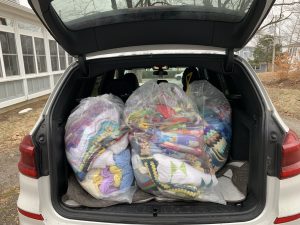
Colourful blankets bagged and loaded in the back of a vehicle

Project Linus blankets ready to be delivered to waiting children. Photo Ben Church

A volunteer organization is working to wrap people in warmth when it is needed most.

Project Linus is group of people making blankets to be distributed to children during times of crisis.

Chapter coordinator for Nova Scotia Rhonda Church says they usually supply dozens of blankets each year, but volunteers stepped up in a big way following the fire that claimed the lives of a woman and three children in Auburndale.

“I think the largest donation in our history, which was 100 blankets between the two South Shore school communities who were impacted by the tragedy in Auburndale,” said Church.

Named after the famous blanket-toting character from the Peanuts comic, Project Linus began in Denver in 1995 and Church opened the Nova Scotia chapter around 2015.

The original goal of providing comfort to children undergoing cancer treatment has expanded to include supporting any seriously ill or traumatized child.

Blankets donated to Project Linus have to meet a few requirements.

They must be handmade or machine sewn of new materials that can stand up to machine washing.

According to Church, “We’re looking for that snuggle factor. So, we are looking for something cuddly and cosy. We’re looking for blankets in colours and fabrics that appeal to a child.”

With COVID restrictions lifting, Church is looking to expand their presence on the South Shore.

“We’d very much like to hear from people who would, not only like to make blankets but to help to deliver and distribute them,” said Church. “It is absolutely heartwarming to provide those blankets.”

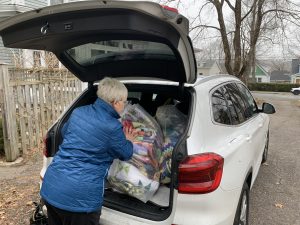
Woman loading clear bags full of blankets into vehicle

Rhonda Church loading blankets destined for children at one of two South Shore schools. Photo Ben Church

Church says she is primarily running the entire operation from her home.

She is looking to partner with another organization or church who would be willing to provide storage and sorting space but more importantly, a venue where makers could meet and learn about knitting, sewing or quilting over a cup of coffee.

To volunteer or learn more about Project Linus, head to their Facebook page.

E-mail: edhalversonnews@gmail.com
Twitter: @edwardhalverson

To listen to the broadcast of this story, press play below.

Society warns against feeding birds to prevent spread of avian flu

A small bird with bright pink feathers on its head and throat perches on a cedar branch

Photo George Sirk

Bird lovers are being cautioned against feeding their feathered friends.

The Nova Scotia Bird Society, an organization that promotes the study and conservation of wild birds says an Avian influenza could be devastating to domestic birds, such as chickens if steps aren’t taken to prevent the spread of the virus.

Society president Diane LeBlanc says all seed and suet feeders should be taken down, bird baths put away and people should even stop throwing feed on the ground.

“What we’re trying to do is reduce the amount that birds gather together. Because as they gather together they are more likely to spread the disease amongst themselves,” said LeBlanc.

The H5N1 virus was detected in Nova Scotia in January.

LeBlanc says the organization usually recommends removing feeders each spring, so this warning comes a little early this year.

She says many people believe they are helping the returning birds, but they could do more harm than good.

“There’s lots of food in the natural environment,” said LeBlanc. “Even migrating birds that are returning and hungry can find food in the natural environment and we know that there are other diseases that are likely to spread at feeders like trichomoniasis.”

LeBlanc says bird feeders should not come out again until the ground has frozen in the fall.

She cautions people about handling any dead birds as they can still carry diseases, or harmful insects and parasites.

Anyone who finds a dead bird should call the Department of Natural Resources and Renewables at 1-800-565-2224 to have it removed.

E-mail: edhalversonnews@gmail.com
Twitter: @edwardhalverson

To listen to the broadcast of this story, press play below.
Queens fire departments distributing smoke detectors in wake of fatal fire

a smoke detector

Photo Ed Halverson

Fire departments in Queens are putting smoke detectors into the hands of schoolchildren.

New Germany fire department started the initiative of handing out smoke detectors to students following a fire in Auburndale in February that claimed the lives of three children and a woman.

They challenged other departments to do the same and so far, Greenfield and North Queens have accepted.

North Queens Fire Department Chief Chris Wolfe says they’ve purchased a supply of smoke detectors locally.

“We’ll be giving out 300 first go, and then probably in a few months we’ll be doing another 300 possibly, but expanding out to grandparents and things like that, to put in their homes,” said Wolfe.

He says the smoke detector giveaway is in addition to efforts they routinely make to educate children.

“I find in Queens County and around that fire prevention is quite outstanding there,” said Wolfe. “Most of the departments take a lot of pride in teaching the kids and going to schools during fire prevention week and making sure that they are aware of fire safety.”

Wolfe says the smoke detectors will be handed out at North Queens Community school sometime in the next couple of weeks.

E-mail: edhalversonnews@gmail.com
Twitter: @edwardhalverson

To listen to the broadcast of this story, press play below.
Privateer Days readies for June relaunch

Photo contributed by Privateer Days Commission

With a new board in place and the province set to lift COVID restrictions Privateer Days is back on for 2022.

The event held each year in Privateer Park along the Mersey River waterfront in Liverpool was cancelled the past two years due to COVID.

Newly elected president Ashley Whynot says the goal this year will be on keeping the event family friendly and historically focused.

“Instead of doing a beer tent this year we’re actually going to keep it as a child-friendly entertainment tent because we have some local bars and pubs that we want to support as well and are very close to where our festivities are going to be,” said Whynot.

She says many people have asked about bringing back the fairground rides but unfortunately organizers have been unable to secure a provider.

“Children don’t so much pay attention to the historical side, which kind of a sin,” said Whynot. “But they love the pirates and they always love the rides and I wish we could’ve done that for them.”

Whynot says the organizers are aware how deeply the pandemic has impacted many of the people and businesses involved with Privateer Days.

They have removed the entry fee to participate in the parade and will be lowering fees for vendors to set up at the event.

“We’re not going to say, can you pay $700 to come, bring your food truck for the weekend because we know right now, that’s just not feasible,” said Whynot. “We’re trying to work with everybody and hopefully we meet everybody’s expectations.”

Whynot says Privateer Days relies on having 30 or so volunteers each day to operate the event.

Anyone wishing to be involved can contact the board on the Privateer Days Facebook page.

The event will run the weekend of June 24 through 26 which means Whynot, and the rest of the organizers have a lot to do in a short amount of time.

“We only have four months to put this together so we’re going to do the best that we can in the time that we have.”

E-mail: edhalversonnews@gmail.com
Twitter: @edwardhalverson

To listen to the broadcast of this story, press play below.