Legal concerns delay decision on Stedman’s building in downtown Liverpool

Eric Fry speaks during a public hearing Wednesday on proposed changes to the Region of Queens land use bylaw. (Region of Queens YouTube)

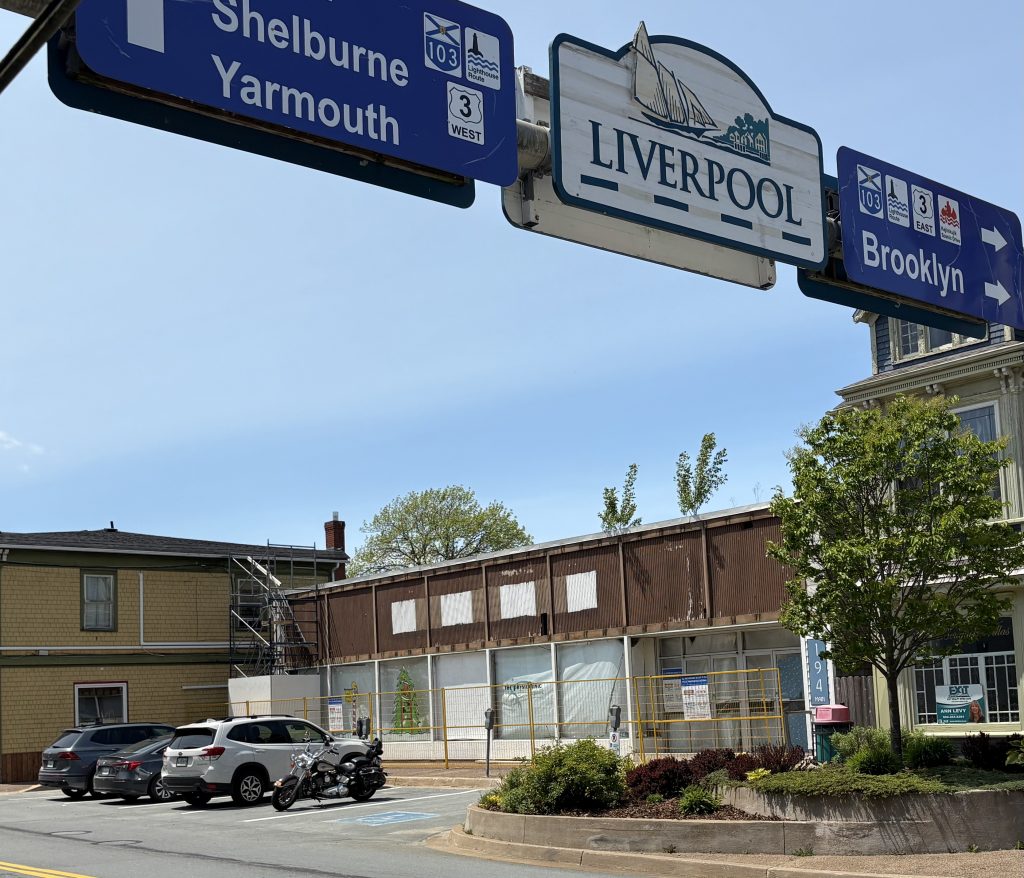
It will take a little longer to find out if the old Stedman’s building on Main Street in Liverpool will have a new life as an apartment complex.

The Region of Queens held a public hearing on Wednesday on proposed changes to the municipality’s land use bylaw that would allow for more residential space on the ground floor of buildings in the downtown commercial district.

At their meeting afterward, councillors voted to seek legal advice on whether they have the authority to make one of those changes.

Developer Eric Fry wants to turn 194 Main St. into 18 residential units, four of which would be “hotel suites”, and two main-level commercial units of 300 square feet each.

Fry bought the 30,000-square-foot building earlier this year and has been trying to get municipal approval for his apartment proposal since February. His original plan was for 16 residential units, indoor parking, storage and no commercial space. Councillors refused to change the bylaw to allow that to proceed.

After Fry listed his property for sale, the region’s planning advisory committee agreed to consider a revised a proposal and return it council.

Municipal rules require that at least half of a building’s ground floor must be commercial space.

On Wednesday, Fry spoke briefly in support of the bylaw changes. Four Liverpool residents spoke against them.

Tara Druzina said she wasn’t sure whether councillors had the authority under the Municipal Government Act to dictate who uses space in a building. A proposed change would forbid the owner or property manager from using one of the commercial spaces as an office.

“Municipalities regulate land-use types and their characteristics, but discriminating against and between identical uses based on ownership arrangements may exceed municipal jurisdiction,” she told councillors.

Denaige McDonnell said she was concerned that councillors were missing the mark in trying to change the bylaw.

“A common argument for expanding residential use is that there isn’t enough demand for commercial space, but deeper issues are at play here,” she said.

“
Many of our commercial buildings simply do not meet current building code, accessibility, or safety standards that are required for occupancy or for commercial use. And really what that’s telling us is that it’s not a demand problem, but it’s a readiness problem.”

McDonnell said the region is trying to change its bylaw to appease one property owner without having a comprehensive commercial plan.

“Structural changes like this need to be informed by clear, data-driven, county-wide strategy, not as reactions to individual development proposals.

“This proposed bylaw change may offer a short-term perception of flexibility and reward a single proponent, but it comes at a long-term strategic cost. Our commercial spaces are a very valuable part of our community. 
They are our most valuable assets for the future, and they deserve to be protected, planned and leveraged as part of a larger vision for economic sustainability.”

Susan McGibbon said she was worried the process is moving too quickly without a proper assessment of business in downtown Liverpool. 

“I’m not saying that is your fault, council. This goes way back. 
There’s been no development of an economic plan for the downtown for a very long time. So there’s no research, there’s no data, and there’s been little to no expertise in the understanding of commercial and retail in the downtown.”

Paul Deveau pointed out that during public consultations in the spring, residents and business owners said that there needed to be a downtown plan that protects commercial space while adding more housing.

“But here we are a few months later, and you’re again trying to amend a bylaw without a comprehensive plan.” 

Later in the meeting, councillors decided that they couldn’t make a decision on the proposed changes until they got legal advice.

Mayor Scott Christian asked whether staff sought advice on the wording around what landlords can do with the commercial space. 

Staff conceded they had not.

Council asked staff to have that information ready for their next meeting on Nov. 25.

Until then, the land use bylaw remains unchanged. Any substantive changes would likely restart the process and require council to have another public hearing.

Once councillors voted for a legal opinion, Christian called a break and met with Fry in his office for about 15 minutes.

Afterward, Fry told QCCR that he appreciated residents’ comments and their passion for the downtown. He said he understands that council has to make sure they have authority to make the changes.

“It’s unfortunate that this wasn’t flushed out as maybe as thoughtfully as it should have been. So, I understand there is a process to remedy, so we’ll have to wait until we hear what those next steps are.” 

Email: rickconradqccr@gmail.com

Listen to the audio version of this story below
Queens councillors OK revised Stedmans building apartment plan

Region of Queens councillors on Tuesday voted on a revised plan to develop 194 Main St. in Liverpool. (Rick Conrad)

Region of Queens council have changed course to allow a developer to build apartments on Main Street in Liverpool after all.

At their regular meeting on Tuesday morning, councillors voted unanimously to start the process to amend the municipality’s land use bylaw. 

A public hearing will be held on Nov. 12 at 9 a.m. in council chambers about changing the bylaw to allow more ground floor space to be used for residential uses in the downtown commercial zone. 

Currently, no more than half of a building’s ground floor can be used for apartments.

RELATED: READ MORE ABOUT 194 MAIN ST.

Developer Eric Fry approached the region in February to change that rule to allow him to turn all of 194 Main St., commonly known as the old Stedman’s building, into apartments. His original plan was for 16 units, with indoor parking and storage.

In July, councillors rejected changing the bylaw. Fry immediately listed the property for sale. 

He returned to the region’s planning advisory committee in August with a new plan that would include two commercial units on the ground floor of the 30,000-square-foot building, in addition to 14 apartments. 

His latest proposal is for 18 residential units, four of which would be “hotel suites”, and two Main Street-level commercial units of 300 square feet each. One of those would be a laundromat. 

“So given the significant size of the building at 194 Main St., 50 per cent of the ground floor area of the building creates some challenges for the owners of the building,” Director of Land Use Mike MacLeod told councillors. 

MacLeod reminded councillors that if the bylaw is changed, it would apply to all property owners in the downtown commercial zone.

“Any proposed amendments would apply not only to the applicant’s property, but would apply to all other owners of property of commercial buildings who want to convert more than 50 per cent of the ground floor area to residential uses.”

Planning advisory committee members originally discussed recommending a minimum depth of 6 metres for commercial space on the ground floor, but settled on 3.66 metres or 12 feet and a minimum floor area of 27.88 square metres or 300 square feet.

The other changes proposed would require that commercial uses extend along the full width of the building facade from its main entrance.

Deputy Mayor Maddie Charlton, who is a member of the committee, said PAC members believe the bylaw needs to be more flexible for property owners in the commercial zone.

“There are buildings of significant sizes that make it really challenging to allow for more residential while protecting the commercial area. And so what this does is it protects the Main Street and surrounding streets in those commercial zones or commercial core zones anywhere.

“We do recognize that there are folks beyond this proposal that have an appetite to decrease the size of commercial space. They could put in more residential space, which we feel like is a win-win.”

Under the proposed amendments, the commercial units could not be used as office space by the building owner or manager.

Mayor Scott Christian said after the meeting that the changes would be good for downtown Liverpool.

“We’re hoping to see that generate more investment, because right now we all know that there’s a lot of vacancy and underutilized spaces in the downtown core and there’s also a lot of space that could be repurposed for residential units, which we know there’s a huge demand for. So we’re hoping that we’ve struck a good balance there.”

Christian said the municipality looked at rules in other areas for guidance on the changes. He pointed to Halifax, which encourages businesses to set up as boutique shops in some buildings.

“Like a fishmonger or a small deli or an ice cream shop or a candy shop or small sort of micro retail models,” he said in an interview. “If property owners take advantage of the opportunity to create really small spaces, that micro retail model,  which I think could be attractive to our residents and our visitors.”

Christian said he understands if some people might believe the process has been tailored to suit one developer. But he says it’s an issue the community had to tackle.

“That was certainly the impetus or the catalyst to have the conversation, but I’m quite excited about where we’re going to land. I think that if the amendment goes through, I think it’s a step in the right direction, in getting more flexible in the way that folks can use those buildings in the downtown core to make it more vibrant, breathe more life, bring more people into the downtown core.”

In a survey conducted by Halifax consultants UPLAND Planning in July, 18 of 30 respondents said they were fully or somewhat supportive of changing the bylaw. 

But 90 per cent of the business owners who responded were against a bylaw change. They said they were concerned about eroding the commercial area.

Email: rickconradqccr@gmail.com

Listen to the audio version of this story below

Residents, business owners to have say on Liverpool downtown development

Eric Fry of SDL Investments Limited is hoping to build 16 apartments in the old Stedmans building on Main Street in Liverpool. (Rick Conrad)

UPDATED Mon., June 2 at 4:45 p.m.

The public will be able to give their feedback on a proposed new apartment building on Main Street in Liverpool that may result in a significant change to the downtown landscape.

The Region of Queens is considering an application from Eric Fry, president of SDL Investments Limited, to turn the former Stedmans building at 194 Main St. into 16 apartments. It was most recently used by a real estate development company. And before that, it housed a discount store and office space on the ground floor.

The region’s land use bylaw permits residential units on Main Street only in buildings with a commercial storefront.

The proposal from Fry’s SDL Investments Ltd. does not have any commercial element.

That means the land use bylaw would have to be amended for the project to go ahead. And that requires a public hearing.

The region’s planning advisory committee discussed the proposal in May.

Deputy Mayor Maddie Charlton, a member of the planning advisory committee, said the committee wasn’t comfortable giving a recommendation on the potential bylaw change without “some thorough public engagement”.

“PAC was uncomfortable moving a recommendation forward without public engagement, knowing that either allowing this use by right or by development agreement, could open it up to some significant change,” she told councillors at their regular meeting last week.

Region of Queens Mayor Scott Christian told QCCR on Monday that the committee wanted a “more robust public information opportunity” before a public hearing “to be able to provide more information to the public about what the shape of the amendment to the land use bylaw that’s being envisioned, what that looks like.”

“So as a way to get a full package of information to engaged members of the community and then providing them with an opportunity to have their say. It’s not required by the province. It’s best practices, I think,” Christian said.

“We know that this is an important conversation for us to be having and so we wanted to make sure that we have lots of opportunity for getting the information out there and giving folks an opportunity to provide their feedback.” 

Public information sessions are planned in the community room at Queens Place Emera Centre, on June 17 and June 19, both from 5 to 8 p.m. One will be geared more toward the business community and the other toward residents, Christian said.

“A formal notice and some promotional materials will be coming out early next week,” Christian said. “It’s going to be a drop-in, drop-out type of engagement and information session as opposed to a town hall with a microphone. … And the organization will be set up with information and with some ways for folks to give their input.”

He said this type of consultation is more effective at getting information to people and gathering feedback.

UPLAND Planning, the consultants that helped draft the region’s land use bylaw and municipal planning strategy adopted in 2022, will lead the public consultation.

Originally, residents and business owners were also going to be able to complete an online survey. But Christian said Monday that may not happen.

According to a report from Mike MacLeod, director of land use, members of the planning advisory committee “felt that opening up the (commercial downtown zone) to residential development as-of-right was not in the best interest of the community and that if council was to permit this use, controls would need to be established.”

MacLeod said the committee asked for draft amendments to be prepared for them to examine before they made a recommendation to council.

The consultants will prepare a report for council by the end of June. The region’s planning advisory committee would review the report, and then council would discuss the committee’s recommendations at its July meeting.

Christian said if there are proposed amendments to the land use bylaw, councillors would vote on those. If it passed first reading, then there would be a two-week notice period for a public hearing to be held before the final vote.

Fry gave councillors details of his proposed development at their April 22 meeting.

He wants to build 16 one- and two-bedroom units over two floors. Parking for the units would be indoors on the ground level, where there would also be storage units and four apartments. One-bedroom apartments would be about 800 square feet, while the two-bedroom units would be from 1,100 to 1,500 square feet. 

Rents would be similar to his apartment building on the Mersey River in Milton, he said, which are around $2,000 a month.

Fry bought the 30,000-square-foot building in January for $235,000.

Email: rickconradqccr@gmail.com

Listen to the audio version of this story below

Milton wind farm public hearing set for March 12

A public hearing is scheduled for March 12 on a proposed wind farm in Milton. (Mersey River Wind)

A public hearing on a proposed wind farm development in Milton is scheduled for March 12 in council chambers at the Region of Queens offices in Liverpool.

The region plans to sign a development agreement with Roswall Development Inc., the owners of Mersey River Wind. The company would build 33 wind turbines on about 80 hectares of Crown land near the Mersey River.

The Halifax-based company is negotiating with the Nova Scotia government to lease the land. Under the municipality’s land use bylaw, large-scale wind farms are not automatically allowed on the land as it’s currently zoned.

Councillors voted Feb. 13 to move ahead with the agreement. As part of the process, though, a public hearing must be held before it moves further.

The hearing is set for Tues. March 12 at 9 a.m., which will be before council’s regular meeting. The staff report that council relied on at its Feb. 13 meeting is available here. More information about the hearing is available on the region’s website here

Roswall promises to sell power from the wind farm directly to consumers, bypassing Nova Scotia Power. It says it will offer it to large customers on the South Shore first, and then to residential customers. The company says its power rates would be lower than Nova Scotia Power’s. The project is expected to employ 100 people temporarily.

Anybody can speak at the hearing. Written submissions must be sent to the region at least two business days before March 12 to mmacleod@regionofqueens.com

Copies of the supporting documents are available at the region’s office at 249 White Point Road, Monday to Friday. 

Email: rickconradqccr@gmail.com

Queens residents to have say on Milton wind project

A tower in the middle of a forest is viewed from above

Roswall Met tower measuring wind speeds at the proposed wind farm site in Milton. Photo Roswall Development

By Rick Conrad

Queens County residents will get their say on a wind farm project planned for Milton.

The Region of Queens plans to sign a development agreement with Roswall Development Inc., the owners of Mersey River Wind. The company would build 33 wind turbines on about 80 hectares of Crown land near the Mersey River.

The company plans to lease the land from the Nova Scotia government. Under the municipality’s land use bylaw, large-scale wind farms are not automatically allowed on the land as it’s currently zoned.

Councillors voted this week to move ahead with the agreement. As part of the process, though, a public hearing must be held before anything is signed.

That hearing is scheduled for March 12 at 9 a.m. in council chambers at 249 White Point Rd.

Mayor Darlene Norman says that while she hasn’t heard much opposition to the project since 2022, it’s important for the public to have their say on the project and the development agreement.

“It gives the region the ability to do some controls and then a development agreement requires a public hearing, so the public has a right to comment on that agreement.

“Anyone can go and present their opinion.”

If they can’t attend the meeting, they can also send written comments to the region.

The company held two public consultations in Milton in 2022, attended by more than 50 residents. It also met with about 40 members of the local indigenous community in February 2023. 

Email: rickconradqccr@gmail.com

Council approves rezoning for co-op housing at latest meeting

A long, brick building

Region of Queens Administration Building. Photo Ed Halverson

Rezoning of an area to accommodate to construction of co-op housing topped the latest meeting of Region of Queens council.

No one spoke in favour or against the proposed multi-unit co-op development at a public hearing ahead of Tuesday’s council meeting.

Council approved the rezoning to allow the construction in the Lawrence Street/Amherst Street part of Liverpool.

Also receiving council approval was a request from the Medway Head Lighthouse Society to allow liquor to be served at the opening night of their annual art show.

Council then approved the $314,700 + HST purchase of a front-end loader for the Queens solid waste facility. The purchase came in over $70,000 less than the budgeted amount of $385,000 + HST.

Next up was the appointment of Miles Harlow as Fire Inspector for the municipality. Harlow is a building inspector for the Region and will continue in that role as he takes on the responsibilities of fire inspector alongside the municipality’s current sole fire inspector Tim Clattenburg.

In the discussion portion of the meeting, a question was asked during the Council Implementation Report as to what progress is being made to sell off some the Region’s surplus properties.

Planning staff had been tasked with developing a policy for the equitable sale of surplus lands but say there hasn’t been time. They are processing a high number of permits which need to take priority over the policy development.

Next council tasked staff with cleaning up graffiti on municipally owned property in Port Mouton.

The first quarter financial review continues to show high deed transfer tax payments. The deed-transfer tax puts 1.5 percent from the sale of any property in Queens into municipal coffers. Staff had predicted $720,000 in tax revenue for the entire year but has taken in $321,905 in just the first three months of the year, almost half of what they were expecting for all of 2023/24.

Finally, council is looking at installing security cameras in the recreation areas at Queens Place after vandals have been leaving broken glass and graffiti throughout the campus. Staff will explore options and bring a report back to council at the next meeting that will outline possible solutions and costs.

The next council meeting will be held in council chambers on September 12 beginning at 9:00am.

E-mail: edhalversonnews@gmail.com

To listen to the broadcast of this story, press play below.