Trust protects 500 acres of forest in Pleasant River, Queens Co.
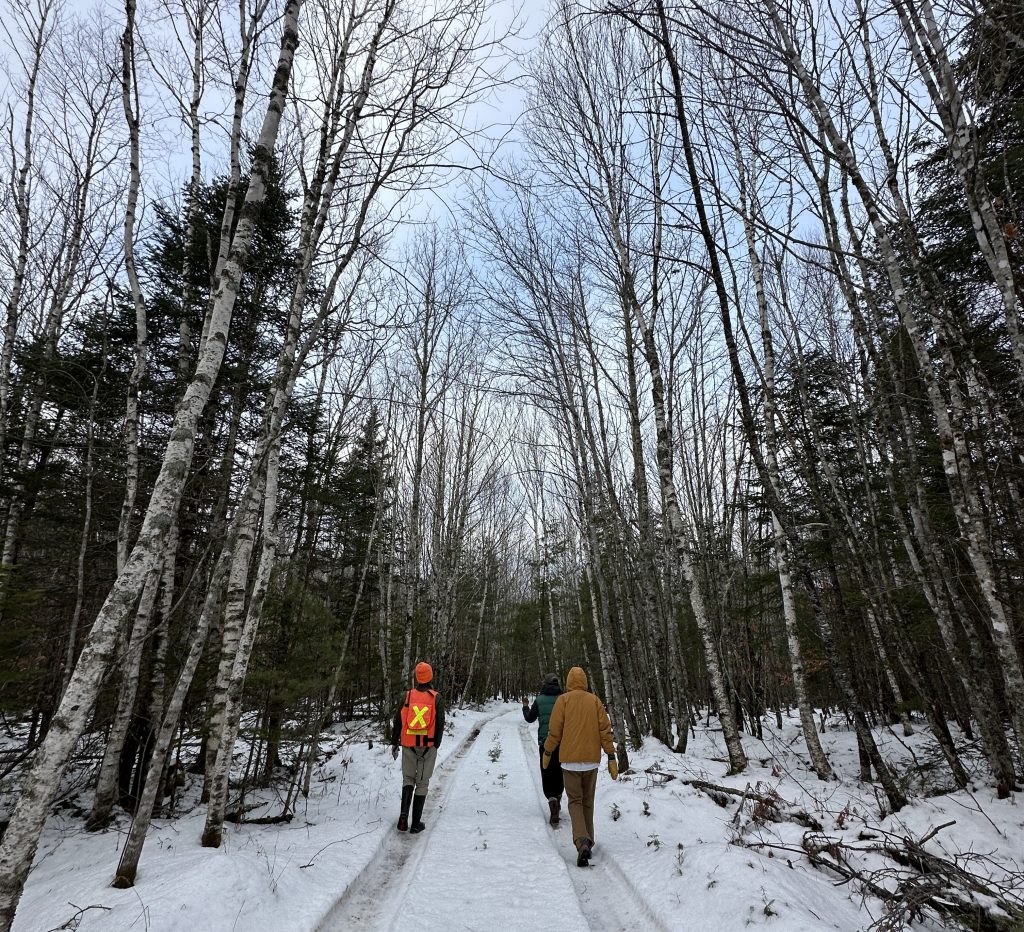
Forested land in Pleasant River will be protected from development. (Nova Scotia Working Woodlands Trust)

About 200 hectares (500 acres) of ecologically significant forest in North Queens will be protected from development by the Nova Scotia Working Woodlands Trust.

The property in Pleasant River is the first one bought by the trust. The acquisition represents about 12.5 per cent of the organization’s goal to protect 4,000 acres by this spring.

Mary Jane Rodger is the executive director of the trust.

“This is a really exciting step for us, obviously, because it’s the first property we’ve ever purchased,” Mary Jane Rodger, the trust’s executive director, told QCCR, “but then also because of some of the unique habitat features and species at risk that exist in North Queens.”

Rodger says the Pleasant River property is a mixed-wood forest that’s about 35 years old. The trust will keep about 100 acres of it wild, while using the remaining land as a demonstration woodlot to help teach sustainable forestry practices.

“Our organization really has the capacity to help this property achieve its full ecological as well as economic potential. Within our model, we’re heavily vested in the working forest aspect as well as the kind of more traditional conservation aspect. So a portion of this property will be permanently protected.

She said the organizaiton will be “showing woodlot owners different ways to steward their lands or manage their woodlot in a way that you get to cut down trees, but still leave most of them standing and hopefully still be economically profitable.”

The property is also significant because it helps the trust get closer to its goal of accessing the carbon offsets market. That will help raise money to cover the long-term costs of protecting and preserving the forest. 

“Land conservation in itself is an expensive endeavor. You have to send someone out to a woodlot every year to make sure there’s no cutting over boundary lines or invasive species or impacts from climate change. So we need to make sure that as an organization, we have the stability to continue to operate into the future because the nature of what we do is very, very long-term.”

The trust bought the property from Neil Emenau for about $300,000. It partnered with the Mersey Tobeatic Research Institute, with funding from Parks Canada and the Southwest Nova Biosphere Region.

The Pleasant River plot is next to the 3,000-hectare (7,400-acre) Pu’tlaqne’katik (“shaving lake” or “shingle lake”) Wilderness Area, which is protected by the Nova Scotia Nature Trust.

The woodlands trust says the acquisition enhances an important conservation corridor around Kejimkujik National Park, which will help foster ecological diversity and strengthen wildlife habitat. The land will be protected from development and conventional clearcutting.

“We see so many lakes and rivers, in Queens County and in Lunenburg County get subdivided and you lose a lot of that ecological integrity when people clear their land all the way to the lake. Another key component of this property is there’s quite a significant river frontage along Pleasant River that will remain forested forever.”

And it will still be accessible to the public.

“So we’re hoping that we can encourage folks to access the property for hiking, snowshoeing, skiing, whatever it might be. I know the ATV community does use it as a thoroughfare as well, which we’d be happy to work with them to continue that access.”

Rodger says the trust hopes to get its charitable status this year, so that it will be more attractive for landowners to sell their properties.

Email: rickcconradqccr@gmail.com

Listen to the audio version of this story below

Domtar’s decision about possible mill in Liverpool due in March

An undated aerial photo of the former Bowater Mersey plant in Brooklyn. (Queens County Historical Society Photo Collection, courtesy of the Queens County Museum)

It will likely be March before Queens County residents find out whether Liverpool will once again be a mill town.

Last May, Nova Scotia Premier Tim Houston said the region could be the home for a new kraft pulp mill. It all depends on whether forestry giant Domtar, which operates Paper Excellence, believes there’s a business case for it.

Nobody from Domtar or the provincial government would do an on-air interview this week. But in emailed statements, both the company and Natural Resources Minister Tory Rushton said more will be known in March.

Domtar said in its statement that it’s in the final stages of a feasibility study into a new mill.

“Our team continues to work with the Province of Nova Scotia and is in the final stages of establishing a business case for building a new bioproducts mill in Liverpool.”

Rushton said in his statement that the province is open to more natural resource development, adding the province believes a new mill would be a good fit for Liverpool. 

“Our interest is in the economic potential for our forestry sector and the province — creating good paying jobs, construction investment and strengthening the overall supply chain. Success in our resource sectors means success for our whole province.”

Last May, the premier announced a deal with Paper Excellence to settle the company’s $450-million lawsuit against the province after its subsidiary Northern Pulp was forced to shut down its mill in Pictou County in 2020.

As part of that deal, Paper Excellence launched a nine-month feasibility study into whether a Liverpool mill is viable. 

“The province has agreed to support Paper Excellence in the idea of building a new kraft pulp mill in Queens County, in the areas around the former Bowater mill,” Houston told reporters last May. “With the support of the region’s forestry sector, the company believes that Liverpool could again support a new mill, and I agree.

“If there is a business case and the company brings forward a project, it could mean an investment of more than $1.4 billion in our economy and that’s just to build a new mill. Let me assure Nova Scotians that any project that comes forward will need to meet today’s standards and will undergo environmental assessment, significant public consulation and Indigenous engagement.”

Under the court-approved settlement agreement, Domtar’s rate of return over 20 years must be 14 per cent. 

“We assess the estimated cost of construction, delivered wood, start-up and operation, labour, and funding and financing structures, among many other items,” Domtar said in its statement to QCCR.

“We are also assessing the price and market for the pulp and any other bioproducts the mill could produce.”

Houston has recently said the province needs to open up to more natural resource development, especially in light of the tariff threat from the U.S.

Bowater operated a pulp and paper mill in Brooklyn from 1929 to 2012, employing hundreds of people in Queens County. 

When it closed, it threw 320 people out of work. It also affected people in other industries.

Many of the employees retired or left for jobs in western Canada or elsewhere. The region fell into an economic funk. And it took years for the local economy to recover.

When the premier announced the prospect of a new mill last spring, though, local reaction was mixed.

Some local politicians and forestry workers said it would be a welcome boon to the local economy and the industry. Some others, including local business leaders, said they were concerned about the environmental impact a pulp mill would have.

Email: rickconradqccr@gmail.com

Listen to the audio version of this story below

Masland: New mill great opportunity for Queens, but environment must be protected

Nova Scotia’s Public Works Minister and Queens MLA Kim Masland. (Rick Conrad photo)

Like many longtime Queens County residents, MLA Kim Masland lived through the closure of the Bowater mill in Liverpool in 2012.

“When we lost Bowater, it was a huge blow, to not only Liverpool but to Queens County and to the western end of the province,” Masland said Wednesday.

The Nova Scotia government announced last Thursday that Paper Excellence Canada, the company that operated the former Northern Pulp mill in Pictou County, is looking at the possibility of opening a new mill in Queens County.

The company plans to conduct a feasibility study that could take nine months. It’s part of an agreement between the province and Paper Excellence to settle the company’s $450-million lawsuit it filed after the mill shut down in 2020.

Premier Tim Houston and Natural Resources and Renewables Minister Tory Rushton said last week that a new mill would fulfill a need identified in a 2018 report on forestry practices by Prof. William Lahey. It found that demand for forestry products in the western end of the province was seriously affected by the closure of Bowater and Northern Pulp.

Houston said that a new mill would represent a $1.4-billion investment.

Masland, who is also Nova Scotia’s public works minister, has heard from a lot of constituents about the possibility of Liverpool becoming a mill town once again.

“When we look at the reputation of Northern Pulp in Pictou, it wasn’t great,” she says.

“Environmental standards have certainly changed, environmental reporting has certainly changed. I am a rural country girl who grew up and was supported through our industries aof forestry, farming and fishing. I believe in all of them. I believe that in our province and in Queens County we can still continue that. But everything that we do does need to be done with the highest, and I mean the highest, of standards, environmentally. And that will be government’s job to make sure that if this does go ahead that all of those standards are being met.”

Masland told QCCR on Wednesday that opinions seem to be evenly split between concern about the environment and the potential for employment that a new kraft pulp mill would bring to Queens County.

“I do believe that we as a forestry sector do have the ability to supply a mill. This is tremendous economic benefit to our community, but I also understand that economic benefit and the health of a community, one can’t outweigh the other.”

She said that while people are concerned about the smell and about Northern Pulp’s environmental record, it’s also clear that residents, woodlot owners and the forestry sector in general would benefit greatly from a mill.

“Let’s think about this. In Liverpool right now, Queens County has one of the highest poverty levels in Nova Scotia. We have no industry. We have a small industry in a sawmill. We have no industry, we have tourism, fabulous, we have two wonderful resorts that offer great employment, but we really do not have any industry for people in our community. People are struggling and people deserve to have an opportunity that others have had.”

Masland said that she won’t commit to supporting a Northern Pulp mill in Queens County until she sees the results of the feasibility study.

“I would want to see the feasibility study before I would support anything. I’m not going to say I’m going to support something unless I have all the information. I’ve never done that.”

Email: rickconradqccr@gmail.com

Listen to the audio version of this story below

Queens mayor says new land use bylaws protect rural areas from urban development

People sitting in chairs listen to a presentation

Public hearing on Queens proposed land use bylaw. Photo Ed Halverson

At a third and final public hearing in Liverpool Queens residents were vocal that a proposed new land use bylaw shouldn’t change the face of rural Queens.

The crowd gathered at the Liverpool Fire Hall took the opportunity to tell Region of Queens council some of the new regulations introduced in the bylaw would interfere with their ability to produce and raise food for their families and community.

Ria Neish is raising 40 chickens and three pigs on 300 acres of land in South Brookfield.

Neish doesn’t feel it’s reasonable to ask someone like herself who is not running a commercial farming operation to apply for permits to be allowed to supply food for themselves.

“Food is deplete in the grocery stores. The animals are treated deplorably in the grocery stores. That is why we live where we live. To raise animals well. To let them live full, happy, fulfilled life, living all their instincts out,” said Neish. “That’s why we’re doing what we’re doing and the fact that I would have to ask permission for that I do object to that.”

Frank Babin of Moose Harbour is concerned enforcing regulations on rural communities will change the culture in Queens.

He wants the region to allow people to continue to live as they have for hundreds of years.

“Especially the kids, ‘cause that’s who I’m thinking of. They used to go by and say hey look at that horse, look at that cow,” said Babin. “I don’t want to see that taken away ‘cause we are a rural community.”

Mayor Darlene Norman says some of the permitting requirements are there to ensure the region is aware of what kinds of activities are taking place on a piece of land.

“A development agreement is just in place to note that in addition to residential, there’s also household livestock as part of that main use, is how it was explained to me,” said Norman.

After reflecting on the discussion, the mayor is concerned that people feel the region is trying to force urban values on rural areas when in fact they’re designed to keep urban uses out of those rural areas.

“These documents actually protect rural interests like livestock farming, like household livestock, like forestry uses. It zones these wharves and says these are fishing marine areas,” said Norman. “So, I sometimes wonder if people have misinterpreted the value of them. Because the majority of our lands are rural, and they allow rural uses.”

Now that the second public hearing sessions are complete, the proposed bylaw will go back to council for consideration at their next meeting May 24.

Council will review the public input and determine whether to make any adjustments before voting on the bylaw.

E-mail: edhalversonnews@gmail.com
Twitter: @edwardhalverson

To listen to the broadcast of this story, press play below.