Ottawa, Nova Scotia announce millions for co-op housing in Liverpool
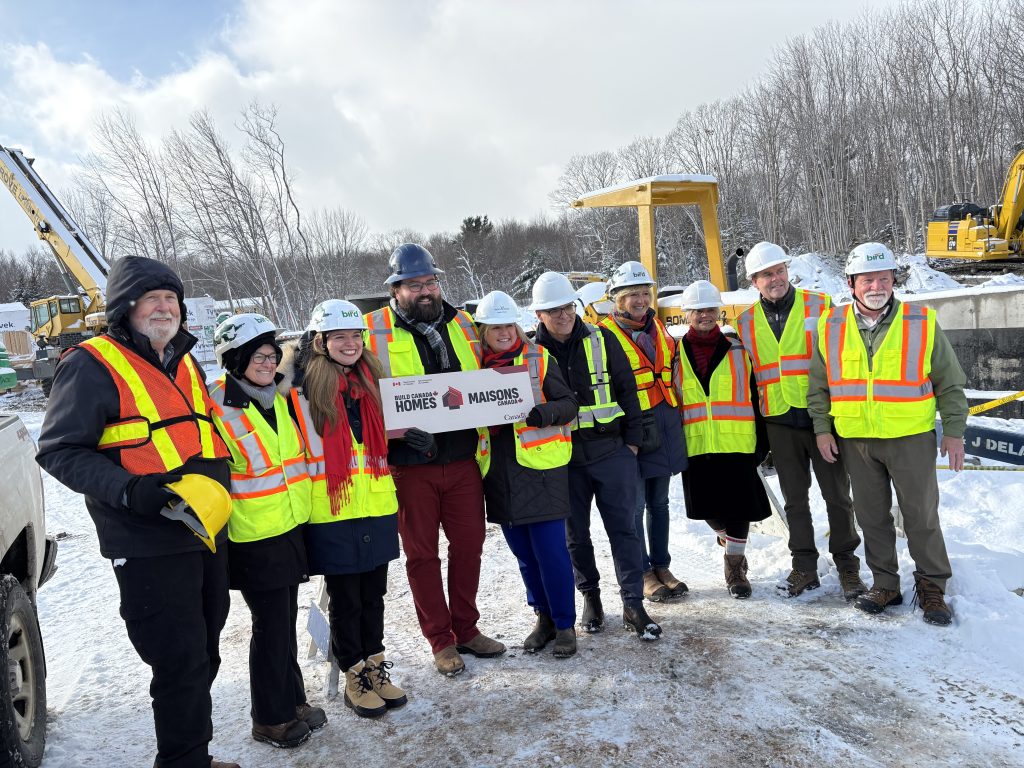
Members of Queens Neighbourhood Co-operative Housing join local politicians on Monday as governments announced millions in funding for a co-op housing project in Liverpool. Pictured are QNCH’s Eric Goulden and Susan MacLeod, South Shore-St. Margarets MP Jessica Fancy, Region of Queens Mayor Scott Christian, Queens MLA Kim Masland, QNCH housing consultant Michael Blair, QNCH’s Janice Wentzell, Randi Dickie, housing consultant Earl Mielke and Queens Coun. Jack Fancy. (Rick Conrad)
As crews worked in the background, politicians from all levels of government on Monday officially announced millions in funding for a new co-operative housing development in Liverpool.
Queens Neighbourhood Co-operative Housing is building 30 rental units on Lawrence Street in Liverpool that will likely be ready by November 2026.
South Shore-St. Margarets MP Jessica Fancy, Queens MLA Kim Masland and Region of Queens Mayor Scott Christian were among those on hand for the announcement of $11.91 million from the federal and provincial governments for the development.
Fancy said the federal contribution of $6.96 million in low-interest loans through CMHC’s Co-operative Housing Development Program will help secure affordable housing for many in the area.
“It’s a chance for a fresh start for many, including some of our most vulnerable people in our community.”
Fancy said the Liverpool co-op housing project is one of seven approved across Canada. It’s being built by Bird Construction.
The province is contributing $4.95 million through its Department of Growth and Development.
Masland applauded the “passion, dedication, effort and grit” of the co-op’s board members to make the project a reality.
“Plain and simple, we need more affordable housing in our community, and it is because of organizations like Queens Neighbourhood Co-operative Housing that more people will have a safe and affordable place to call home.”
The co-operative got approval for the federal and provincial funding earlier this year, but Monday’s announcement was the first time they could speak about it publicly.
The Region of Queens sold four lots to the group in 2023 for $1 and rezoned the area to pave the way for the development. It also committed $203,000 for project management and architectural fees.
Other funding includes:
- $175,000 from the Federation of Canadian Municipalities
- $343,500 from the Nova Scotia Sustainable Communities Challenge Fund
- $400,000 from Efficiency Nova Scotia
- $75,000 from the Nova Scotia Community Housing Growth Fund
Mayor Scott Christian said the municipality is looking at other properties it can give to groups like QNCH to help spur more affordable housing in Queens.
“This is a step in the right direction. We all know that we need to do a lot more. We have a lot of folks who need access to affordable, accessible, barrier-free housing, and I commend these folks in terms of their environmental stewardship and working toward net-zero emissions too, because we also need to build homes in a way that’s climate resilient and is appropriate for the future.”
Planning for the project began about four years ago, with most of the work on design and funding happening in the past two and a half years.
The 30 fully accessible apartments will include one-bedroom, two-bedroom and three-bedroom units. It will be targeted toward seniors, with about 70 per cent occupancy set aside for older residents, but available for anyone who meets the application criteria.
Rents will be based on income, but the maximum charged for a one-bedroom will be $790 a month, $1,004 for a two-bedroom and $1,100 for a three-bedroom.
Queens County is in desperate need of affordable housing. Data from the 2021 census showed that 35 per cent of renters in Queens spend more than 30 per cent of their income on housing.
And 34 per cent of Queens residents have considered leaving the community due to housing issues, according to a report from the South Shore Housing Action Coaltiion.
To keep pace with population growth, the report projected that the county will need 555 new units by 2027.
On Monday, even the project’s construction foreman was interested when he heard about the rents.
Michael Blair, a housing consultant working with the co-op on the Lawrence Street project, said the group’s ultimate goal is to try to build 100 affordable units throughout Queens County.
“We’re thrilled to finally have the funding both by the CMHC through the Co-operative Housing Development Program and through the province with the Nova Scotia Department of Growth and Development announced. Now we’re able to tell the story about the exciting new neighbourhood that we’re building.”
He said the apartments’ net-zero, passive design means that tenants won’t have to worry as much about rising energy costs.
“Building with highly energy-efficient mechanical and electrical systems, triple-glazed windows, extra insulation, all those things contribute to the long-term sustainability of the co-op, of the neighbourhood, and kind of insulates it to a certain degree from increasing energy costs, which thus make (us) able to keep … (the units) affordable long-term.”
Rental applications will probably be posted on the housing co-op’s website in the spring.
Email: rickconradqccr@gmail.com
Listen to the audio version of this story below
