Ottawa, Nova Scotia announce millions for co-op housing in Liverpool
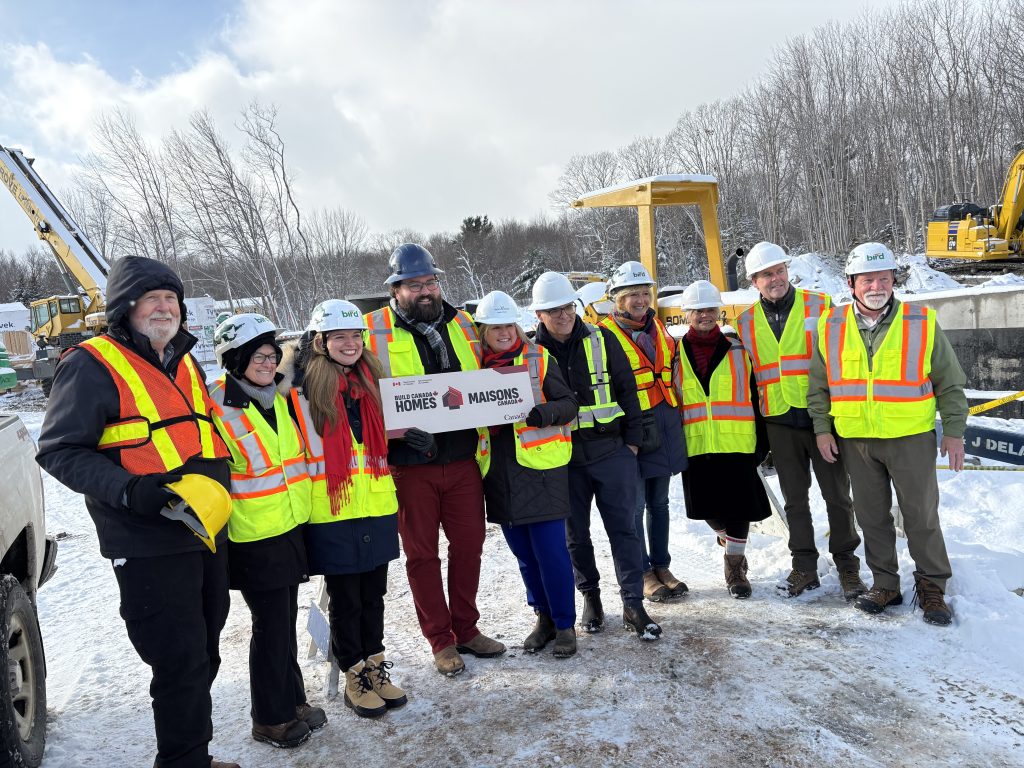
Members of Queens Neighbourhood Co-operative Housing join local politicians on Monday as governments announced millions in funding for a co-op housing project in Liverpool. Pictured are QNCH’s Eric Goulden and Susan MacLeod, South Shore-St. Margarets MP Jessica Fancy, Region of Queens Mayor Scott Christian, Queens MLA Kim Masland, QNCH housing consultant Michael Blair, QNCH’s Janice Wentzell, Randi Dickie, housing consultant Earl Mielke and Queens Coun. Jack Fancy. (Rick Conrad)

As crews worked in the background, politicians from all levels of government on Monday officially announced millions in funding for a new co-operative housing development in Liverpool.

Queens Neighbourhood Co-operative Housing is building 30 rental units on Lawrence Street in Liverpool that will likely be ready by November 2026.

South Shore-St. Margarets MP Jessica Fancy, Queens MLA Kim Masland and Region of Queens Mayor Scott Christian were among those on hand for the announcement of $11.91 million from the federal and provincial governments for the development.

Fancy said the federal contribution of $6.96 million in low-interest loans through CMHC’s Co-operative Housing Development Program will help secure affordable housing for many in the area.

“It’s a chance for a fresh start for many, including some of our most vulnerable people in our community.”

Fancy said the Liverpool co-op housing project is one of seven approved across Canada. It’s being built by Bird Construction.

The province is contributing $4.95 million through its Department of Growth and Development.

Masland applauded the “passion, dedication, effort and grit” of the co-op’s board members to make the project a reality.

“Plain and simple, we need more affordable housing in our community, and it is because of organizations like Queens Neighbourhood Co-operative Housing that more people will have a safe and affordable place to call home.”

The co-operative got approval for the federal and provincial funding earlier this year, but Monday’s announcement was the first time they could speak about it publicly.

The Region of Queens sold four lots to the group in 2023 for $1 and rezoned the area to pave the way for the development. It also committed $203,000 for project management and architectural fees.

Other funding includes:

  • $175,000 from the Federation of Canadian Municipalities
  • $343,500 from the Nova Scotia Sustainable Communities Challenge Fund
  • $400,000 from Efficiency Nova Scotia
  • $75,000 from the Nova Scotia Community Housing Growth Fund

Mayor Scott Christian said the municipality is looking at other properties it can give to groups like QNCH to help spur more affordable housing in Queens.

“This is a step in the right direction. We all know that we need to do a lot more. We have a lot of folks who need access to affordable, accessible, barrier-free housing, and I commend these folks in terms of their environmental stewardship and working toward net-zero emissions too, because we also need to build homes in a way that’s climate resilient and is appropriate for the future.”

Planning for the project began about four years ago, with most of the work on design and funding happening in the past two and a half years.

The 30 fully accessible apartments will include one-bedroom, two-bedroom and three-bedroom units. It will be targeted toward seniors, with about 70 per cent occupancy set aside for older residents, but available for anyone who meets the application criteria.

Rents will be based on income, but the maximum charged for a one-bedroom will be $790 a month, $1,004 for a two-bedroom and $1,100 for a three-bedroom.

Queens County is in desperate need of affordable housing. Data from the 2021 census showed that 35 per cent of renters in Queens spend more than 30 per cent of their income on housing.

And 34 per cent of Queens residents have considered leaving the community due to housing issues, according to a report from the South Shore Housing Action Coaltiion.

To keep pace with population growth, the report projected that the county will need 555 new units by 2027.

On Monday, even the project’s construction foreman was interested when he heard about the rents. 

Michael Blair, a housing consultant working with the co-op on the Lawrence Street project, said the group’s ultimate goal is to try to build 100 affordable units throughout Queens County.

“We’re thrilled to finally have the funding both by the CMHC through the Co-operative Housing Development Program and through the province with the Nova Scotia Department of Growth and Development announced. Now we’re able to tell the story about the exciting new neighbourhood that we’re building.”

He said the apartments’ net-zero, passive design means that tenants won’t have to worry as much about rising energy costs.

“Building with highly energy-efficient mechanical and electrical systems, triple-glazed windows, extra insulation, all those things contribute to the long-term sustainability of the co-op, of the neighbourhood, and kind of insulates it to a certain degree from increasing energy costs, which thus make (us) able to keep … (the units) affordable long-term.”

Rental applications will probably be posted on the housing co-op’s website in the spring. 

Email: rickconradqccr@gmail.com

Listen to the audio version of this story below


Nova Scotia building public housing to address housing crisis

Municipal Affairs and Housing Minister John Lohr, left, and Halifax MP Andy Fillmore, on behalf of Sean Fraser, federal Minister of Housing, Infrastructure and Communities, announce $83 million to create 222 new public housing units, including 80 barrier-free units, during a news conference in the media room at One Government Place, Halifax, September 27

Municipal Affairs and Housing Minister John Lohr, left, and Halifax MP Andy Fillmore announce $83 million to create 222 new public housing units at One Government Place, Halifax, September 27. Photo Communications Nova Scotia

Nova Scotia is building the first public housing in the province in decades.

Municipal Affairs and Housing Minister John Lohr and Member of Parliament for Halifax, Andy Fillmore, announced Wednesday, $83 million will be used to build 222 new public housing units, 80 of which will be fully barrier-free.

These developments are expected to benefit 522 families, individuals, and low-income seniors across both rural and urban communities in Nova Scotia.

The new housing will be built on provincially owned land close to existing public housing developments in several locations, including Bridgewater, Kentville, Truro, Cape Breton (multiple locations), and the Halifax Regional Municipality (multiple locations).

The buildings will be designed to be energy-efficient, sustainable, and affordable for residents. Importantly, rents for these units will be tied to the resident’s ability to pay. Gearing the rent towards income, will make the units accessible to individuals and families with varying financial means. The new units will be operated and managed by the Nova Scotia Provincial Housing Agency.

The funding breakdown for the project includes $58.8 million from the provincial government and an additional $24.4 million from the federal government.

The PC government has long held government shouldn’t be involved in public housing, instead they should provide the means for private developers to create affordable units.

Minister John Lohr said government began shifting their thinking over the summer.“If you look back to my more recent quotes I was softening that position because I realized that this was something that we had been working on as a department over the summer to look at this possibility. And I can tell you that the, what did change, was we do have an agreement and the money from CMHC, the federal partner, $24 million to build 80 accessible barrier free units,” said Lohr. “The way that we were doing that was we were going into 40-year-old buildings and renovating them and my staff pointed out that this was a pretty inefficient way of doing it”

Lohr says the renovated older unit would be tied up for a year during construction and in the end didn’t always result in the best accessible living space.

It was at that point the department decided to build 80 new accessible units and fund the creation of the 222 affordable spaces.

Andy Fillmore, Member of Parliament for Halifax, echoed these sentiments, emphasizing the importance of federal-provincial collaboration. He says the solution to the housing crisis won’t come from one level of government or from one organization.

“It has to come from every single person who is involved in every single organization and order of government who is involved in in housing. We all own a piece of it and we all have our own jurisdictional boundaries we need to observe,” said Fillmore. “We are working hard to play within our lines, work with provinces to change some of those lines where we need to, to provide more capital and get more units built”

Nova Scotia NDP Leader Claudia Chender was in Bridgewater discussing affordable housing prior to this announcement.

She was direct when asked what she hoped to hear from the province and federal government.

“I would expect to see the creation of a significant number of truly affordable housing units across Nova Scotia. That’s what I’m looking for,” said Chender. “And I would further expect that the province comes to the table with significant investment of their own to make that happen because so far the vast majority of the affordable housing units that have been built in Nova Scotia in the past five years have been built with federal dollars and I think it’s time for the province to also take the role that really, they have by legislation and in our constitution”

Chender says the new units are a start but fall far short of meeting the demand for affordable housing across Nova Scotia.

Minister Lohr says construction of the first new units is set to begin in spring 2024 with a goal to have people moving in during fiscal 2024/25.

To hear the broadcast of this story click play below.

E-mail: edhalversonnews@gmail.com

Funding announced for community groups to support affordable housing initiatives

Housing development plan

Mount Hope Development Plan Map. Photo Nova Scotia Government

The province has announced more initiatives aimed at increasing the amount affordable housing in Nova Scotia.

The federal and provincial governments announced over $916,000 through the Community Housing Capacity Program.

According to a release from the province, the grants will fund governance and operations reviews, growth and development plans, create community land trusts, and other capacity building needs.

Minister of Municipal Affairs and Housing John Lohr says one of the ways the Community Housing Capacity Program can be used by community groups is to develop a co-op approach to housing.

“They know their communities best and we’re optimistic that this seed money will provide for more projects in the future,” said Lohr.

The minister was also in Dartmouth Monday to announce the Nova Scotia government will spend $21.8 million in a forgivable loan to subsidize 373 residences in a new 875 home development.

The agreement between the province and Clayton Developments stipulates the units must remain affordable for 20 years.

Rents in the new development could be as low as $605 per month for a one-bedroom apartment, or $788 a month for a two-bedroom, based on current Canada Mortgage and Housing Corporation data.

This project uses the last of the $35 million committed in the Quick Start program to create 1,100 new affordable housing units.

But Lohr says the province isn’t finished yet.

“This Mount Hope was always part of the plan for the $35 million Quick Start program. There will be more affordable housing announcements to come.”

Lohr stopped short of committing the government to building more public housing units, indicating they prefer to find development partners

“No government has added to the public housing stock in 30 years. We’re responding to the crisis,” said Lohr. “We believe that this is a very efficient use of what resources we have and we’re very pleased to be doing it this way.”

The new units are expected to be ready for occupants by fall of 2023.

E-mail: edhalversonnews@gmail.com
Twitter: @edwardhalverson

To listen to the broadcast of this story, press play below.