Queens councillors OK $181,000 on design work for future bridge upgrades

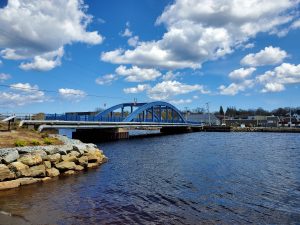
The Region of Queens has greenlit design work to begin on improvements to the town bridge. (Rick Conrad)

The Region of Queens is going ahead with design work to make the town bridge safer and more accessible for pedestrians and cyclists.

The two-lane bridge over the Mersey River is the main thoroughfare into downtown Liverpool.

The steel structure was built in 1958 and spans about 100 metres with an inside width of 9.6 metres. It has a narrow sidewalk on each side. There are no paved shoulders, dedicated bike lanes or barriers to separate traffic from pedestrians.

Two years ago, regional council commissioned a technical evaluation from engineering firm CBCL to look at active transportation upgrades. Council at that time decided to hold off on any work until more funding became available from the provincial or federal governments.

Simply to maintain the bridge with no improvements would have cost $325,000. To realign the two lanes and expand one sidewalk would have cost $700,000. An active transportation expansion with a dedicated space for pedestrians and cyclists had a price tag of $3.4 million. A totally separate pedestrian bridge over the river was estimated at $4.4 million.

Adam Grant, the region’s director of infrastructure, discussed the issue this week at council’s regular meeting. He said those estimates from 2023 would now likely be about 10 per cent more. He recommended the $3.4-million option.

“I think we get rid of a lot of the challenges that’ll be found working inside the existing structure,” he told councillors.

“Going that way would open up an avenue to create bicycle lanes on the existing bridge once the sidewalks are removed, as well as it wouldn’t require a realignment of the street from lanes all the way through to Water Street so it would be less invasive on the existing street structure, and would probably be able to provide a more fulsome solution on the exterior of the bridge as opposed to trying to fit within a kind of more refined area.”

Grant said he wanted to get the design work started so that the project would be shovel-ready if funding is secured. Councillors had set aside $181,749 in the region’s capital investment plan.

Under the municipality’s current agreement with the province, maintenance and repair work on the bridge is cost-shared 50/50.

But improvements to the bridge would require a new funding agreement, he said.

“At this point under the agreement we have, they’re under no obligation to entertain any upgrades.”

Councillors supported the less costly $3.4-million active transportation expansion, but said they need to look for funding from other levels of government.

Deputy Mayor Maddie Charlton said she wants to see the expansion go ahead, but the region needs help from the province.

“I feel like we need to address this certainly. It’s not safe. If you’re walking on the bridge now, you’re quite high up, people misstep, and you could very easily be on the road. … We do have cyclists in Queens and so that’s a bit of a problematic place as it is,” Charlton said.

“We’re funding the design work. We should have some really meaningful conversations to look for support (for the expansion) because I don’t think we can take that on on our own, nor would it be fair for us to take it on on our own.”

Councillors voted unanimously to spend the money for the design work, while directing staff to look for funding for the improvements from the federal and provincial governments.

Email: rickconradqccr@gmail.com

No walk in the park: Liverpool walk audit exposes hurdles to pedestrian safety around new library

People participate in a walk audit near the Thomas H. Raddall Library off the White Point Road in Liverpool. (Rick Conrad)

People took to the streets this week to brave some cool and wet conditions, and traffic, to get an idea of how safe it is for walkers around the new Liverpool library location.

Hike Nova Scotia held a walk audit in the area. Program manager Catherine Droesbeck said the organization has done about 15 walk audits around the province through its NS Walks program. But this was the first one for Liverpool.

The Region of Queens asked the group to hold the event to help get community input on how to encourage people to use active transportation, like walking and cycling, to get to and from the library.

We’ve been doing walking audits now for the past nine months or so all over the province in communities big and small, who are all interested in improving the experience for pedestrians in getting around their communities,” Droesbeck said in an interview.

“Then we’ve been going in and helping them do the audit, which gives us some good data in terms of people’s experience, but also it’s a great way to engage community with government officials and other organizations to bring people together to say, ‘This is what we love about our community, but this is how we we’d like to make it better.’”

About 15 people participated in the walk audit, which took participants on a two-kilometre route from the library, along Harley Umphrey Drive, up to White Point Road, along Payzant Street, across Parker to Union, over to Waterloo and back to the library.

Morgan MacDonald, the region’s new physical activity co-ordinator, said walking is one of the most popular and accessible forms of physical activity. 

“And one of the barriers to walking for many people is safety,” he said.

“So having a walkability audit allows us to take a certain portion of the region, which is around our new library location in Liverpool, and looking at the accessibility and the barriers to active transportation around this location and tying it into the existing infrastructure of the town of Liverpool. So by trying to address some of the barriers to people walking and rolling, we’re hoping that they’ll feel comfortable and confident to make that part of their everyday life.

When participatns got back to the library, they were asked to rate the route on various factors, such as traffic, sidewalks, crosswalks and safety, out of an overall score of 120. Most were in the 40 to 50 range, with one as high as 92.

They said that even though there are no sidewalks on roads around the library, the shoulders are wide enough in some areas for walkers. But they added that the unevenness of the unpaved shoulders would make it difficult for people in wheelchairs to navigate.

They also talked about the lack of clearly marked crosswalks on the route, and suggested installing crosswalk flags at certain intersections.

When regional council decided to move the library from downtown to the new location, residents were concerned about safety because the area has no sidewalks and limited lighting.

Sylvia Hurley of Liverpool was one of the walkers. She says she loves to walk, but it can sometimes be hazardous.

“And I have a lot of concerns about areas of walking, crosswalks, how walkers are treated locally, not stopping at crosswalks, not paying attention to us. I wanted to express my concerns big time,” she said on the route.

“I used to walk out on this street (White Point Road), but I haven’t walked here for a very long time. It’s dangerous, very dangerous. It’s narrow. But I’m fortunate because I can come up George Street from my house and be to the library which suits me. I don’t have to come out on to this road, but not everyone’s that fortunate.”

Hurley said she thinks the walking audit is a great idea.

“But if they’re going to do an audit, do the audit but honour what people say. Don’t just, ‘Oh yeah, they complained about this, they complained about that.’ Let’s do something about it.”

Hike Nova Scotia’s Droesbeck said responses from the walk audit will be compiled in a report to the municipality.

I think we identified some, what we’ll call low-hanging fruit today, that the community can do that will go a long way to make people feel safer when they’re walking this particular route. So whether it’s marking the crosswalks better, looking at speed limit signs, more some benches and things that will make it look more like, OK, people want to walk here and walk safely. So I think there’s some possibilities there.

The region’s MacDonald said this was only the first of a few community consultations about active transportation, including walking and cycling. More are planned this summer through Cycling Nova Scotia in Caledonia, Greenfield and again in Liverpool.

He said the results of this week’s walk audit are important to highlight for regional staff and council the community’s concerns about walking in the area.

“So it was looking at how all of these different systems interact and how we can make infrastructure and spaces that work for everybody and encourage healthy activity and safe activity in our community.”

Email: rickconradqccr@gmail.com

Listen to the audio version of this story below

Council votes against multi-million dollar upgrade to Liverpool Town Bridge

Liverpool Town Bridge spans the Mersey River

Liverpool Town Bridge Photo Ed Halverson

A possible active transportation corridor on Liverpool’s Town Bridge will not go ahead.

Municipal staff had determined the railings and sidewalks on the 60-year-old structure needed to be replaced.

Council wanted repair work completed to make the sidewalks safe but asked staff for a more comprehensive solution that would widen the pedestrian walkways and allow for potential bicycle lanes.

CBCL Engineering was contracted to come up with ways to possibly reconfigure the bridge. They developed four options.

The first is to maintain existing bridge, replacing the deteriorated railing and rehabilitating the asphalt and concrete sidewalk surfaces at a cost of $325,000.

The second option is to modify the existing bridge, spending $700,000 to combine the two sidewalks on one side of the bridge and widening it to allow better access for cyclists.

The third option is to move the sidewalk and bicycle lane to the outside of the bridge structure. That comes with a price tag of $3,400,000.

At $4,400,00, the final and most expensive option is to build a separate pedestrian bridge across the Mersey River to create a Separate Active Transportation Structure.

The bridge is owned by the province but maintained through a cost sharing agreement with Queens.

Region of Queens Mayor Darlene Norman coming up with that kind of money just isn’t in the cards for the municipality at this time.

“To spend three, four million dollars on a structure that does not belong to us; we’re just going to look after what’s there,” said the mayor.

Norman says there could be other opportunities to upgrade the infrastructure down the road.

“So needless to say, we’re just going to maintain what we have for now and keep our eyes open to any federal monies that may be coming in the next two years.”

Council voted to address the current deficiencies to make the bridge safe and not go ahead with any new infrastructure.

E-mail: edhalversonnews@gmail.com

To listen to the broadcast of this story, press play below.