Renowned Hunts Point researcher collects Order of Canada medal
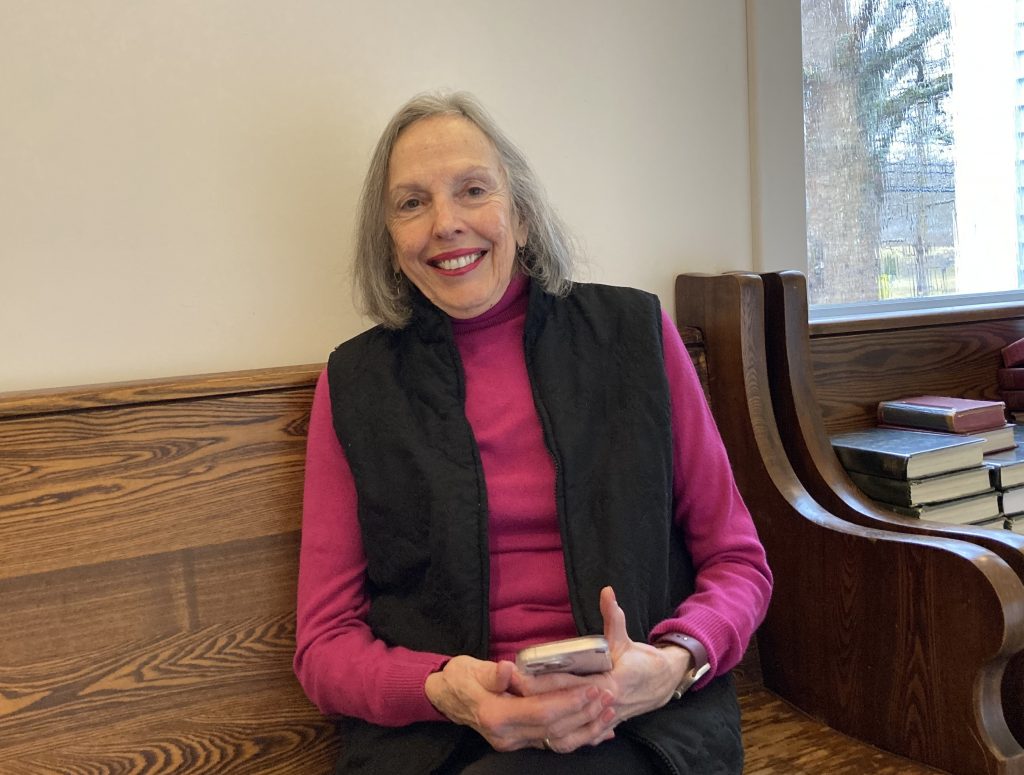
Celeste Johnston from Hunts Point recently received her Order of Canada medal from Gov. Gen. Mary Simon at a ceremony in Ottawa. (Rick Conrad photo)
When the governor general’s office called Celeste Johnston to tell her she would be inducted into the Order of Canada, she almost didn’t pick up.
The medical researcher, professor and nurse had been getting a lot of spam calls from the Ottawa area code, so she hesitated. But she did answer and it was a representative from Gov. Gen. Mary Simon’s office telling her she would be named an officer of the Order of Canada.
“I said, ‘Is this real? Are you serious? Is this spam?’ And she laughed and said no, it’s real, and that I’m not the first person who had asked that question.”
That was back in December 2021. Johnston, a longtime professor at McGill University who retired to Hunts Point with her husband in 2010, received her medal at a ceremony at Rideau Hall in February.
“I was a little incredulous,” she said in an interview. “And still to this day, I’m still incredulous. I just don’t think of myself as someone who would get the Order or Canada. And I thought I really don’t think I should be getting this. Look at all these other people who have gotten it. But then I started thinking about people from the McGill community who had gotten it. And I thought, ‘OK if they can get it, then I can get it too.’”
Johnston was recognized for her 35 years of work researching pain in premature babies. An internationally renowned expert and advocate for recognizing and treating infant pain, she was also the first nurse and woman to lead the Canadian Pain Society.
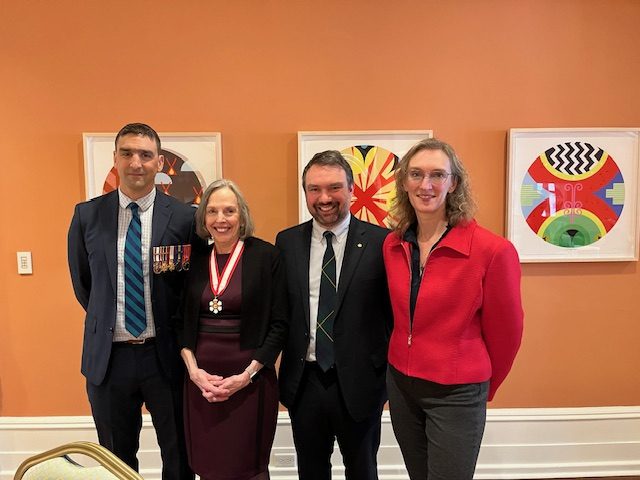
Celeste Johnston with her children Rob, Andrew and Elise after receiving her medal for being named an Officer of the Order of Canada. (Celeste Johnston photo)
Johnston’s groundbreaking work began when she was working at the Montreal Children’s Hospital. Nurses in the neonatal unit approached her and asked if she could measure pain in babies. They said doctors didn’t believe the babies experienced pain in the same way. But the nurses said they saw otherwise.
“At the time I started doing that work, babies were having painful procedures done all the time in the neonatal intensive care unit. And nothing was being done for it. And they said, ‘It’s just a short procedure and it’s going to be OK.’ But it isn’t OK. Not only for ethical reasons, but there are long-term consequences … above and beyond whatever medical conditions they might have as part of being pre-term.”
She and her team of researchers began by developing a way to measure pain in pre-term infants, a standard that soon became accepted by the American Hospital Association and the Canadian Pediatric Society.
Next, they wanted to figure out how to treat the pain without drugs.
“Because you can’t give them heavy duty analgesics every time they’re having a painful procedure because that has long-term effects too and they won’t develop as well as they should,” she says.
She began by studying the effects of giving babies a small drop of diluted sugar water, known as sweet taste treatment. That was effective in managing the pain, but Johnston was concerned about the long-term developmental effects of that kind of treatment.
She teamed up with a neuro-developmental scientist who was studying pain response in the brain of young rats who were still with their mothers. They studied how rat pups who experienced pain but were groomed by their mothers afterward seemed to do better than the baby rats who experienced no pain and didn’t receive the extra attention from their mothers.
At the same time, Johnston says, she heard about mothers in South America who acted almost like incubators for their premature babies, because of a shortage of the devices.
“And the mothers carried the babies skin to skin on their chest as the incubator. And they did it 24 hours a day. And they found that those babies that might have otherwise died survived because they were kept warm and (with) demand feeding. So I thought why don’t we try kangaroo care for pain.”
She did seven studies on kangaroo care over 12 to 15 years, in which the baby is placed against the mother’s chest skin to skin and they’re both wrapped in a blanket.
“All this worked. It was profound, the effect.”
They tried the experiment with fathers and with other women like paternal grandmothers. But nothing was as effective as a mother’s love, Johnston says.
Eventually, Marsha Campbell-Yeo, one of Johnston’s PhD students and a professor at Dalhousie University, furthered the research and founded Mom-Linc Lab, which studies the effects of maternal presence.
“And so I think between the kangaroo care and the work she is doing now, mothers are able to spend more and more time in the neonatal intensive care unit and not have that separation. It’s stressful on the mothers and I think it’s stressful on the babies too.”
Johnston’s research days are behind her, but she hasn’t slowed down. She is heavily involved in various groups in Queens County, including the region’s pool committee and the community cafe at the Trinity Church parish hall. And she’s teaching a course called Pain Explained for the Seniors College Association of Nova Scotia.
Johnston said being in Ottawa for the Order of Canada ceremony was an amazing experience. And it was even more special because her three adult children, Elise, Rob and Andrew, were there with her.
“The people I was meeting around me were just amazing. They were from all walks of life. There were writers, there were musicians, businesspeople, basic scientists, a lot of health scientists. So it was very exciting to be there.”
But the visit to Rideau Hall was rivalled later in the weekend.
“I went from Ottawa to Montreal to visit with Andrew and his two young daughters, who are 3 and 5, and so I must say that competed with being the highlight of the weekend.”
Email: rickconradqccr@gmail.com
Listen to the audio version of the story below