Province parks North Queens medical first responders due to COVID-19

North Queens Fire Department

Trucks outside North Queens station. Photo Credit: North Queens Fire Department

Medical first responders in North Queens are being told not to respond to calls because of COVID-19.

The MFRs are volunteer firefighters trained to attend to someone in medical distress until paramedics arrive on scene.

Queens-Shelburne MLA Kim Masland says when someone is having a medical emergency, waiting 40 minutes for an ambulance to arrive from the nearest EHS base in Liverpool is too long.

“If you’re living in Caledonia and you’re in cardiac arrest, the local MFRs can no longer come to you, who actually have an AED on site, there’s no way someone’s going to get to you in time,” said Masland.

In March, the EHS/MFR coordinator told MFRs across the province they could respond only to motor vehicle accidents and to leave emergency calls to EHS paramedics because at the time, there wasn’t enough personal protective equipment to go around.

A spokesperson for Emergency Health Services says since COVID-19 restrictions have started to ease up, they have been bringing MFRs back online in 21 areas with high incidents of cardiac arrests.

Already, 11 have received the training around proper use of the new personal protective equipment and are currently operating.

The other ten are slated to return to service in the coming weeks but unfortunately, none of those are in the Western Zone servicing North Queens.

The EHS spokesperson says the North Queens MFR agency is one of the more remote agencies in the province and is also scheduled to receive training in the coming weeks.

Masland is concerned about what could happen if an ambulance can’t get to the area in time.

“We’re so rural, we’re so geographically isolated and if I’m getting text messages saying on a Saturday morning at 11:55 there’s not an ambulance to be seen from Barrington to Halifax, that’s very, very frightening,” said Masland.

North Queens Fire Chief Chris Wolfe says the community has always relied on the department as medical responders and as fire fighters.

He’s frustrated they’re being left in the dark as to why the department is no longer being dispatched for medical emergencies.

“Every time I see somebody in Caledonia they’re saying, why aren’t you guys answering medical calls?So and so had this problem the other night and you guys weren’t there,” said Wolfe. “To me, if EHS is not going to allow us to do this they should be making it more publicly aware and giving briefings to the public on what’s taking place, why we’re not responding.”

Wolfe is well aware of the strain on the province’s ambulance system.

He has been writing to government officials for the past three years to explain the dire situation residents in North Queens can face when looking for emergency medical help.

“It’s an ongoing problem and the province doesn’t seem to see that there is a problem. I’m to the point myself, that I can’t write no more or talk no more to change anything so, where do you go, right? It’s one of them things that a little town fire chief like me isn’t going to be able to fix ‘cause there’s too many people above me that make the decisions,” said Wolfe.

The president of Local 727 of the International Union of Operating Engineers, the union representing paramedics in Nova Scotia, says the EHS system in Nova Scotia is in chaos as it struggles to fill shifts and reduce offloading time for patients at hospitals.

Michael Nickerson says it’s helpful to have MFRs to service remote areas before his members arrive.

“They can provide oxygen therapy and get vital signs and treat fractures, like, splint fractures and dress wounds, bandage and whatnot,” said Niickerson. “So, they are a great, great asset.”

Nickerson says his members have been warning the province since before the COVID-19 outbreak that the pre-hospital system in Nova Scotia is not working.

The health department took those concerns to heart when they commissioned a $145,000 report by Fitch and Associates in October 2018 to review the ambulance system across the province.

The province received the report in December of that year, but Nickerson says despite repeated requests by IUOE 727, they still have not released the results.

“I don’t understand why they’re not putting it out there. They’re saying because, you know, negotiations and whatnot. Our contract’s settled, so they can’t use that as an excuse. They need to put that report out and let us see what’s in it. I’m sure there’s recommendations in there to make the system better than it is right now,” said Nickerson.

Health department spokesperson Marla MacInnis said they are currently in negotiations with Emergency Medical Care Incorporated, the company contracted by the province to provide paramedic services.

She says while the paramedics working under EMCI have a contract in place, the contract with the supplier (ECMI) is still being negotiated and releasing the Fitch report could put the province at a disadvantage.

Back in Queens, Kim Masland says now that the province has the personal protective equipment in place the focus should be on getting the medical first responders trained, and back in action.

“So let’s get our agencies back in the saddle,” said Masland. “Let’s get them doing what they do best in our communities.”

Reported by Ed Halverson 
E-mail: edhalversonnews@gmail.com
Twitter: @edwardhalverson
Few changes for Queens voters this municipal election

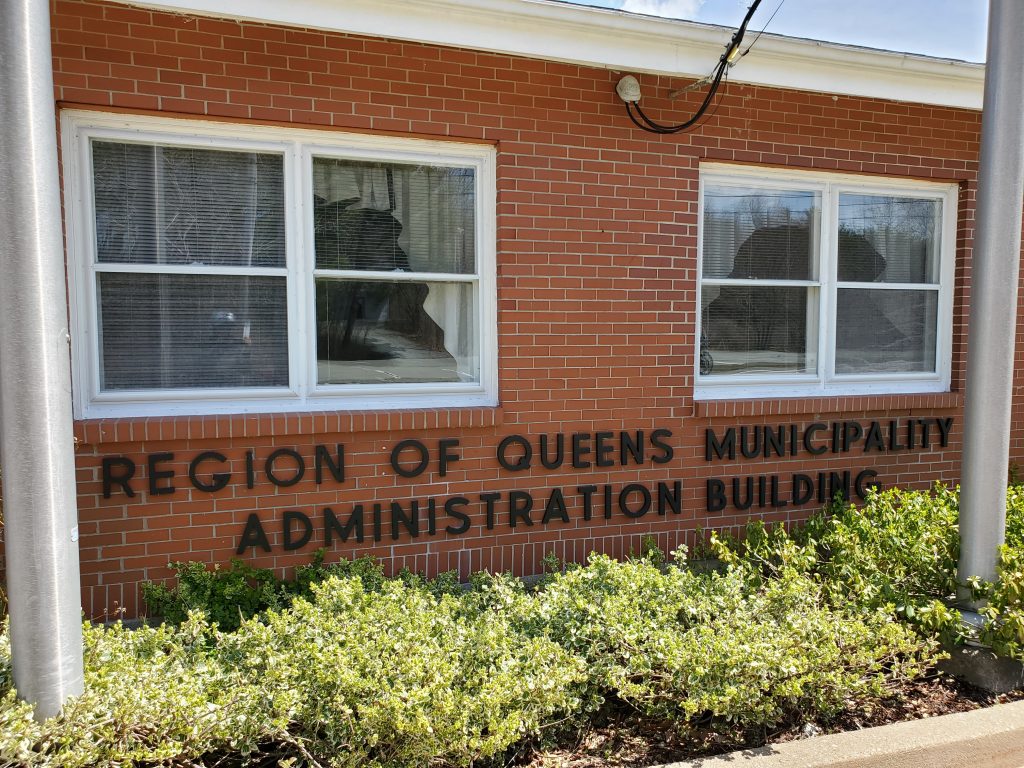
Region of Queens administration building

Municipal Elections are going ahead as normal in the Region of Queens despite the COVID-19 pandemic.

Returning officer Ted Bulley says people will see little difference when they go to the polls October 17.

“It’s a normal election with COVID sitting over the top of us and that we have to, naturally, abide by all the rules that are out there for COVID-19 with masks and that kind of thing,” said Bulley.

Bulley says the polling locations will look similar to what people have gotten used to seeing when they visit their local shops.

“When you come in to vote, you’ll see screens in front of the DRO and the poll clerks,” said Bulley. “We’re having screens made, and there’ll be a person controlling traffic, and they’ll be the social distancing, and hand sanitizers, that kind of thing.”

While some other municipalities across the province have moved voting online, Region of Queens council opted to stay with the familiar paper ballots.

Anyone who has lived in Nova Scotia prior to April 8, is a Canadian citizen over the age of 18 and a resident of the Region of Queens before October 8 is eligible to vote.

Bulley says this is his third municipal election as Returning Officer and the first time he hasn’t seen a seat on council won by acclamation.

Whether or not it’s because people have had more time to sit and look around them during COVID-19, Bulley says he’s pleased to see a full slate of candidates running in all seven districts and for the mayor’s chair.

“I don’t know why people put their name forward when they do, but it seems that people are more engaged these days,” said Bulley.

He says typically, the municipal election draws about 40 precent of eligible voters to the polls.

He is optimistic the large number of candidates will also mean more people getting out to cast their ballot.

“In most cases I’ve found that where you have an election for a councillor will draw the people out, versus just the mayor running in that particular district,” said Bulley.

Advance polls will be available where people from any district can vote for their candidates October 8 at the North Queens Fire Hall, West Queens Recreation Centre and the Milton Community Hall, or on October 13 at the Greenfield or Mill Village Fire Halls, or at the Royal Canadian Legion in Liverpool.

After the advance polls, residents must vote in their districts at their designated polling stations.

Bulley says a team of two election staff will be going into the area’s three long-term care homes on election day to collect the resident’s votes.

“Dr. Strang and the department of health have added election workers as essential workers,” said Bulley. “That means they can go into any nursing home.”

People of Queens have until October 5 to get themselves on the final List of Electors, which will speed up the voting process at the polls.

Anyone not on the final list may still vote on election day, but will have to take the extra step of swearing an oath before they can cast their ballot.

The Region of Queens has posted information about how and where to vote on their website.

Reported by Ed Halverson 
E-mail: edhalversonnews@gmail.com
Twitter: @edwardhalverson

Nova Scotia readies to take on Teddy

Tracking Hurricane Teddy. Photo Credit: Environment Canada

Nova Scotians are battening down the hatches ahead of Hurricane Teddy’s arrival.

Environment Canada expects Teddy will diminish to a tropical storm by the time it touches down in our province sometime Tuesday afternoon.

They warn winds could reach speeds of 65km/h gusting up to 80 to 100km/h over exposed areas and along the coast. Heavy rainfall is also expected which could cause flooding and Teddy could dump between 50 and 100mm over the central and eastern parts of the province. Coastal residents will also need to be prepared for storm surges.

Region of Queens mayor David Dagley says municipal crews have been out preparing for the storm.

“They will check the storm drains to make sure that they’re not blocked so that any rain would be able to drain away,” said Dagley. “They’ll collect or remove or secure items that may blow in the wind and become a hazard.”

Dagley says staff will also be keeping a close eye out for storm surges along the Mersey river.

“Our staff will be vigilant and they will block off access to the waterfront parking area and waterfront road such as Henry Hennessey drive so we can ensure that vehicles aren’t parked there if we get a storm surge,” said Dagley.

In a release, Nova Scotia’s Emergency Management Office asks people to check on their neighbours, to see if they need any supplies. They note this is especially important for the elderly or vulnerable. They also want Nova Scotians to make sure anything that can be picked up by the wind such as yard furniture, trash cans, hanging plants or other equipment or structures are taken inside or secured.

Dagley adds people should be prepared with a storm kit that can get them through 72 hours.

“We always ask that they have potable water, drinking water, that they have flashlights, they have a battery powered radio, they have some food staples that don’t require electricity to become nourishment,” said Dagley.

Tropical Storm Teddy is expected to move away from Nova Scotia by Thursday night. However, another period of strong winds is possible Wednesday morning over easternmost sections of Nova Scotia.

Mayor Dagley says the Region of Queens will be providing updates on their website, through social media and over the radio as the storm passes through the area.

Reported by Ed Halverson 
E-mail: edhalversonnews@gmail.com
Twitter: @edwardhalverson

Premier calls for cooler heads in heated lobster dispute

ns

Premier Stephen McNeil has weighed in on a dispute between indigenous lobster fishers and the federal government.

Members of the Mi’kmaq community around St. Mary’s Bay have said they will start to assert their right to a make a moderate livelihood by establishing their own fishery.

That has sparked protests in recent days by non-indigenous Canadians who want the department of fisheries and oceans to pull the traps out of the water for what they’re calling illegal fishing.

During a press briefing follow Thursday’s cabinet meeting, Premier McNeil called on everyone involved to take a breath.

“But I’m asking for citizens, that cooler heads needs to prevail and be respectful in this dispute. The last thing we need is to see this escalate to the point where decisions are made that cause either public damage or private damage, or quite honestly, leaves a lasting legacy that I don’t think anyone wants,” said McNeil.

The Supreme Court ruled in 1999 that First Nations people have the right to a communal food, social and ceremonial fishery and to make a moderate livelihood.

Two decades later, the two sides still haven’t reached an agreement on how to reconcile that decision.

Federal fisheries minister Bernadette Jordan released a statement on social media today expressing her deep concern of the escalating tensions.

The minister, who is also the MP for South Shore-St. Margaret’s says she is in communication with First Nations leaders on how they can resume negotiations. She calls implementing the Marshall decision critical to the work of reconciliation, which the government of Canada has established as a priority.

However, she says until those negotiations result in an agreement on how, when and where an indigenous fishery will operate, any unauthorized commercial fishing outside the season is a violation of the fisheries act and could be subject to enforcement action.

In her statement, Jordan says her department prefers negotiation to litigation to settle these longstanding issues.

When asked if there was a role for him to play in those negotiations as Nova Scotia’s minister for indigenous affairs Premier McNeil says it’s out of his hands.

“It is the responsibility of the national government to work nation to nation,” said McNeil. “They’ve made it very clear, that’s both the Mi’kmaq and the federal government, this is a relationship between both of them and I expect them to solve this in a way that respects the laws of the country.”

Reported by Ed Halverson 
E-mail: edhalversonnews@gmail.com
Twitter: @edwardhalverson

NDP leader wants province to produce COVID recovery plan

The leader of Nova Scotia’s NDP is still waiting to hear government’s plan to help the province’s economy recover from the COVID-19 pandemic.

Gary Burrill says people across the province want the same answers from their provincial government.

“What are your plans, what are your ideas, what are your suggestions for the things that government should invest in as a way of pulling our province out of this, unprecedented, in our lifetimes, economic downturn?”

Burrill says the pandemic has revealed the desperate state of a number of social programs, and his party would start by reinforcing the province’s social safety net.

The NDP leader has been sounding the alarm on the need for more beds in nursing homes since he was elected to his position, so it’s no surprise a revamp of long-term care homes tops his list. He says both the previous NDP and PC governments invested in the creation of thousands of long term care beds. But that came to a halt under Premier Stephen McNeil.

“When the liberals came to power, there was a moratorium placed on the opening of new nursing home beds and it’s placed a lot of people in a vulnerable situation from the point of view of viruses of all kinds, but particularly, COVID,” said Burrill.

He says COVID-19 has demonstrated the need to move away from the shared-room model in nursing homes and every person in long-term care should have their own room and own bathroom.

The NDP leader says staffing levels also have to be increased to ensure the safety and proper care of residents and investments should be made to train and hire more continuing care assistants. He says Nova Scotia used to have a model in place that kept facilities supplied with enough care workers.

“If you think back to ten years ago, people were entering this field in droves,” said Burrill. “There were subsidy programs about the tuition for CCAs at the community college. There were innovative programs by which, you could go in and get your GED and your CCA at the same time. I can remember attending community college graduations, eight, nine years ago, when the CCA class would take you longer to get from A to Z through the diplomas of the CCAs then it would for all the rest of the graduates – this was in Truro- all the rest of the graduates combined.”

Burrill says attracting new people into the profession has become more difficult as constant understaffing at long-term care homes took its toll.

“Lifting that requires two people ends up being done by one person. What drew people originally to that very important work – their love for older people, their motivation to provide them support, that kind of got pushed to the side and it’s place got taken by frustration of never having enough people there to work, day in and day out, year in and year out. So people got ground down and burnt out. The next thing we knew, we didn’t have enough CCAs in Nova Scotia,” said Burrill.

He gives the federal government full marks for identifying the income crisis and providing Canadians with an income to see them through as many were put off work by the pandemic. But says by comparison, the provincial government has done little to support workers in need of a financial lift.

“When you have, as we do in Nova Scotia, a third of your working people working for less than $15 an hour, no surprise that the population doesn’t have enough money to buy the goods and services businesses have to sell to pull us out of an economic contraction.”

Burrill says the province also has the authority to impose rent controls to keep people from spending half the money they make just to keep a roof over their heads.

The NDP leader is eagerly anticipating bringing these ideas forward in the Nova Scotia legislature, which hasn’t sat since the start of the pandemic began and is legally bound to sit before the end of the year.

Reported by Ed Halverson 
E-mail: edhalversonnews@gmail.com
Twitter: @edwardhalverson

Council calls on province to form Carters Beach committee

Region of Queens Council hopes striking a new committee will resolve issues at Carters Beach.

A lack of parking, places to dispose of garbage and washroom facilities have only gotten worse as the beach has become more popular with visitors.

At a recent meeting with Queens CAO Chris McNeill and Mayor David Dagley, the residents of Carters Beach Road proposed striking a new committee that would have authority to approve decisions about Carters Beach.

The residents believe the existing community liaison committee lacks the teeth necessary to make changes at Carters Beach.

Mayor Dagley say the residents want personnel from the departments of lands and forestry, environment and transportation and infrastructure renewal, as well as representatives from Region of Queens, the residents group, business community and RCMP to come to the table and develop solutions with the ability to act upon them in a timely manner.

“There were some other requests in there, that, they were looking for performance deadlines be included,” said Dagley. “And the Region of Queens, when we’re looking to make a request to a minister, we’re not looking to put a large numbers of restrictions and time frames upon those requests.”

Region of Queens council voted to write a letter to lands and forestry minister Iain Rankin to request his department begin the work set up the committee.

The decisions need to run through the provincial government as Carters Beach is a provincial beach and many of the problems fall under the province’s jurisdiction.

Mayor Dagley says the municipality and province have spoken repeatedly about Carters Beach and Queens is willing to do their part.

“At the end of the day, they are the only ones that are able to determine what actions they will take. We’re able to support most of the actions that I’m anticipating they would like to do. But until we hear them, and we have that conversation, it’s a work in progress,” said Dagley.

Residents are looking for a parking area, garbage cans and washrooms to be built on site.

Dagley says the region is willing to send crews to pump out the holding tanks if the province is willing to put proper facilities in place, They’re also looking for the province to install garbage containers which the region will empty.*

The province has been hesitant to do anything that would encourage more visitors to Carters Beach because it is an environmentally sensitive area.

There is sensitive ecology along with nesting birds that could be endangered by an increase in beach-goers.

Dagley says the region appreciates the difficulties being faced by the residents of Carters Beach road but they are limited as to how mush support they can offer.

“It is provincial land and it is under the control of the Nova Scotia department of lands and forestry and the minister in that department is having conversations on solutions,” said Dagley. “What they determine, including the formation of this committee will be at their discretion.”

The letter has been sent, and Dagley says the municipality will have to wait to hear from the province what they are prepared to do.

*A previous version of this story indicated the region was willing to send crews to clean washroom facilities. That has been changed to more accurately reflect the region’s willingness to pump the holding tanks they’re asking the province to place on site.

Reported by Ed Halverson 
E-mail: edhalversonnews@gmail.com
Twitter: @edwardhalverson

Home care worker is Nova Scotia’s latest coronavirus case

Nova Scotia’s chief medical officer of health Dr. Robert Strang announced the new case discovered Monday in the Central zone is a homecare nurse who had previously tested positive for COVID-19 several months ago but had recovered.

“We are working with our local lab and the national lab to determine whether this is a true case of reinfection or not,” said Strang.

He says if this is determined to be a recurring case of infection it could mean the understanding of COVID-19 may have to change.

“The implications of reinfection are making it more likely that we can’t count on a one-time infection producing lifelong immunity,” said Strang. “That’s actually not a surprise for us. Most respiratory viruses act like this.”

Strang says the worker wore all the recommended protective equipment and public health is following up with all the clients they visited, and as a precaution, they are treating this as a new case of COVID-19.

Nova Scotia has had 1,086 positive COVID-19 cases and 65 deaths, so far, and as of Wednesday September 9, there are three active cases of COVID-19 in the province.

No new cases were identified Tuesday.

Despite the province welcoming roughly 3,200 students to university and post-secondary schools over the past few weeks, only 3 new cases have been discovered from that group.

Those are numbers Dr. Strang finds reassuring.

“It’s good news in two ways,” said Strang. “It shows that the risk from students is relatively low. But it also shows that our strategy has worked because we had three individuals who, without the measures in place, could well have been following a normal student life and having much more significant potential exposures here in Nova Scotia.”

The province has cut the list of symptoms it will consider when looking for COVID-19.

Public health wants Nova Scotians to call 8-1-1 if they have a fever or a new or worsening cough or if they display two or more of sore throat, runny nose/ nasal congestion, headache or shortness of breath.

Dr. Strang says based on what they’ve seen of how people experience COVID-19, the previous list was unnecessarily long.

“We had a lot of issues about kids in daycare through the summer with a runny nose, which at the time, qualified for a test,” said Strang. “As we look at it, we realized, just a runny nose isn’t how COVID presents.”

Dr. Strang cautions Nova Scotians that there are many unknown questions around immunity to COVID-19 including how effective a vaccine could be and how long it may last.

“All of which leads us to the point that we need to continue to respect COVID-19 and focus on the interventions we know that do work, which are the low-tech public interventions that we talk about at every briefing,” said Strang.

Those measures include frequent hand washing, wearing a mask and social distancing. A complete list of symptoms, direction on when to be tested and how to self isolate are located on the Nova Scotia government’s coronavirus page.

Reported by Ed Halverson 
E-mail: edhalversonnews@gmail.com
Twitter: @edwardhalverson

Liverpool firefighters ready for hurricane season thanks to community

The Liverpool fire department is better prepared for the next disaster.

They’ve just received a $10,000 donation from the Liverpool Firefighter Ladies Auxiliary to equip their station with everything from cots, blankets and pillows to phone charging cords.

Auxiliary president Becky Munroe says the department quickly realized they were under-equipped when Hurricane Dorian hit in 2019.

“The region didn’t help us with anything or EMO didn’t help us with anything so we decided, well, we’re not going to be caught with nothing here,” said Munroe.

That’s when the Ladies Auxiliary stepped up to get the money to purchase the equipment the department determined it needed.

Because COVID-19 cancelled most of the auxiliary’s traditional fundraising events the group had to move their efforts online.

“We couldn’t have bingo, we couldn’t have flea markets, we couldn’t do anything at the hall because you weren’t allowed,” said Munroe. “There was no way of raising funds for the fire department at all so we looked into this crowd-funding on Facebook and we decided that that’s what we’d go with.”

It was a pleasant surprise for the group when the totals from this new way of fundraising surpassed all their previous efforts. Munroe says the auxiliary has raised $10,000 since they moved online in June. She attributes the increase to meeting people where they are.

“I think the younger generation really don’t want to come out. They’d like to support but they’d like to do it on their iphone or their ipad or their phone or whatever they’ve got. I don’t want to come to your function, but I’ll donate,” said Munroe.

Munroe says she and the members of the auxiliary felt it was important to buy equipment to assist the public during a disaster because the money came from the public so it should assist the public.

While the bingo and flea markets are back on, Munroe says they are going to continue crowd-funding on Faceboook.

“Is just a lot of work. It’s on a computer a lot but it’s well worth it. I love the fire service,” said Munroe. “My son is the chief, my husband is a captain, my daughter is the vice-president of the auxiliary, my son-in-law is a firefighter in the department, my two grandchildren are in the junior fire department, it’s a family affair.”

And for Munroe, that makes the effort worthwhile.

Since 1968 the Ladies Auxiliary has raised approximately $250,000 for the Liverpool fire service.

Munroe says people don’t understand the costs involved with outfitting firefighters with the protective gear they need to serve the community. That’s why she and the other members of the auxiliary will continue working to raise money to equip the department with the tools they need.

Reported by Ed Halverson 
E-mail: edhalversonnews@gmail.com
Twitter: @edwardhalverson

High-speed internet arrives in North and Central Queens

Residents of North and Central Queens can now jump on the information superhighway.

The final-mile work to install wires to the poles was completed this spring and summer and high-speed internet is now available in those areas.

Over 1,250 premises in North and Central Queens can connect to high speed internet, providing speeds of up to 100Mbps.

Region of Queens mayor David Dagley says he’s looked forward to this moment for a long time.

“It’s really great news to have Bell Canada to the point where they have the cables on the poles and they’re now willing to take requests from residents to be hooked up,” said Dagley.

He says this announcement comes after years of time, effort and investment from the region.

The mayor says without a $64,500 investment from the region in partnership with the federal invest to connect program during the winter of 2018/19 that laid the backbone of the high-speed connection, today’s news wouldn’t be possible.

The high-speed fibre-optic lines installed by Bell Canada this summer were the result of a $435,500 investment from the region as well as $487,000 from Develop Nova Scotia’s Internet Funding Trust for Nova Scotia initiative.

Dagley says many government agencies want people to access their services online, which given the current low speed connections in some parts of Queens, is virtually impossible.

“I have friends in North Queens that, I send them an ordinary e-mail with maybe four lines of text,” said Dagley. “It takes a minute to download it for them to read it. When you look at that crawl speed, it’s just not acceptable.”

Dagley says the newly available high-speed internet will do more than just improve the daily quality of life for residents.

He explains, “It also will improve and grow home-based businesses in that area. If you really want to picture it, and if you are fortunate enough to have a property on a lake, you can put your feet up on the deck and you can do your home-based business in the best of scenery.”

Dagley says governments at both the provincial and federal level have been aggressive about providing grants to connect people to high-speed internet.

He says the investment from Queens is significant, but they can’t pass up the opportunity to improve the lives of their residents.

“We certainly can’t afford to miss that boat. We have worked hard to get grants in the system in partnership with Bell Canada and it’s working. It certainly is working well for the Region of Queens and it appears to be working very well for residents at this point. So, we’ll keep expanding and improving services where it’s sub-standard,” said Dagley.

Residents can sign for high-speed internet now, by following this link, calling Bell Aliant at 1-844-305-4228 or by dropping into the nearest Bell Aliant  store.

Dagley expects residents will begin connecting to the service this fall.

Reported by Ed Halverson 
E-mail: edhalversonnews@gmail.com
Twitter: @edwardhalverson

Government provides more details of back to school plan

Date: 2020-09-03

A framework is now in place for students heading back to school during the covid pandemic

Nova Scotia’s public health department has outlined a series of levels and responses ranging from low to high for dealing with COVID-19 exposure in schools.

A high-risk contact is a close contact with a minimum 15 minutes contact up to 48 hours before the case became sick. That would include students and teachers in the same class, riding the same bus, or engaged in the same activity.

Moderate risk will be assessed if the person managed to maintain a 2-metre distance from the affected person.

Low risk would be anyone who had incidental contact such as walking past the affected case in the hallway.

The province’s chief medical officer Dr. Robert Strang says that is what his department is trained for.

“There’s a lot of work for public health to say, where has that person, the case been? What have they been doing? Who else was in those spaces and what were the types of interactions that happened,” said Strang. “But that’s the types of work that we do everyday with all types of communicable diseases.”

Those exposed to the high risk will have to isolate at home for 14 days and anyone who tested positive will have to follow the prescribed protocols.

Strang says a key piece will be communicating any cases within the school community.

Students showing symptoms while in school will be isolated in the building and a parent will be contacted to pick them up.

Strang says anyone testing positive for COVID-19 needs to stay home and that should be part of getting ready to return to school.

“Parents, teachers and students should now be thinking about having a plan in the possibility they may be at home for 14 days,” said Strang.

Schools will only closed if public health feels there is a great risk to the entire school population. He says it is more likely cohorts, such as classes within the school may be sent home.

Strang notes a great deal of focus has been placed on social distancing.

He says it is important but is not the only consideration when trying to stop the spread of COVID-19.

“We have a package, if you will, or a range of preventative measures that work together in a complimentary manner. Starting with keeping kids home from school and getting them assessed if they’re feeling unwell to masking on buses, masking in hallways, increased cleaning, increased hand-sanitization, older kids grades four and up wearing masks in school, keeping separated as much as possible in the classroom,” said Strang. “All those together provide, I believe, the appropriate level of safety for where we’re at with a low-risk of COVID occurring in school.”

The province has published their back-to-school plan online. 

Education and early childhood development minister Zach Churchill says he understands parents, teachers and students have concerns about returning to the classroom.

“I think, once people get back to school, get used to the new measures that are in place, get use to the new habits that we all have to develop with COVID hanging over our shoulder; and if we can do that without seeing any major issues and people see that the health protocols and safety protocols are working, I think that will help with the reduction of anxiety.”

Churchill says too ensure a successful transition back to the classroom, parents need to talk to their kids to calm those concerns before they return to class September 8.

Reported by Ed Halverson 
E-mail: edhalversonnews@gmail.com
Twitter: @edwardhalverson

Drive-in moving to new home

Date: 2020-09-02

The South Shore Drive-In is moving into a permanent home.

Every weekend since July, a dedicated group of volunteers has been showing movies on the side of the Mill Village Fire Station.

Beginning September 12, people can now enjoy the show from the comfort of their vehicle at the drive-in’s new home at the Hank Snow museum in Liverpool.

One of the organizers, Catherine Croft, says since the province was hit so hard by the Portapique shootings and COVID-19, her goal was to bring the community together. She says the support for the drive-in has been beyond her wildest hopes.

“So many volunteers, so many people that believe in what we’re doing, it’s been phenomenal,” said Croft. “It’s been crazy to me.”

Croft says visitors to the new location will notice the screen is unlike any other drive-in. Where most are built with a wood backing, this screen takes the area’s sailing heritage to heart and is made of fabric.

“I had always said my screen was like a ji-normous sail, so let’s do that. So with rigging gear and cables and lines, we’re able to rise and lower the screen for shows,” said Croft.

At around $8,000, she says the design is significantly less money than the roughly $20,000 it would cost to build a traditional wood screen. The screen can be pulled taught for a crisp picture and the flexible design provides another safety benefit.

“We can retract it for storms because around here, as you know, we can suffer massive storms and with a wooden structure, it may not survive,” said Croft.

The new location will increase the drive-in’s capacity to approximately 200 cars.

Croft says one of the group’s goals is to keep the entertainment affordable. Each carload is charged $10 admission, half of which goes towards the venue hosting the drive-in.

Croft says while the South Shore drive-in will have a permanent home at the Hank Snow museum, they still intend to bring the experience to communities throughout Queens. They have stops planned for Caledonia and Greenfield in the next two weeks.

Croft says the admission will be a little higher at $15 because of the additional expense to bring a team to a different location, but that cost will be lowered to $10 for anyone bringing a non-perishable food item for the North Queens food bank.

Croft says people can look forward to films being shown at Hank Snow each weekend until October 31.

She plans to show classic horror movies for the Halloween closing night and says people should keep their eyes peeled for zombies and ghouls roaming the parking lot as well.

Croft says the drive-in will be back in action in the spring by the beginning of June and maybe sooner, if weather permits.

She is excited they’ve been able to bring the drive-in experience to a new generation.

“The grandparents are taking their grandchildren to our shows and they’re loving it,” said Croft. “It’s been nothing but positive and we’re so looking forward to getting to the Hank Snow park.”

Reported by Ed Halverson 
E-mail: edhalversonnews@gmail.com
Twitter: @edwardhalverson

More support coming for South Shore domestic violence survivors

Date: 2020-09-01

An organization that gets people out of violent situations is coming to the South Shore.

Shelter Movers provides everything from an escort to a full team of movers and a truck for anyone looking to escape domestic violence.

Nova Scotia chapter director Suzanne Rent says partnership with local support services is key to their operation. On the South Shore, they’ve partnered with Harbour House and Second Story Women’s Centre.

“That’s what we do in Halifax and all of the cities we work in because that’s where we get our referrals, it’s the transition houses or the women’s centres who call us and say they have a client who needs to move,” said Rent.

Shelter Movers offer three types of move: an urgent exit where the client is safely transported to a shelter or safe space, an escorted move where a client will be escorted back into their home by volunteers to collect their things, and resettlement where volunteers pack and move the client and all their belongings to a new home.

Rent says through her work she’s learned there continues to be a lot of stigma around domestic violence.

“It’s still really considered a private issue, a family issue.,” said Rent. “Women don’t want to come forward, especially in smaller communities.”

According to statistics released by the Nova Scotia Advisory Council on the Status of Women, domestic violence rates among women in Nova Scotia are more than three times higher than men. And rates for both women and men have increased across Canada according to the latest data available.

Rent says communities need to acknowledge the problem of domestic violence.

“It’s important that people know that this exists because we hear a lot of the bigger headlines of domestic violence cases – of course, the shootings in April that started in Portapique, that started with a domestic violence incident, but there are a lot of cases we don’t hear about,” said Rent.

Shelter Movers began in Toronto in 2016 when founder Marc Hull-Jacquin realized how difficult and dangerous it could be for survivors to try to leave their abusers.

The organization has grown to include Ottawa, Vancouver and Nova Scotia. Since arriving in Halifax in July of 2019, Shelter Movers has completed 160 moves in the Halifax area.

Shelter Movers is just now setting up their operation in Bridgewater, which will service the area an hour around the town.

Rent says the South Shore location, which aims to open in October, is the start of a planned expansion to provide their service in communities across Nova Scotia. She is looking for volunteer drivers and movers as well as people to work on marketing their service to the broader community.

To learn more about Shelter Movers or to volunteer, follow this link.

Reported by Ed Halverson 
E-mail: edhalversonnews@gmail.com
Twitter: @edwardhalverson

Education minister responds to international students

International students will return to Nova Scotia schools in a phased approach.

The Minister of Education and Early Childhood Development says students who remained in Nova Scotia over the summer will be admitted in September, while a decision on those arriving from outside Canada will be made in December.

Zach Churchill says this is part of the province’s plan to minimize the risk levels as students return to school.

However, universities, colleges and private schools in Nova Scotia are accepting international students from abroad back into the classes this fall with the understanding they quarantine for 14 days and submit to three COVID-19 tests.

Churchill says the nature of the private schools and colleges allows them to contain and better monitor students in the closed environment of their campuses and dorms.

“With the public school system, you have essential have students that can be at 360 schools in every single community across the province.”

The education minister recognizes Nova Scotians are already on edge about sending children back into the classroom in two weeks.

“As we open up our school system, we just wanted to make sure that we were mitigating as many risks as we can. Especially considering the high level of anxiety people have as we reopen schools.”

Churchill says his department made the decision based on recommendations from public health.

Despite a comprehensive plan from the Nova Scotia International Student Program, which would have seen students arriving from outside Canada quarantined at a hotel under strict supervision for 14 days, the province determined placing those students into the community posed too great a risk.

The province’s chief officer of health Dr. Robert Strang says there needs to be an appropriate level of safety around COVID-19.

“Having students come live with families here in Nova Scotia does put us at increased risk of bringing COVID-19 into the province.”

Churchill appreciates people were expecting to come and billet families were looking forward to hosting international students but the department had to prioritize getting Nova Scotia schools up and running first.

“We want to get through semester one, see how this all works and see what COVID does and see if all of our safety measures are working to the extent that us and public health believe they will. Then reach a decision point on international student admittance after semester one.”

Reported by Ed Halverson 
E-mail: edhalversonnews@gmail.com
Twitter: @edwardhalverson

Clean up crew answers frustrated walker’s call

Tired of seeing trash, a frustrated walker decided to do something about it.

Each day, Deborah Raddall hikes a route from her home in Summerville to Broad River.

Part of her walk takes her along the abandoned connector between Highway 3 and Highway 103.

For months she has watched the garbage strewn along the path pile up.

“There’s another Tim Hortons Cup, there’s another Tim Hortons cup. There’s a this and that, and I just kept seeing more and more trash, going, why do people do this and why am I looking at this and who’s going to do something about it,” asked Raddall. “I just realized, I’m going to have to do something about it.”

Raddall thought about posting photos of all the trash to Facebook but quickly realized bringing attention to the problem was not enough, more affirmative action was going to be needed.

She decided to, as she says, put her money where her mouth is.

“And I said, okay, I’m going to do a clean up. Even if it’s just me, I’m going to pick up a couple of things, realizing that it would be a huge job but I’m going to do a little bit maybe each day. That’s what I was thinking in my head. I said, I’m going to do a clean up if anybody wants to do it with me, and it just sort of went from there,” said Raddall.

She posted an event to Facebook that she would be cleaning up the stretch of road Monday the 24 and it wasn’t long before a list of volunteers signed up to help.

She wondered about getting supplies to clean up the litter safely and learned from some of the volunteers who had done this sort of clean up before, that the Region of Queens provides the necessary equipment.

Raddall made arrangements to pick up gloves, bags, buckets, trash grabbers, safety vests and road signs from the region and was pleasantly surprised when a public works truck dropped everything off at her door.

On clean up day, a crew of 11 spent two hours picking litter off the road, out of the bushes and even up embankments to fill 10 garbage bags with trash.

Raddall says despite the dirty work the mood was very upbeat.

“It’s not pleasant. At the same time, there’s a real satisfaction with picking it up and doing it,” said Raddall. “If you can imagine it, we did have fun.”

Raddall says Region of Queens staff even saved her a trip to the dump.

“And then they came and picked up the garbage from my house. It was easy, breezy, that part of the putzy stuff. They are so, so interested in making sure they make it easy for us to do it and they are so grateful,” said Raddall.

Her volunteer team’s good work will also benefit another group in the community.

Since 2018, the Region of Queens has supported the solid waste community litter collection program, setting aside $3,000 each year for non-profit groups to conduct litter cleanups. The fund pays the groups $100 per kilometer up to a maximum of $300 per year.

Because the volunteers cleaned an approximately three-kilometer stretch, they’re eligible to receive $300 which Raddall plans to donate to the Queens Universally Designed Play Park.

While she is pleased with what they’ve accomplished, Raddall recognizes a single effort won’t solve the littering problem.

“Like any other clean up project it never stays done. You clean your kitchen; you don’t clean it once and don’t do it for the rest of your life. Well, it’s the same as this. People are still going to chuck things out,” said Raddall.

She says she doesn’t have plans to organize another clean up in the near future but is grateful for the community’s support for this effort.

“It just, is a small step,” said Raddall. “But if everybody did a bunch of these little tiny things, and I think a lot of people do, that’s what makes our community great.”

Reported by Ed Halverson 
E-mail: edhalversonnews@gmail.com
Twitter: @edwardhalverson

NS public schools closed to students outside Canada this fall

International students coming from outside Canada will not be admitted into public schools this fall even if the student has a valid visa.

The decision from the Department of Education was revealed in an email sent out late Friday afternoon.

The news came as a surprise to parents like Heather Kelly who are expecting their students to arrive in the next week or so.

“He’s booked his ticket, his plane ticket and he has a visa,” said Kelly. “They can’t refuse him if he has a visa to come here and nobody’s been in touch with him about cancelling his visa.”

Immigration, Refugees and Citizenship Canada, the federal agency responsible for approving student visas, had previously said anyone holding a student visa issued before March 18 would be permitted to return to classes in Nova Scotia this fall.

The Nova Scotia International Student Program (NSISP) submitted a plan to public health for arriving students to quarantine at a hotel away from their host families for 14 days.

The proposed measures are in line with those in place for university and college students announced Thursday by premier Stephen McNeil. Post-secondary students coming to the province are required to self-isolate for 14 days and undergo COVID-19 testing three times during that period.

Kelly can’t understand why the two groups are being treated differently.

“I’d understand if they weren’t allowing anybody in. But the fact that they’re allowing in other university students from international, it just doesn’t seem, I don’t know what possibly could be the rationale for that,” said Kelly.

The department of education and early childhood development has not commented why the two groups of students are being treated differently.


Program lead left in the dark


NSISP executive director Paul Millman was just as surprised as anyone to learn the students weren’t going to be coming this year.

“As recently as Monday we were under the impression that the kids were going to be able to come,” said Millman. “Our plans were in place. On Monday it was all a go. On Friday it was a no-go. I don’t know what changed.”

Millman says they were on track to welcome 1,300 international students to the province when the pandemic broke in February

About 10 per cent of those or 130 remained in Nova Scotia and will be going to class this fall, 13 of those, on the South Shore.

He says ISP has 775 students meant to arrive in September who will now have to make other arrangements.

“It’s tough, these are kids that have been with us for a long time, some of them. And they don’t have home schools to go to anymore because they’ve withdrawn completely from the school systems in their country and have been committed to Nova Scotia for multiple years,” said Millman. “ It’s not like they can just change their minds and go back.”

Millman says Nova Scotia joins Newfoundland as the only two provinces in the country not accepting international students in their public schools this year.


Students scrambling to find schools


Rene Bourgeois, a recruiter who has been bringing international students to Nova Scotia from Thailand since 2008 also received the letter late Friday and has several questions

“The number one is, there’s no consistency. Why are you not letting the international kids come to public high school when they can go to a university or a private high school? Two, they told everybody go home, those with visas and valid study permits can come back. How do I tell a Thai parent, well Nova Scotia, your kid has a visa that’s good to September 2021. They can go to BC but they can’t go to Nova Scotia. And then, there’s the lateness of it. It’s just about the twelfth hour,” said Bourgeois.

He warns there will be an immediate economic impact to public schools and their communities.

“The program’s about $18,000 a year to the province, of which, $9,000 is tuition and the other $9,000 would be say, home-stay and insurance,” said Bourgeois. “But kids are probably spending three to five hundred dollars a month.”

Many Nova Scotians have expressed the desire to keep the province’s borders closed until the country and the world gets a handle on the pandemic.

Unfortunately, that leaves some international students out in the cold.

Bourgeois says one of the reasons many students decide to take high school in this province is to be able to apply to local universities as a Nova Scotia high school graduate. He fears universities will lose out on this group of students as they may now look elsewhere when they graduate.

“Nova Scotia has been a difficult sell. They’ve done a remarkable job considering most of the kids go from cities with two million [people] down to communities of 5,000,” said Bourgeois. “The whole program has been one of the best in Canada and I just never saw this coming.”

Bourgeois says it will be difficult in the near future to convince parents to send their children to  Nova Scotia instead other locations in Canada because the situation was handled so poorly. He says it could take years for the province’s reputation to recover.

“And if you ruin a kid, well, she’s going to be on their version of our WhatsApp and they’re just going to trash the program. It will take three or four years to get the numbers back on, until the group of kids that are here now that are being directly affected, until their friends, until they move on to university,” said Bourgeois.

Bourgeois shares Millman’s concerns about students losing a year of education because they’ve missed enrolment into their home country’s school system.

The letter sent Friday from NSISP indicates international students may be able to take their courses online through the province’s Nova Scotia Virtual School. But Bourgeois is concerned there is no guarantee the program will be offered as the education department determines if there is enough demand.

Neither Regional Executive Director of the South Shore Regional Centre for Education Paul Ash nor Minister Zach Churchill replied to requests for comment for this story.

Millman says everyone expected there would be challenges returning students to class this fall.

“It doesn’t matter what we do this was going to be a tough year. But again, I think we’re all trying our best to make the best of a really bad situation and there’s some international students that have gotten caught up in all of this for, at this time at least, reasons unknown beyond the obvious of COVID-19,” said Millman.

A spokesperson for the department of education says a decision on whether or not to allow international students to return in February will be made in December.

Reported by Ed Halverson 
E-mail: edhalversonnews@gmail.com
Twitter: @edwardhalverson

International students still in limbo as school year approaches

As students across Nova Scotia prepare to return to an uncertain school year, most international students still don’t know if they’ll even be allowed into the country.

Up to 200 international students from 30 countries spend part or all of the year attending high schools and junior highs in the area.

South Shore director of the Nova Scotia international student program (ISP) Mitch Landry says his team has submitted a plan to Dr. Strang and the Nova Scotia public health department that would have incoming students quarantine at a hotel for 14 days before moving in with their host families.

Landry says there’s been no word yet whether or not their plan will be approved.

“We’ve been asking and we do not have an indication at this time, when those decisions will be made,” said Landry. “We just continue to plan. We continue to be hopeful and optimistic.”

Landry says any student who received a visa before March 18 is eligible to come study in Nova Scotia.

When the pandemic hit the province this spring, 13 international students decided to stay and wait it out.

“We do have some students here and they’ve been here through the summer, they never left the country. Those students will be starting in September,” said Landry.

A spokesperson from the Nova Scotia department of education and early childhood development confirms international students currently residing in the province will be attending classes in the fall. However, they point out that border restrictions are a federal matter and it will be up to Ottawa to decide when and if international students who applied after March 18 will be permitted to come to Nova Scotia.

Several attempts were made to find out from Immigration, Refugees and Citizenship Canada what would be required to allow international students into the province but they have not responded.*

Premier Stephen McNeil announced Thursday that post-secondary students arriving in Nova Scotia will have to self isolate for 14 days and be tested three times during that quarantine period.

Education minister Zach Churchill says his department is working with public health to decide if international students will even be permitted into school this year.

Nova Scotia operates the fifth largest international student program in the country behind two in Toronto and two in Vancouver. Landry says that is a testament to the giving nature of Nova Scotians.

“We open our hearts and our homes to these students. Our home-stay families love them like their own children,” said Landry.”These students leave Nova Scotia and have a memory of Nova Scotia for the rest of their lives, hold it as their second home.”

Landry says they’re looking for creative solutions to ensure the program continues. He says the whole reason for the program is to provide an opportunity for Nova Scotian students to interact with people from around the world.

“It’s of course a global world and the goal of our program is to help our own local students see different perspectives and meet people from different parts of the world so that they’re better prepared to function in that world when they go off to university and ultimately in their employment,” said Landry.

Aside from the cultural benefits, ISP students pay tuition, which covers the cost of the program and provides some funding to the schools they attend.

Should the province accept the hotel quarantine plan, Landry says the program would help cover the expense of the rooms so the students would not cost taxpayers a dime.

Landry is hopeful he will hear soon that international students can come back this fall. Less than three weeks remain before schools start on September 8, and international students arriving from abroad will need time to quarantine for 14 days or risk starting at a later date.

*Since this story aired, a representative from Immigration, Refugees and Citizenship Canada  has replied and confirmed the details reported here. They said also described efforts to make the process less onerous for international students but did not provide a timeline when students applying after March 18 would be eligible to study in Canada.

Reported by Ed Halverson 
E-mail: edhalversonnews@gmail.com
Twitter: @edwardhalverson

Broad River forest fire cost five bucks

A forest fire that broke out Friday near Broad River is now largely contained.

Scott Tingley, manager of forest protection with the department of lands and forestry says the fire consumed 32 hectares over the weekend.

He says 20 staff and 6 volunteers from local fire departments were involved in knocking the fire down.

The remote location had to be accessed using helicopters and ATVs.

The only structure in the area was a cabin, which managed to escape any damage.

Cabin owner Suzanne Verge says she believes the fire was started on their property by some hikers.

“They left a note saying that they come down the path and it got dark and they decided to stay by the water, made a fire,” says Verge. “I don’t know, anyone using common sense wouldn’t have started a fire, as dry as what it is cause it’s going to burn down into the ground.”

Verge is thankful the fire didn’t destroy their cabin but is baffled by the hiker’s actions.

“Well, they left a note with five dollars saying here’s five dollars for the wood. But, you dingbat, why did you start a fire?” wonders Verge.

Tinlgey says the fire is now 66 percent contained.

“So that means, crews on the ground have most of it wrapped with hose and they’re just continuing to contain that outside perimeter, trying to limit the growth,” says Tingley.

He says crews don’t anticipate the fire will get any larger but they’re aware the forecast is calling for temperatures to rise later in the week.

“Where it’s burning so deep, our focus is on containing that outside perimeter so we do limit the growth,” says Tiingley.

He’s hearing from the crews that the fire is burning at least a foot deep.

“When it get’s this dry it’s pretty challenging,” says Tingley. “They have to spend that much longer digging things up, putting water on it, digging it up again.”

He says those crews will be on site for the next few days to ensure the fire is fully out.

The fire is the largest of eight that were burning in the province last week.

A dry hot summer has increased the fire risk for most of Nova Scotia and lead to burn bans being put in place.

Tingley says the heavy rain that fell in parts of the province last week did provide some relief, but not for everyone.

“A lot of the areas where we really, really needed it, they got only light amounts,” says Tingley.

He recommends people check the Nova Scotia burn safe website every day to learn whether or not it is safe to have a campfire.

Reported by Ed Halverson 
E-mail: edhalversonnews@gmail.com
Twitter: @edwardhalverson

Off-leash park opens in Milton

Dogs in Queens now have a place to play.

The Jack Fancy Dog Park and Community Trail officially opened last week.

Located in the former ball field behind the Milton Pool, the park offers a safe place for dog owners to let their pets run off-leash.

The opening brings to a close 18 months of work by the Queens Community Dog Park Association.

From initial meetings in early 2019, six founding members worked to raise the money to bring the park to life.

President John Simmonds says the group began approaching the community to purchase a membership to the proposed park, but the initial reaction wasn’t overwhelming.

“I mean it’s the old question, build it and they will come,” says Simmonds. “There was a lot of lukewarm interest, oh yeah, it’s a great idea, do it, and then I’ll come and check it out and see if I want to join, kind of thing. “

Simmonds says the group managed to raise the $18,000 necessary by selling charter memberships, holding a number of fundraisers, and grants received from the Region of Queens and Nova Scotia Trails which accounted for close to half of the cost.

Simmonds credits District 5 Councillor Jack Fancy with being the driving force behind getting the park built.

“Well apart from the fact that Jack was the originator of the idea of doing it, and got the organizing committee meeting together and acted as an advisor to the board throughout, he has probably spent, I have no idea what the number is, but dozens, possibly hundreds of hours actually mowing the lawns, cutting brush, grooming the trail. He has a lot of sweat equity in that thing,” says Simmonds.

He says the committee kept Fancy in the dark and surprised him with the name at the unveiling.

Fancy says he is honoured the committee thought enough of him to put his name on the park but insists it shouldn’t be named after a single person when so many worked so hard to make the park a reality.

“I want to make sure it’s always remembered as Queens Community Dog Park. That’s what it is,” says Fancy.

He is proud of the work the committee has done but jokes he can’t even show off the results.

“How can I bring friends over there to a dog park when I got my name on it?” asks Fancy.

The park occupies roughly three quarters of the original ball field and is divided into two sections: one for large dogs and another for smaller or mobility impaired dogs.

A locked, double-gate system ensures dogs don’t escape when another owner is trying to bring their pet into the park.

Simmonds says the committee along with a team of volunteers will maintain the park.

He says that’s part of the reason for making it members-only.

“That gives us greater control over who goes in and the things that take place in the park,” says Simmonds.

He says people can become a member for as little as $25 a year.

They already have 35 members and Simmonds hopes to see that number double by the end of the year.

Anyone wishing to join can contact Angela Dixon following this link to the group’s Facebook page.

Reported by Ed Halverson 
E-mail: edhalversonnews@gmail.com
Twitter: @edwardhalverson

Masks now mandatory in grades 4 and up

Education and Early Childhood Development minister Zach Churchill says masks will need to be worn inside schools anytime students are not sitting at their desks, separated by two metres from other students and facing the same direction.

The minister couldn’t say how many students may have to leave masks on all day because a lack of space in their classrooms.

“I don’t have that information for you but our regional centres of education, our schools know where they’re able to do that and where they’re not able to do that,” says Churchill. “Orders have been given to school communities to maximize space in our classrooms by removing unnecessary furniture, clutter, anything.”

Every student returning to class in September will also receive two cloth masks and are encouraged to bring their own.

If a student forgets their mask, they can receive a disposable one from the school office.

Churchill says anyone with a valid medical reason for not wearing a mask will not have to do so, but they will also not have to produce any documentation to be exempted.

He says in the case of schools, any students with persistent medical conditions are already known to staff for other reasons.

The province’s chief medical officer of health Dr. Robert Strang says people within the school community will be notified if a case of COVID-19 is detected.

Anyone testing positive for the coronavirus will have to quarantine for 14 days along with any of their close contacts.

When asked if an entire class would have to self-isolate if a case is detected, Strang says that would depend on his department’s assessment of who the person has come into contact with while they were infectious.

“I think people need to understand, that that assessment is what public health does, we’ve done with every single COVID-19 case. We do this all the time with a full range of notifiable diseases. For each disease, the period of time when that person could have been infectious and able to spread to others, we understand in detail all their activities and what would have put other people at risk and then we take appropriate measures. It’s that same approach around COVID-19 in a school,” says Strang.

Churchill also announced $40 million in provincial funding to hire more teachers and cleaning staff as well as supplies.

He says every school in the province is currently being assessed to determine if their ventilation systems and windows can adequately circulate the air in the buildings to help prevent the transmission of COVID-19

The minister has committed to ensuring those that need to be improved will receive the proper attention.


Plan to hire unqualified substitutes upsets teachers union


As part of Friday’s announcement, the education minister says close to $30 million of the $40 million in new funding will be used to hire substitute teachers.

To find that many substitutes, the minister says he will exercise tri-partite agreements in place between the department, regional centres for education and the Nova Scotia Teachers Union to hire people without a bachelor of education degree.

“We’re using those as the basis those to go outside of the B Ed requirement for substitute teachers, and bring in other qualified people who might not have a B Ed because at the end of the day, we need to have people in school to run our schools,” says Churchill. “If we are facing a risk of less people being there because of COVID, we need to be prepared to meet that demand in our schools.”

President of the Nova Scotia Teachers Union Paul Wozney says the only places where the tri-partite agreement was approved in the last 15 years are the CSAP and Tri-Counties regions.

Requests for a tri-partite agreement made by the province’s two largest regional centres, Halifax and Chignecto last year were turned down by the union, according to Wozney.

He agrees more substitutes will need to be hired to meet the demand but says putting an adult in front of a classroom requires more than having two feet and a heartbeat.

“But really, that feeds the notion of public school as babysitting and not a place where meaningful learning occurs,” says Wozney. “That’s a slap in the face to everybody who is qualified to teach in this province, who have spent a lifetime being properly educated and trained to make sure kids have the best public education possible.”

Wozney says the move is also a slap in the face to substitute teachers across the province who are equally as qualified as their full-time colleagues.

While the education minister is assuring teachers that qualified personnel will be hired before unqualified staff, Wozney isn’t so sure.

“Because we all know principals are going to be run off feet, starting September 8, to find people to cover for teachers who are sick and displaying symptoms. It’s entirely plausible that fully qualified substitutes are going to lose work to unqualified substitutes as a matter of convenience for the school system,” says Wozney.

The NSTU president calls the entire situation an incredibly slippery slope for his members.

Churchill couldn’t say what qualifications a substitute without a B Ed would need to have, referring the matter to the local regional centres.

A call to the south shore regional centre for education went unreturned before the time of this report.

Reported by Ed Halverson 
E-mail: edhalversonnews@gmail.com
Twitter: @edwardhalverson

Queens finances faring well in the face of COVID-19

Region of Queens seems to be weathering the economic storm brought on by COVID-19.

The first quarter financial results presented at the most recent session of council show the municipality is in good fiscal shape despite dealing with the coronavirus.

Director of finance Jennifer Keating-Hubley says the municipality allowed residents more time to pay their property taxes, moving the due date back a month from June 30 to July 31.

Keating-Hubley says the measure seems to have worked as over 95 percent of residents made payment arrangements by the July deadline.

“There might be the odd business that’s finding cash flow to be a bit of an issue. But they’re still making substantial payments, probably in an effort not to have a big bill later,” says Keating-Hubley. “But no, we’ve not had anybody call to say I just can’t do it”

At $13.5 million, property taxes make up over half the Region of Queen’ budgeted revenue of $21 million.

The province had offered loans to municipalities struggling to make ends meet.

Keating-Hubley says because of their high collection rates, the Region of Queens decided not to take the province up on their offer.

She says the municipality has the option to dip into their reserve fund to make up any cash shortfalls.

“We prepare for, or do budget prep for a rainy day and here it is. Rainy day/pandemic. So I have a reserve money to float our cash flow issues in the interim,” says Keating-Hubley.

The remainder of the municipality’s revenue comes from quarterly government equalization payments, transfer payments and grants in-lieu, which arrive later in the year.

Keating-Hubley says council will still need to be cautious about adding any new spending.

She says the recreation department was particularly hard hit earlier in the year when they had to close Queens Place for COVID-19 at almost the peak of ice-rental season.

“This statement shows Queens Place revenue is shy of the, this would be a 25 percent marker, first quarter, and we’re at 8.6 percent.,” says Keating-Hubley . “So we’re down revenues from where we should be this time of year.”

She says the 16 percent projects to an annual shortfall of approximately $350,000.

Keating-Hubley says one bright spot on the ledger sheet is the rise in deed-transfer fees for the fourth year in a row.

“Which means houses are selling. Real estate, it’s supposedly a sellers market out there right now, from what I’m hearing. But from what I’m seeing, there’s a lot of property movement. That hasn’t declined at all,” says Keating-Hubley.

She says the first quarter report overall is quite positive, and Region of Queens is fortunate to not feel the impact of COVID-19 as desperately as other municipalities around the province.

Reported by Ed Halverson 
E-mail: edhalversonnews@gmail.com
Twitter: @edwardhalverson

Dal prof working to get residents more involved in their communities

A university professor is hoping online sessions will get more people involved with their community and perhaps even entice more people to run for a seat on local councils.

Jack Novack, director of Dalhousie University ‘s local government program says the four free sessions called Your Decision, teach people what local government is all about, why they should care, what it’s like to be an elected official and how to organize a campaign.

The session consist of a panel of experts who will present information over Zoom, then answer questions from participants.

Novack says the technology that is available to people now makes campaigning simpler than it’s ever been.

“Especially today with home printers, it’s very easy to produce a promotional piece and get a few people to help you and get out and start talking to your neighbors,” says Novack.

He is encouraging people to be involved in their communities at a level that is appropriate for whatever stage of life they find themselves but recognizes not everyone can be a full-time councilor if, perhaps they are raising children, but everybody can do something.

“The strength of your community is the sum total of all the individual contributions that people make,” says Novack. “The other side of the spectrum is to have people simply as recipients of what others will do for them, and that doesn’t really lead, I think, to a healthy democracy.”

Novack would like to see a more dynamic and active local government where citizens move away from being recipients to becoming, what he calls ‘co-architects’ of their community.

“I think that is more likely to happen when you have a greater energy and greater participation both by people who are active citizens as well as those people who are competing for positions on council,” says Novack.

The Region of Queens has posted links to the sessions on their website.

Mayor David Dagley says councils constantly receive new information from the province.

He says it’s important for people to understand what they’re signing up for when they put their name on the ballot.

“I think it will be very beneficial to any individual in Queens who’s considering running for office to have all the information that is available,” says Dagley.

Novack says people need to realize they have skills to offer to their communities as there’s a tendency for potential candidates to eliminate themselves from the running.

“Some people say, I’m not a layer, I’m not an engineer, I’m not a dentist, I’m not an architect, I’m not at planner, and my response to them well, that’s good. That’s a major advantage because that’s not the reason why you should be on council,” says Novack. “You should be on the council because you care deeply about your community, you have average ability, and you have the most important ingredient, which is time.”

Novack hopes by offering these sessions, new people will be encouraged to run for council and bring their fresh energy and ideas with them to help revitalize the municipal level of government.

Potential candidates have until September 8 to get their name on the ballot for the October 17 municipal election.

The Your Decision information sessions are held via Zoom meeting each Tuesday until September 8 between 6:00pm and 7:00pm.

There is no charge but people must sign up in advance to get the log in information.

Reported by Ed Halverson 
E-mail: edhalversonnews@gmail.com
Twitter: @edwardhalverson

Dry conditions put damper on campfires

Numerous heat warnings over the past number of weeks have created dry conditions that have provincial officials on the lookout for forest fires.

The department of lands and forestry burnsafe map has gone red across mainland Nova Scotia indicating a burn ban is in place on open fires of any kind.

The ban includes campfires and backyard chimineas and also prohibits people from setting off fireworks.

Manager of forest protection Scott Tingley says the ban will be in effect until the weather changes.

“Until we get some rain those restrictions, the ones that are in place, are going to remain,” says Tingley. “With no rain, people can probably expect tighter restrictions going forward.”

Restrictions are based on precipitation, relative humidity, temperature along with wind direction and speed observed at 31 weather stations the department of lands and forestry has in place across Nova Scotia.

Tingley says they’re seeing crunchy grass, and dry twigs but what’s most concerning is the lack of moisture in the ground, causing the forest floor to dry out.

“The result of that is, fires that do start in these conditions are just that much more persistent and harder to put out. You have to dig deeper and get water deeper and put it on for a longer period of time to actually put them out,” says Tingley.

Often, campers will think because they’ve dowsed their campfire with water they have extinguished the fire, but Tingely says that’s not always the case.

“It really is hard in these conditions to put them out. They really have to, where they are permitted; to put water on them, stir them up really good, soak them again,” says Tingley. “You just have to be very, very diligent with any fire that’s out there right now”

In 2016, fires burned for days near Kejimkujik national park.

In August of that year, the province issued a burn ban, but the minister also took the extra step of restricting travel in the woods for hikers and all-terrain vehicles.

While the situation is not at 2016 levels yet, Tingley says similar actions could be taken if conditions don’t improve.

“We have had them in the past, but they’re few and far between. But give it another week or two of drying in some of these areas and we probably will be having those discussions,” says Tingley.

He encourages Nova Scotians to check the burn restriction map updated daily at 2:00pm by visiting www.novascotia.ca/burnsafe.

Reported by Ed Halverson 
E-mail: edhalversonnews@gmail.com
Twitter: @edwardhalverson

Long-awaited Perkins House rebuild underway

An iconic cornerstone of Liverpool is about to undergo a complete overhaul.

The province is investing $1.5 million to restore Perkins House museum.

The site has been closed to the public since May 2015.

Queens County Museum Director Linda Rafuse says the effort began after staff reported hairline cracks in the walls to the department of transportation and infrastructure renewal.

“They thought it best to bring in some structural engineers, who then went through it and said it was probably best to close it down and at some point, when money was available, to address the structural issues,” says Rafuse.

She went on to say after restoring Province House several years ago, the Nova Scotia government decided they would also restore one of the province’s heritage houses.

“And that was just music to our ears,” according to Rafuse. “That Perkins House was chosen to be the example.”

The house was built for merchant and civic-leader Simeon Perkins in 1766.

As with any house of that age, time, and renovations by previous owners have taken their toll.

Rafuse says initially, the museum board had hoped to get enough funding to do the work necessary to allow Perkins House to reopen.

She says meetings with TIR and the department of communities, culture and heritage exceeded their wildest hopes.

“I remember them saying, the complete restoration will make it look like the first day that Simeon Perkins walked into his new home,” says Rafuse.

In March, a tender for $275,965.00 was awarded to Architecture 49 to complete the design work necessary to renovate the building.

A spokesperson for the Nova Scotia department of transportation and infrastructure renewal says Mid Valley Construction was awarded the contract on July 15, 2020 for $1,223,700.00 to restore The Perkins House Museum.

Keen-eyed observers will notice fencing is going up and the site is being prepared for work to begin.

TIR expects to see substantial completion of the project 37 weeks from the award.

Residents can expect to see the work finished sometime in Spring 2021.

Reported by Ed Halverson 
E-mail: edhalversonnews@gmail.com
Twitter: @edwardhalverson

Premier steps down

Stephen McNeil has announced he is stepping down as premier of Nova Scotia.

McNeil began the media scrum following the weekly cabinet meeting by recounting some of the significant episodes of his tenure as premier before dropping the news he was resigning.

McNeil says he is not leaving immediately and will stay on as premier until the liberal party can elect another leader.

The premier says after 17 years he is still honored to serve Nova Scotians, but the time has come to move on.

“I’m not tired of being premier,” says McNeil. “ I’m tired.”

McNeil says he has been contemplating stepping away from politics for months, but recommitted to the position once COVID-19 hit.

“I’m not going to leave the province I care about, the people I love, in the midst of a pandemic, with not knowing what was going to happen. So all of those plans were put on hold and I gave this my all,” says McNeil.

Now that the province is through the first wave, McNeil felt he had to make the announcement.

“I either had to say I was going or I was too late,” says the premier. “Because if I waited ‘til much later in the fall, second wave happens and we’re dealing with that, and it just wouldn’t have given the party enough time and that wouldn’t have been fair.”

The liberal party now has to elect a new leader who will take over as premier of Nova Scotia until another general election is held.

This government was elected in May 2017 and won’t have to face another until May 2022.

Even as he is stepping down, McNeil still believes his government is charting the right course for Nova Scotians.

“Two terms is a long time. Do I believe there was a third one? Yes, I do. Do I believe we could’ve been re-elected? Yes, I do. And I believe with a new leader and a new team they can still be re-elected. But it’s just time for the province and for the government to have a new leader,” says McNeil.

The premier says no-one has expressed an interest in following in his footsteps as the announcement is too new.

“I don’t think anyone knew the job was vacant until about an hour ago,” says McNeil. “And I think they all believed that I was still going.”

McNeil offered this wisdom to his eventual successor.

“My advice that I would give to anyone leading, whatever party, or wanting to be leader of a particular province, be true to who you are.”

In a prepared statement, McNeil expressed his gratitude to Nova Scotians.

“I love this job. I’ve enjoyed every day of it, and every day, I’m inspired by the people of this province. But this is not a life-long career. I’ve always believed that governing is not about power, it is about purpose,” says McNeil. “And I want to thank Nova Scotians for giving me the opportunity to be your premier. I may not have always gotten it right, but here’s what I know for sure: we are better together, and being kind, matters.”

Reported by Ed Halverson 
E-mail: edhalversonnews@gmail.com
Twitter: @edwardhalverson

Region of Queens and workers reach a deal

Engineering and public works employees have agreed to a new four-year contract with the Region of Queens.

Council ratified the deal at their last regular council meeting on July 28.

Workers will receive a two percent hourly-wage increase in each of the next four years, retroactive to April 1.

Materials recovery facility sorters who were on the lower end of the pay scale will also receive a one-time 50 cent increase in their hourly rate.

The workers are represented by Local 1928 of the International Brotherhood of Electrical Workers (IBEM).

The union’s business manager Jim Sponagle says his membership is pleased with the outcome.

“My position as business manager is not to lose what you have,” says Sponagle. “If you can build on a collective agreement and get a modest increase or a fair increase, you’ve done your job. I think we’ve done that.”

The 24 full-time and 15 temporary engineering and public works department employees are responsible for materials recovery, solid waste management, water and sewage treatment, capital works, as well as the streets in Liverpool, sidewalks, storm water and other municipal parks and properties throughout Queens County.

Twenty-eight of the 32 voting members cast their ballot to approve the agreement, an overwhelming show of support.

Region of Queens mayor David Dagley is pleased to say the municipal workers are valuable assets in the community.

Dagley says the province requires the municipality to put their work out to tender, and their works department always comes out on top.

“Traditionally, our cost of doing it internally with our own crews and our own equipment comes in 30 percent cheaper than a tendered cost. So we are saving taxpayers dollars and providing quality work,” says Dagley.

But the mayor says being able to use municipal employees is about more than just dollars and cents.

“They’re local people that live here, and have a job here and they spend their money here. It’s good for all in Queens,” says Dagley.

Negotiations began in March and were concluded with the help of a conciliator in June.

In addition to the to the pay raises, Sponagle says his members will also see a $50 per year top-up to buy protective work boots, and meal allowances provided when working overtime will increase from $11 to $15.

Employees can bank any overtime hours at a rate of one and a half times the actually extra hours worked.

In this latest contract, the amount of time they can bank has risen from 40 hours to 60.

According to Sponagle, one of the most important elements of the deal was reached before contract negotiations even got underway.

The union and municipality agreed the workers pension plan would be migrated away from the Region of Queens defined pension plan and roll into the province’s Public Service Superannuation Plan.

Sponagle says the union did their homework and the move made sense for everyone.

“Market changes makes significant impacts to a small plan where a multi-billion dollar plan, it doesn’t, it makes a ripple,” says Sponagle.

He says they also realigned how overtime was awarded to ensure full-time employees were offered the hours ahead of temporary workers.

Sponagle says his members signed a fair deal.

Mayor Dagley says the municipality is also pleased with how negotiations turned out.

“What we have here is an agreement that both parties can live with,” says the mayor. “There are good increases for the employees and cost-savings, of course, for the Region of Queens. It’s a good agreement.”

Reported by Ed Halverson 
E-mail: edhalversonnews@gmail.com
Twitter: @edwardhalverson