Library faces tough road to restore faith with BIPOC community

Photo Ed Halverson

The first steps have been taken to strengthen the relationship between South Shore Public Libraries and the region’s BIPOC community.

Chief Librarian Troy Myers describes Friday’s meeting with the anti-racism task force from the town of Bridgewater as a starting point.

“Our role was to listen, to learn. We started a relationship that we know is going to take some time,” said Myers. “We still accept full responsibility.”

Tensions arose between SSPL and supporters of the Black, Indigenous and People of Colour community last week when the library attempted to provoke discussion around “Freedom to Read” week.

Their choice to use the recent controversy around the publisher’s decision to stop printing some Dr. Suess titles because they contained racist language and imagery provoked a strong reaction online.

Members of the Bridgewater anti-racism task force didn’t want to be recorded for this story. The representative said they, in no way, wish to portray that they speak for the entire BIPOC community.

They did say that the library board listened to their position during the meeting but there is still a long way to go before real change in the institutional racism can be fully addressed.

Myers appreciates the task force member’s willingness to engage with the library and provide their perspective. He reiterated just how sorry he was to have upset members of the community.

“We want our spaces to be safe and secure for everybody and it’s our fault that some people are feeling they’re not. We’re not asking for people to accept this apology. We want people to watch our actions moving forward,” said Myers.

Actions before words

Hours before the meeting, South Shore BIPOC, a collective of BIPOC people on the South Shore of Nova Scotia organizing advocacy, events, and community supports for BIPOC posted a 17 page letter to Facebook outlining several concerns, among which are how the controversy has been handled, the deletion of posts and how Myers could confuse their group with the Bridgewater anti-racism task force.

The letter included several suggestions as to how SSPL could begin to address institutional racism including: providing dedicated funding for resources by and for BIPOC communities, creating an independent advisory council to decide next steps, a review of senior library staff and equity hiring practices, anti-racism training and education for staff, and a commitment to a timely review of children’s and young adult books to ensure racist and discriminatory materials are removed.

The letter was addressed to SSPL board of directors and senior staff, the director of Nova Scotia Public Libraries, Vanessa Fells with the African Nova Scotia decade for people of African descent coalition and the minister of communities cultures and heritage Suzanne Lohnes-Croft.

Spokesperson for South Shore BIPOC Jessika Hepburn says they highlighted several resources the library can engage to begin reparations. Until they see action being taken they will not accept Myers’ offer to meet.

“No work has been done to guarantee any kind of safety,” said Hepburn. “I could go to that meeting, it’s going to be upsetting and traumatic for me but there is no way that any of the people in our community are going to be willing to sit down with a library or any sort of institution that is so clearly not capable of having this conversation.”

Hepburn says the library didn’t acknowledge the group’s concerns on the original posts and have done nothing to engage with South Shore BIPOC since.

She says she has yet to see any outreach by the library, including inviting the Bridgewater anti-racism task force to a meeting.

“A municipal task force that they have a fiduciary responsibility to, because they receive financial contributions every year from the town of Bridgewater, that’s not outreach,” said Hepburn. “That’s responding to a letter that you received. They had a responsibility to respond, that’s PR.”

Myers says the library and the anti-racism committee will meet again in the coming weeks. He hopes the continued dialogue will help lead to changes to make everyone feel safe and included at South Shore public libraries.

“We ask for people’s patience and understanding,” said Myers. “These things take time. We’re not going to fix it tonight or tomorrow; it’s going to take some time. It’s a long journey and I’m making that pledge to leave this library in a better position than I found it 11 years ago and I’m committed to that.”

Reported by Ed Halverson 
E-mail: edhalversonnews@gmail.com
Twitter: @edwardhalverson

To listen to the broadcast of this story, press play below.

Library called out for attempt to spark controversy

Thomas H. Raddall Library

Thomas H. Raddall Library. Photo credit Ed Halverson

A social media post meant to provoke discussion around controversial topics has landed South Shore Public Libraries officials in hot water.

Members of the South Shore Black, Indigenous and People of Colour group are taking the library to task after they published an article on Wednesday by National Post writer John Robson.

The post offers the writer’s stance against the decision by the estate and publisher of Dr. Seuss to cease publishing six of his books featuring racist imagery or language.

The library has apologized for the post but spokesperson for BIPOC South Shore Jessika Hepburn says there needs to be more.

“I don’t accept apologies from my children. I tell them the best apology is changed behaviour. I ask them what are they going to do. An apology means nothing without meaningful action.”

The post was the first in a series by the library as part of their participation in the Freedom to Read initiative.

Chief librarian at South Shore Public Libraries Troy Meyers says they didn’t set out to offend anyone.

“We just wanted to foster, in the spirit of freedom to read and access to information, a larger, more open discussion of the merits of the titles that should continue to be celebrated.”

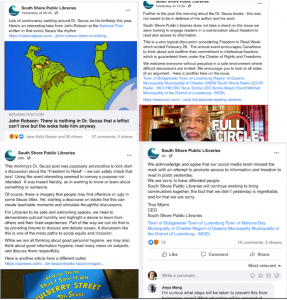
Screen shots of South Shore Public Libraries Facebook posts

Reaction was swift as members of the public condemned the library’s intention to spark controversy.

Later in the day the library uploaded another video to their Facebook page offering a differing viewpoint on the Seuss discussion, but by that time the damage was already done.

Dozens of comments asking for the library to explain itself went unanswered*. Meyers attributes the silence to a lack of resources.

“We’re new to the world of how to manage social media and we don’t have a person who is directly responsible for it. We should’ve had a full-time moderator and we didn’t. We have people who are doing nine other things throughout the day and they help with our social media.”

Meyers says the library now recognizes social media was not the place to have this discussion.

Hepburn is concerned the library would have such a blind spot where issues of race are involved.

“It’s important to recognize, it’s not just a misstep, it’s not just an unintentional mistake; it is systemic racism.”

Meyers says members of the BIPOC community make up only a small number of the total staff working for the library and none of them were on the social media team responsible for the posts.

The offending posts were removed from Facebook late Thursday afternoon and by Friday the library’s apology post was deleted as well. Meyers says they’ve learned a valuable lesson and deleting the posts is part of an effort to move forward and correct their error.

“It was a mistake and it’s not to scrub the corporate memory, it’s just to be able to start the next chapter in this conversation which is how South Shore Public Libraries can do a better job, and to promote diversity and to work with our local BIPOC communities in Queens County and Lunenburg County and strive to do better.”

Hepburn says as an organization, South Shore Public Libraries need to educate themselves on why the posts were so offensive and upset so many.

“There’s a huge amount of work that needs to be done and the first part is to actually demonstrate some humility, to recognize that they obviously do not have the skills or the capacity or the knowledge to address these concerns and to reach out to the people who do.”

To that end, Myers says he had a conversation with a representative of the Bridgewater anti-racism task force and will be meeting with members of that group next week.**

“We’d love to have a member of their group join our board. And we’d love to have them help us develop some training modules that we can use and to help deliver them so we can make sure that people are sensitized to the issues that are important to us as a healthy diverse community.”

*A previous version of this story said the responses were answered. They in fact were unanswered and the story has been changed for accuracy.

**A previous version of this story indicated SSPL was going to meet with members of South Shore BIPOC. Myers has clarified that during the conversation with the Bridgewater anti-racism task force he thought he was speaking with members of South Shore BIPOC as well. He has reached out to South Shore BIPOC and has offered to meet with them.

Reported by Ed Halverson 
E-mail: edhalversonnews@gmail.com
Twitter: @edwardhalverson

To listen to the broadcast of this story, press play below.